
In Brief
- UK businesses have quickly embraced AI in their customer service operations, finance operations, healthcare processes, and decision-making, thereby making AI security an essential concern for businesses in 2026.
- Major AI security threats are prompt injection, sensitive information leakage, data and model poisoning, adversarial attacks, security threats in the AI supply chain from third parties, and autonomous AI agents.
- Organizations can look into frameworks that are relevant for the UK, such as UK GDPR, the Data Protection Act 2018, NCSC AI security guidelines, ISO/IEC 27001, ISO/IEC 42001, and ISO/IEC 23894, while working on security and AI governance.
- An AI security lifecycle consists of risk assessment, data and model security, secure development and testing, least privilege, secure deployment, monitoring, and incident response.
- UK businesses will be able to create more secure AI systems by leveraging the power of good governance, frequent security testing, third-party risk management, monitoring, and expert implementation services.
The application of AI is becoming an increasingly common practice for UK enterprises in various sectors, ranging from customer service and financial analysis to healthcare, automation, and decision-making. Along with using generative AI, machine learning models, AI assistants, and autonomous systems, UK enterprises face additional security threats connected to their use of such innovations. In contrast to conventional software, AI can be affected by its training data, prompts, models, integration, and inputs from users.
This blog post will provide you with an overview of the AI security risks faced by enterprises in the UK in 2026. The significance of safeguarding AI systems and the types of AI security threats associated with their application by businesses will be covered in this post. Additionally, you will become acquainted with the necessary rules concerning AI in the UK, as well as the process of AI system development that will ensure the safety of your business.
Why AI Security Matters for UK Enterprises in 2026
AI is not limited to either experimentation or startups. Businesses that operate in the UK are using AI tools in sectors including customer service, finance, healthcare, retail, manufacturing, operations, and decision-making. The impact of the breach could be even more damaging because of the increased usage of these tools in enterprise data and applications.
The first problem that should be mentioned concerns the processing of business information. Such systems may operate with customer information, financial information, staff information, intellectual property, and any other type of confidential information. If no security is provided, this information may become open to exposure and exploitation.
The second problem that occurs concerns the growing importance of autonomous agents that can take actions independently of humans.
Top AI Security Risks Facing UK Enterprises in 2026
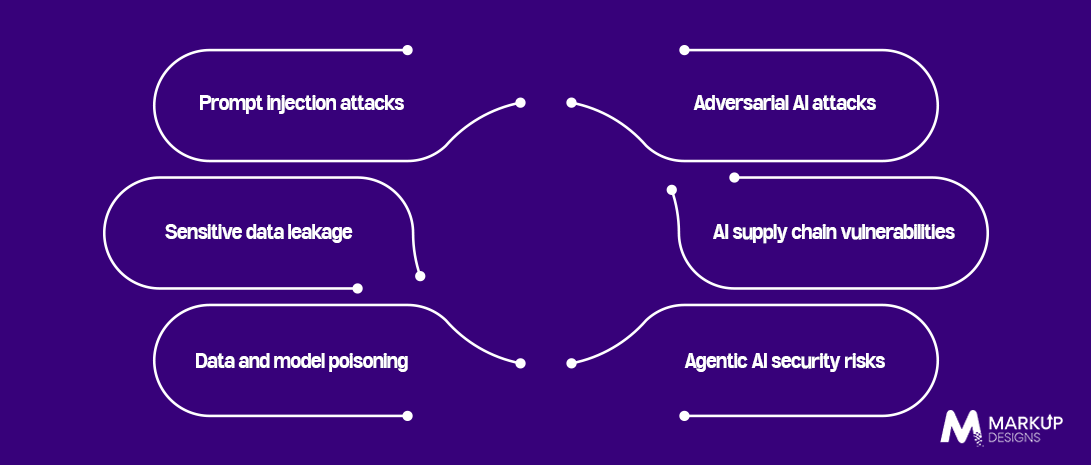
With the growing adoption of AI in the corporate world, there is an emergence of complex security challenges. Organizations have to recognize the sources of these security threats and how they can affect AI-based systems, models, data, and processes.
1. Prompt injection attacks
Hackers can exploit AI-based systems by providing them with malware that will cause them to disregard some instructions, execute tasks, and provide sensitive information.
2. Sensitive data leakage
The adoption of AI in organizations makes it possible for them to process personal data of clients, employees, and companies. This makes it prone to leakage of this data if proper security is not observed.
3. Data and Model Poisoning
Attackers who poison data being used to train or fine-tune AI models might result in erroneous outputs.
4. Adversarial AI Attacks
Slight modifications to input data that have been intentionally introduced will result in erroneous classifications, predictions, and decisions from the AI model.
5. AI Supply Chain Vulnerabilities
Third-party models, datasets, APIs, plugins, libraries, and AI platforms can be a risk to enterprises.
6. Agentic AI Security Risks
Agentic AI has the ability to use tools and carry out tasks on behalf of users.
How AI Security Risks Impact UK Businesses
The challenges that are linked to security within AI may be much more than what is related to the technology alone. In case there is a breach of security for AI software development, the repercussions may reach far beyond the technology domain and spread to other aspects, including business processes, customers, money, and regulation.
- Financial implications: There can be fraud, operational interruptions, costs for investigation, and expensive recovery.
- Privacy implications: Any data leakage of the customer or employee can pose serious privacy issues and increase regulatory risk.
- Disruption of business processes: If AI applications play a vital role in workflow processes, the attack may disrupt operations, decision-making, or day-to-day processes.
- Loss of intellectual property: AI systems can access private documents, source code, business plans, and many other important pieces of information.
- Damage to reputation: Customers and business partners can lose trust in a company if it cannot secure its AI systems and the data processed by them.
- Regulatory issues: UK companies need to think about all data protection and security regulations that apply in connection with AI systems, especially when personal or sensitive information is involved.
This is why AI security in the UK should be treated as an ongoing business responsibility rather than something addressed only after an incident occurs.
Read Also: How to Choose the Right AI Cybersecurity Consultant for Enterprise AI Security
UK AI Security Regulations and Standards Enterprises Should Know
Not only should AI security in UK businesses involve protection against any attacks but they should also be aware of some regulations and guidelines that could help design and implement AI. Such regulations and guidelines may vary depending on the organization, industry, AI system and type of data.
The following are some of the guidelines and regulations:
- UK GDPR: Helps organizations to protect personal data and implement necessary security controls while processing it through AI systems.
- Data Protection Act 2018: Offers a UK legal framework for the protection of personal information.
- NCSC AI Security Guidelines: Help organizations to design, develop, deploy, and operate AI systems.
- ISO/IEC 27001: Facilitates a company-wide process for managing information security.
- ISO/IEC 42001: Establishes a management system for responsible and controlled usage of AI.
- ISO/IEC 23894: Assists companies in assessing and managing risks related to AI technology.
For organizations, adherence to specific standards can facilitate a systematic way of managing AI-related risks and governance while increasing trust in AI technology adoption.
Looking to build secure and reliable AI systems for your UK business?
AI adoption can create new opportunities for UK enterprises, but those opportunities come with security responsibilities. Building secure AI systems from the beginning can help businesses reduce risks, protect sensitive information, and create a stronger foundation for long-term AI adoption.

What is a Secure AI Development Lifecycle?
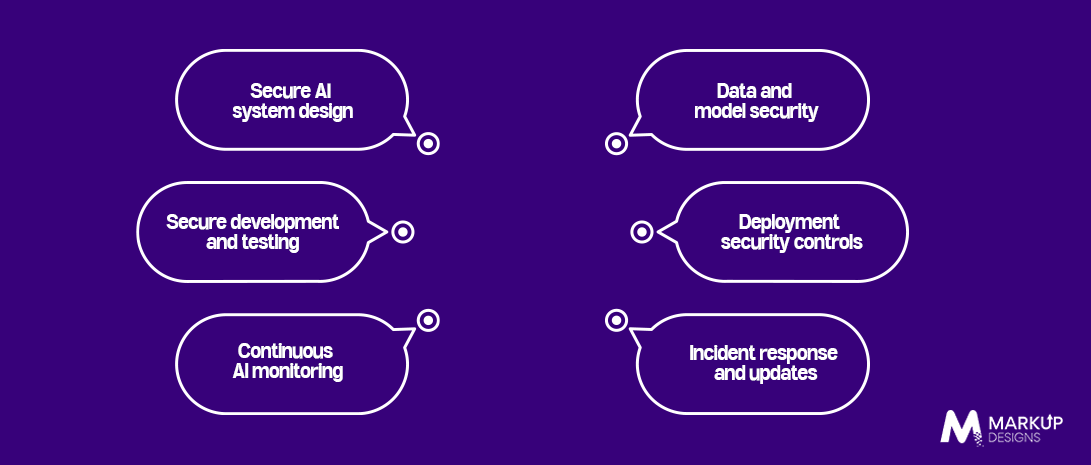
The Secure AI Development Lifecycle (Secure AI SDLC) incorporates security across all phases of developing and operating an AI system. Rather than securing an application after it has been developed, companies think about possible threats to their application from its early development phase through operation.
The key stages include:
Secure AI system design
Identify risks, specify security requirements, and design controls prior to development.
Data and model security
Check datasets for accuracy and validate them, secure training data, and evaluate models for possible vulnerabilities.
Secure development and testing
Secure AI development requires strong coding practices and testing against prompt injection, data leakage, malicious inputs, and unsafe outputs. The right AI development partner can embed security from the start and identify vulnerabilities before deployment.
Deployment security controls
Secure the infrastructure, APIs, models, credentials, and enterprise systems connected to AI.
Continuous AI monitoring
Monitor the behavior of AI, its access, outputs, and suspicious activity.
Incident response and updates
Be prepared for security incidents and maintain models, dependencies, and security controls up to date.
The suggested model would help UK companies integrate security throughout the AI development process.
How UK Enterprises Can Reduce AI Security Risks
Reducing AI threats involves a blend of technological measures, management, and ongoing supervision. The following actions could be taken by businesses in the UK to mitigate AI threats.
1. Set Up AI Governance
Identify who will be in charge of security for AI, how it will be employed, and which systems would need an extra security assessment.
2. Safeguard Sensitive Information
Categorize your business information and personal information and set up proper data access control, encryption, and data handling policies.
3. Use Least-Privilege Access
Give AI applications and agents only the permissions they actually need. This can limit the impact of a compromised system.
4. Evaluate Third-Party AI Components
Inspect third-party components, including models, APIs, datasets, plugins, and vendors, before integrating them into the enterprise systems.
5. Conduct Regular Testing on AI Systems
Testing can be conducted in order to uncover any vulnerabilities such as prompt injection, data leakage, and hazardous behavior of models.
6. Maintain Continuous Monitoring of AI Systems
Monitoring of any system activity and unusual requests, the behavior of models, APIs, and agents, needs to be done.
These are some steps that can assist in creating a better framework for AI usage in enterprises.
AI Security Checklist for UK Enterprises in 2026
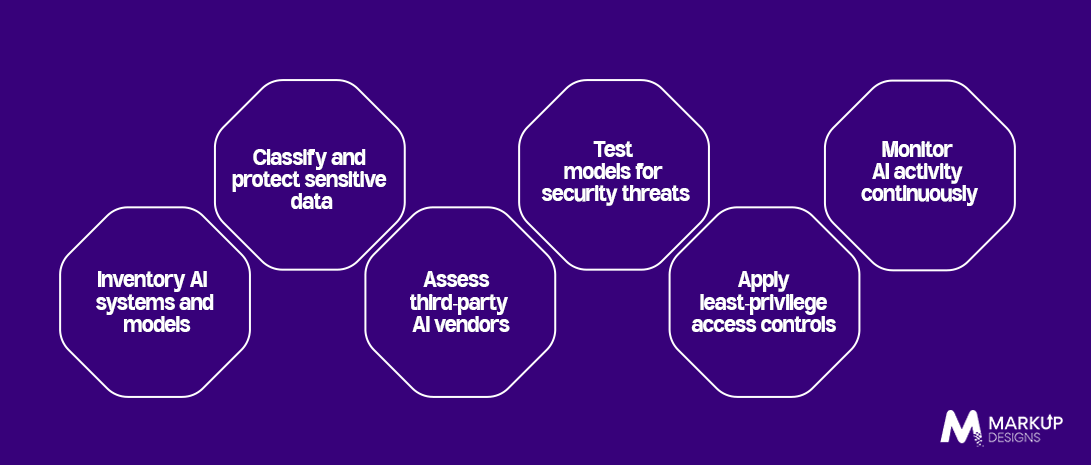
With more use of AI technology by businesses in the UK, there is a requirement for a real security checklist that helps employees spot problems that should be sorted out before using any system. The security of AI should not only be done in one go but also frequently, since requirements change all the time.
Inventory AI systems and models
Make sure you have a list of all AI systems, models, APIs, agents, and external AI services that are currently being used by your company.
Classify and protect sensitive data
Classify personal, financial, confidential, and sensitive data. Take appropriate actions regarding access control and encryption of data.
Assess third-party AI vendors
Consider the security stance, data management strategy, dependencies, and access requirements of AI service providers and platforms.
Test models for security threats
Check your AI systems for vulnerabilities like prompt injection, data leakage, model poisoning, adversarial attacks, and unsafe outputs generated by AI.
Apply least-privilege access controls
Provide AI programs and agents with the least permissions required.
Monitor AI activity continuously
Constantly monitor the AI prompts, outputs, API requests, data access, and anomalous activities.
Enterprises should be prepared to respond to any security incidents related to AI. Besides, enterprises need to perform security assessments every time there is any modification to AI models, datasets, integrations, or processes. This strategy could help UK businesses build better AI systems by 2026.
How Markup Designs Can Help Secure Enterprise AI Systems
The design of an AI solution within an enterprise requires more than just finding the best model, because security must be embedded within the process. And that’s when our technology partner will come in handy in helping companies transition from AI prototyping to AI solution implementation.
Markup Designs can help businesses in the United Kingdom develop their AI solution and implement it in a secure manner through our technology, which is customized to fit the specific requirements of your enterprise. Some of the ways we can help include:
- AI Security Evaluation: Identify vulnerabilities that exist in all aspects of AI, from the application to the model, data, APIs, and integration.
- Securing AI Development: Create AI applications while incorporating security features into the development process.
- AI Governance: Incorporate policies, access management, risk management, and responsible AI.
- AI Model Security: Evaluate the models for several risks such as prompt injection, data leakage, and model manipulation.
- AI Monitoring: Monitor the operations of the AI applications in order to identify any suspicious activity.
- Agentic AI Security: Guarantee proper permission, monitoring, and human involvement in the interaction between the AI agent and other enterprise solutions.
The integration of both AI and security in the development process enables enterprises to create more dependable and scalable systems.
Ready to build a secure AI solution for your UK enterprise?
Identify AI security risks, improve governance, and implement stronger protection across your AI lifecycle with expert support from design and development to deployment and monitoring.

Conclusion
AI has become increasingly significant for corporate operations in the UK. However, despite the fact that it has gained increasing popularity among firms, some challenges have emerged, as there are risks linked to the security of AI solutions and their use in cyberattacks on business organizations.
The perfect approach to handle this problem would be to ensure that the security of AI is maintained throughout its entire lifecycle, which includes protecting the data and models, controlling access to AI, reviewing third-party tools, as well as testing the operation of AI solutions and continuously monitoring their performance.
Apart from the strategies discussed above, UK corporations should take into account the regulatory and security requirements related to the security of AI solutions. This means that it is necessary to make AI security a continuing process.
Using such an approach, companies will be able to reduce the risks involved while still benefiting from using AI.
FAQs
1. What are the biggest AI security risks for UK enterprises in 2026?
Major risks include prompt injection, sensitive data leakage, data poisoning, adversarial attacks, AI supply-chain vulnerabilities, and risks associated with autonomous AI agents.
2. Why is AI security different from traditional cybersecurity?
AI systems can be influenced by prompts, training data, model behaviour, and external inputs. This creates security risks that may not exist in conventional software applications.
3. How can UK businesses protect sensitive data when using AI?
Businesses should classify sensitive information, apply access controls, use secure data-handling practices, assess AI vendors, and monitor how data is accessed and processed by AI systems.
4. What UK regulations are relevant to AI security?
Depending on the use case, organisations may need to consider the UK GDPR, Data Protection Act 2018, and relevant industry requirements, along with security and AI governance standards.
5. What is a Secure AI Development Lifecycle?
It is an approach that integrates security into AI design, development, testing, deployment, and ongoing monitoring instead of addressing security only after deployment.
Author's Perspective
By now, you have a clear idea of why AI security in the UK has become an important enterprise priority in 2026. AI can bring significant value to businesses, but its benefits are sustainable only when security is considered alongside innovation. From protecting data and models to securing AI agents and continuously monitoring systems, enterprises need a proactive approach. The goal is not to slow down AI adoption, but to make it safer, more controlled, and reliable for long-term business use.
Discuss Your Project NowJupinder Singh Arora
Founder and CEO
Related Posts
How Artificial Intelligence Is Changing Mobile Game Development
How to Build Production-Ready Applications with AI Coding...
Cost, Benefits & Business Impact: Generative AI vs....
Insights Are Valuable & Execution is Priceless
You’ve read about the digital future. Now, let’s build the infrastructure to take you there. Move your strategy from the page to the product.
Design Your Solution Now
Contact Us
Schedule The Appointment At Your Convenience Date And Time.
30 Min
Web Conference
Time Zone
Indian standard time (08:30pm)

Thanks For Getting In Touch!
You’ve Taken The First Step Toward Transforming Your Digital Presence. Our Experts Will Reach Out Shortly To Take It Forward.
Launch Your Dream Project
Provide a brief overview of your project, and our specialists will evaluate your requirements. We will connect with you to explore how the right digital solutions can help you launch faster.