

In Brief
- In Saudi Arabia, healthcare app development costs differ depending on how complex the app is, what functions it performs, what tech integrations it will have, compliance needs, and the technology chosen to create it.
- For example, the development budget can be influenced by how much AI will be used in the app, the use of telemedicine, the need for remote patient monitoring, as the app connects with EMR/EHR systems, etc.
- To ensure that you will have a good, scalable, and secure app in accordance with Saudi local legislation, you will have to pay special attention to the planning and architecture of the application.
- If you want to reduce the cost of your healthcare app development, start by defining your development methodology, determining the key features you are going to implement, and using the MVP method.
- Choosing a trustworthy healthcare app development vendor means that you will have your app delivered quickly and integrated easily and that your ROI is high.
The healthcare industry in Saudi Arabia is going through profound digital transformation thanks to Vision 2030, investments in health technology, and health services prospects.
As healthcare providers continue embracing digital innovation, understanding the cost of developing a healthcare app has become a critical step in planning successful technology investments.
The cost of developing a medical app in Saudi Arabia will vary widely, depending on several factors, including the nature of the app, the complexity of features, user roles, third-party integrations, security requirements, and laws related to healthcare, like those HMPO, NPHIES, and SHIE will demand. Whether you are planning to build a telemedicine platform, hospital management system, or AI-powered healthcare application, understanding development costs will help you plan the budget properly and increase your business value.
Herein, we will present a comprehensive analysis of development costs of healthcare apps in Saudi Arabia, the components that define the pricing, the possible ways to optimize the budget, and recommendations on the choice of the right vendor.
Saudi Arabia’s Digital Healthcare Landscape and Why App Development Costs Are Rising
Saudi Arabia is in the process of digitizing its healthcare sector and changing the landscape by creating new opportunities for medical institutions and companies concerned. It is made possible by government policies, a growing number of smartphones, and increasing expectations of patients for mobile solutions.
Vision 2030 and Healthcare Digital Transformation
According to Saudi Vision 2030, the Kingdom has made significant investments in digital health to provide people with better access, efficiency, and results. Hospitals, clinics, and healthcare startups are adopting technologies such as telemedicine, artificial intelligence, electronic health records, and remote monitoring, which generates a considerable demand for innovative mobile healthcare applications.
Growing Demand for Healthcare Mobile Applications
Patients are getting used to receiving digital services such as online booking, online consultations, prescription management, and access to their medical records. Meanwhile, healthcare institutions require integrated platforms that will improve their efficiency and engage patients.
Why Understanding Development Costs Matters
Healthcare applications involve sensitive patient data, compliance with various regulations, integrations with other systems, and the necessity to ensure the confidentiality of stored data. Thus, a company needs to understand the cost of development as it enables it to estimate the budget, prioritize the features to be implemented, and find an appropriate partner for the development.
Types of Healthcare Mobile Apps and Their Development Costs
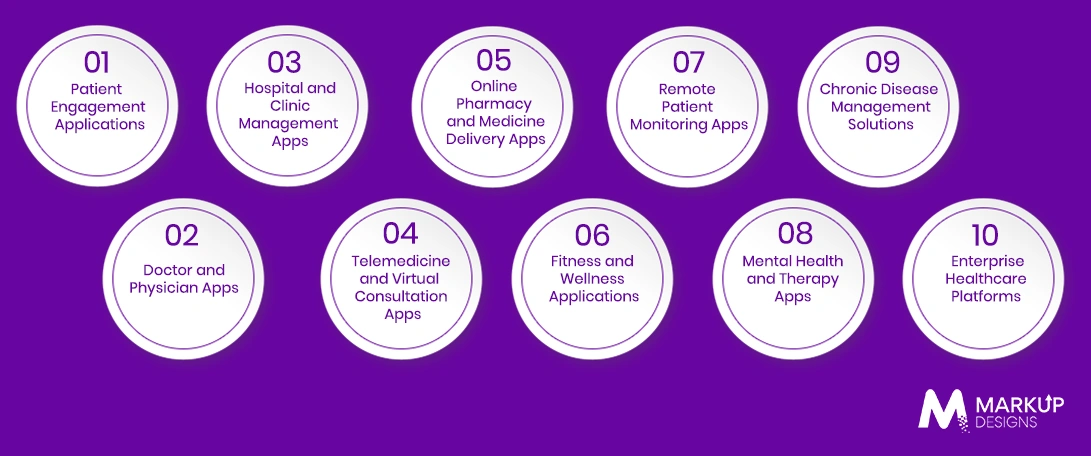
Healthcare applications serve different purposes, users, and business models. The complexity of each app type directly impacts its development cost, implementation timeline, and technology requirements.
| App Type | Purpose | Key Users | Typical Features | Estimated Cost (SAR) | Best For |
| Patient Engagement Apps | Improve patient interaction | Patients | Appointment booking, profiles, medical records, reminders | SAR 80,000–180,000 | Hospitals, clinics |
| Doctor and Physician Apps | Manage consultations and schedules | Doctors | Patient records, scheduling, prescriptions | SAR 120,000–250,000 | Clinics, healthcare providers |
| Hospital & Clinic Management Apps | Streamline hospital operations | Hospitals, Admins | Staff management, billing, reporting | SAR 250,000–700,000+ | Hospitals |
| Telemedicine Apps | Enable virtual consultations | Patients & Doctors | Video calls, chat, ePrescriptions | SAR 180,000–500,000 | Telehealth providers |
| Online Pharmacy Apps | Medicine ordering and delivery | Customers & Pharmacies | Prescription upload, payments, tracking | SAR 150,000–350,000 | Pharmacy chains |
| Fitness & Wellness Apps | Promote healthy lifestyles | Consumers | Workout plans, nutrition, activity tracking | SAR 100,000–250,000 | Fitness brands |
| Remote Patient Monitoring Apps | Track patient health remotely | Doctors & Patients | Wearable integration, health monitoring | SAR 250,000–600,000 | Healthcare organisations |
| Mental Health Apps | Digital therapy and counselling | Patients | Therapy sessions, mood tracking, journals | SAR 120,000–300,000 | Mental healthcare providers |
| Chronic Disease Management Apps | Monitor long term conditions | Patients & Physicians | Medication reminders, health reports | SAR 180,000–450,000 | Specialised healthcare providers |
| Enterprise Healthcare Platforms | Connect multiple healthcare systems | Large healthcare organisations | AI, EHR/EMR, analytics, enterprise integrations | SAR 700,000+ | Enterprise healthcare groups |
Healthcare App Development Cost in Saudi Arabia by Complexity
The cost of a healthcare application largely depends upon the complexity of the app, its features, the integrations required, and the needs for scalability. Hence, businesses have to choose the development option based on their operational goals and future plans for business development.
Basic Health Apps
Basic healthcare apps include essential features like user registration, appointment scheduling, alert notifications, and patient profiles. These applications are perfect for clinics and small health-related companies and startups that want to launch the MVP.
Medium Complexity Apps
Medium complexity apps offer additional functionality such as payment gateways, video consultations, cloud infrastructure, and multilingual support. These apps are suitable for growing companies in healthcare.
Enterprise Platforms
Enterprise solutions provide support for multiple user roles, AI functionality, EMR/EHR support, Internet of Things devices, advanced predictive analytics capabilities, and enterprise security systems. Enterprise platforms are designed for hospitals and large healthcare providers.
| Complexity | Estimated Cost (SAR) | Timeline | Key Features | Technology Stack | Suitable For |
| Basic | 80,000–180,000 | 3–5 Months | Core healthcare features | Flutter/React Native, Node.js | Startups, Clinics |
| Medium | 180,000–450,000 | 5–8 Months | Telemedicine, Payments, APIs | Flutter, Laravel, AWS | SMEs, Healthcare Providers |
| Enterprise | 450,000–1,000,000+ | 8–15 Months | AI, IoT, EMR/EHR, Analytics | Native Apps, Cloud, AI Stack | Hospitals, Enterprise Healthcare |
Healthcare App Development Cost Breakdown by Development Phase
Healthcare application development follows an organized lifecycle where each phase contributes to the budget for the overall project. Each stage should be planned in such a way so as to minimize risks and ensure a successful launch.
Discovery and Business Analysis
Business goals, user requirements, compliance needs, and project roadmap are mapped out before the initiation of development.
UI and UX Design
User journeys, wireframes, prototypes, and healthcare-oriented interfaces are created, delivering a better user experience.
Frontend Development
Responsive mobile interfaces for patients, doctor, and administrator functionalities are developed.
Backend Development
Development of secure servers, databases, authentication systems, APIs, and business logic as applied in the application.
Third Party API and System Integrations
Integrates payment gateway applications, EHR/EMR systems, video consultation tools, wearable devices, and notification services.
Testing and Quality Assurance
Validates security, usability, functionality, performance, and compliance with the law before deployment.
Deployment and Launch
The application is published, cloud infrastructure is configured, and the platform is put into production mode.
Ongoing Maintenance and Support
Includes monitoring performance, security updates, functionality improvements, bug fixes, and overall infrastructure optimization.
| Development Stage | Cost Allocation | Estimated Timeline | Deliverables |
| Discovery & Business Analysis | 8–10% | 2–3 Weeks | Requirements, Roadmap |
| UI & UX Design | 10–15% | 3–5 Weeks | Wireframes, Prototypes |
| Frontend Development | 20–25% | 6–10 Weeks | Mobile User Interface |
| Backend Development | 25–30% | 8–12 Weeks | APIs, Database, Server |
| API & System Integrations | 10–15% | 3–6 Weeks | EHR, Payment, Third Party Services |
| Testing & QA | 10–12% | 3–4 Weeks | Tested Application |
| Deployment & Launch | 3–5% | 1–2 Weeks | Live Production App |
| Maintenance & Support | 15–20% Annually | Ongoing | Updates, Monitoring, Improvements |
Key Factors That Influence Healthcare App Development Costs
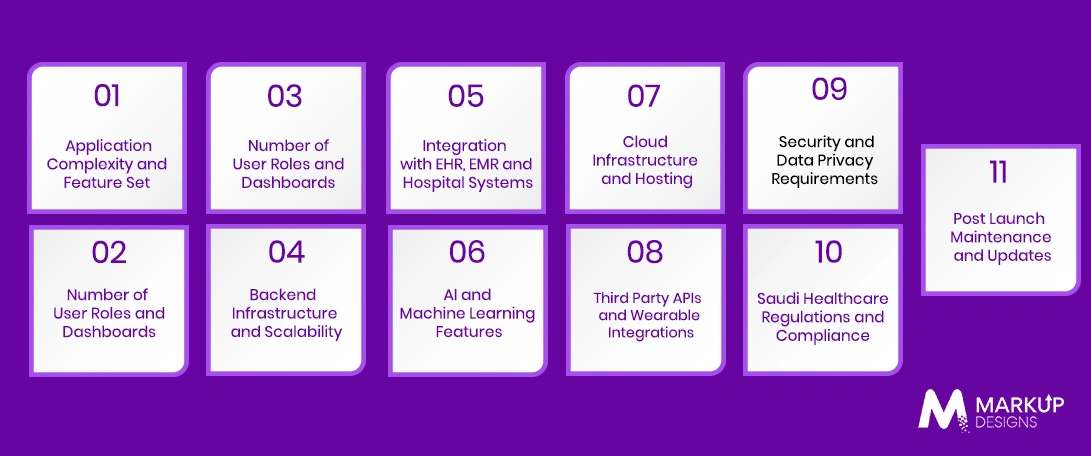
When developing a healthcare application, the cost is influenced by many factors, not only by the number of features. The technical complexity of the application, regulatory aspects of app development, integration of third parties into the system, as well as its long-term scalability should also be considered in forming the total amount to be spent on project implementation.
Application Complexity and Feature Set
If compared with simple healthcare apps that provide appointment booking and user registration functionality to clients, more complex applications such as enterprise-level platforms having features related to telehealth, artificial intelligence, analytics, and remote monitoring will require more investment.
Number of User Roles and Dashboards
Creating functionalities for different users (patients, doctors, admins, pharmacists, and caregivers) implies the presence of separate dashboards and processes, which means that more effort should be invested in development.
Arabic and English Language Support
When it comes to bilingual apps, their development involves localization, design in right-to-left order, and providing functionality for different languages.
Backend Infrastructure and Scalability
A robust backend capable of handling growing user traffic, real-time data processing, and secure data storage requires greater investment than a basic infrastructure.
Integrating with EHR, EMR, hospital information systems, laboratories, and insurance platforms requires complex API development and interoperability.
AI and Machine Learning Features
AI features in medical applications include symptom checkers, diagnostics, predictive analytics, and recommendations; however, implementation also needs special infrastructure.
Cloud Infrastructure and Hosting
A cloud platform allows increasing scalability and reliability; however, it also means further costs related to hosting services, data storage, backups, and resource management.
Third Party APIs and Wearable Integrations
Integrating payment systems, SMS services, mapping programs, wearables, and health monitoring APIs adds more complexity to the application development process.
Security and Data Privacy Requirements
Healthcare applications require special solutions like data encryption, data confidentiality measures, audit logs, and secure data delivery.
Saudi Healthcare Regulations and Compliance
The development of health apps for the Saudi market means ensuring compliance with PDPL, medical data regulations, and other legal acts.
Post-Launch Maintenance and Updates
The development process is ongoing, as continuous bug fixing, improvements, updates of operating systems, and performance optimization are vital to keeping applications functioning.
Read More: Hire Mobile App Developers in Saudi Arabia
Hidden Healthcare App Development Costs Businesses Often Miss
Healthcare software calls for both development costs of building the software and recurring costs, which very few businesses consider in total costs.
Regulatory Compliance Updates
Healthcare regulations continue to evolve, requiring businesses to regularly review and update their applications to maintain compliance.
Cloud Hosting and Storage
Monthly running costs recurrently come in the form of cloud servers, databases, data backups, and media storage.
Security Audits and Penetration Testing
They help to identify vulnerabilities and ensure compliance with internationally recognised healthcare standards.
App Store Publishing and Renewals
Developer accounts, publishing fees, and ongoing app updates should be included in the long-term budget.
Third Party Licensing Fees
Looking at most healthcare apps, licensed APIs, payment gateways, video consultation platforms, and messaging services are subject to subscription costs.
Performance Monitoring
Use application performance, uptime, and user behaviour to maintain service quality and hasten the identification of any issues.
Infrastructure Scaling
With the growth of user adoption comes the growing need to upgrade servers, databases, and cloud resources for optimal performance.
Employee Training and Support
Healthcare professionals and administrators often require onboarding and training to maximise the value of new digital platforms.
Essential Features Every Healthcare Mobile App Should Include
Regardless of the app type, every healthcare application should include features that improve patient care, streamline clinical workflows, and simplify administration.
Patient Module
Patients should be able to register securely, manage profiles, book appointments, access medical records, receive notifications, and make online payments.
Doctor Module
Doctors require appointment scheduling, patient history, consultation management, ePrescriptions, and secure communication tools.
Administrator Module
Administrators manage users, healthcare providers, reports, appointments, analytics, permissions, and overall platform operations.
| Feature | Business Benefit | Development Complexity |
| User Registration & Login | Secure user access | Low |
| Patient Profiles | Personalised healthcare management | Medium |
| Appointment Scheduling | Reduces manual coordination | Medium |
| Video Consultation | Enables virtual healthcare | High |
| Electronic Medical Records | Centralised patient information | High |
| ePrescription Management | Faster prescription processing | High |
| Push Notifications | Improves patient engagement | Low |
| Payment Gateway | Simplifies online transactions | Medium |
| Analytics Dashboard | Supports data driven decisions | Medium |
| Admin Panel | Efficient platform management | Medium |
Advanced Features That Increase Healthcare App Development Costs
Advanced technologies enhance patient care, improve operational efficiency, and increase development complexity, resulting in higher implementation costs.
AI-Powered Diagnostics
The application of AI in healthcare assists medical staff thanks to quick identification of symptoms and analysis of medical histories.
AI Medical Chatbots
AI healthcare chatbots are capable of helping people with scheduling appointments, providing answers to frequently asked medical questions, and holding conversations with patients about their well-being at any time of the day or night.
Video Consultations
Video conferencing enables doctors and patients to communicate while respecting security and privacy constraints.
Integration of Internet of Things (IoT) and Wearable Devices Integration
Medical applications can work with the help of smart gadgets, like watches, sports trackers, and medical devices to gather information about patients in real time.
Remote Patient Monitoring
Remote monitoring enables healthcare providers to track patient health continuously and improve the management of chronic conditions.
Smart ePrescription Management
E-prescribing software solves issues of medication misuse and enhances the cooperation between clinics and pharmacies.
Predictive Analytics
Predictive analytics helps healthcare providers identify risks, forecast patient outcomes, and support proactive clinical decisions.
Voice Assistant Integration
Voice-enabled functionality improves accessibility by allowing users to schedule appointments, access information, and navigate the application through voice commands.
Step by Step Healthcare App Development Process
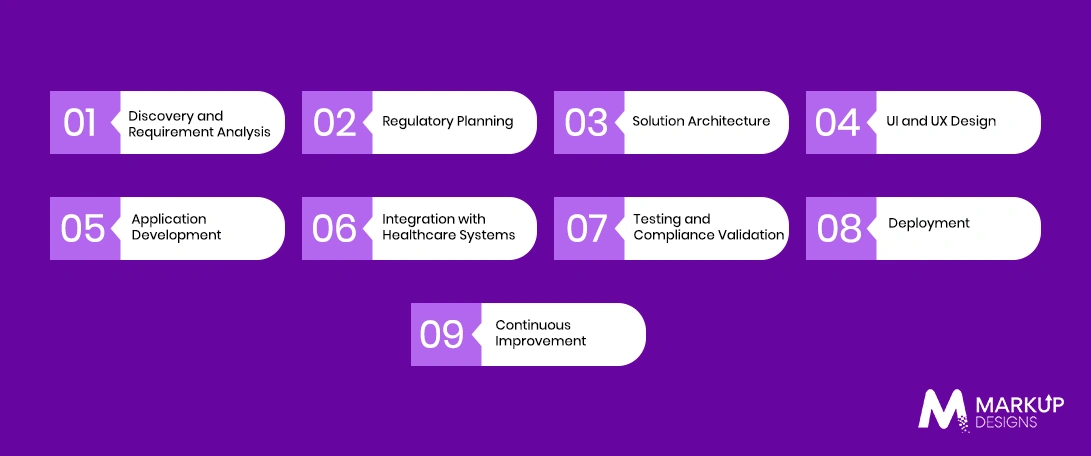
Building a successful healthcare app requires a structured approach that balances user experience, regulatory compliance, security, and scalability. Following a well-defined development process helps minimise risks and ensures a high-quality product.
Discovery and Requirement Analysis
Identify business objectives, target users, market needs, and essential features to create a clear project roadmap.
Regulatory Planning
Assess applicable healthcare regulations, privacy requirements, and security standards to ensure compliance from the beginning.
Solution Architecture
Design a scalable architecture, select the technology stack, and define system integrations to support future growth.
UI and UX Design
Create intuitive, accessible, and user-friendly interfaces for patients, doctors, and administrators.
Application Development
Develop the frontend, backend, APIs, and core functionalities while following secure coding practices.
Integration with Healthcare Systems
Connect the application with EHR/EMR systems, payment gateways, wearable devices, and third-party healthcare services.
Testing and Compliance Validation
Conduct functional, security, usability, and performance testing to ensure the application meets healthcare quality standards.
Deployment
Launch the application on app stores or enterprise environments with proper monitoring and infrastructure support.
Continuous Improvement
Regularly release updates, optimise performance, introduce new features, and maintain compliance with evolving regulations.
Proven Strategies to Reduce Healthcare App Development Costs
Healthcare app development can be cost-efficient when businesses focus on strategic planning and phased implementation.
Build an MVP First
Launch with essential features to validate the idea before investing in advanced functionality.
Prioritise Core Features
Focus on features that deliver the highest business value during the initial development phase.
Use Cross-Platform Development
Frameworks such as Flutter and React Native reduce development time and maintenance costs.
Reuse Secure APIs
Leverage trusted third-party APIs for payments, notifications, and authentication instead of building everything from scratch.
Adopt Agile Development
Agile methodology enables faster releases, continuous feedback, and better budget control throughout the project.
Choose a Scalable Cloud Infrastructure
Cloud platforms provide flexibility to scale resources as user demand increases while optimising infrastructure costs.
Revenue Models for Healthcare Mobile Apps
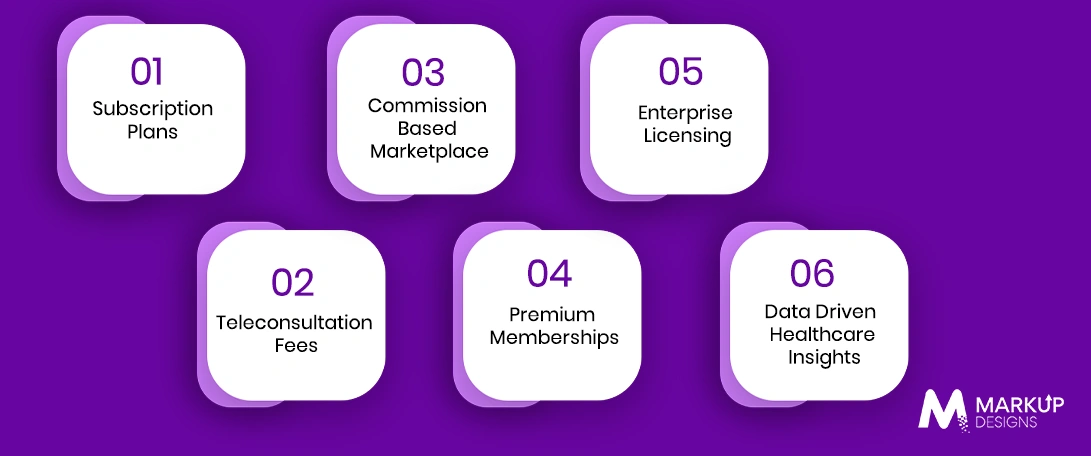
Choosing the right monetisation strategy helps healthcare businesses maximise returns while delivering value to users.
Subscription Plans
Offer monthly or annual memberships for premium healthcare services and exclusive features.
Teleconsultation Fees
Generate revenue by charging patients for online doctor consultations.
Commission-Based Marketplace
Earn commissions by connecting patients with healthcare providers, pharmacies, or diagnostic centres.
Premium Memberships
Provide advanced health tracking, wellness programmes, and personalised care plans through paid subscriptions.
Enterprise Licensing
License healthcare platforms to hospitals, clinics, insurance providers, and healthcare organisations.
Data-Driven Healthcare Insights
Offer anonymised analytics and reporting solutions to healthcare organisations while complying with privacy regulations.
Healthcare App Development Trends Shaping Saudi Arabia
Saudi Arabia’s healthcare sector continues to adopt innovative technologies that improve patient care and operational efficiency.
Artificial Intelligence in Healthcare
Artificial Intelligence helps in diagnostics, decision-making, process automation, and predictive healthcare.
Personalised Patient Experiences
Healthcare mobile applications are capable of providing customised recommendations, alerts, and wellness programs.
Arabic First Digital Experiences
By first creating an application in Arabic, it’s guaranteed that the app will deliver more user-friendly outcomes when utilizing the product in the future.
Smart Hospital Integrations
Health applications are also introducing integration with hospitals’ information systems, connected medical devices, and digital health platforms.
Cloud-Based Healthcare Ecosystems
The power of cloud technologies has made sharing medical data between different organizations secure and much easier.
Why Choose Markup Designs for Healthcare App Development in Saudi Arabia?
Markup Designs possesses expertise in the healthcare category and offers advanced app development to create secure, scalable, and compliant digital health applications.
From telemedicine platforms and patient engagement apps to AI-powered healthcare systems and enterprise hospital solutions, we deliver end-to-end services covering strategy, UI/UX design, development, system integration, testing, deployment, and ongoing support. With expertise across 350+ technologies, 12+ years of industry experience, and a team of 300+ technology experts, we help healthcare organisations in Saudi Arabia accelerate digital transformation while ensuring performance, security, and long-term scalability.
Ready to Build a Secure Healthcare App in Saudi Arabia?
Transform your healthcare idea into a scalable, compliant, and feature-rich mobile application with our healthcare technology experts.

Conclusion
The development of healthcare applications is gaining significance among organizations seeking to elevate patient care, optimize processes, and aid the digital transition of healthcare in Saudi Arabia. Vital to success are the insights into conditions affecting costs, the selection of important features, and the assessment of future expansion possibilities.
The experience of a well-established company with developing healthcare applications will favorably lead to investments, whether it is a telemedicine platform or a system for managing hospitals. Markup Designs uses industry-related knowledge, the latest technology, and reliable development practices to create sustainable healthcare apps.
FAQs
1. How much does it cost to develop a healthcare app in Saudi Arabia?
The price ranges from SAR 80,000 to SAR 1,000,000+ depending on the app’s complexity, functionality, integrations, and regulations.
2. How much time does it take to create a healthcare application?
A basic application needs 3–5 months for development, while large healthcare systems need 8–15 months.
3. Which law regulations are implied in the creation of healthcare apps in Saudi Arabia?
Apps must comply with the Saudi PDPL and other laws about health data privacy depending on the app’s functions.
4. What technologies are ideal for healthcare app development?
Top technologies include technologies like React Native, Flutter, Swift, Kotlin, AWS, Azure, Node.JS, and many others, depending on the project complexity.
5. Which features have the highest impact on development costs?
Healthcare apps featuring AI, telemedicine, EHR/EMR integration, connection to wearables, cloud technologies, multilingual capabilities, and high-level security usually have high implementation costs.
6. Why should companies collaborate with a healthcare mobile app development company?
Hiring an experienced mobile app development company in Saudi Arabia will provide businesses with proper regulatory compliance, security, seamless integration, fast delivery, and the capability to scale.
Author's Perspective
As the healthcare industry continues to transform in accordance with Vision 2030 of Saudi Arabia, apps will play a key role in boosting patient care and operational efficiency. It seems to me that effective healthcare app development relies not only on sophisticated technologies like AI or telemedicine, but also on building secure and compliant solutions for the existing problems of the healthcare sector.
Discuss Your Project NowJupinder Singh Arora
Founder and CEO
Related Posts

How to Build a Chat App Like Arattai:...

How to Hire Mobile App Developers in the...

How Much Does It Cost to Build a...
Insights Are Valuable & Execution is Priceless
You’ve read about the digital future. Now, let’s build the infrastructure to take you there. Move your strategy from the page to the product.
Design Your Solution Now
Contact Us
Schedule The Appointment At Your Convenience Date And Time.
30 Min
Web Conference
Time Zone
Indian standard time (08:30pm)

Thanks For Getting In Touch!
You’ve Taken The First Step Toward Transforming Your Digital Presence. Our Experts Will Reach Out Shortly To Take It Forward.
Launch Your Dream Project
Provide a brief overview of your project, and our specialists will evaluate your requirements. We will connect with you to explore how the right digital solutions can help you launch faster.