
In Brief
- Learn about the reasons why AI voice agents frequently do not perform as expected when put into actual settings, despite successful demos.
- Understand what factors can influence the implementation of AI voice agents and typically impact their overall performance, as well as how users experience those deployments.
- Gain practical ideas for improving speed, accuracy, and enterprise integration by leveraging government best practices for the development of secure, scalable, and dependable AI voice agents.
- Research future technology trends that will influence future iterations of conversational AI.
AI voice agents are changing how customers interact with companies by allowing them to create fast, natural, and customized conversations. AI voice agents are being used by businesses such as customer support, banks, healthcare facilities, retailers, logistics providers, and many more to automate daily administrative functions and improve how quickly they can serve customers.
Building a production-quality AI voice agent is significantly harder than creating a quality demo or proof of concept. A lot of people successfully build prototypes that work within a controlled setting, but most find it difficult to use same prototypes in an uncontrolled or real-world environment because of issues like slow response times, voice recognition inaccuracies, bad conversation flows, failed integrations with CRM or APIs, or bad transitions from AI to human agents.
According to Gartner, approximately 57% of all AI projects do not achieve success due to unrealistic expectations, and another 38% of AI projects fail because of poor-quality data. This means that achieving success through deploying AI technology will require more than just a powerful natural language algorithm, but also a strong foundation of good processes, reliable connections, and continued optimization throughout the life cycle of the AI deployment.
In this blog, we’ll cover the main obstacles regarding AI voice agents; their practical solutions; the best practices for implementation; and the new technologies that will transform the future of enterprise voice AI.
Understanding AI Voice Agents
What is an AI Voice Agent?
Businesses planning to automate customer interactions can use AI voice agent development to build systems tailored to specific workflows, data sources, and enterprise applications that allows users to communicate with software using their own voice. Powered by Automatic Speech Recognition (ASR), Large Language Models (LLM), Natural Language Processing (NLP), and Text-to-Speech (TTS) technologies, an AI voice agent will recognize spoken requests, determine the user’s intent, search an enterprise data system, and respond with human-like speech.
Unlike traditional IVR systems, which use menu options to lead users through an interaction, AI voice agents can identify the context of a conversation, conduct multi-turn conversations, provide real-time data, and automate complex business processes. Because of these capabilities, AI voice agents have substantial value across all industries, including customer support, making appointments, tracking orders, helping with banking, and healthcare.
How an AI Voice Agent Works
An AI voice agent uses a combination of several technologies to interpret and respond to the conversation.
Speech Input
A user initiates a conversation with an AI voice agent by speaking into a phone, mobile app, smart device, or voice-enabled device; this is known as speech input.
Automatic Speech Recognition (ASR)
Automatic Speech Recognition (ASR) converts spoken words into text. Since it creates the transcript that AI relies on, any errors in transcription can lead to incorrect responses or actions.
AI/LLM Processing
Analysing the text is done with NLP and LLMs to determine what the user is requesting, interpret the data contained in the text, produce a response to the transcription, and determine the correct action to be taken against the business.
Control Layer (Voice Agent Orchestration)
The control layer, or voice Agent Orchestration, is the part of the architecture that manages the flow of the conversation, confirming that the request is a valid request, applying business rules, routing prompts, maintaining context for the conversation, and ensuring that responses to the users are compliant with company policy before interacting with enterprise systems.
Enterprise Systems & APIs’
With reliable AI integration services, the AI voice agent establishes a secure connection to a business application via an API (Application Programming Interface), which can be a CRM, ERP, payment processors, healthcare records, booking engines, and other enterprise business applications.
Text-to-Speech (TTS)
The final process for responding to the user by converting the generated text into natural speech to allow user to receive their answer in a clear, conversational manner in real-time.
Read Also: Hire AI Consultants: What Businesses Should Evaluate Before Hiring
Common AI Voice Agent Failure Patterns
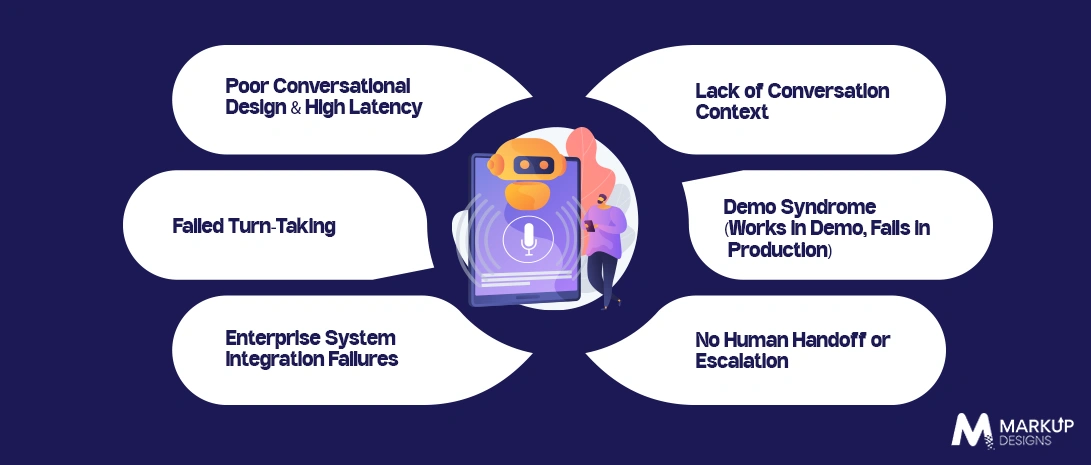
Many of the AI voice agents fail to produce the desired results, not due to the AI model but because of a lack of architectural integrity, poor conversation design, and a lack of enterprise integration. Knowing the cause of failure for AI voice agent systems is critical to designing an AI voice agent solution that will perform reliably in production.
Poor Conversational Design and High Latency
Users get frustrated when they have to wait a long time for responses and are not able to communicate smoothly through natural conversation flow. When there is a delay in AI speaking or processing (such as because of speech processing delays, AI inferences, or backend delays), it creates a slower-feeling interaction and decreases the level of customer satisfaction.
Failed Turn-Taking
Conversational Turn-Taking operates on the principle of smooth transitions from one person to the other as they speak to one another (conversation exchange). If AI agents interrupt customers prematurely or fail to accurately detect when a customer has finished speaking, conversations become fragmented and confusing, ultimately leading to a poor user experience.
Enterprise System Integration Failure
Voice Agents rely on the ability to communicate seamlessly with any existing enterprise application (CRM, ERP, Payment Processor, etc.). If the Voice Agent’s endpoint can’t work with these (and vice versa) (e.g., poor API integration or Backend Failure), then it may not be able to execute accurately and completely for the end user..
Lack of Conversation Context
Users expect the AI to remember previous questions and responses within the same conversation. If context is not managed effectively, the voice agent may repeat questions, fail to retain important information, or provide inconsistent answers during multi-turn conversations.
Demo Syndrome
While many of the AI Voice Agents may perform at a high level during controlled demonstrations, their performance may decrease significantly once they are put into production. The real world provides significantly greater variability in accents, background noise, unintentional user errors, and complex enterprise scenarios that will expose weaknesses in the architecture.
No Human Handoff/Escalation
Not every customer interaction can be resolved by AI. When a voice agent is incapable of recognizing an advanced situation or passing on a conversation to a live human representative without interruption, this will lead to a higher level of frustration on customer’s end and less satisfaction in terms of the quality of service they receive.
Top AI Voice Agent Problems and Realistic Solutions
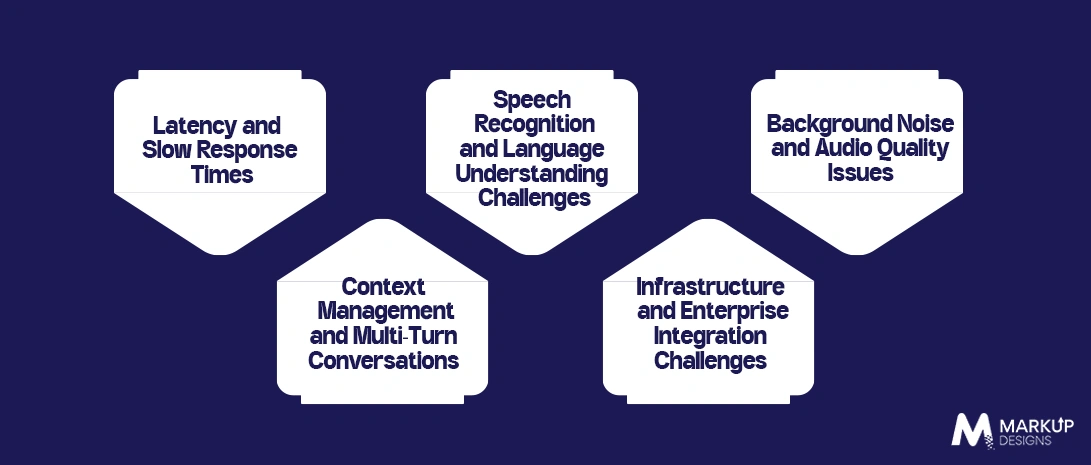
Let us discuss some of the most popular AI voice agent issues and their potential solutions one by one-
Latency and Slow Response Times
Low latency is essential for AI voice agents. Unlike text-based chatbots, voice conversations require responses almost instantly to feel natural and maintain a smooth user experience. Even the slightest delay will interrupt the flow of the conversation and create uncertainty for the end-user, and increase the likelihood of the call being abandoned.
Importance of Latency When Responding
Most users expect a voice response within one second. A delayed voice response creates an uncomfortable pause or break in the interaction and doesn’t sound very human-like.
Common Causes of Latency
- Processing delays associated with Automatic Speech Recognition (ASR) systems.
- Inference Time for Large Language Model (LLM) solutions.
- APIs and Database requests.
- Text-to-Speech (TTS) of the generated response.
- Latency associated with Network Connectivity.
Realistic Solutions
- To reduce latency, organizations should utilize:
- Streaming capabilities for Speech pipelines.
- Token Streaming to improve the speed of AI responses.
- Parallel API processing to provide faster application response times.
- Regional deployment of services to minimize network latency.
- Use response caching for repetitive queries.
- Monitor continuous, 95th percentile latencies in order to detect and eliminate performance constraints.
Table: Voice AI Latency Budget
| Stage | Typical Delay |
| Speech Recognition (ASR) | 150–300 ms |
| LLM Processing | 200–500 ms |
| API & Database Calls | 100–300 ms |
| Text-to-Speech (TTS) | 150–300 ms |
Speech Recognition and Language Understanding Challenges
Speech recognition accuracy directly impacts the effectiveness of an AI voice agent. Misinterpreted words or incorrect intent detection can lead to poor customer experiences and failed task execution.
AI speech recognition challenges
- Accent and dialect recognition
- Industry-specific terminology
- Code-switching and multilingual conversations
- Slang and informal language
- Elderly users or speech impairments
- Hallucinations caused by ASR transcription errors
Practical Solutions
Improve recognition accuracy by implementing:
- Domain-trained ASR models
- Custom vocabularies for industry terminology
- Phonetic lexicons for names and technical terms
- Confidence scoring to detect uncertain responses
- Confirmation prompts before executing critical actions
Background Noise and Audio Quality Issues
AI voice agents often operate in noisy environments such as call centers, factories, vehicles, hospitals, and public spaces. Poor audio quality can significantly reduce speech recognition accuracy.
Common Challenges
- Background conversations
- Echo and microphone quality
- Packet loss during voice transmission
- Voice interruptions and overlapping speech
Practical Solutions
Banks and enterprises can improve audio quality through:
- Beamforming microphones
- AI-powered noise suppression
- Acoustic modeling
- Codec optimization
- Smart barge-in detection that distinguishes user interruptions from background noise
Context Management and Multi-Turn Conversations
Unlike traditional IVR systems, AI voice agents must maintain context throughout a conversation. Losing context forces users to repeat information, leading to frustration and lower task completion rates.
Key Components
- Session Memory – Stores information during the active conversation.
- Persistent Memory – Retains user preferences for future interactions.
- Entity Extraction – Identifies names, dates, account numbers, and other important information.
- Intent Resolution – Determines what the user wants to achieve.
- Goal-Oriented Conversation Design – Keeps conversations focused on completing specific tasks.
- Dialogue Management – Controls the flow of multi-turn conversations.
Practical Solutions
Organizations can strengthen conversation management by implementing:
- Intelligent context retention
- Dynamic memory management
- Intent validation before executing actions
- Conversation state tracking across multiple interactions
These capabilities help AI voice agents deliver more natural, personalized, and consistent experiences while reducing repetitive questions and improving task completion.
Infrastructure and Enterprise Integration Challenges
Stand-alone AI voice agents do not operate independently. They communicate with enterprise systems (such as CRM, ERP, payment gateway, contact center, and healthcare) in order to execute actual business functions as part of an enterprise-level solution. Poor integration can result in failed transactions, poor customer experiences, and delayed operations.
CRM System Integration
By integrating voice agents with CRM systems, voice agents can have access to customers’ profiles and interaction history, enabling the voice agents to provide personalized conversations without requiring users to provide the same information again.
ERP System Integration
By connecting voice agents with ERP systems, the voice agents can access real-time data on inventory, order status, invoices, and other operational data.
Payment Gateway Integration
By providing secure integration with payment gateways, users can complete transactions, validate their payments, and confirm their transactions using voice.
Contact Center Integration
When the voice AI transfers a conversation to a live agent, it will pass the entire conversation history and customer context to that live agent.
Healthcare System Integration
AI voice agents can assist patients in scheduling appointments, answering questions, and retrieving medical information by integrating with EHRs while adhering to all regulatory compliance guidelines.
API Reliability
Reliable APIs facilitate steady communication between AI voice agents and enterprise applications and minimize both downtime and failed requests.
Practical Solution
By adopting a microservices architecture and using event-driven communication and standard APIs, organizations will enhance scalability and overall system reliability.
Table: Enterprise Integration Best Practices
| Best Practice | Business Benefit |
| Microservices | Better scalability and flexibility |
| Event-Driven Architecture | Faster communication between systems |
| Contract-First APIs | Consistent integrations |
| Idempotency Keys | Prevent duplicate transactions |
| Unified Customer Context | Personalized user experiences |
| Graceful Degradation | Improved service continuity |
Control Layer and AI Governance
The control layer is the intelligent component of enterprise AI voice agents. It acts to validate requests from the language model without giving the language model the ability to directly interact with business systems. In addition to validating requests, the control layer also maintains AI voice agent security and manages every action occurring through enterprise voice agents prior to any actions taking place.
What is the control layer?
The control layer provides an orchestration layer that facilitates coordinating conversations, business logic, enterprise tools, and AI models to ensure that all outcomes are achieved securely and reliably.
Why do all voice agents need a control layer?
Without proper governance of the underlying AI models, there is a good chance that the models will produce inaccurate responses or take unauthorized actions. The control layer reduces these risks and helps to ensure that all enterprise voice agent actions are legitimate through consistent and compliant regulation.
Key functions of the control layer:
The control layer enforces organizational policies; validates the use of tools; routes prompts; grounds responses using trusted data; maintains and audits actions; supports human approvals; and coordinates activities of multiple AI agents completing actions.
Practical considerations:
Organizations must implement a comprehensive AI governance framework with rule-based validations, human supervision of sensitive actions, and continuous monitoring to provide transparency and accountability.
Read Also: Choosing the Right AI Consultant for Enterprise AI Security
Privacy, security, and regulatory compliance:
Enterprise AI voice agents communicate using highly confidential information about customers, making security and regulatory compliance an extremely important component for deployment of enterprise AI voice agents. Protecting the voice recordings, biometric data, and personal data of customers will be critical to establishing trust with customers for using enterprise AI voice agents.
Voice Verification
Voice verification uses the distinctive way an individual talks to confirm their identity, providing an extra layer of protection.
Data Security
Confidential information must be kept safe through strong encryption, secure storage, and limited access, all of which will protect the information from being accessed by unauthorized persons throughout its life cycle.
Regulatory Compliance
Organizations that deploy voice authentication technology must stay compliant with any governing laws or regulations (such as GDPR, HIPAA, and BIPA) that apply to their area of operation or industry to ensure that they’re meeting stringent requirements on the collection, use, storage, and sharing of data, as well as obtaining valid consent before collecting any biometric data.
Real-Life Approaches
Organizations that utilize voice authentication technology should always encrypt data in transport and at rest, utilize secure methods of authentication, establish appropriate access controls, and continuously verify that they’re compliant with the rules set forth by regulators, as they continue to evolve.
Ongoing Assessment, Oversight, and Improvement
Implementing an AI voice agent only marks the start of the journey. Therefore, ongoing assessment, as well as the regular testing and evaluation of the system, are essential to ensure that the system is functioning as intended, while also remaining reliable, accurate, and responsive to changes in business needs.
Prompt Assessment
Testing and revising prompts regularly allows for improved response quality and reductions in errors experienced during conversations.
Automated Evaluation
Automated testing assists in the discovery of inconsistencies, measurement of performance, and verification of responses before the release of any updates.
Conversation Data Review
By reviewing customer interactions, organizations have the opportunity to gain insight into repeated problems, unsuccessful attempts, and user patterns.
Human Feedback Loop
Obtaining feedback from both customers and support teams improves conversation design and enhances the user experience as a whole.
Performance Tracking
Through a continuous and ongoing measurement system, latency, task completion rates, response accuracy, and customer satisfaction will be closely monitored to guarantee performance is maximized.
Practical Approaches
As an organization, you must treat a prompt as though it were an application that requires continuous testing, the measurement of real-world interactions, and the use of analytics for ongoing improvement to the performance of your voice AI.
AI Voice Agent Development Best Practices
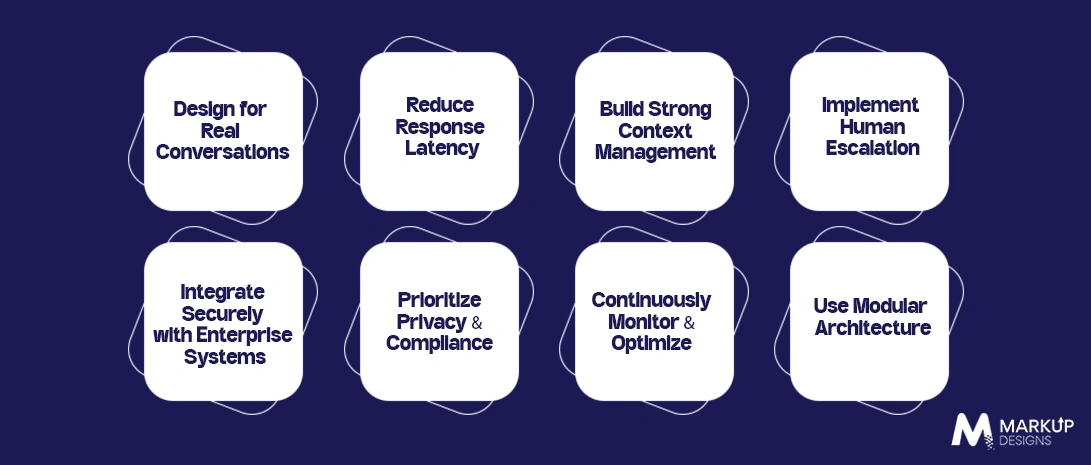
In order for your AI voice agent to be successful, you cannot rely solely on an advanced language model to build your voice agent. You need an AI voice agent that includes intelligent conversation design, secure integrations, a continuous optimization effort, and strong governance to provide your users with reliable, consistent experiences.
Design for Real-Life Conversations
The ability for voice agents to recognize natural human speech, appropriately manage interruptions, and conduct multi-turn conversations while maintaining the context of previous interactions is imperative to providing improved customer experiences.
Reduce Response Latency
The optimization of speech recognition technology, voice AI integration time, and backend integrations will reduce latency, thus keeping the conversation flow natural.
Build Strong Context Management
The proper implementation of session memory, tracking user intent, and providing access to historical conversation data for your users will result in increased frequency of providing users with more personalized and accurate results.
Implement Human Escalation
Not every request can be completed solely by an AI voice agent. A well-defined and seamless process for transitioning from an AI voice agent to a human will provide your users with an efficient mechanism through which their complex issues will be handled, while still maintaining the context of previous interactions.
Integrate Securely with Enterprise Platforms
Secure integration using enterprise systems like CRM or ERP (e.g. payment gateways), will allow the voice agents to automate business processes while helping to ensure the security of sensitive data.
Prioritize Privacy & Compliance
Strong encryption, access control, consent management, and regulatory compliance should be part of an organization’s strategy to protect customer data and maintain customer trust.
Continuous Monitoring & Optimization
The use of regular testing, performance monitoring, conversational analysis, and user input can aid in increasing efficiency and help keep voice agents aligned with changing business requirements.
Use Modular Architecture
Companies will be able to scale their AI capabilities, offer new features and technologies into existing business processes by implementing a modular architecture system.
Future AI Voice Agent Trends
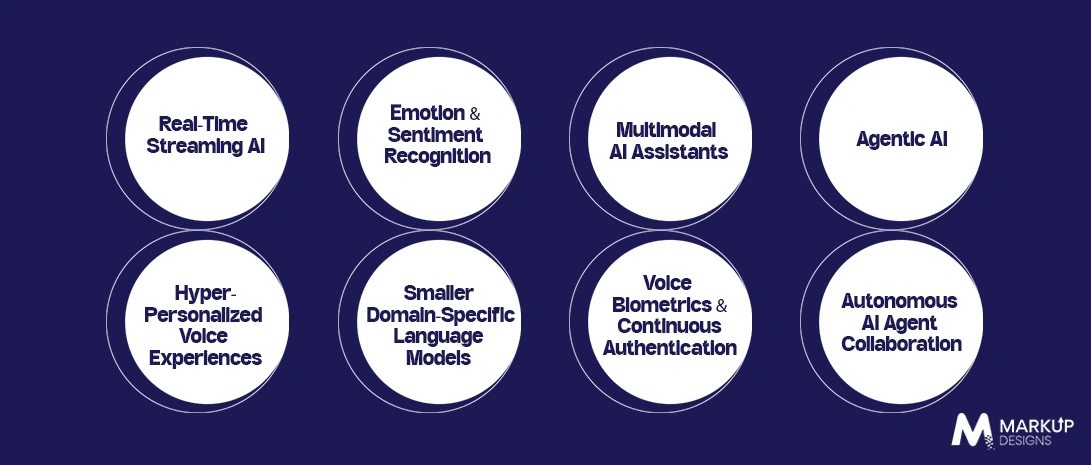
AI voice technology is continually evolving into smarter, more responsive, and more personalised interactions with customers.
Real-Time Streaming AI Technology
Streaming AI technology will greatly reduce the time it takes to provide responses to customers, as streaming allows for the simultaneous processing of speech and then the generating of a response, creating a more natural conversational flow.
Emotion and Sentiment Recognition
Using information captured from tone, emotion and sentiment in the future will allow for delivery of much more empathetic responses that have a much greater context when responding to the user.
Multimodal AI Assistants
AI voice technology will be increasingly implemented across a multitude of devices to provide a richer customer experience.
Agentic AI
Autonomous AI agents, by design, will require little to no human intervention to accomplish their own tasks autonomously (i.e., planning activities, making decisions, and coordinating and monitoring workflows).
Hyper-Personalized Voice Experiences
Advanced analytics and customer insights will enable highly personalized recommendations and conversations tailored to individual preferences.
Smaller Domain-Specific Language Models
Organizations are increasingly adopting specialized AI models trained for specific industries, improving accuracy while reducing operational costs.
Voice Biometrics and Continuous Authentication
Voice biometrics will provide secure, frictionless authentication by continuously verifying user identity throughout conversations.
Autonomous AI Agent Collaboration
Multiple AI agents will work together across departments and enterprise systems to complete complex workflows more efficiently.
Why Choose Markup Designs for AI Voice Agent Development
At Markup Designs, we help businesses build enterprise AI voice agents that deliver secure, intelligent, and scalable conversational experiences. From strategy and architecture to deployment and optimization, our team develops custom voice AI solutions tailored to your business objectives.
Our expertise includes AI voice strategy and consulting, custom AI agent development, enterprise system integration, low-latency architecture, AI governance, security and compliance, and continuous monitoring to ensure long-term performance and reliability.
Transform Conversations with Intelligent AI Voice Agents
Build secure, scalable, and enterprise AI voice agents that deliver faster responses, seamless integrations, and exceptional customer experiences.

Conclusion
AI voice agents are redefining customer interactions by enabling faster, smarter, and more personalized conversations. However, achieving success in production requires more than powerful AI models. Organizations must address challenges related to latency, speech recognition, context management, enterprise integration, security, and governance while continuously optimizing performance.
By adopting best practices and leveraging emerging technologies, businesses can build AI voice agents that improve operational efficiency, enhance customer satisfaction, and support long-term digital transformation.
FAQs
1. What are AI voice agents?
AI voice agents are conversational AI systems that use speech recognition, natural language processing, and text-to-speech technologies to understand spoken requests and perform tasks through voice interactions.
2. Why do AI voice agents fail in production?
Common reasons include high latency, AI speech recognition challenges, weak context management, unreliable integrations, and inadequate governance.
3. What causes latency in AI voice systems?
Latency is typically caused by delays in speech recognition, AI inference, API processing, database queries, network communication, and text-to-speech generation.
4. How can speech recognition accuracy be improved?
Using domain-trained ASR models, custom vocabularies, confidence scoring, phonetic lexicons, and confirmation prompts significantly improves recognition accuracy.
5. What is the Control Layer in AI voice agents?
The Control Layer validates requests, enforces business rules, manages interactions, and securely connects with enterprise AI voice agents.
Author's Perspective
As AI voice technology becomes a core component of digital transformation, organizations must focus on building production-ready solutions rather than demo-ready prototypes. Success depends on combining intelligent AI models with strong architecture, enterprise integrations, security, governance, and continuous optimization. Businesses that invest in these foundations will be better positioned to deliver reliable, scalable, and future-ready voice experiences that create lasting value for both customers and the organization.
Discuss Your Project NowGaurav Goyal
Global Sales- VP
Related Posts

How Artificial Intelligence Is Changing Mobile Game Development

How to Build Production-Ready Applications with AI Coding...
Cost, Benefits & Business Impact: Generative AI vs....
Insights Are Valuable & Execution is Priceless
You’ve read about the digital future. Now, let’s build the infrastructure to take you there. Move your strategy from the page to the product.
Design Your Solution Now
Contact Us
Schedule The Appointment At Your Convenience Date And Time.
30 Min
Web Conference
Time Zone
Indian standard time (08:30pm)

Thanks For Getting In Touch!
You’ve Taken The First Step Toward Transforming Your Digital Presence. Our Experts Will Reach Out Shortly To Take It Forward.
Launch Your Dream Project
Provide a brief overview of your project, and our specialists will evaluate your requirements. We will connect with you to explore how the right digital solutions can help you launch faster.