

In Brief
- AI adoption is growing rapidly, but many organizations struggle to achieve measurable business results due to challenges such as poor data quality, unclear objectives, and integration complexities.
- AI consultants help businesses identify valuable use cases, develop implementation roadmaps, evaluate data readiness, and align AI initiatives with overall business goals.
- Before hiring an AI consultant, businesses should assess technical expertise, industry experience, proven project success, data governance knowledge, communication skills, and strategic thinking.
- Asking the right questions and recognizing red flags-such as unrealistic promises, lack of case studies, and technology-first recommendations-can help organizations select the right consulting partner.
- The right AI consultant can accelerate implementation, reduce risks, improve ROI, and provide long-term guidance that enables businesses to scale AI initiatives successfully.
Artificial Intelligence has moved from being an emerging technology to a business necessity. Organizations across industries are increasingly investing in AI to improve efficiency, automate processes, enhance customer experiences, and gain a competitive advantage.
According to Stanford University’s AI Index Report, nearly 90% of organizations now use AI in at least one business function, highlighting how rapidly AI adoption has become mainstream. At the same time, research from McKinsey shows that many companies are deploying AI across multiple business areas rather than limiting it to isolated projects.
Despite this growing adoption, achieving meaningful results from AI remains a challenge. Many businesses struggle to move beyond experimentation and generate measurable value from their AI investments.
McKinsey research indicates that while AI usage continues to rise, only a small percentage of organizations consider their AI initiatives mature enough to deliver significant business impact. Common obstacles such as poor data quality, legacy infrastructure, unclear business objectives, integration challenges, and scalability issues often prevent companies from realizing the full potential of AI.
This is why hiring the right AI consultant has become increasingly important. AI consultants help organizations identify high-value opportunities, create practical implementation strategies, align AI initiatives with business goals, and ensure solutions deliver tangible outcomes.
Rather than investing in AI based on trends or assumptions, businesses can make informed decisions backed by expertise and proven methodologies.
However, not all AI consultants offer the same level of expertise, industry knowledge, or strategic guidance. Choosing the wrong partner can lead to wasted resources, delayed projects, and disappointing results.
Before making a hiring decision, businesses must carefully evaluate several critical factors to ensure they select a consultant capable of turning AI investments into long-term business value.
Understanding What AI Consultants Actually Do
AI consultants are often misunderstood as just technical experts who build AI models. In reality, their role is much broader and more strategic. They don’t just focus on coding or tools, they focus on solving business problems using AI in the most effective way possible.
Their work usually begins with understanding the business, its challenges, and its goals. Based on this, they identify where AI can actually add value instead of forcing the same into areas where it may not be needed.
Core responsibilities of AI consultants include:
AI Strategy Development
Defining a clear roadmap for AI adoption aligned with business goals and long-term growth.
Use Case Identification
Finding practical applications of AI such as automation, forecasting, personalization, or fraud detection.
Data Assessment and Preparation Guidance
Evaluating data quality, structure, and availability to ensure it is suitable for AI models.
Solution Design and Architecture Planning
Suggesting how AI systems should be built and integrated into existing software or workflows.
Technology and Tool Selection
Recommending suitable frameworks, platforms, and tools based on project needs.
Implementation Support and Monitoring
Working with development teams to guide execution and ensure results align with expectations.
Performance Evaluation
Measuring outcomes like efficiency improvement, cost reduction, or revenue impact.
Why Businesses Need AI Consultants
As AI technologies continue to evolve, many businesses recognize their potential but struggle to determine where and how to start. Implementing AI is not simply about adopting new tools, it requires a clear strategy, quality data, technical expertise, and alignment with business objectives. This is where AI consultants provide significant value.
AI consultants help organizations avoid costly mistakes and accelerate their AI journey by offering specialized knowledge and practical guidance. Instead of relying on trial-and-error approaches, businesses can leverage proven frameworks and industry best practices to achieve faster and more measurable outcomes.
Businesses often hire AI consultants to:
- Identify high-impact AI opportunities that align with business goals
- Develop a realistic AI adoption roadmap
- Evaluate data readiness and infrastructure requirements
- Reduce implementation risks and project failures
- Ensure AI investments generate measurable ROI
- Support seamless integration with existing systems and workflows
Another major advantage is access to expertise that may not exist internally. Hiring and building an in-house AI team can be time-consuming and expensive, especially for organizations that are just beginning their AI initiatives. Consultants bring immediate experience from working across multiple industries and use cases, helping businesses make informed decisions more quickly.
Ultimately, AI consultants act as strategic partners who help transform AI from a promising concept into a practical business asset. Their guidance enables organizations to adopt AI with greater confidence, efficiency, and long-term success.
Key Factors to Evaluate Before Hiring AI Consultants
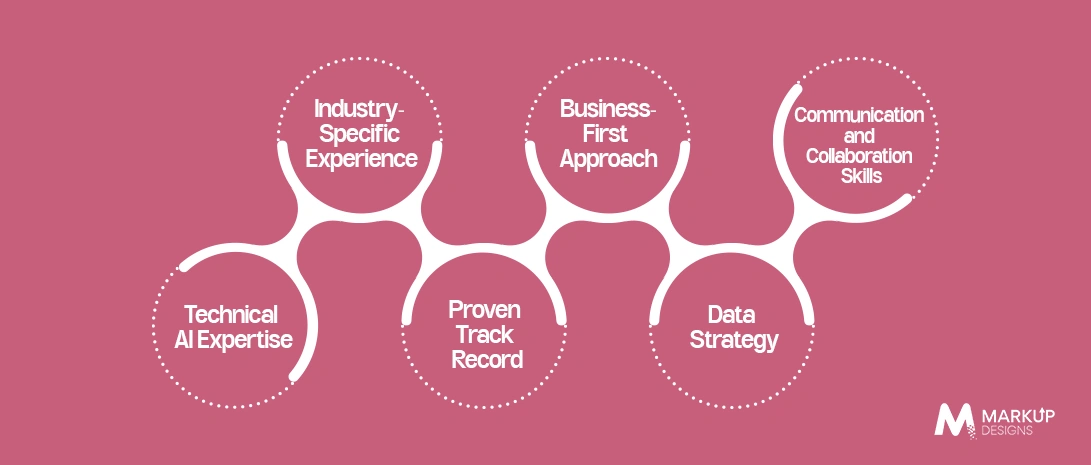
Selecting an AI consultant is a strategic business decision that can directly impact the success of your AI initiatives. While many consultants claim expertise in artificial intelligence, not all possess the technical capabilities, industry knowledge, or implementation experience required to deliver meaningful business outcomes. Before making a hiring decision, businesses should carefully evaluate the following factors.
1. Technical AI Expertise
A consultant should have strong knowledge of AI technologies, frameworks, and implementation methodologies. Their expertise must extend beyond theory and include practical experience in deploying AI solutions.
Look for experience in:
- Machine Learning (ML) and Deep Learning
- Generative AI and Large Language Models (LLMs)
- Natural Language Processing (NLP)
- Computer Vision and Predictive Analytics
- AI model deployment, monitoring, and optimization
The consultant should also be familiar with modern AI platforms, cloud environments, and integration technologies.
2. Industry-Specific Experience
AI implementation challenges vary significantly across industries. A consultant who understands your industry can identify practical use cases and anticipate potential obstacles more effectively.
Evaluate whether they have experience in:
- Healthcare and life sciences
- Financial services and fintech
- Retail and ecommerce
- Manufacturing and logistics
- Education and enterprise software
Industry knowledge often leads to faster implementation and better business outcomes.
3. Proven Track Record
Past performance is one of the strongest indicators of future success. Experienced AI consultants should be able to demonstrate how they have helped organizations solve business challenges through AI.
Review:
- Client success stories
- Case studies with measurable results
- Testimonials and references
- Project outcomes related to cost savings, efficiency, or revenue growth
A consultant who cannot provide evidence of previous work, may lack the experience needed for complex AI initiatives.
4. Business-First Approach
Effective AI consultants focus on business goals rather than simply promoting technology. Their recommendations should address specific operational challenges and growth objectives.
A strong consultant should:
- Understand your business model
- Define clear AI objectives
- Prioritize high-value use cases
- Measure success using business KPIs
This approach ensures AI investments are aligned with organizational priorities.
5. Data Strategy
AI success depends heavily on data quality. Consultants should assess your organization’s data readiness and establish frameworks for responsible AI usage.
Key areas to evaluate include:
- Data quality assessment
- Data security practices
- Compliance and regulatory awareness
- Ethical AI implementation
- Data governance frameworks
6. Communication and Collaboration Skills
AI projects often involve multiple stakeholders, including executives, technical teams, and operational departments. Consultants must be able to communicate complex concepts in a way that all stakeholders are able to understand.
Strong communication ensures:
- Better alignment across teams
- Faster decision-making
- Improved project transparency
- Smoother implementation processes
By evaluating these factors, businesses can identify AI consultants who are capable of delivering scalable, practical, and value-driven AI solutions rather than simply providing technical advice.
Best Strategies to Hire ML Engineers for AI Solutions
Strategy to hire machine learning engineers for scalable AI solutions. Explore hiring models, ML engineer skills, MLOps practices, deployment expertise, and enterprise AI development strategies.
Benefits of Hiring the Right AI Consultant
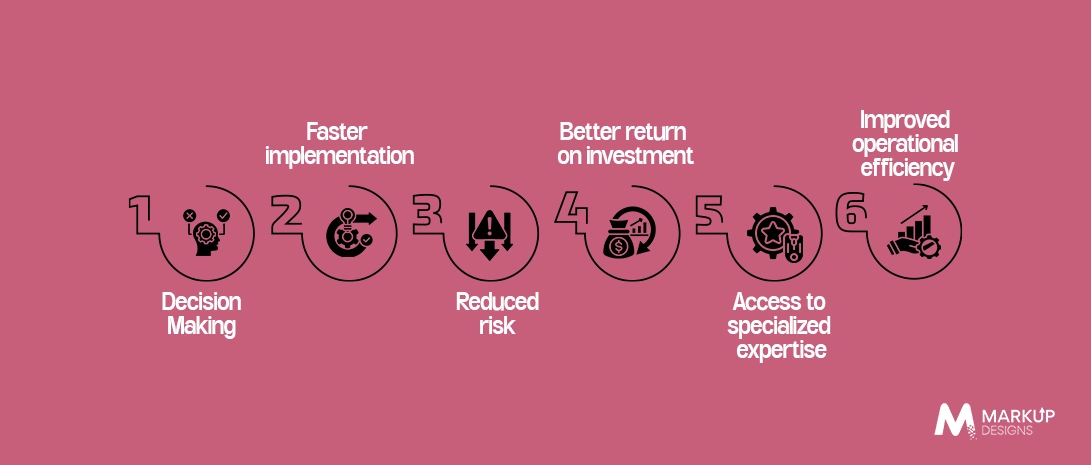
Many businesses are excited about AI, but excitement alone doesn’t lead to results. The real challenge is knowing where AI can create value, how it should be implemented, and how to avoid costly mistakes along the way. This is where experienced AI consultants make a difference.
When you hire AI consultants, you’re not simply bringing in technical expertise. You’re gaining access to professionals who have worked on multiple AI projects, understand common roadblocks, and know how to align technology with business goals. Instead of spending months experimenting with different tools and approaches, businesses can move forward with a clear strategy and a defined roadmap.
Here are some of the key benefits businesses can expect:
1. Clearer direction and decision-making
AI consultants help differentiate practical opportunities from industry hype, allowing businesses to focus on initiatives that can deliver measurable value.
2. Faster implementation
With proven frameworks, best practices, and hands-on experience, consultants can accelerate project timelines and reduce avoidable delays.
3. Reduced risk and costly mistakes
From selecting the right technology stack to identifying data challenges early, consultants help prevent expensive implementation errors.
4. Better return on investment
Rather than investing in AI for the sake of innovation, consultants must ensure projects are aligned with business objectives and performance metrics.
5. Access to specialized expertise
Businesses gain knowledge in areas such as machine learning, generative AI, automation, analytics, and AI governance without hiring a full in-house team.
6. Improved operational efficiency
AI consultants often identify opportunities to automate repetitive tasks, improve workflows, and enhance productivity across departments.
The most valuable AI consultants do more than deliver recommendations. They become strategic partners who help organizations navigate complexity, minimize uncertainty, and turn AI investments into sustainable business growth.
Red Flags to Avoid When Hiring AI Consultants
Hiring an AI consultant can significantly improve the success of your AI initiatives, but choosing the wrong partner can lead to wasted budgets, delayed projects, and disappointing outcomes. While many consultants claim to be AI experts, not all have the experience or strategic mindset required to deliver real business value. Before making a decision, watch for these common warning signs.
- Unrealistic Promises and Guaranteed Results
AI is powerful, but no consultant can guarantee perfect accuracy, instant ROI, or overnight transformation.
Warning signs include:
- Claims of 100% accuracy
- Promises of immediate business results
- Overly aggressive timelines without proper assessment
A reliable consultant will set realistic expectations and explain potential risks along with opportunities.
- Lack of Proven Experience
Experience is important when implementing AI solutions. Consultants should be able to demonstrate successful projects and measurable outcomes.
Warning signs include:
- No case studies or client references
- Limited evidence of real-world AI implementations
- Vague descriptions of past projects
Always ask for real world case studies that show how their solutions delivered business impact.
- Technology-First Instead of Business-First Thinking
Effective AI consultants focus on solving business problems, not simply promoting the latest AI tools or trends.
Warning signs include:
- Excessive use of technical jargon
- Recommendations without understanding business goals
- Generic solutions for every client
The right consultant will prioritize business objectives and recommend AI only where it creates genuine value.
Questions Businesses Should Ask Before Hiring AI Consultants
Hiring an AI consultant isn’t just about finding someone with technical expertise, it’s about finding the right partner for your business objectives. Before signing a contract, take time to ask the right questions. A right consultant will welcome these discussions and provide clear, confident answers.
Use the checklist below to evaluate potential AI consulting partners:
1. Have you worked on projects similar to ours before?
What to Look For: Look for industry-specific experience and real-world case studies rather than generic AI projects.
2. What AI opportunities do you see for our business?
What to Look For: A strong consultant should quickly identify practical use cases instead of offering one-size-fits-all solutions.
3. How do you measure AI project’s success?
What to Look For: The answer should focus on business outcomes such as efficiency gains, cost savings, revenue growth, or customer experience improvements.
4. What data and resources will you need from us?
What to Look For: This helps you understand project requirements, timelines, and internal involvement.
5. How will the solution integrate with our existing systems?
What to Look For: Integration challenges can significantly impact project success, hence important to discuss early.
6. What is your approach to security, compliance, and AI governance?
What to Look For: Responsible AI practices are essential, especially when handling sensitive business data.
7. What support do you provide after implementation?
What to Look For: AI is not a one-time deployment. Ongoing monitoring, optimization, and maintenance are often necessary.
The best AI consultants won’t just answer these questions, they’ll ask thoughtful questions of their own. That’s usually a sign they’re focused on solving business problems, not just selling AI services.
AI Consulting Engagement Models
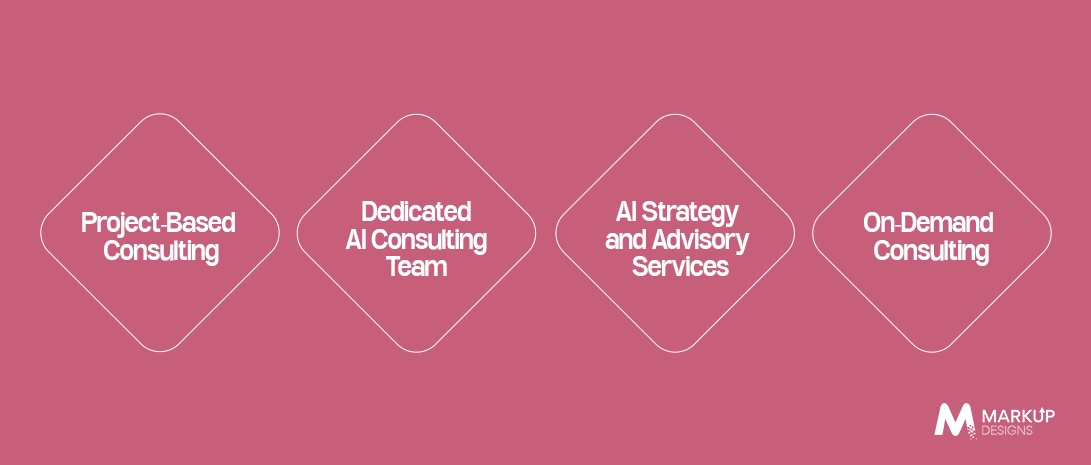
Not every business requires the same level of AI support. Some organizations need guidance for a specific project, while others require ongoing strategic assistance as their AI initiatives grow. Understanding different AI consulting engagement models can help you choose an approach that aligns with your goals, budget, and internal capabilities.
1. Project-Based Consulting
This model is ideal for businesses with a clearly defined AI objective, such as implementing an AI chatbot, developing a predictive analytics solution, or automating a specific process.
Best for:
- Short-term AI projects
- Clearly defined requirements
- Businesses seeking targeted expertise
2. Dedicated AI Consulting Team
In this model, consultants work closely with your internal teams over an extended period. They provide strategic guidance, technical expertise, and implementation support throughout the project lifecycle.
Best for:
- Large-scale AI initiatives
- Enterprise AI transformation projects
- Organizations requiring ongoing collaboration
3. AI Strategy and Advisory Services
Some businesses are still exploring AI opportunities and need expert guidance before investing in implementation. Strategy-focused consultants help assess readiness, identify use cases, and create an adoption roadmap.
Best for:
- Early-stage AI planning
- AI readiness assessments
- Long-term digital transformation initiatives
4. On-Demand Consulting
This flexible engagement model provides access to AI expertise whenever needed, without a long-term commitment.
Best for:
- Small and medium-sized businesses
- Occasional AI guidance
- Cost-conscious organizations
Choosing the right consulting model ensures you receive the level of support needed to achieve successful and sustainable AI outcomes.
Future of AI Consulting
The future of AI consulting is moving beyond simple advisory services toward end-to-end implementation and optimization. As AI technologies become more advanced and accessible, businesses will increasingly seek consultants who can not only recommend solutions but also help deploy, monitor, and scale them effectively.
Generative AI, AI agents, predictive analytics, and intelligent automation are expected to drive the next wave of business transformation. This shift will create greater demand for consultants with deep technical expertise and industry-specific knowledge. Organizations will also prioritize consultants who understand AI governance, compliance, data privacy, and responsible AI practices.
In the coming years, AI consultants are likely to become long-term strategic partners rather than short-term advisors. Their role will focus on helping businesses continuously adapt to evolving technologies, maximize AI investments, and build sustainable competitive advantages in an increasingly AI-driven marketplace.
Transform Your AI Vision Into Business Value
Whether you’re exploring AI opportunities or planning a large-scale implementation, the right guidance can make all the difference. Work with experienced AI consultants who can help you build a clear roadmap, reduce implementation risks, and create AI solutions that drive measurable business results.

Conclusion
AI has the potential to transform how businesses operate, innovate, and grow. However, achieving meaningful results requires more than simply adopting the latest technology. Success depends on choosing the right strategy, identifying high-impact use cases, and ensuring seamless implementation across the organization.
This is why selecting the right AI consultant is important. A qualified consultant can help bridge the gap between business objectives and AI capabilities while reducing risks and maximizing return on investment. By carefully evaluating expertise, industry experience, communication skills, and proven success, businesses can make more informed hiring decisions.
FAQs
1. Why should businesses hire AI consultants?
AI consultants help organizations identify valuable AI opportunities, create implementation strategies, reduce risks, and ensure AI investments align with business goals.
2. How do I choose the right AI consultant?
Look for technical expertise, industry experience, proven case studies, strong communication skills, and a business-focused approach to AI implementation.
3. What industries can benefit from AI consulting?
Almost every industry can benefit, including AI in healthcare, finance, retail, manufacturing, logistics, education, and professional services.
4. How much does it cost to hire AI consultants?
Costs vary depending on project complexity, consultant expertise, engagement model, and project duration. Strategy engagements typically cost less than full-scale implementation projects.
5. Can AI consultants help small businesses?
Yes. Many consultants offer flexible models and can help small businesses identify cost-effective AI opportunities that improve efficiency and growth.
Author's Perspective
The conversation around AI has shifted from possibility to practical implementation. While many organizations recognize the potential of AI, the real challenge lies in turning that potential into measurable outcomes. In my experience, businesses achieve the best results when AI initiatives are driven by clear objectives rather than technology trends. The right AI consultant provides the expertise, structure, and strategic direction needed to ensure AI investments create lasting value rather than becoming another unfinished experiment.
Discuss Your Project NowJupinder Singh Arora
Founder and CEO
Related Posts
How AI is Revolutionising Industrial Automation in Australia

How UK Enterprises Can Build an Effective AI...

AI Voice Agent for Real Estate: Features, Benefits,...
Insights Are Valuable & Execution is Priceless
You’ve read about the digital future. Now, let’s build the infrastructure to take you there. Move your strategy from the page to the product.
Design Your Solution Now
Contact Us
Schedule The Appointment At Your Convenience Date And Time.
30 Min
Web Conference
Time Zone
Indian standard time (08:30pm)

Thanks For Getting In Touch!
You’ve Taken The First Step Toward Transforming Your Digital Presence. Our Experts Will Reach Out Shortly To Take It Forward.
Launch Your Dream Project
Provide a brief overview of your project, and our specialists will evaluate your requirements. We will connect with you to explore how the right digital solutions can help you launch faster.