

Brief
- An app’s success in the market is totally reliant on its backend capabilities. Even if the user interface is perfect, it would be useless if it can’t withstand any increase in web traffic or protect sensitive user data.
- AWS provides an easy way to develop mobile applications through its cloud-based approach, where software replaces inflexible hardware, thereby enabling companies to scale up or down their infrastructure according to consumer demand.
- With the help of Amazon CloudFront’s worldwide distribution of edge locations, AWS reduces latency by storing all media content and API responses near consumers.
- With AWS cost-effective pricing and serverless architectures such as AWS Lambda, app developers can now make their backend expenditure dependent upon the use of the application. Thereby, they don’t have to pay when the app is not being used.
- AWS has made high-end features easily accessible to everyone. Now, small development teams can easily incorporate top-of-the-line functions like secure authentication services, real-time synchronization of data, and AI models into apps.
- Navigating the massive ecosystem of AWS requires professional cloud experience; partnering with a dedicated technology solutions provider like Markup Designs helps organizations optimize cloud costs, secure user records, and deploy scalable apps smoothly.
Imagine spending six months burning through your savings, drinking too much coffee, and arguing over hex codes to build a mobile app you truly believe in. The launch day arrives. A prominent creator shares your link, or you get featured on a major tech forum. Downloads start climbing. You are ecstatic.
Then, the crash happens. The loading screen spins forever, your database chokes, and the app goes dark. Within two hours, your hard-earned marketing budget transforms into a graveyard of brutal one-star reviews.
Here is the hard truth about the mobile app market: users do not care how beautiful your interface is if your backend stalls. They want immediate responses and absolute data privacy. If your app stumbles when traffic hits, they will delete it without giving you a second thought.
In the early days of development, handling this backend strain meant renting physical hardware, guessing how much server capacity you might need, and praying your systems wouldn’t overheat. Amazon Web Services completely changed that dynamic. By taking over the heavy lifting of cloud infrastructure, AWS lets small startups and massive corporations focus on what actually moves the needle: building features that people love.
What Does AWS Actually Do Behind the Scenes in Mobile App Development?
If you strip away the marketing buzzwords, a mobile app is essentially split into two parts. The part you download from the app store is just a visual shell. It requires an external brain to manage user profiles, handle payments, store images, and process data.
In a traditional setup, you had to host this brain on a fixed, physical computer. AWS replaces that static model with a highly flexible, virtual network.
Instead of purchasing physical servers, your application logic, databases, and media storage live inside Amazon’s global data centers. Your mobile app talks to these cloud systems through APIs. To make this loop seamless, AWS offers specialized development kits that let frontend engineers plug straight into the cloud backend using their preferred tools, whether they are writing native code for iOS and Android or utilizing cross-platform frameworks like Flutter and React Native.
Why Do Businesses Choose AWS for Mobile App Development?
Moving to AWS isn’t about following a technology trend. It is a calculated business strategy that alters your financial and operational runway.
For an early-stage startup, speed and cash flow are your lifeblood. Startups lean on AWS because it removes the massive upfront costs of buying hardware. You can launch a bare-bones product using the free tier, gather real user feedback, and scale up your capabilities without rewriting your core architecture from scratch.
Large enterprises operate in a completely different reality. They face intense regulatory pressure and have
to maintain older, complicated databases. Enterprises stick with AWS because of its massive list of security certifications and its ability to build hybrid setups that connect legacy office mainframes directly to modern cloud applications.
The beauty of this model is that it levels the battlefield. A pair of developers working out of a spare bedroom has access to the exact same computing power, data security, and machine learning capabilities as a top-tier global enterprise.
Top Benefits of AWS Cloud for Mobile App Development

When you look past the technical jargon, AWS solves the three biggest nightmares in app development: surviving unexpected user growth, keeping screens loading instantly, and protecting user privacy.
Scaling Automatically Under Pressure
Predicting how many people will use your app on any given Tuesday is nearly impossible. If you run a shopping app, traffic might skyrocket during a holiday promotion. If you run a fitness app, everyone logs on at the exact same hour after work.
AWS handles this volatility through automatic scaling. Instead of forcing you to pay for expensive, massive servers year-round just to survive your busiest days, the cloud watches your application resource strains in real time. When a massive wave of users hits, the system spins up extra virtual servers to shoulder the weight. The moment traffic slows down in the middle of the night, those extra instances automatically turn off. You only pay for the exact computing seconds your app actually utilizes.
Beating the Loading Spinner
A delay of even a few seconds will cause a user to close your app and open a competitor’s. AWS tackles this latency bottleneck with a worldwide content delivery network called Amazon CloudFront.
CloudFront stores copies of your app’s data in hundreds of edge locations globally. If your primary database sits in a data center in Virginia, but a user opens your app in London, they don’t have to wait for data to travel across the Atlantic Ocean. CloudFront serves cached images and user data from the closest European location, keeping load times incredibly snappy regardless of where the user lives.
Bulletproof Security and Regulatory Compliance
With data breaches making headlines daily, security cannot be something you patch on later. AWS runs on a shared responsibility model. Amazon protects the physical data centers and underlying hardware, while you control the data you store inside them.
To help you secure your side of the app, AWS builds encryption straight into the platform. Your data is scrambled while sitting in databases and while traveling through the air to a user’s phone. Furthermore, for apps dealing with delicate medical records or financial accounts, AWS provides infrastructure that complies with rigid international standards like GDPR, HIPAA, and PCI-DSS, which saves your legal team months of headache during a compliance audit.
Keeping Costs Rational
Traditional hosting forces you to buy hardware based on worst-case scenarios, meaning you spend money on computing power that sits idle most of the week. The pay-as-you-go approach changes the economics of software.
By taking advantage of serverless technologies like AWS Lambda, you eliminate server upkeep costs entirely. If no one uses your app at four in the morning, your backend code sits dormant, and your computing bill for those hours drops straight to zero.
Unlocking Premium Features Without a Massive R&D Budget
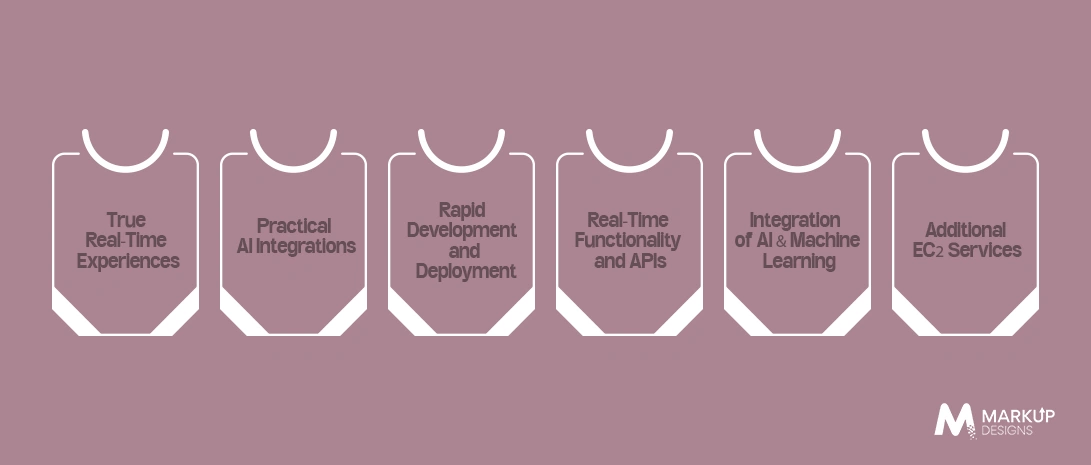
Beyond hosting files and running databases, AWS gives you access to advanced capabilities that would normally require a team of specialists to build from the ground up.
True Real-Time Experiences
If you are building a ride-sharing tracker, a fast-paced chat tool, or a live auction app, static data doesn’t cut it. You need instant synchronization. By using tools like AWS AppSync, developers can establish an open, continuous communication channel between the user’s phone and the cloud. This means updates reach your users the very millisecond they occur on the backend.
Practical AI Integrations
Adding artificial intelligence to your app no longer requires a degree in data science. AWS provides ready-to-use machine learning models that plug straight into your software. You can offer hyper-personalized content feeds based on how a user scrolls, deploy conversational customer support chatbots that understand multiple languages, or use predictive tools to spot fraud before a transaction even clears.
Rapid Development, DevOps, and Continuous Deployment
Modern mobile app development depends heavily on fast iteration cycles. AWS enables development teams to accelerate product releases through integrated DevOps and automation tools that reduce manual deployment risks.
Services like AWS CodePipeline and CodeBuild help automate testing, integration, and deployment workflows, ensuring that new app features move from development to production faster and with fewer errors. Instead of manually configuring servers after every update, teams can automate infrastructure provisioning using Infrastructure as Code tools such as AWS CloudFormation.
AWS CloudWatch further strengthens operational stability by monitoring backend performance, tracking application health, identifying unusual spikes in resource usage, and sending real-time alerts when issues arise. This proactive monitoring approach allows businesses to fix problems before they impact end users.
By automating deployments, monitoring systems, and backend configurations, companies can release updates more frequently while maintaining reliability and reducing operational overhead.
Real-Time Functionality and APIs
Mobile applications have become increasingly dependent on real-time capabilities because they offer a better user experience. The various services offered by AWS make it possible for developers to enable real-time functionality such as push notification, live chat, delivery tracking, activity synchronizing, analytics, and instant content updating. AWS AppSync and API Gateway facilitate constant connectivity between the mobile applications and the cloud infrastructure.
Integration of AI & Machine Learning
Businesses can integrate sophisticated AI and machine learning features into their mobile applications without having to invest in building an elaborate infrastructure through AWS. Businesses can utilize AWS’s AI products to incorporate personalized content feeds, recommenders, AI chatbots, fraud detection features, voice recognition, and predictive analytics into mobile apps.
Additional EC2 Services
One service offered by AWS that is integral to mobile app infrastructure is Amazon EC2. This product offers virtual computing instances and scalable server space to host back-end applications and enterprise workloads. Businesses can scale their computing power as per the needs of the application.
The Essential AWS Toolbelt for Mobile App Development
While the AWS ecosystem includes hundreds of separate features, a standard mobile development team relies heavily on a core set of services.
In AWS Amplify, you have the opportunity to develop the entire back-end system through frontend development without worrying about configuring any servers. AWS Lambda is responsible for executing your code serverlessly and performing the work based on the trigger created by an end-user.
Amazon Cognito is used to guarantee security for you by taking care of users’ registration and login, including Apple, Google, and Facebook sign-ins. Meanwhile, Amazon API Gateway is the entrance that ensures the safe transfer of data from the mobile device to the cloud. To store media uploads, Amazon S3 is utilized, while Amazon DynamoDB will provide quick searches of the user profile.
To strengthen operational visibility and infrastructure security, development teams also rely on AWS CloudWatch for real-time monitoring and application analytics. CloudWatch helps track backend performance, server activity, API usage, and system health metrics while automatically generating alerts during unusual traffic spikes or failures.
AWS Identity and Access Management (IAM) plays a critical role in controlling backend security permissions by ensuring that only authorized users and systems can access sensitive cloud resources.
For mobile apps that depend on notifications and real-time engagement, Amazon SNS (Simple Notification Service) enables businesses to deliver push notifications, alerts, and user communication efficiently across devices.
Additionally, Route 53 helps manage domain routing and traffic distribution, ensuring that users connect to the nearest and most responsive backend infrastructure available.
AWS vs Traditional Hosting for Mobile Apps
| Comparison Factor | AWS Cloud Infrastructure | Traditional Hosting |
| Infrastructure Model | Cloud-based virtual infrastructure with on-demand resource allocation | Physical or fixed server-based infrastructure |
| Scalability | Automatically scales resources based on live traffic demands | Requires manual server upgrades and capacity planning |
| Cost Structure | Pay-as-you-go pricing based on actual usage | Fixed upfront costs regardless of server utilization |
| Initial Investment | Minimal upfront investment with flexible scaling | High upfront spending on hardware and infrastructure |
| Traffic Handling | Handles sudden traffic spikes dynamically through auto scaling | Performance can crash if traffic exceeds server limits |
| Maintenance | AWS manages physical infrastructure, hardware, and availability | Businesses must manage server maintenance and upgrades |
| Deployment Speed | Rapid deployment with automated cloud provisioning | Slower deployment due to hardware setup and configuration |
| Global Performance | Uses global edge networks and CloudFront for low latency | Limited global reach unless multiple servers are deployed manually |
| Reliability & Uptime | High availability with multi-region redundancy and failover systems | Higher downtime risks if hardware or local servers fail |
| Security Features | Built-in encryption, IAM controls, compliance certifications, and monitoring tools | Security depends heavily on internal server management |
| Backup & Disaster Recovery | Automated backups and disaster recovery capabilities | Requires separate backup infrastructure and manual planning |
| DevOps & Automation | Extensive automation tools for CI/CD, monitoring, and infrastructure management | Limited automation unless configured independently |
| Resource Optimization | Resources scale up or down automatically to reduce wastage | Idle server resources still generate ongoing costs |
| Real-Time Monitoring | Advanced monitoring through CloudWatch and automated alerts | Requires third-party tools or manual monitoring setups |
| Flexibility | Supports serverless, containers, AI integration, APIs, and hybrid architectures | More rigid infrastructure with limited expansion flexibility |
| Long-Term Scalability | Designed for startups to enterprise-scale ecosystems | Scaling becomes expensive and operationally complex over time |
AWS vs Firebase for Mobile App Development
| Comparison Factor | AWS | Firebase |
| Best Use Case | Ideal for scalable, long-term mobile applications with evolving infrastructure needs | Best suited for MVPs, prototypes, and lightweight applications |
| Setup Speed | AWS Amplify enables rapid backend setup while allowing future expansion | Extremely fast setup for authentication, databases, and real-time syncing |
| Scalability | Highly scalable for enterprise-grade workloads and growing user bases | Works well initially but can become restrictive as complexity increases |
| Infrastructure Flexibility | Supports custom architectures, containers, networking, and hybrid cloud environments | Limited flexibility due to platform-centric architecture |
| Backend Customization | Extensive backend control with customizable infrastructure and services | Easier to manage initially but limited for advanced backend customization |
| Advanced Querying | Supports powerful database architectures and advanced querying capabilities | Advanced querying can become difficult and restrictive at scale |
| Vendor Lock-In | Lower risk due to broader cloud ecosystem and migration flexibility | Higher lock-in risk because deeply integrated Firebase systems are harder to migrate |
| Cost Structure | Granular pricing with optimization tools and reserved capacity planning | Appears affordable initially but costs can increase unpredictably with usage spikes |
| Security & Compliance | Strong enterprise-grade security, IAM controls, compliance certifications, and customizable protocols | Provides standard security features but less enterprise-level infrastructure flexibility |
| Real-Time Functionality | Supports real-time APIs, synchronization, and scalable event-driven architectures | Excellent built-in real-time syncing for lightweight applications |
| Enterprise Readiness | Well-suited for complex enterprise ecosystems and legacy integrations | Better aligned with smaller-scale or startup-focused applications |
| DevOps & Monitoring | Extensive DevOps ecosystem including CloudWatch, CodePipeline, and automation tools | Simpler management but fewer advanced operational controls |
| Future Expansion | Easy expansion into AI, machine learning, edge computing, and advanced cloud services | Scaling into highly customized enterprise systems can become challenging |
| Long-Term Engineering Freedom | Allows gradual evolution without rebuilding backend infrastructure | Complex applications may eventually require major architectural migration |
Industry Use Cases of AWS Mobile App Development
FinTech Applications
Financial technology applications require real-time processing, high-level encryption, fraud prevention systems, and strict regulatory compliance. AWS enables fintech businesses to build secure mobile ecosystems capable of handling digital payments, transaction processing, account authentication, and AI-driven fraud detection at scale.
With services such as Amazon Cognito, Lambda, DynamoDB, and machine learning integrations, fintech software can securely manage sensitive financial information while maintaining low latency and high transaction reliability. AWS also supports compliance-ready infrastructure aligned with standards such as PCI-DSS, which is critical for financial platforms.
Healthcare Applications
Healthcare mobile applications handle highly sensitive patient data, appointment systems, telemedicine platforms, medical records, and remote patient monitoring services. AWS provides secure and scalable cloud infrastructure that helps healthcare organizations maintain data privacy while supporting real-time accessibility across devices.
By leveraging AWS cloud services, healthcare providers can enable encrypted patient communication, AI-assisted diagnostics, cloud-based medical record management, and secure video consultations. AWS also supports HIPAA-compliant infrastructure, making it suitable for healthcare environments requiring strict regulatory compliance.
Logistics and Transportation Applications
Logistics and transportation platforms depend heavily on real-time tracking, route optimization, live delivery updates, fleet monitoring, and operational analytics. AWS helps logistics companies process massive amounts of live location and operational data with minimal latency.
Using services like AWS AppSync, API Gateway, and CloudFront, businesses can provide real-time shipment visibility, predictive delivery estimations, automated inventory synchronization, and scalable fleet management systems. AWS infrastructure also enables businesses to handle seasonal delivery spikes without disrupting operational performance.
eCommerce Applications
eCommerce applications experience highly unpredictable traffic patterns during seasonal sales, flash promotions, and festive campaigns. AWS allows online retailers to automatically scale infrastructure during peak shopping periods while maintaining fast page loading speeds and secure payment processing.
AWS also enables personalized product recommendations, AI-powered customer support, inventory synchronization, and real-time analytics through its machine learning and cloud automation ecosystem. Services like CloudFront and DynamoDB help improve user experience by reducing latency and accelerating content delivery globally.
Travel and Hospitality Applications
Travel applications require real-time booking systems, location-based services, payment gateways, dynamic pricing systems, and multilingual customer support. AWS helps travel businesses build highly responsive mobile applications capable of handling fluctuating booking demand and global user traffic.
Through AWS cloud infrastructure, travel platforms can provide instant booking confirmations, live itinerary updates, AI-driven travel recommendations, and scalable customer engagement systems. AWS also supports global content delivery and low-latency performance, which is essential for serving international travelers across different geographic regions.
Architectural Challenges While Using AWS
The cloud is very powerful, but it is not a cure-all solution that allows for poor planning. Designing applications on AWS means understanding the challenges it presents.
There is simply too much choice, as the sheer number of services makes it easy for even the most unaided group to over-complicate their backend setup.
To avoid this, it is smart to start small with managed services that automate your setup before trying to customize every layer.
Managing your cloud budget is another critical discipline. Because you pay for exactly what you consume, an unoptimized data loop or a runaway piece of code can lead to a surprise bill at the end of the month. You have to establish spending caps and automated alerts on day one so you are notified the moment your resource usage spikes unexpectedly.
Despite the benefits of AWS, it is imperative to have cloud management skills to ensure operational efficiency. Business organizations will face problems related to architectural complexity, billing issues, cloud optimization, and DevOps implementation. Without proper monitoring and infrastructure planning, companies might incur higher cloud resource usage costs. The adoption of proper cost monitoring measures, alerts, and optimized cloud architecture is vital.
Strategic Engineering Habits for the Cloud

To get the most out of your AWS investment, your development team should embrace a few core architectural habits.
- First, default to a serverless architecture. Using tools like Lambda and DynamoDB keeps your ongoing overhead directly tied to your real-world usage and removes the time sink of server maintenance.
- Second, make caching a priority. Do not strain your core database by making it fetch the exact same files thousands of times. Use content networks to keep common images and API answers close to your users.
- There are a number of measures that companies must put in place in order to enhance the effectiveness of AWS. These include implementing serverless architectures, implementing security optimization techniques, developing automation for CI/CD pipelines, and adopting proactive monitoring systems. Adopting cache mechanisms through solutions such as CloudFront can be very beneficial in improving the speed of applications and reducing the workload of databases.
- Finally, automate your release cycle. Setting up a clean deployment pipeline means updates and bug fixes go from a developer’s laptop to the app stores safely and traceably, eliminating human errors during stressful launch windows.
Future of AWS in Mobile Application Development
In the coming years, the use of artificial intelligence-driven automation, edge computing, cloud-native application development, 5G technology, and real-time data processing in AWS mobile application development services is going to become increasingly popular. With the rise in the need for more responsive mobile apps, AWS’s edge computing capabilities and cloud services would further make it possible to develop highly responsive applications. Additionally, the trend of using artificial intelligence-driven solutions, real-time systems, and predictive analytics would also grow among businesses using AWS for application development.
Turning Complex Infrastructure into a Strategic Edge with Markup Designs
Choosing to build your mobile application on AWS is an excellent long-term business decision, but executing it flawlessly requires genuine engineering experience. A single misconfigured security setting can leave user records exposed, and a messy data setup can quickly drain your development budget.
That is where Markup Designs comes into play.
Markup Designs can assist companies in developing AWS-powered mobile apps that are ready to face the future. We have considerable experience in developing cloud-native mobile applications, designing secure backend architecture, building artificial intelligence applications, and creating highly-scalable mobile application ecosystems. Given our expertise in working with businesses operating in the GCC, we have been helping organizations optimize their cloud infrastructures.
Ready to Scale Safely on AWS?
Don’t let a sudden traffic spike crash your mobile launch. Our certified cloud experts handle the complex backend architecture, serverless optimization, and bulletproof security for you. Let’s transform your app idea into a secure, flawless digital reality.

A Final Thought
If you analyze what distinguishes those mobile applications that make their way through millions of users from those that simply disappear, you will find out that successful operation is not determined by marketing or eye-catching visual elements. In fact, it is based on fundamental stability.
Surely, almost every backend performs perfectly if it works with no more than five people who use it. However, it is worth mentioning that it does not matter how well your software performs until hundreds or even thousands of new clients join your application at the same time during the holidays. In such circumstances, if your technical platform cannot operate normally, all expenses related to user acquisition become useless.
What actually makes AWS superior to any other solution is its flexibility. By converting the rigid hardware into flexible, easily customizable source code, cloud computing allows trying something new at no cost, as well as constantly changing and improving the product. Thus, if some element of your service does not appeal to your audience, it may be deleted without further financial expenses. Moreover, you grow together with your audience.
FAQ
1. Why is AWS a better solution than classic server hosting for mobile apps?
The main difference between these two options is Fthat hosting forces you to invest in infrastructure proportional to maximum estimated traffic; in contrast, AWS uses a consumption-based model where your infrastructure automatically scales according to actual usage, which allows you to save costs on idle infrastructure during off-hours.
2. Is AWS a good solution for an MVP at an early stage?
Absolutely, AWS can help you keep your initial investments low by utilizing services such as AWS Amplify, combined with staying within AWS free tier. Using this strategy, you will be able to develop and deploy a fully operational app infrastructure without spending money on the physical infrastructure upfront.
3. Does AWS provide sufficient measures to ensure mobile app data security?
Indeed, AWS is responsible for the safety of physical equipment and data centers. However, it offers additional means to protect your software layer, including network traffic encryption, access control through IAM services, and configuration aligned with worldwide regulations like GDPR and HIPAA.
4. Can an application initially developed on Firebase be migrated to AWS seamlessly?
Yes, technically, it is possible to move it to AWS. However, as these platforms
If you anticipate your app growing into a complex enterprise product, starting on AWS via Amplify is often more practical than planning a major migration down the line.
5. Which AWS services are best for mobile apps?
Some of the most commonly used AWS services for mobile app development include AWS Amplify for backend management, AWS Lambda for serverless computing, Amazon Cognito for user authentication, API Gateway for secure API communication, Amazon S3 for file storage, DynamoDB for scalable databases, EC2 for virtual server hosting, and CloudFront for faster global content delivery.
6. How much does AWS cost for a mobile application?
AWS pricing depends entirely on application usage, backend complexity, storage requirements, and traffic volume. Early-stage MVPs can often operate within AWS Free Tier limits, while larger applications typically scale costs based on active users, API requests, storage consumption, and computing resources utilized.
7. Is AWS suitable for gaming and social networking applications?
Yes. AWS is widely used for gaming platforms, social media apps, messaging systems, and streaming applications because it supports real-time synchronization, scalable infrastructure, low-latency delivery, and high-volume traffic management.
8. How long does migrating a mobile application to AWS take?
Migration timelines vary depending on application complexity, existing infrastructure, database size, and integration requirements. Small applications may migrate within a few weeks, while enterprise-grade systems with legacy architecture can require several months of planning, testing, and deployment optimization.
Author's Perspective
The true success of an application does not lie in fancy features but rather resilience. While almost any backend can work for five testers, the true test comes when you suddenly have thousands of live people logging into your website due to some viral activity online. If your servers cannot stand such a load, all your advertising budget and good name are wasted.
The real power of Amazon Web Services lies in its ability to transform the rigidity of hardware to programming software. This lets you freely experiment and scale up when something succeeds, while at the same time tearing down a failed idea and not paying for it.
Discuss Your Project NowJupinder Singh Arora
Founder and CEO
Related Posts

Cost to Build a Mobile App in Qatar...

How Much Does It Cost to Build an...

How to Build a Car Wash App: Development...
Insights Are Valuable & Execution is Priceless
You’ve read about the digital future. Now, let’s build the infrastructure to take you there. Move your strategy from the page to the product.
Design Your Solution Now
Contact Us
Schedule The Appointment At Your Convenience Date And Time.
30 Min
Web Conference
Time Zone
Indian standard time (08:30pm)

Thanks For Getting In Touch!
You’ve Taken The First Step Toward Transforming Your Digital Presence. Our Experts Will Reach Out Shortly To Take It Forward.
Launch Your Dream Project
Provide a brief overview of your project, and our specialists will evaluate your requirements. We will connect with you to explore how the right digital solutions can help you launch faster.