
Fitness Apps are Taking Over-Here’s How to Build One That Wins
Today, where “good looks” and overall well-being are highly valued, many people strive to stay fit and healthy. While some start gym routines or try strict diets, consistency often becomes a challenge. The idea of a “quick fix” for fitness may seem unrealistic, but mobile app development companies have made it easier to stay on track by offering guidance, structure, and motivation.
With the growing presence of mobile apps across industries like gaming, entertainment, education, banking, and finance, health and fitness apps have also seen a significant rise. These apps are becoming increasingly popular as more users turn to digital solutions to manage their fitness goals, track progress, and maintain a healthier lifestyle.
What is Health & Fitness App Development?
The development of health and fitness apps is the process of creating mobile apps that assist users in reaching their health and wellness goals. This type of app integrates technology, health knowledge, and innovative designs to make health and fitness activities accessible anywhere and anytime.
Why are Health & Fitness Apps So Popular?
The demand for fitness apps is increasing in the health and wellness industries due to various reasons. People look for convenient and personalized experiences. With these apps, users can:
- Have access to personalized fitness plans at all times
- Follow video instructions to maintain proper body alignment
- Monitor progress through in-depth statistics
- Connect fitness apps to wearables such as Apple Watch or Fitbit
- Stay engaged and motivated through reminders and competitions
- All these features contribute to user engagement.
About Health & Fitness App Benefits
Here are some of the most important benefits of using health and fitness mobile apps:
- Easily keep track of your progress:
Of course, you have set the goals. However, you must keep an eye on the day to day results so as to check if it is working for you or not. These apps help you keep track of your progress. It helps you know whether you are going in the right direction or not. If there is progress, then you can continue with your plans, you should change your plans.
- Get free workout ideas:
These mobile apps also have blogs and articles that provide you with some of the best and most effective workout ideas, which help you achieve your targets.
- Set goals you can achieve:
When you begin exercising, you must set realistic goals. You must set targets as to how much weight you want to lose in how much time. So, you can use mobile applications for health and fitness to set realistic goals and achieve them.
- Carry your own yoga studio:
We are all aware of the fact that yoga is one of the best exercises to achieve fitness in terms of strength and flexibility. Most of these exercises are beyond their budget and time. But now you don’t need to worry because your yoga class is in your pocket. These apps are providing you with yoga guidelines and videos of all yoga poses.
- Monitor your diet every day:
Every individual who is eager to maintain fitness needs to follow a particular diet plan. With healthcare app development services, health and fitness apps enable users to track calories and analyze nutrient intake according to their eating habits.
What Features Make a Fitness App Successful?
The most effective apps include features that boost both usability and engagement, such as:
- Personalized Exercise Plans: The fitness apps develop personalized exercise plans for users based on their fitness goals and preferences. These plans are constantly updated based on the user’s progress and performance to ensure that they are effective and goal-oriented.
- Progress Tracking Dashboards: Users can track their fitness progress through advanced dashboards in fitness apps developed using modern mobile application development technologies. The dashboards display the user’s fitness progress in terms of workouts done, calories burned, and fitness goals achieved. The user can also keep track of their fitness progress using charts and graphs.
- Instructional Video Libraries: The fitness apps have a huge library of instructional videos that can be accessed by the user. The videos have instructions and tutorials that can be followed by the user in order to effectively perform the exercises and workouts.
- Push Notifications for Consistency: The fitness apps send push notifications to the user in order to make sure that the user is consistent with the workout and exercises.
- Integration with Smart Devices and Wearables: The fitness apps can be integrated with smart devices and wearables in order to track the health and fitness-related activities of the user in real time.
- Gamification & Social Challenges: Fitness apps use gamification techniques such as rewards and badges to encourage users to become physically active. Fitness apps employ social challenges to encourage users to take part in physical activities and ensure they get satisfaction from the experience.
- Workout Tracking: Fitness apps provide users with the ability to log in and track their physical activities such as running, cycling, and gym.
- Nutrition Logging: Users log in and enter food intake on a daily basis to track nutritional levels and hydration levels. Nutrition logging helps users derive an understanding of nutritional patterns and how they align with fitness goals.
- Goal Setting: The apps enable users to set personal goals, for instance, losing weight, gaining muscle mass, and improving their endurance. This helps users to be focused and maintain a fitness routine based on the insights gained from the app.
- Social Sharing: Most fitness apps have social features that enable users to link up with social communities for support and motivation. This feature is helpful in sharing their success with others and competing in a healthy way.
- Data Analytics: The fitness apps offer advanced analytics that allow users to make decisions based on the insights they gain from tracking their workout and nutrition.
Step-by-Step Process to Develop a Fitness App
To develop a fitness app, the following steps are involved:
- Define the target audience and app objectives:
Clearly define who your app is intended for and what it is intended to achieve in terms of fitness issues. - Research your target market and analyze your competitors:
Research your target market to identify your competitors and how you can capitalize on them. - Create an intuitive interface and an interesting user experience:
Create an interface that is simple and interesting enough to engage your target audience.
- Develop the main features and functionalities of your fitness app:
Create the main features of your app as they relate to your objectives. - Add security features to your app:
Add security features to your app to protect your target audience’s information. - Test your app before presenting it to your target audience:
Test your app to avoid any problems that might arise when it is in use by your target audience.
Choosing the Right Platform
Selecting the appropriate platform is a crucial step in mobile application development for a fitness app, as it directly influences its reach, performance, and cost.
Mobile Platforms
For the development of mobile apps, the best choice is to develop native apps.
- iOS App Development: This is the best choice if you are targeting the premium segment of the market, as users of iOS devices are known to have the highest capacity to spend.
- Android App Development: This choice is best if you are looking to penetrate the market of emerging countries, as the user base of Android devices is the largest in the world.
Cross-Platform Development
For faster development and lower costs, cross-platform development is the best choice.
- Flutter: This technology allows developers to create visually appealing apps with the ability to develop apps for both iOS and Android using the same code.
- React Native: This technology also allows developers to create apps for both platforms using the same code.
The best choice for startups looking to validate their idea.
Web-Based Fitness Apps
Web-based apps are the best choice as users don’t have to install the app on their devices, thus providing the highest level of convenience.
Read Also: Build a Winning Fitness App: Features, Monetization & Growth
How much does developing a Fitness App Cost in Various Phases?
Estimating the exact cost of developing a fitness app can be challenging, as it depends on several factors such as app type, features, complexity, and specific client requirements. Additionally, different fitness app development companies charge varying rates, so it’s important to evaluate all aspects before making a decision.
One of the biggest cost factors is the app’s features and functionalities. A basic fitness app typically costs between $15,000 and $20,000, while more advanced features will increase the overall budget.
The platform also plays a key role. Developing for a single platform like iOS or Android may cost around $8,000 to $12,000, whereas building for multiple platforms can raise costs to $15,000 to $20,000 due to additional efforts.
Hiring fitness app developers and their expertise further impacts pricing, with hourly rates ranging from $50 to $150 depending on experience.
Backend infrastructure and database setup also add to the cost. Using scalable solutions like cloud services may require an initial investment of $5,000 to $10,000, along with annual maintenance costs of 15–20% of the development budget.
Lastly, app testing can cost between $5,000 and $8,000, ensuring smooth performance and a reliable user experience.
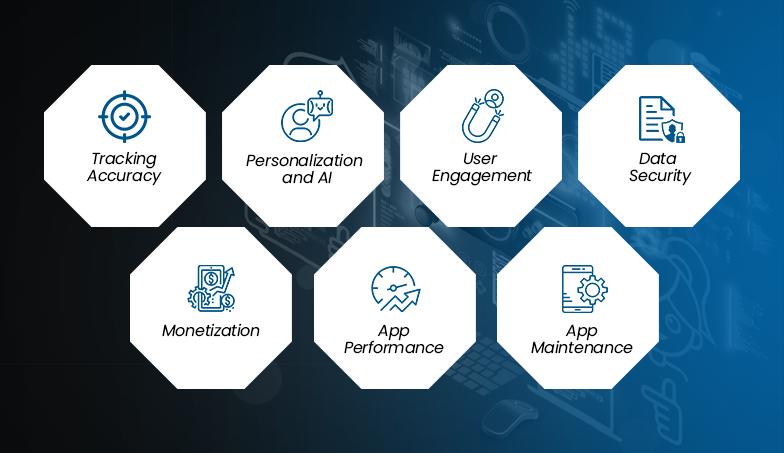
Challenges in Fitness App Development
Tracking Accuracy
Tracking accuracy is vital for building trust among users. Fitness applications use different sensors and GPS to track steps, calories, and heart rate. However, different data sources may have different information that can affect the accuracy of fitness applications. Fitness application developers should focus on calibrating and synchronizing fitness applications to ensure accuracy.
Personalization and AI
Fitness application users want to be provided with personal fitness plans based on their fitness goals. Developing successful AI models requires large amounts of data and learning. However, keeping user information relevant and confidential is a big challenge for fitness app developers. Failure to deliver personalization may result in user disengagement.
User Engagement
Engaging users is another challenge that is tricky to handle. For example, they might lose interest in fitness apps after using them for some time. In order to engage the users of such apps for extended periods of time, various features such as gamification can be included in the application.
Data Security
Since fitness apps involve dealing with sensitive information, it is important to consider data security. For example, it is important to consider whether there is encryption in place and whether API requests are secure. Data breaches can be detrimental to any application.
Monetization
Selecting an appropriate monetization strategy is another challenge that is tricky to handle. For instance, developers can use models such as subscription fees, in-app purchases, and advertising. The challenge is to ensure that monetization is effective without compromising the application experience. For instance, flooding users with too many advertisements can be detrimental to any application.
App Performance
An application that is slow to respond or has many errors can become very frustrating to use. Fitness applications often have to process real-time data and can be used with many different devices. This can be very demanding on the application’s performance.
App Maintenance
Launching an application is just the beginning; maintaining it is a continuous responsibility for any mobile app development company. Fitness applications must be kept up to date to ensure that they remain relevant. The application must be kept up to date to ensure that it is still compatible with new devices and new versions of operating systems.
Role of AI in Fitness App Development
Artificial Intelligence is changing the face of the wellness app development industry from basic tracking apps to highly advanced and personalized health assistants. The days of fitness apps providing general workout plans to their users are gone, thanks to the power of Artificial Intelligence.
The biggest advantage of Artificial Intelligence is its power of personalization. It analyzes the user data and provides a highly personalized fitness plan to the user based on their fitness level and workout patterns. This keeps the user highly motivated and helps them achieve better fitness results.
The second biggest advantage of Artificial Intelligence is its power of prediction. It analyzes the patterns of the users and predicts that the user might miss a workout. It sends reminders to the users to keep them active and engaged.
Artificial Intelligence is also being used to plan the nutrition of the users. It provides highly personalized nutrition plans to users based on their diet and fitness goals. This provides a highly integrated fitness experience to the users.
In short, Artificial Intelligence is not only making fitness apps more efficient and effective for the users but also providing them with a highly interactive and efficient fitness experience.
Conclusion
It’s not only about technology to create a fitness application, but it is equally about making something that people want to use every day. When you focus on people and create something smart and easy to use, then you are on the right path. Start simple and keep improving and innovating.
FAQs
- How long does it take to build a Fitness app?
The time required to develop a fitness app ranges between 3 to 9 months. However, it is important to understand that simple apps take less time to develop compared to complex apps that incorporate AI capabilities.
- What is the process of building a Fitness app?
The process of custom fitness app development involves goal setting, market research, UI/UX designing, feature development, security implementation, testing, and launching. However, it is important to understand that updating is essential in order to achieve success in the industry.
- What is the cost of Fitness app development?
The cost of fitness app development can range from as little as $10,000 to as much as $150,000 or even more. The cost of developing an app is directly proportional to the complexity of the app’s features, design, and the technology used in developing the app.
- Which tech is best for Fitness apps?
Some of the best technologies used for developing fitness apps include Flutter and React Native for cross-platform development, Swift for iOS development, Kotlin for Android development, and cloud computing technologies such as AWS and Firebase.
- Can startups build Fitness app platforms?
Yes, Startups can develop Fitness Apps through MVPs with basic features and with the aid of cost-effective cross-platform development tools. Scaling up can also be done gradually.
Author's Perspective
From my experience working with B2B organizations, one pattern is clear—businesses that invest early in scalable IT infrastructure grow faster and face fewer operational challenges. Remote managed IT services are not just a cost-saving measure; they are a strategic move. They allow businesses to focus on what truly matters—growth, innovation, and customer experience.
Companies that try to manage everything internally often struggle with delays, inefficiencies, and security gaps. On the other hand, those who partner with the right IT provider gain speed, flexibility, and confidence to scale without hesitation.
Gaurav Goyal
Global Sales- VP
Related Posts

Fitness & Wellness App Development: Key Features, Business...
Insights Are Valuable & Execution is Priceless
You’ve read about the digital future. Now, let’s build the infrastructure to take you there. Move your strategy from the page to the product.
Design Your Solution Now
Contact Us
Schedule The Appointment At Your Convenience Date And Time.
30 Min
Web Conference
Time Zone
Indian standard time (08:30pm)

Thanks For Getting In Touch!
You’ve Taken The First Step Toward Transforming Your Digital Presence. Our Experts Will Reach Out Shortly To Take It Forward.
Launch Your Dream Project
Provide a brief overview of your project, and our specialists will evaluate your requirements. We will connect with you to explore how the right digital solutions can help you launch faster.