

In Brief
- Responsible AI solutions allow Australian businesses to guarantee that their AI solutions are ethical, transparent, safe, and accountable.
- Australian approach to governing artificial intelligence implies the development and implementation of voluntary AI Ethics Principles along with current privacy, consumer protection, and sector-specific laws.
- Companies require the development of structured AI governance frameworks in order to identify risks, organize data management, and ensure human supervision.
- Monitoring, bias testing, and audit procedures assist organizations in keeping their AI applications functional and compliant with rules and laws.
- Collaboration of company executives, tech staff, legal consultants, and AI specialists is essential for responsible AI application.
AI solutions are being used more and more often by businesses in Australia in such areas as customer service, financial analytics, healthcare, and process automation. The increase in the usage of AI applications raises issues related to data privacy, potential biases, transparency of algorithms, and accountability of companies. Lack of governance of AI systems leads to operational, legal, and reputational risks for companies and consumers.
The implementation of responsible AI requires not only following ethical standards or using safe algorithms. This involves establishing clear accountability, evaluating AI-related risks, protecting sensitive information, and maintaining human oversight throughout the AI lifecycle. In this guide, we explore the essential steps business leaders can take to implement responsible AI in Australia while supporting innovation and long-term business growth.
What Does Responsible AI Implementation Mean for Australian Businesses?
Responsible AI adoption includes creating, using, and controlling AI systems in such a way that they give preference to such aspects as fairness, transparency, privacy, security, and accountability. For Australia-based companies, this would mean that AI-driven decisions comply with ethics, regulations, and business practices and are monitored to see their impact on customers, employees, and operations.
Understanding the Core Principles of Responsible AI
Responsible AI is built on the principles that ensure the fair, secure, and transparent use of AI systems. Such principles include automated decision-making based on fairness, accountability of artificial intelligence usage, personal information protection, system reliability, and appropriate human oversight.
Why Responsible AI Matters for Australian Enterprises
With the increase in the number of applications of AI in such areas of enterprise operations as customer service, healthcare, finance, and operational processes, responsible adoption becomes vital. It will help businesses develop customer trust, make better decisions, lower risks, and achieve sustainable adoption of AI while keeping compliance with relevant regulations.
Key Business Risks of Unregulated AI Adoption
AI adoption without proper governance may lead to such issues as algorithmic biases, privacy problems, security issues, and incorrect decisions. Unclear accountability can further complicate issue resolution, while non-compliance with applicable regulations may lead to financial penalties and reputational damage.
What Australian AI Regulations and Governance Standards Should Businesses Follow?
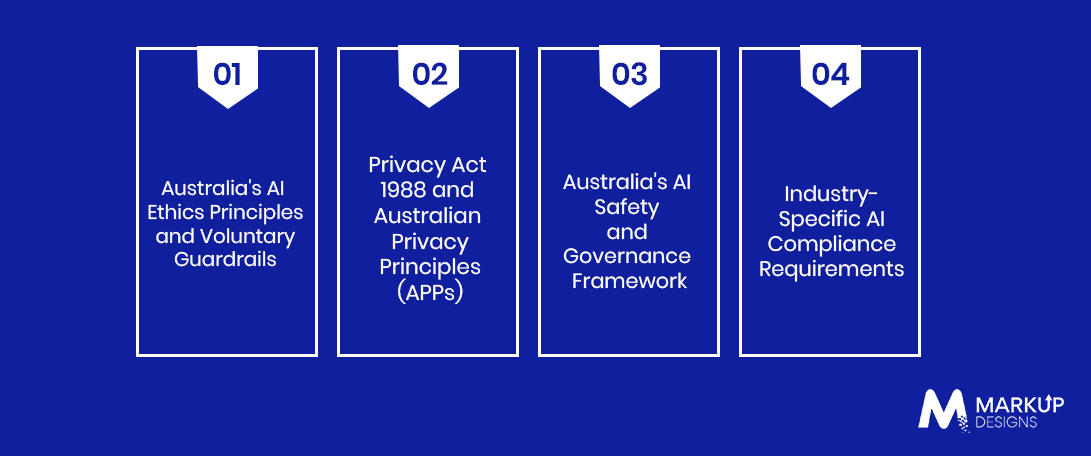
AI governance in Australia uses a combination of voluntary ethical guidelines and existing laws and regulations. Businesses need to be aware of the implications of these frameworks for their specific application of AI technologies, especially where personal information is processed, or important decisions affecting individuals are made.
Australia’s AI Ethics Principles and Voluntary Guardrails
AI Ethics Principles in Australia provide voluntary guidance for the responsible development and deployment of AI. The AI Ethics Principles address the following eight areas: human wellbeing, human-centred values, fairness, privacy and security, reliability and safety, transparency and explainability, contestability, and accountability. Businesses can make use of these principles to develop an internal policy regarding AI and to evaluate potential risks.
Privacy Act 1988 and Australian Privacy Principles (APPs)
The Privacy Act 1988 regulates the process of collecting, handling, storing, and disclosing personal information by certain Australian organisations under 13 Australian Privacy Principles (APPs). When using AI technologies, businesses should pay attention to such APPs as APP 3 regarding the collection of information, APP 5 regarding collection notifications, APP 6 regarding the use and disclosure of information, and APP 11 regarding information security.
Australia’s AI Safety and Governance Framework
Australian AI safety strategy will require the identification and management of the risks associated with the development and deployment of AI technologies. Organizations will need to conduct risk assessments, document their systems, ensure proper human oversight and monitor AI system performance. Additionally, organizations will have to take into consideration the differences between the existing legal obligations, guidelines and the proposed regulatory measures while formulating their compliance strategies.
Industry-Specific AI Compliance Requirements
AI compliance requirements will differ based on the industry, type of information that is being processed, and the decisions being made by an organization’s AI technology.
Healthcare
AI implementation within healthcare organizations should consider the privacy obligations, state and territory health records laws and clinical safety considerations.
Financial Services
AI implementation within financial services should include assessment of ASIC regulations, APRA prudential standards, privacy obligations and responsible lending provisions.
Education
AI implementation within education sector will require the protection of students’ data, privacy obligations and transparency of automated decision-making.
Retail and E-commerce
When implementing AI within retail businesses should consider the Australian Consumer Law and privacy requirements.
Government
Government organisations must account for public-sector privacy, cybersecurity, procurement, and AI governance requirements when introducing automated systems into public services.
How to Implement Responsible AI in Australia: 7 Essential Steps
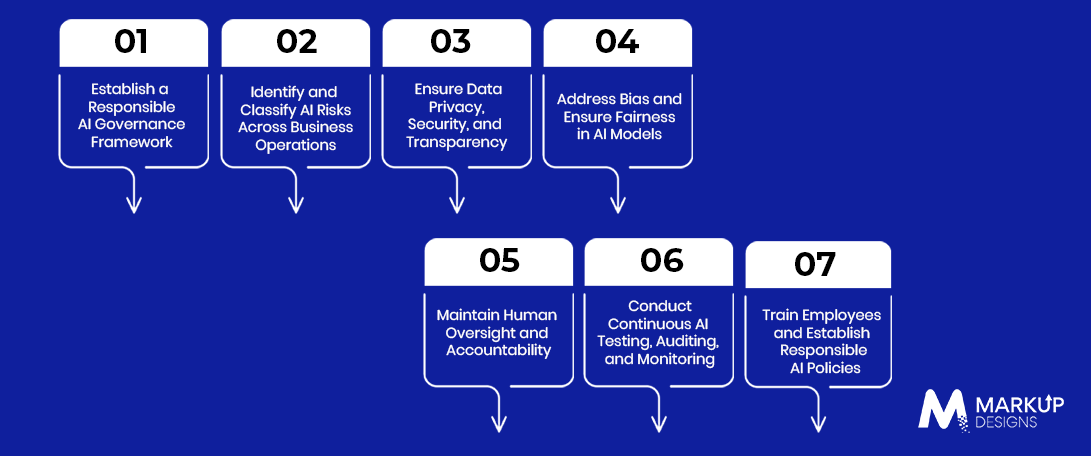
The deployment of responsible AI involves the implementation of business policies as well as technological controls and continuous monitoring. The following process provides a practical means of managing risks and driving business innovation using AI.
Step 1. Establish a Responsible AI Governance Framework
Businesses should first develop clear policies for the development, implementation, and management of AI technologies. Responsibilities should be assigned to technology, legal, compliance, and business personnel in order to create accountability and oversee AI projects.
Step 2. Identify and Classify AI Risks Across Business Operations
AI technologies can be classified according to risks associated with data sensitivity, possible harm, and their impact on business decision-making. Such classification will help to prioritize risk assessment and mitigation activities and implement necessary security controls.
Step 3. Ensure Data Privacy, Security, and Transparency
Data governance practices should be developed concerning data collection, storage, processing, and access. Encryption, access controls, and anonymization should be used in addition to data usage policies to protect data privacy and provide transparency.
Step 4: Address Bias and Ensure Fairness in AI Models
AI technologies might result in unfair treatment of certain groups of users due to biased datasets used in the training of models. Businesses should use representative datasets, conduct regular fairness assessments, and review model outputs across relevant user groups to identify and address potential bias.
Step 5: Maintain Human Oversight and Accountability
Make it possible for employees to assess, dispute, or even override decisions made by the AI system, especially in high-stakes areas like recruitment, health care, and banking. Clearly defining decision-making authority will help avoid over-reliance on the automatic outcome.
Step 6: Conduct Continuous AI Testing, Auditing, and Monitoring
Test and monitor the AI system for accuracy, biases, data drift, security weaknesses, and anomalies. Frequent audits and documented procedures for handling incidents allow businesses to identify performance problems and put remedial measures into place throughout the AI lifecycle.
Step 7: Train Employees and Establish Responsible AI Policies
Train employees on AI ethics, data privacy, cybersecurity, and responsible use of AI technology. Create responsible AI policies that outline the use of the tools in the organization, information sharing, and human oversight.
What Are the Key Challenges of Implementing Responsible AI in Australia?
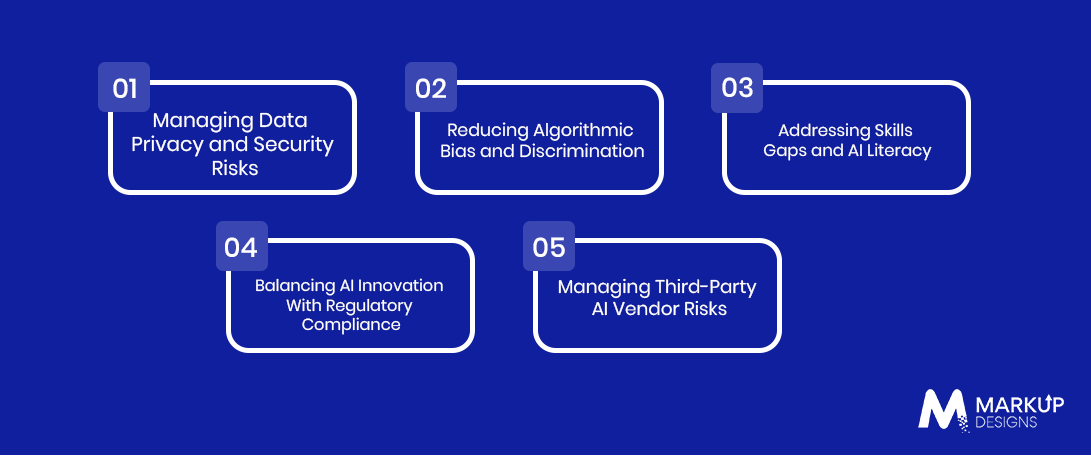
Despite numerous advantages of responsible AI, the integration of such technology in companies poses certain technical, operational, and regulatory challenges. Such challenges should be addressed by companies while sustaining their innovation, efficiency, and customer trust.
Managing Data Privacy and Security Risks
AI-based technologies are responsible for processing significant amounts of company and customer information, which puts data at risk of being exposed and accessed by unauthorized users. Effective data governance, encryption, access controls, and third-party security evaluations will enable organizations to protect data and adhere to privacy requirements.
Reducing Algorithmic Bias and Discrimination
Bias and incompleteness in AI training datasets lead to discrimination through AI-generated results. Companies need to have representative datasets, regularly run bias testing, and conduct human evaluations to spot biases.
Addressing Skills Gaps and AI Literacy
Responsible AI needs knowledge of machine learning, cybersecurity, data governance, and regulations. Employees’ training, recruiting specialists, and cooperation with technological partners may help companies gain the necessary skills to work with AI systems.
Balancing AI Innovation With Regulatory Compliance
Rapid adoption of AI technologies in companies is often associated with compliance and operational problems. Integrating governance checks into the AI development lifecycle allows businesses to manage potential risks while maintaining a practical pace of innovation.
Managing Third-Party AI Vendor Risks
There may be data privacy, security, and transparency concerns associated with third-party AI platforms. The businesses should evaluate security policies, data handling procedures, contract terms, and response actions of the vendors to the incidents before implementing external AI solutions into their operations.
Which Responsible AI Tools and Technologies Can Support Implementation?
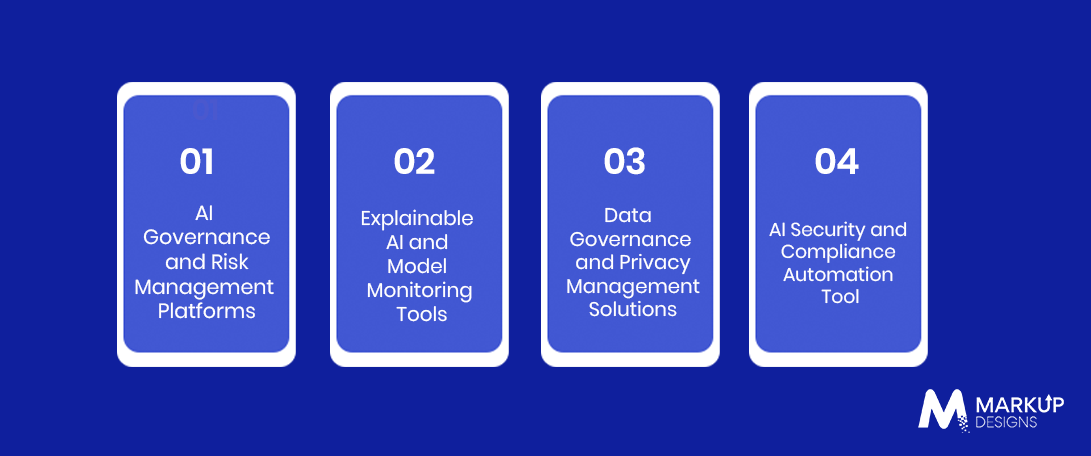
The technology is necessary for managing and measuring responsible AI governance. Businesses can use specific platforms to monitor AI operations, conduct risk assessment, protect confidential information, and maintain oversight of AI operations.
AI Governance and Risk Management Platforms
Such platforms assist organisations in inventory maintenance, risk assessment, workflows, approvals, and documentation of compliance activities. Such platforms allow organisations to maintain AI oversight and keep track of the governance activities of business leaders.
Explainable AI and Model Monitoring Tools
Explainable AI tools allow businesses to interpret machine learning model processes for generating predictions and recommendations. Model monitoring tools allow organisations to track such aspects of models as accuracy, bias, data drift, and other performance aspects after deployment.
Data Governance and Privacy Management Solutions
These solutions support data classification, access management, consent tracking, and information lifecycle controls. They help organisations maintain data quality, monitor information usage, and manage applicable privacy obligations.
AI Security and Compliance Automation Tools
AI security tools protect models, datasets, APIs, and supporting infrastructure against cyber threats and unauthorised access. Compliance automation solutions simplify audit documentation, control monitoring, and evidence collection, strengthening governance across AI operations.
How Can Businesses Measure the Success of Responsible AI Implementation?
Businesses need to use criteria that include compliance, technical performance, accountability, and impact for evaluation of responsible AI systems. The development of metrics enables managers to know how responsible and valuable these systems are for the business.
AI Compliance and Risk Reduction Metrics
Calculate the share of AI applications that are subject to risk assessments, compliance issues, the number of audits conducted, and the duration of resolution of the detected risks. Such metrics will help you evaluate your governance and risk management capabilities.
Model Accuracy, Fairness, and Transparency
Observe the accuracy, fairness, number of false positives, explainability, and changes in performance of models by various users. Such metrics help you detect inconsistencies and find out whether your AI system operates efficiently and fairly.
Human Oversight and Accountability Metrics
Calculate the share of important decisions that are made by humans, the rate of overrides, the number of elevated decisions, and the time required for investigating AI-related incidents. This helps you find out whether there is enough human supervision and accountability in place.
Operational Efficiency and Business Impact
Evaluate improvements in processing time, workflow efficiency, error reduction, customer satisfaction, and operational costs against pre-implementation benchmarks. This helps organisations determine whether responsible AI initiatives are delivering measurable business benefits without compromising governance standards.
How Can Markup Designs Help Australian Businesses Implement Responsible AI?
A proper implementation of responsible AI needs a certain balance of skills, data governance, and security practices. Markup Designs assists Australian companies in building scalable, transparent AI-driven solutions with responsible technology adoption. Whether you need assistance in AI strategy, model development, implementation, or maintenance – we have you covered. Our approach to AI development includes data security, reliable models, performance monitoring, and human oversight.
Build Responsible AI Solutions with Confidence
Implement AI solutions that prioritize transparency, security, fairness, and accountability. Markup Designs helps Australian businesses develop scalable AI solutions with responsible governance and reliable technology.

Conclusion
Responsibility in AI implementation becomes an increasingly relevant issue for Australian companies that seek to scale AI adoption but want to preserve their privacy, fairness, security, and accountability. Proper governance, risk management, human oversight, and constant monitoring can contribute to more trust in automated processes. Proper combination of ethics, technology and compliance will lead to more sustainable AI adoption.
FAQ
1. What are the principles of responsible AI in Australia?
Fairness, transparency, accountability, privacy, security, reliability, human oversight, and contestability are the principles of responsible AI in Australia. AI Ethics Principles of Australia contain voluntary guidance on implementing these principles.
2. Is responsible AI compulsory for companies in Australia?
There is no overarching responsible AI legislation applicable to all businesses in Australia at present. Nevertheless, companies need to abide by the current legislation, including the Privacy Act 1988 if applicable and other consumer and industry-specific rules.
3. How much time do companies require to implement the responsible AI framework?
It depends on factors such as the company’s size, the level of complexity of AI algorithms, current governance procedures, and regulatory requirements. Implementation of a responsible AI framework may take a couple of weeks for a basic version and several months for enterprise-level governance.
4. What are the major difficulties in the responsible AI implementation?
Main issues include privacy management, reduction of algorithmic bias, addressing AI skills gaps, ensuring transparency, mitigation of risks associated with third-party vendors, and balance between innovation and regulation.
5. How do small businesses implement responsible AI in Australia?
Businesses need to develop their AI application policy, use safe and reliable AI technologies, protect their customers’ data, and conduct an assessment of AI outcomes before critical decisions are made.
Author's Perspective
Responsible AI should not be treated as a compliance exercise that businesses address after deploying AI solutions. In my view, governance, data protection, and human accountability must be considered from the initial planning stage. Australian businesses that integrate these practices into their AI development strategies will be better positioned to manage risks, build customer trust, and scale AI adoption sustainably.
Discuss Your Project NowAjit Kumar Jha
VP - Business Operations
Related Posts

AI Strategy Services in Dubai: Helping Enterprises Scale...

How Businesses in Dubai Can Scale AI Integration...

AI Virtual Health Assistants in Healthcare: Use Cases,...
Insights Are Valuable & Execution is Priceless
You’ve read about the digital future. Now, let’s build the infrastructure to take you there. Move your strategy from the page to the product.
Design Your Solution Now
Contact Us
Schedule The Appointment At Your Convenience Date And Time.
30 Min
Web Conference
Time Zone
Indian standard time (08:30pm)

Thanks For Getting In Touch!
You’ve Taken The First Step Toward Transforming Your Digital Presence. Our Experts Will Reach Out Shortly To Take It Forward.
Launch Your Dream Project
Provide a brief overview of your project, and our specialists will evaluate your requirements. We will connect with you to explore how the right digital solutions can help you launch faster.