
In Brief
- The cost of creating DICOM software is dependent on imaging capabilities, system complexity, and integration options.
- Standard products have the primary function of viewing and storing images, whereas advanced products offer AI-based imaging analytics and multi-modality imaging.
- The integration of PACS, RIS, and EHR impacts the product creation process and the total price.
- Technical and implementation-related needs such as security of the data, compliance to DICOM standards, and compliance with healthcare regulations should be considered.
- Proper design and feature planning contribute to the management of the initial and ongoing costs.
Medical imaging is vital to modern healthcare because it allows clinicians to view, analyze, and handle diagnostic imaging from different fields. DICOM (Digital Imaging and Communications in Medicine) represents a standard framework used for storage, transmission, and access to medical images. With the growing adoption of digital imaging solutions by health care providers, the demand for custom DICOM medical imaging software increases.
However, DICOM product development requires more than an image viewer. Businesses need to consider imaging capabilities, PACS integration, patient data management, security, and compliance needs. The total cost of development depends on the complexity of the software, its deployment and customization needs.
What Is the Average Cost to Develop DICOM Medical Imaging Software?
The price of DICOM medical imaging software development is usually between $30,000 and $250,000+, depending on the capabilities of the platform, its complexity and level of integrations required. While a basic solution will involve the minimum price, the enterprise-level software will require higher investments because of all the additional capabilities it has to offer.
Cost of Basic DICOM Medical Imaging Software
Basic DICOM software will cost you somewhere between $30,000 and $60,000. Its main functions are medical image viewing, manipulation, patient management, and DICOM files handling. This software will be suitable for smaller clinics and diagnostic centers that do not require additional complex features.
Cost of Mid-Level DICOM Medical Imaging Software
Mid-level DICOM software will usually cost you somewhere between $60,000 and $120,000. It includes more complex image processing, advanced annotation capabilities, support for multiple modalities, report generation, and integration with PACS or EHR. This software will be useful for larger hospitals and diagnostic networks.
Cost of Advanced Enterprise DICOM Medical Imaging Software
Enterprise-level DICOM software may cost you up to $250,000+. Such platforms support advanced 3D visualization, AI-assisted image analysis, extensive system integrations, cloud infrastructure, and complex security controls. They are designed for large hospitals and healthcare networks with demanding imaging requirements.
These are indicative development estimates, not fixed market rates. Actual costs depend on project scope, location, compliance requirements, and technology choices.
Key Factors Affecting DICOM Software Development Costs
Several technical and operational factors influence the overall development budget:
- DICOM compliance and integration: Supporting DICOM standards and connecting imaging systems adds development and testing effort.
- Image processing complexity: Advanced visualization, reconstruction, and analysis tools require specialized development.
- PACS, RIS, and EHR integration: Connecting existing healthcare systems increases integration and testing requirements.
- Data security and regulatory compliance: Encryption, access controls, audit trails, and applicable healthcare regulations add to implementation costs.
- Cloud infrastructure and storage: Hosting, image storage, data transfer, and backup requirements affect infrastructure expenses.
- Development team expertise: Specialized healthcare software developers and medical imaging engineers influence project costs.
What Features Influence the Cost of DICOM Medical Imaging Software?
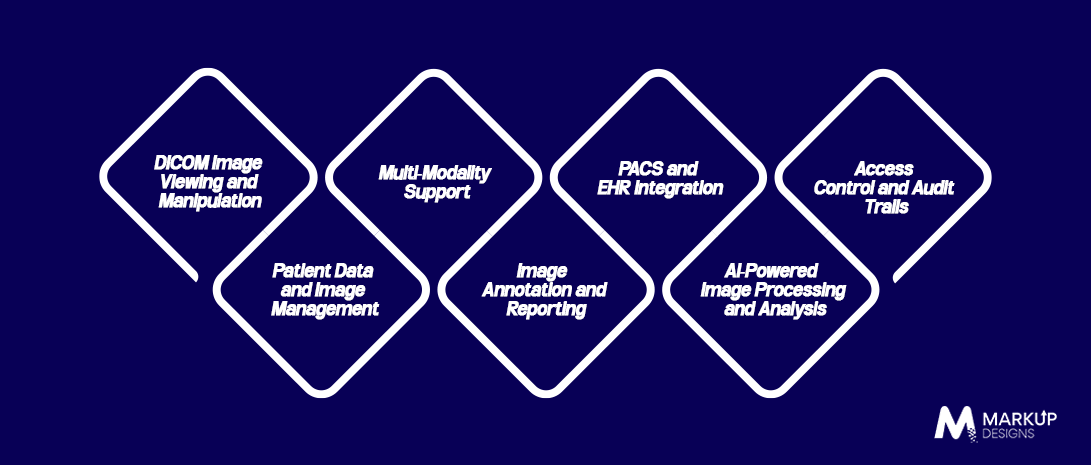
The feature set will impact the development process and software costs in general. Although the basic imaging functionality provides the basis for the development process, advanced functionalities will need extra effort.
DICOM Image Viewing and Manipulation
DICOM viewers allow health care providers to view, manipulate, zoom in, rotate, and adjust medical images. Advanced viewing capabilities, such as the ability to change windows and reconstruct images, will complicate the development process.
Patient Data and Image Management
The management of patient data allows health care organizations to store, search, and retrieve medical records, imaging studies, and diagnosis history. Additional capabilities like searching, filtering, retrieving, and linking records improve the efficiency of this process.
Multi-Modality Support
Imaging modality support, such as MRI, CT, X-Ray, ultrasound, PET, and others, implies that images created by these devices must be supported in terms of image format and acquisition workflow.
Image Annotation and Reporting
The annotation tools allow the radiologist to mark areas of interest, take measurements, and make diagnostic notes. The automated reporting and templates will also increase the complexity of features.
PACS and EHR Integration
Integration with PACS and EHR platforms will allow exchanging images and patient data between systems. The process presupposes compatibility of the interfaces and interoperability testing.
AI-Powered Image Processing and Analysis
AI technologies are capable of providing image segmentation and automated detection and analysis of abnormalities. Implementation of the capabilities may imply model creation, training data, validation, and integration with imaging workflows.
Access Control and Audit Trails
Role-based access control, user authentication, activity logging, and audit trails will enable protection of the confidentiality of sensitive medical information. This is important from the perspective of security and compliance.
What Is the DICOM Medical Imaging Software Development Process?
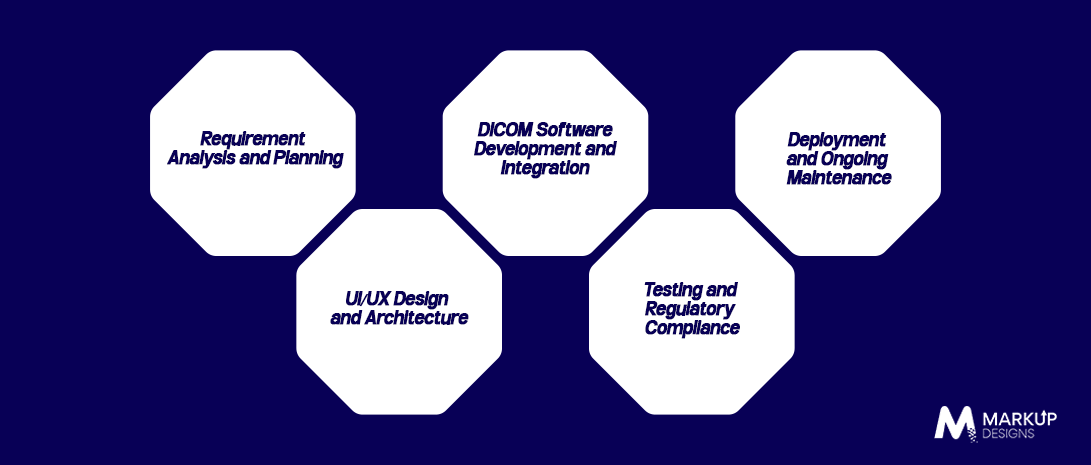
Medical imaging software development includes a number of processes which aim at meeting clinical, technical, and interoperability requirements.
Requirement Analysis and Planning
Before starting to work on a project, developers need to understand imaging workflows, users, requirements, integrations, and compliance standards.
UI/UX Design and Architecture
UI/UX designers create user-friendly interfaces for radiologists and other healthcare professionals, whereas software architects develop software architecture, databases, and infrastructure.
DICOM Software Development and Integration
It implies implementation of the capabilities of the software and its integration with PACS, RIS, and EHR platforms.
Testing and Regulatory Compliance
The software is tested for functionality, performance, security, and interoperability. Relevant requirements concerning regulations and data protection are assessed.
Deployment and Ongoing Maintenance
After the deployment, the team keeps an eye on the performance of the system, fixes issues, and performs updates and maintenance to ensure its operation.
What Are the Challenges in DICOM Medical Imaging Software Development?
The creation of the software requires a number of difficulties that can influence development time, cost, and system performance.
Ensuring DICOM Standard Compliance
Compatibility with the DICOM standard requires proper implementation of image formats, metadata, and protocols of communication.
Managing Large Medical Imaging Datasets
High-resolution imaging files need proper mechanisms for storing, retrieving, compressing, and transferring.
Integrating with Legacy Healthcare Systems
Hospitals’ legacy systems can have different interfaces and data formats, making integration more complicated.
Maintaining Patient Data Security
Security measures should include encryption, authentication, access controls, and continuous monitoring of the system.
How Can Businesses Optimize DICOM Software Development Costs?
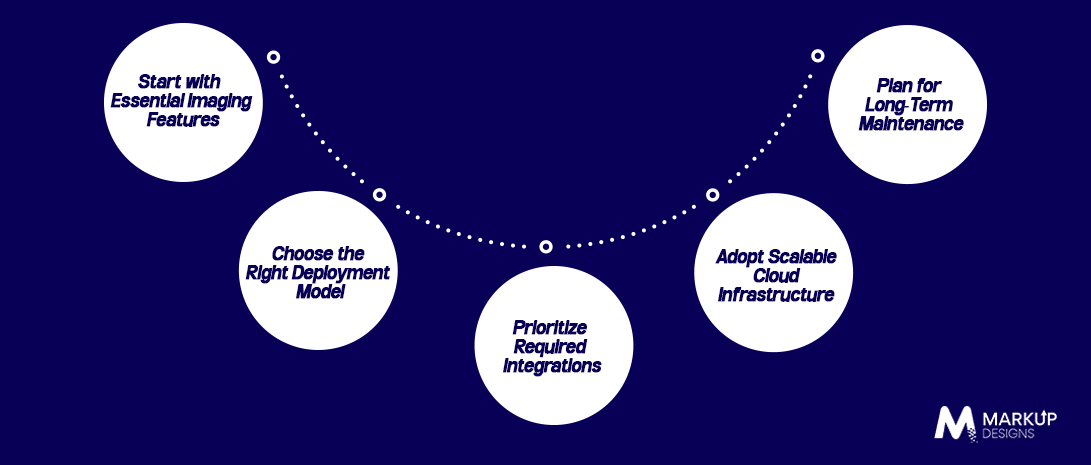
Health care organizations can keep the cost of development to a minimum without reducing the necessary functionality through proper technical and planning decisions.
Start with Essential Imaging Features
Place emphasis on image viewing, image storage, patient management, and basic DICOM functionality. Extra functionalities can be introduced as the necessity arises.
Choose the Right Deployment Model
Consider the cloud, on-premises, and hybrid deployment models depending on data management and scalability considerations.
Prioritize Required Integrations
Understand the integrations with PACS, RIS, and EHR that need to be done initially to save time and money for extra integration efforts later.
Adopt Scalable Cloud Infrastructure
Select infrastructure that will allow you to scale imaging volumes without having to alter the architecture significantly.
Plan for Long-Term Maintenance
Consider software updates, security updates, infrastructure monitoring, and technical support when calculating the total cost of ownership.
What Is the Future of DICOM Medical Imaging Software Development?
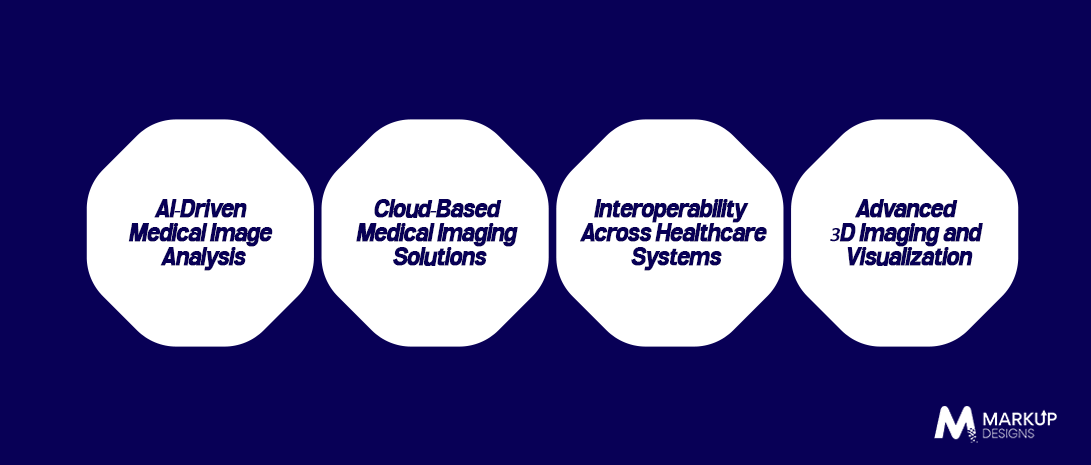
Novel technologies are increasing the intelligence, accessibility, and interconnectivity of medical imaging solutions.
AI-Driven Medical Image Analysis
Intelligent algorithms are being implemented for automated segmentation, pattern recognition, and decision support.
Cloud-Based Medical Imaging Solutions
Cloud solutions provide remote access to medical images, cloud-based storage and cooperation between healthcare professionals.
Interoperability Across Healthcare Systems
The widespread use of interoperability standards and API’s allows connecting medical imaging platforms with other clinical information systems.
Advanced 3D Imaging and Visualization
Advanced 3D reconstruction and visualization technologies are helping clinicians examine complex anatomical structures and plan medical procedures.
Why Choose Markup Designs for DICOM Medical Imaging Software Development?
The creation of dependable DICOM medical imaging software is possible only with profound knowledge of technologies used in the sphere of healthcare, data handling, system integration, and safe software development. Markup Designs offers you 12+ years of experience in software development services, supported by a team of more than 300 tech professionals. We provide unique healthcare software that is consistent with workflows, medical imaging needs, and other important factors. From DICOM-compliant imaging systems and PACS integration to highly scalable cloud applications, we concentrate on efficiency, interoperability, and data safety. We are here to provide you with the most suitable software solutions based on technical requirements.
Build Smarter Medical Imaging Solutions with Custom DICOM Software
Develop a secure, scalable, and feature-rich DICOM imaging platform tailored to your healthcare workflows. Partner with Markup Designs to bring your medical imaging software vision to life.

Conclusion
As you can see, the development of DICOM medical imaging software includes a number of expenses, starting from basic functions for image viewing up to integration of advanced AI solutions and full interoperability of the platform across an entire organization. The final price of such a project will depend on numerous aspects, including features, deployment, data protection, and system integration with other healthcare systems of an organization. If you want to create a DICOM platform, we recommend that you choose the most important features, a scalable architecture, and take into account the issue of maintenance.
FAQ
1. What is the price of creating DICOM medical imaging software?
It takes from $30,000 to $250,000+ to create DICOM medical imaging software, based on its functionality, integration options, security needs, and other aspects. The more advanced the platform is, the higher the costs you will face when developing it.
2. How long will it take to create a DICOM imaging solution?
Development of a basic DICOM imaging solution takes 3-5 months, while creation of an intermediate platform may take 5-8 months. It may take 9-12 months or even more for development of an advanced enterprise DICOM solution.
3. Which technologies are used to build DICOM medical imaging software?
The most common technologies that can be used in DICOM software development are C++, C#, Python, Java, and JavaScript. Also, DICOM toolkits such as DCMTK and Orthanc can be used. Other tools can include cloud platforms, databases, imaging libraries, and healthcare interoperability APIs.
4. Is DICOM software compatible with existing PACS and EHR systems?
Yes. Integration of DICOM software with other PACS and EHR systems is possible via DICOM communication protocols, HL7 interface, and FHIR API, depending on what the connected platforms support.
5. Is DICOM medical imaging software required to be HIPAA compliant?
Medical imaging software that processes PHI in the USA will likely have to adhere to HIPAA regulations. This means that necessary data security measures will have to be taken.
Author's Perspective
The thing is that DICOM medical imaging software is not just about viewing images. DICOM medical imaging software is an integral part of a healthcare facility’s IT infrastructure, which is why development has to consider all imaging processes and needs. Although initial cost management is an important factor for any business, companies have to avoid being careless regarding security and stability of the platform developed.
Discuss Your Project NowGaurav Goyal
Global Sales- VP
Related Posts
How Healthcare ERP Software is Transforming Hospital Management...
How to Build a Hospital Management System in...
Insights Are Valuable & Execution is Priceless
You’ve read about the digital future. Now, let’s build the infrastructure to take you there. Move your strategy from the page to the product.
Design Your Solution Now
Contact Us
Schedule The Appointment At Your Convenience Date And Time.
30 Min
Web Conference
Time Zone
Indian standard time (08:30pm)

Thanks For Getting In Touch!
You’ve Taken The First Step Toward Transforming Your Digital Presence. Our Experts Will Reach Out Shortly To Take It Forward.
Launch Your Dream Project
Provide a brief overview of your project, and our specialists will evaluate your requirements. We will connect with you to explore how the right digital solutions can help you launch faster.