
In Brief
- New payment solutions ensure transaction speed and reliability as well as operational efficiency.
- Payment channels are integrated into business systems using APIs and cloud technology.
- Automatic reconciliation and fraud prevention minimize manual processing and payment risks.
- Legacy payment solutions, compliance, and cost of implementation are major hurdles.
- Step-by-step modernization is an effective way for enterprises to improve their payment processes.
Processing delays, manual reconciliation, increasing expenses, and disconnected financial systems are some common problems faced by enterprises dealing with several payment channels. It is hard for them to monitor transactions and introduce innovations to payment processes because of legacy payment solutions.
Payment process modernization is an approach that can help enterprises solve the above problems and streamline their payment operations. By implementing cloud platforms, APIs, automation tools, and enhanced security controls, enterprises can improve payment processes.
What Is Payment Process Modernization?
Payment process modernization is a process of updating payment systems and payment workflows. It may involve payment gateway integration, automation of payment reconciliation, and other innovations.
Traditional Payment Processing vs Modern Payment Systems
Traditional payment processing often relies on fragmented applications, manual data input, and batch processing. Modern payment systems use API, automation, and centralised monitoring for improved visibility, easier integrations, and reduced processing time.
Why Enterprises Should Modernize Their Payment Operations
With the increasing volume of payments and payment channels, outdated payment systems may become inefficient and cause operational bottlenecks and reconciliation mistakes. Modernization is needed to enable enterprises to optimize their operations, keep costs low, and enhance financial reporting capabilities.
What Is Payment Process Modernization?
Payment process modernization refers to the upgrades of the payment infrastructure, payment software, and payment workflows for efficiency, security, and scalability of transactions. The term refers to those technologies and approaches that facilitate payment processing, integration, and minimize manual involvement.
Traditional Payment Processing vs Modern Payment Systems
Traditional payment processing often uses fragmented applications, manual reconciliation, and batch processing. Modern payment systems utilise API, automation, and centralised monitoring for improved transaction visibility, simplified integrations, and faster processing.
Why Enterprises Need to Modernize Payment Operations
The growing number of transactions and payment channels make outdated payment systems costly and error-prone to operate. Modernization helps enterprises manage payments more efficiently, improve financial reporting, and adapt to changing business requirements.
What Are the Key Components of a Modern Payment Processing System?
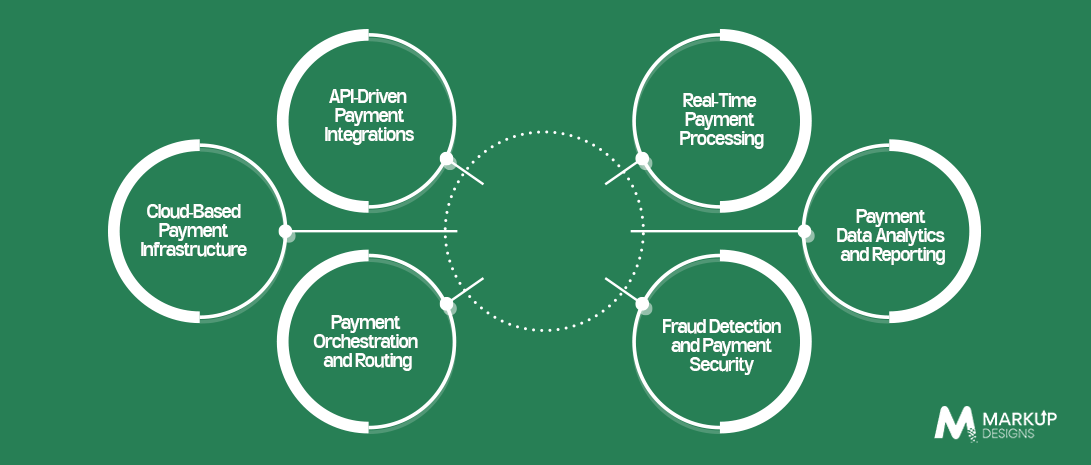
A contemporary payment processing system consists of different components that ensure the management of transactions at all stages of their lifecycle. These components help increase reliability, control, and operational efficiency.
Cloud-Based Payment Infrastructure
The cloud-based infrastructure is a computing environment that offers flexible resources necessary to process changing transaction volumes. This type of infrastructure may decrease dependence on physical infrastructure, facilitate system maintenance, and promote business continuity provided that proper backup and recovery strategies are implemented.
API-Driven Payment Integrations
Payment APIs integrate gateways, banking systems, accounting software, and other business solutions. Thanks to such integrations, it is possible to exchange transaction data between systems automatically, avoid duplicated data entry, and implement new payment solutions more easily.
Payment Orchestration and Routing
Payment orchestration manages transactions across various payment solutions and channels. With intelligent routing, transactions may be directed based on different criteria such as availability of payment solutions, transaction fees, transaction requirements, etc. Such routing helps enterprises enhance payment performance.
Real-Time Payment Processing
With real-time payments, transactions may be authorized, processed, and settled faster, depending on the payment solution and network. They help businesses provide quicker payment confirmations and improve transaction visibility without relying entirely on periodic batch updates.
Fraud Detection and Payment Security
Fraud detection tools analyse transaction patterns and identify potentially suspicious activity. Combined with encryption, tokenisation, multi-factor authentication, and access controls, these measures help protect sensitive payment information and reduce unauthorised transactions.
Payment Data Analytics and Reporting
Payment analytics consolidates transaction information into reports and dashboards. Finance teams can monitor approval rates, failed transactions, processing costs, and settlement discrepancies to identify inefficiencies and make informed operational decisions.
What Are the Key Strategies for Payment Process Modernization?
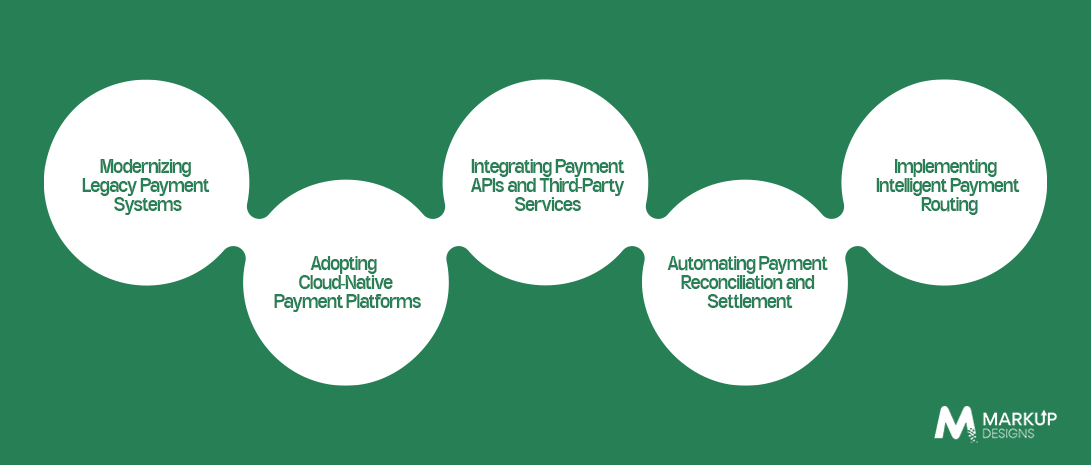
The choice of modernization techniques should be based on the existing enterprise infrastructure, business needs, and resources.
Modernizing Legacy Payment Systems
Modernization of legacy payment systems implies updating or upgrading those systems, which are too limited in performance, integration, and maintenance capabilities. In some cases, it may be sufficient to modernize only particular elements of the legacy system; otherwise, the whole payment system has to be updated.
Adopting Cloud-Native Payment Platforms
Cloud-native technology uses technologies that provide flexibility in terms of deployment and system scalability. Some payment-related processes can be successfully moved to cloud-native platforms only if they meet certain requirements.
Integrating Payment APIs and Third-Party Services
Integration of payment APIs implies the connection between existing applications and payment providers, banks, fraud-prevention services, etc. While doing so, enterprises need to check the reliability, documentation, security measures, and compatibility of these third-party services.
Automating Payment Reconciliation and Settlement
Payment reconciliation implies automatic comparison of payments with invoices, bank statements, and other documents to eliminate the necessity of manual reconciliation of transactions. However, the process of payment settlement will depend on the payment provider.
Implementing Intelligent Payment Routing
Intelligent routing uses predefined rules or transaction data to select an appropriate payment provider or processing route. Enterprises can consider approval rates, fees, availability, and geographic requirements when configuring routing rules to improve transaction outcomes.
What Are the Benefits of Payment Process Modernization for Enterprises?
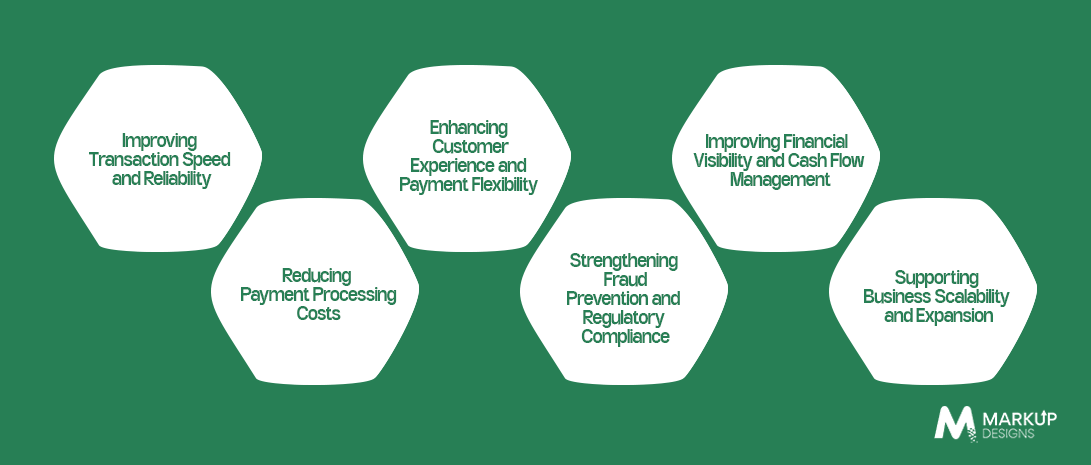
Modernizing payment operations could enhance transaction management, reduce unnecessary manual processes, and give finance teams more control over their financial transactions. The outcome would largely depend on the technologies employed and the efficiency of their implementation.
Improving Transaction Speed and Reliability
Infrastructure modernization and automation would enable the removal of processing roadblocks and better monitoring of transactions. Proper integration and efficient error handling would allow businesses to detect failed transactions and handle them.
Reducing Payment Processing Costs
Automation would result in lower costs connected to manual transaction reconciliation, monitoring, and reporting. Payment routing and provider analysis would allow enterprises to detect opportunities for reducing payment processing costs.
Enhancing Customer Experience and Payment Flexibility
Providing customers with the ability to pay via the right payment methods through different digital channels would increase payment flexibility. Reduced transaction failures, quicker payment processing, and a uniform experience in making transactions would lower friction during shopping.
Strengthening Fraud Prevention and Regulatory Compliance
Modernized payment systems would be able to monitor fraud attempts, secure access to payment methods, provide encryption, and generate transaction audit logs. These features would allow enterprises to manage their security risks and comply with regulatory requirements.
Improving Financial Visibility and Cash Flow Management
Integrated payment reporting helps finance teams track incoming payments, outstanding transactions, settlement status, and reconciliation discrepancies. Better visibility supports cash flow forecasting and helps businesses identify delays that may affect working capital.
Supporting Business Scalability and Expansion
Scalable payment infrastructure enables enterprises to accommodate higher transaction volumes, add payment channels, and enter new markets without rebuilding their entire payment environment. Businesses must still assess local payment methods, currencies, regulatory requirements, and provider availability before expanding.
What Challenges Do Enterprises Face During Payment Modernization?
While modernizing payment processes can enhance efficiencies, there are various technical, financial, and operational challenges involved. Early recognition of the potential risks associated with implementation can help enterprises plan to upgrade their payment process without any threat to transaction reliability or enterprise continuity.
Integrating Legacy Systems With Modern Payment Platforms
There is a possibility that old payment systems will be utilizing archaic architecture that will make it hard for such systems to interface with modern applications. API integration, middleware integration, and phased integration can help with this challenge.
Managing Data Migration and Transaction Continuity
For data migration to occur within the payment systems, proper data validation, mapping, and reconciliation are required. Testing of migrations, backing up of data, and rollback strategies can minimize data loss and transaction disruptions.
Addressing Payment Security and Compliance Requirements
Payment systems are responsible for handling confidential financial data. Risks such as fraud, data breaches, and unauthorized access need to be addressed using appropriate measures like authentication, encryption, and regular security assessments.
Controlling Implementation Costs and Operational Disruption
The implementation cost of modernizing payment systems can increase because of issues such as complexities in integration, licensing costs, infrastructure modification, and employee training. Clear project scope, realistic budgets, and phased implementation help control expenditure while reducing disruption to daily payment operations.
Managing Change Across Finance and Technology Teams
New payment workflows may require employees to adopt unfamiliar tools and processes. Involving finance and IT teams during planning, providing role-specific training, and documenting responsibilities can improve adoption and reduce implementation errors.
How Can Enterprises Modernize Their Payment Processes?
A strategic modernization program can help enterprises focus on their needs, assess the risk, and track the outcome. The modernization phase must address the specified business needs before the enterprise broadens the solution.
Assess Existing Payment Infrastructure and Workflows
Evaluate the current infrastructure and the number of transactions per period, processing cost, the need for system integration, and the way to reconcile transactions.
Define Modernization Goals and Success Metrics
Identify quantifiable goals of the modernization effort – e.g., lower the time needed for reconciliation, increase transaction approval rate, reduce the processing cost, etc. The metrics will help you evaluate whether your modernization project is delivering the desired outcome.
Select the Right Payment Technology and Integration Approach
Compare different payment platforms, APIs, cloud services, and orchestration services against your business needs in terms of security, compatibility, scalability, service provider support, etc.
Implement Changes Through a Phased Rollout
Roll out the modernization in phases, starting with the most critical workflows or payment channels. In that way, your team can evaluate the results, fix issues, and limit disruption.
Test Transaction Security, Accuracy, and Reliability
Test transaction authorisation, reconciliation, error handling, access controls, and recovery procedures before going live. Simulating failed payments and unexpected transaction volumes can help identify weaknesses before they affect customers.
Monitor Performance and Continuously Optimise Operations
Track transaction success rates, processing times, payment costs, reconciliation discrepancies, and security incidents after deployment. Regular performance reviews help enterprises identify emerging issues and prioritise further improvements.
What Are the Emerging Trends in Payment Process Modernization?
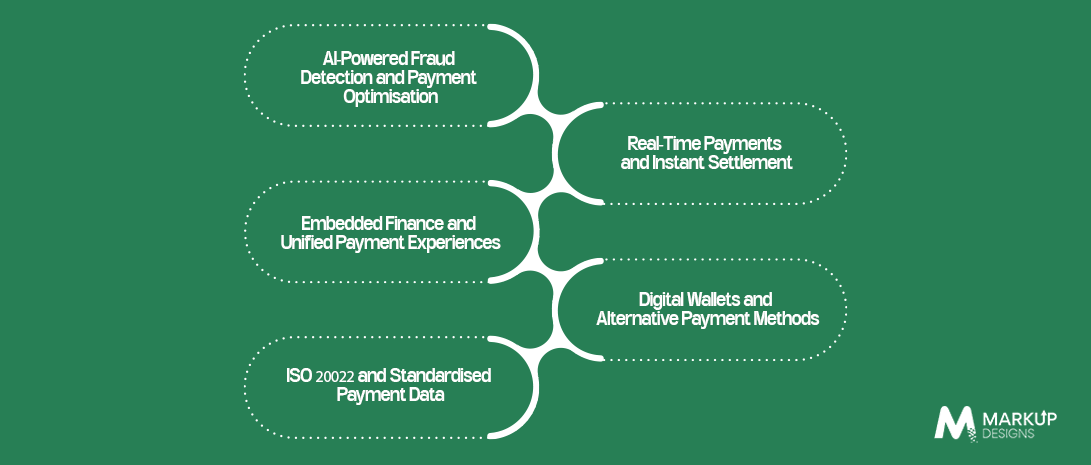
In an effort to make transactions faster, increase transaction security, and connect their financial services, businesses are coming up with new payment technologies. The following are some of the trends that are shaping payment operations.
AI-Powered Fraud Detection and Payment Optimisation
AI software is capable of analysing transaction data to detect fraud and make informed decisions. It can also be used to check on payment performance, even though human intervention is required.
Real-Time Payments and Instant Settlement
Real-time payment infrastructure is capable of transferring funds within seconds or minutes, depending on the network and conditions in the transaction. Companies can leverage the technology to speed up collections and improve payment visibility, all depending on the availability of the network and the terms of settlement.
Embedded Finance and Unified Payment Experiences
Embedded finance is all about embedding payment and financial services into business platforms, marketplaces, and applications.
Digital Wallets and Alternative Payment Methods
Customers have different alternative payment solutions such as digital wallets and account-to-account payments. Companies need to select appropriate payment solutions depending on their customers’ needs and preferences, markets, security concerns, and cost of processing.
ISO 20022 and Standardised Payment Data
ISO 20022 provides a common messaging standard for financial transactions, supporting richer and more structured payment information. Its adoption can improve data consistency, reconciliation, and interoperability, although implementation requirements vary across payment networks and institutions.
Read Also: Digital Payment App Development: Everything Businesses Need to Know in 2026
How Can Enterprises Choose the Right Payment Modernization Partner?
Selecting a payments modernization partner involves assessing both technical skills and security and implementation capabilities. A proper partner would be able to understand the environment of the enterprise and come up with realistic solutions to meet the payment requirements.
Evaluate Payment Technology Expertise and Industry Experience
Take into consideration the experience of the provider in working with payment systems, financial integrations, transaction processing, and enterprise software. References can be used to evaluate whether the provider can meet the technical and operational needs of the organization.
Assess Integration Capabilities and Platform Flexibility
Check whether the provider will be able to integrate payment gateways, banks, accounting applications, and other necessary platforms. Such integration options will allow you not to change the solutions that are already used now and prepare for future technologies.
Verify Security Standards and Compliance Support
Find out about the approach of the provider to such aspects as encryption, access management, fraud prevention, monitoring and incident response. Confirm that there are necessary certifications. Evaluate how the responsibilities for compliance and data protection will be shared.
Consider Scalability, Maintenance, and Long-Term Costs
Assess the solution’s ability to handle growing transaction volumes, additional payment channels, and future integrations. Compare implementation fees, licensing, maintenance, support, and upgrade costs to understand the total investment.
How Can Markup Designs Help Enterprises Modernize Payment Processes?
Markup Designs helps enterprises identify technology solutions aligned with their operational requirements and digital growth objectives. Through custom software development, API integration, AI-powered applications, and enterprise system development, businesses can address disconnected workflows and improve system connectivity. The approach begins with understanding existing challenges and defining practical requirements before selecting an appropriate technical solution. This helps enterprises plan modernization around their business priorities, integration needs, and long-term scalability.
Modernize Your Payment Operations With the Right Technology
Build more efficient, secure, and scalable business systems with technology aligned with your operational goals.

Conclusion
Modernizing the payment process will allow organizations to benefit from effective transaction management, minimized workload, and improved financial visibility. Technologies such as cloud platforms, payment APIs, automation, and advanced security technologies can be employed to achieve these benefits depending on organizational needs.
However, successful payment process modernization requires more than just choosing the appropriate technology. Integration challenges need to be addressed, transaction data secured, measurable goals set, and all the steps taken carefully to facilitate change.
FAQ
1. What is payment process modernization?
Payment process modernization refers to the upgrading of payment infrastructure, integrations, and workflows to increase transaction efficiency, security, and scalability. Payment process modernization may involve automation, cloud platforms, payment APIs, and payment reconciliation solutions.
2. How much does payment process modernization cost?
The price of payment process modernization is dependent on system complexity, transaction volume, integrations, licensing, security requirements, and many other factors. Organizations have to factor in all these considerations when budgeting for modernization.
3. How long does payment modernization take?
The time that is needed to modernize the payment process is determined by the nature of the existing infrastructure and the magnitude of the necessary changes. Limited integrations may take weeks or a few months, while complex enterprise-wide modernization can take considerably longer. Testing, migration, and compliance requirements also affect delivery time.
4. What are the challenges to modernizing payment systems?
The common challenges may be listed as follows: integration of legacy systems, data migration, continuity of transactions, cybersecurity, compliance with regulations, and cost of implementation.
5. How does payment modernization help secure transactions?
Modern payment systems can implement such mechanisms as encryption, tokenization, multi-factor authentication, detection of fraud, and transaction monitoring. This way, sensitive data can be secured and any suspicious activities identified.
6. Is it possible for enterprises to modernize payment systems without replacing their current infrastructure?
Yes. Enterprises can modernize certain parts of their payment systems using APIs, middleware, cloud integration, workflow automation, and so on, while keeping the legacy systems that work fine.
7. What types of technology can be used in modern payment processing?
The typical technologies used in modern payment processing include cloud computing, payment APIs, payment orchestration platforms, real-time payment networks, automatic reconciliation, AI-based fraud detection, and analytics. The right mix of these technologies depends on the payment needs of enterprises.
Author's Perspective
It makes sense to start the process of payment modernization by identifying priorities from the standpoint of operations. Thus, enterprises need to understand what is causing delays in payments, reconciliation mistakes, and extra costs. Enterprises should identify the biggest sources of payment delays, reconciliation errors, and unnecessary costs before deciding which systems to upgrade. A phased approach with measurable performance targets helps control risk and demonstrate value. The most effective modernization strategy is one that improves payment operations while remaining secure, maintainable, and adaptable as business requirements evolve.
Discuss Your Project NowJupinder Singh Arora
Founder and CEO
Related Posts

Digital Payment App Development: Everything Businesses Need to...
How Much Does It Cost to Develop an...
How Fintech Development Outsourcing Helps Businesses Scale Faster
Insights Are Valuable & Execution is Priceless
You’ve read about the digital future. Now, let’s build the infrastructure to take you there. Move your strategy from the page to the product.
Design Your Solution Now
Contact Us
Schedule The Appointment At Your Convenience Date And Time.
30 Min
Web Conference
Time Zone
Indian standard time (08:30pm)

Thanks For Getting In Touch!
You’ve Taken The First Step Toward Transforming Your Digital Presence. Our Experts Will Reach Out Shortly To Take It Forward.
Launch Your Dream Project
Provide a brief overview of your project, and our specialists will evaluate your requirements. We will connect with you to explore how the right digital solutions can help you launch faster.