

In Brief
- A strong AI governance framework assists companies in the UK in managing AI-associated risks, ensuring accountability, and facilitating responsible AI use.
- Companies in the UK are required to comply with AI governance standards related to UK GDPR, the Data Protection Act 2018, and relevant regulatory acts based on the business conducted.
- AI governance includes risk assessment as an internal component that enables the efficient functioning of AI technology.
- Having a well-defined implementation methodology allows businesses to implement governance throughout the whole AI lifecycle.
- Regular auditing, staff training, and the use of risk-based solutions help companies to stay compliant while developing AI technology.
The implementation of AI in business processes plays a significant role in the work of UK companies since it can streamline decision-making processes, allow process automation, enhance customer service, and improve predictive abilities. But despite the fact that AI is being more widely used among businesses all across the UK, they still face issues linked to data privacy, bias in the functioning of algorithms, security, as well as transparency and accountability.
Creating a robust AI governance framework enables UK businesses to address the various issues related to AI implementation at the same time. This framework creates policies, identifies responsible individuals, and helps put controls aimed at risk assessment and management of AI systems throughout the whole life cycle of a system. Even though the UK currently has an approach to AI regulation based on particular conditions and is led by the regulatory body rather than on the basis of having one comprehensive AI law, companies still need to know the legal nuances of their operation. A good governance framework helps maintain the balance between AI innovation and responsible use.
What Is an AI Governance Framework and Why Does It Matter for UK Enterprises?
The AI governance framework is understood as a formalized set of rules that define regulations, procedures, responsibilities, and technical requirements concerning the way an organization builds, develops, tracks, and manages AI systems. Such a framework makes sure that AI systems are functioning according to the current safety, equity, and transparency regulations applicable in the area.
AI governance, in the case of UK enterprises, helps with risk management in connection with data privacy, bias in algorithms, and accountability, thus preserving the trust of stakeholders. When a framework is clear, this helps businesses implement AI innovations in a responsible manner and provides the appropriate level of security when working with sensitive information while being in line with corporate goals.
What Are the Key Regulations Shaping AI Governance in the UK?
The UK deems AI governance to be a specific context and thus an executive regulatory approach is in use, where current laws, requirements of specific business sectors and cross-sector principles are combined to solve the given issue, without legislating a single comprehensive AI law. Business entities are to know what obligations should be observed concerning AI systems depending on their intended use, the data they work with, and the sector of the economy they represent.
UK GDPR and Data Protection Act 2018
UK GDPR and the Data Protection Act 2018 set forth the conditions regarding the processing of personal data in terms of AI systems and solutions, including lawfulness, transparency, security and accountability. Businesses using AI for profiling or automated decision-making must also assess applicable safeguards, particularly when decisions have legal or similarly significant effects, and conduct data protection impact assessments where required.
The UK Government’s AI Regulatory Principles
The principles that the UK government has mentioned are five overarching principles that are to be followed when developing and utilizing AI, which include safety, security and robustness; proper transparency and explainability; fairness in use; accountability and regulation; and contestability and redress. Companies take these principles into serious consideration when coming up with their policies regarding AI.
EU AI Act: Considerations for UK Businesses Operating in Europe
The EU AI Act provides global compliance requirements for UK companies providing AI technologies in Europe. The requirements of the Act are tied to risks and may vary from risk-givers through data to human oversight, which makes it important for UK companies to understand their roles and expectations.
Industry-Specific Compliance Requirements
There are many industries where companies have to comply with certain regulations; therefore, companies should look at the country and industry they belong to when deciding on their obligations. Companies in the financial services sector will have to think about obligations posed by the FCA and PRA; companies in the healthcare sector will want to focus on data protection regulations and key medical device regulations; retailers will have to pay attention to consumer protection and privacy regulation requirements.
What Are the Core Components of an Effective AI Governance Framework?
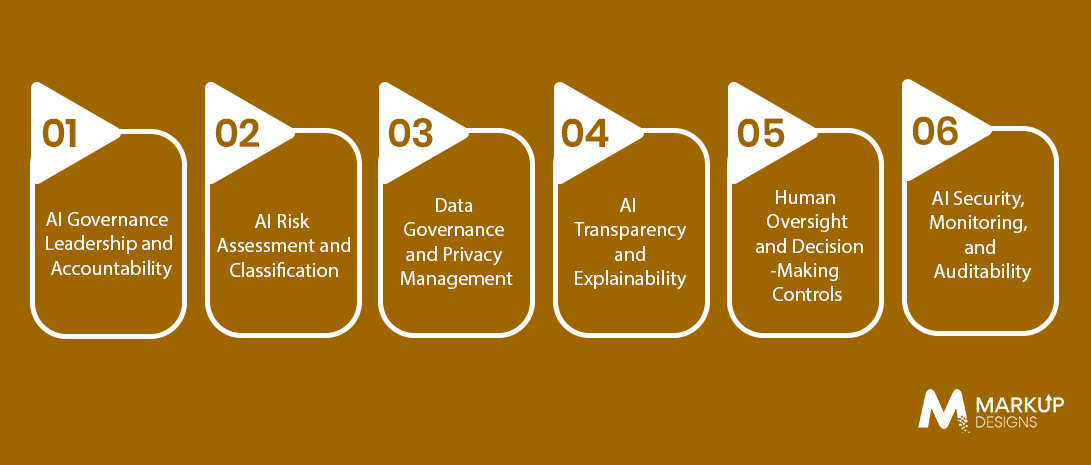
An efficient AI governance system combines organizational accountability, technological safeguards, and constant monitoring to eliminate any risks involved in AI operations. The key components clarify the roles and responsibilities of involved parties, enable proper use of data, and assist organizations in evaluating whether their AI systems are consistent, secure, and compliant.
AI Governance Leadership and Accountability
Any organization should specify who takes responsibility for planning AI initiatives, controlling risks, and monitoring the efficiency and compliance of the systems. Setting up an AI governance committee made up of representatives from different branches makes it possible to streamline decision-making, appoint people responsible for the implementation of the project, and make the process fast and efficient.
AI Risk Assessment and Classification
It is important to assess the AI system considering its intended purpose, data sensitivity, influence it may have on people, and operational implications. Using a risk approach helps organizations determine the amount of testing, compliance, and monitoring they need to apply.
Data Governance and Privacy Management
Effective data management guarantees that AI systems use information that is true, appropriate, and acquired legally, securing protected data. Enterprises should establish rules for data ownership, access permissions, retention, quality checks, and lawful processing to reduce privacy risks and improve the reliability of AI outputs.
AI Transparency and Explainability
Transparency ensures that workers, consumers, auditors, and authorities know how AI works and impacts decisions. Companies must record every system’s goals, abilities, restrictions, and known dangers, making necessary disclosures and explanations when the use of AI in decision-making greatly influences people.
Human Oversight and Decision-Making Controls
Human oversight prevents relying too much on the recommendations made by AI systems when it comes to high-impact decisions about hiring, financial issues, healthcare, or access to critical resources. Organizations must indicate when there is a need for people to check the effectiveness of recommendations made by AI and make sure that authorized people can challenge, ignore, and escalate AI results if necessary.
AI Security, Monitoring, and Auditability
AI-based systems should be protected against being accessed illegally, leaking data, manipulation of data used in decision-making, and faulty decisions. Enterprises must establish restrictions on access, conduct testing of AI security, log all actions taken, and develop response plans.
How Can UK Enterprises Build an Effective AI Governance Framework?
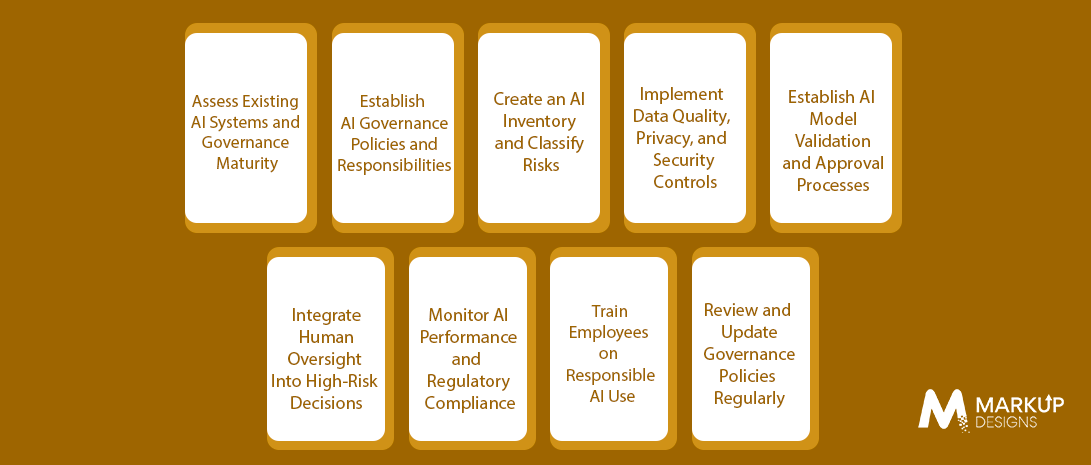
Building an AI governance framework requires a structured process that connects business objectives, regulatory obligations, risk management, and technical execution. The following steps help enterprises establish practical governance controls and integrate them into everyday AI operations.
Step 1: Assess Existing AI Systems and Governance Maturity
Review how the organisation uses AI across internal applications, third-party platforms, embedded features, and generative AI tools. Evaluate existing policies, approval processes, data protection measures, security controls, and monitoring practices to identify governance gaps and prioritise improvements based on risk.
Step 2: Establish AI Governance Policies and Responsibilities
Develop an organisation-wide AI policy defining acceptable uses, restricted activities, approval requirements, risk ownership, and escalation procedures. Assign responsibilities across business leaders, technology teams, legal specialists, compliance professionals, and data owners so that AI initiatives receive appropriate review before deployment.
Step 3: Create an AI Inventory and Classify Risks
Maintain a central inventory documenting each AI system’s purpose, provider, business owner, data sources, deployment status, and potential impact. Classify systems according to their risk levels and update the inventory whenever new tools are introduced or existing applications undergo significant changes.
Step 4: Implement Data Quality, Privacy, and Security Controls
Establish controls for collecting, processing, storing, sharing, and retaining AI-related data, ensuring that information is appropriate for its intended use and accessible only to authorised users. Integrate privacy and security assessments into development and procurement, using measures such as encryption, access monitoring, data quality checks, and impact assessments where appropriate.
Step 5: Establish AI Model Validation and Approval Processes
Evaluate AI systems before deployment to determine whether they perform reliably under expected operating conditions. Depending on the application’s risk, testing should cover accuracy, bias, robustness, security, and defined performance thresholds, with findings, limitations, and approval decisions documented before release.
Step 6: Integrate Human Oversight Into High-Risk Decisions
Identify AI applications where errors could cause significant financial, legal, operational, or personal harm, and establish appropriate human review requirements. Train reviewers to interpret outputs, recognise warning signs, escalate concerns, and restrict or suspend systems when their performance creates unacceptable risks.
Step 7: Monitor AI Performance and Regulatory Compliance
Monitor deployed AI systems for changes in accuracy, bias, security, reliability, and compliance with applicable requirements. Establish performance thresholds, periodic reviews, incident investigation procedures, and corrective actions to address emerging risks as data, models, and operating conditions change.
Step 8: Train Employees on Responsible AI Use
Provide role-specific training on data protection, confidentiality, output verification, bias awareness, approved tools, and incident reporting. Developers may require detailed technical guidance, while business users need practical instructions for handling sensitive information and checking AI-generated content or recommendations.
Step 9: Review and Update Governance Policies Regularly
Review governance policies periodically using audit findings, incident reports, performance data, employee feedback, and regulatory developments to identify necessary improvements. Reassess AI systems whenever their intended purpose, data inputs, capabilities, or deployment environments change significantly, ensuring governance remains an ongoing management process rather than a one-time compliance exercise.
Read Also: LLM-as-a-Judge Explained: How Enterprises Can Improve AI Evaluation and Governance
What Challenges Do UK Enterprises Face When Implementing AI Governance?
Implementing AI governance can be challenging when enterprises lack clear policies, technical infrastructure, or dedicated resources. Businesses must address these barriers to maintain effective oversight without slowing down AI adoption.
Managing Legacy Systems and AI Integration
Many UK enterprises rely on legacy systems that lack the flexibility to support modern AI tools or governance controls. Integrating AI with these systems can create data compatibility, security, and monitoring issues, requiring businesses to assess existing infrastructure and plan upgrades carefully.
Balancing Innovation With Regulatory Compliance
Enterprises must balance the need to experiment with AI against their obligations to manage risks and protect users. Unclear approval processes can delay projects, while insufficient oversight can expose businesses to legal, operational, and reputational risks. Risk-based reviews help maintain this balance.
Addressing Bias and Data Privacy Risks
AI systems can produce biased outcomes when trained on incomplete, inaccurate, or unrepresentative datasets. Processing personal information also creates privacy risks if businesses lack appropriate safeguards, lawful processing grounds, or access controls. Regular testing and data governance help identify and address these issues.
Defining Accountability Across Teams
AI initiatives often involve developers, business teams, legal specialists, and external technology providers, making ownership difficult to establish. Without clearly assigned responsibilities, risk assessments and corrective actions may be overlooked. Defined roles, approval procedures, and escalation paths help maintain accountability.
Managing Governance Costs and Resource Constraints
Building AI governance requires investment in skilled professionals, compliance processes, security tools, testing, and ongoing monitoring. Smaller enterprises and resource-constrained teams may struggle to implement every control at once. Prioritising high-risk applications and introducing governance measures incrementally can help manage costs.
What Are the Best Practices for Maintaining AI Governance at Scale?
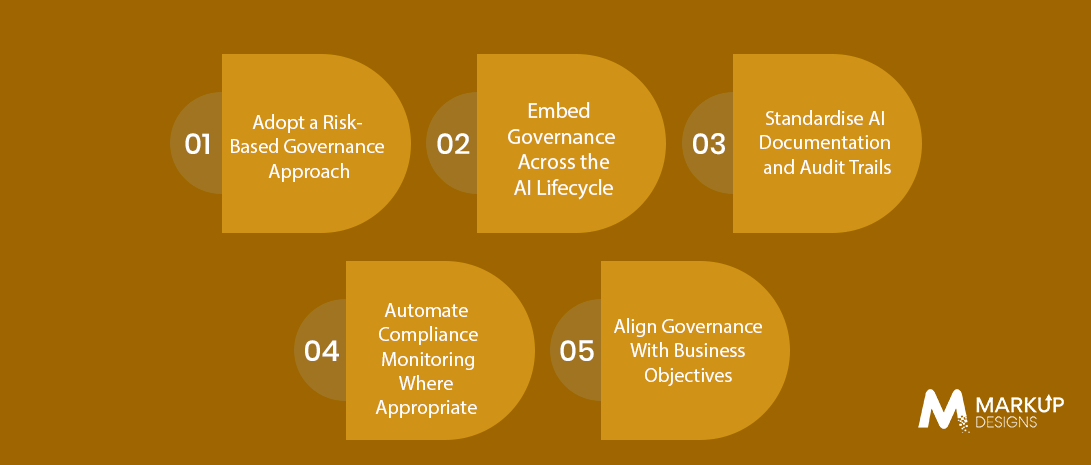
Maintaining AI governance across multiple departments and applications requires consistent policies, repeatable processes, and continuous monitoring. The following practices help enterprises expand AI adoption while keeping risks and responsibilities manageable.
Adopt a Risk-Based Governance Approach
Apply controls according to each AI system’s potential impact, intended use, and risk exposure. High-impact applications should receive more rigorous assessments and oversight, while lower-risk tools can follow proportionate review processes, helping organisations allocate resources effectively.
Embed Governance Across the AI Lifecycle
Integrate governance into AI planning, data collection, development, QA testing, deployment, and ongoing maintenance. Reviewing risks at each stage helps identify problems early and ensures that accountability, security, and compliance remain part of everyday AI operations.
Standardise AI Documentation and Audit Trails
Use consistent templates to record system purposes, data sources, risk assessments, testing results, approvals, and significant changes. Maintain audit trails that allow authorised teams to investigate incidents, verify decisions, and demonstrate that appropriate governance procedures have been followed.
Automate Compliance Monitoring Where Appropriate
Automation can help track system performance, flag unusual behaviour, monitor access, and identify potential policy violations. Enterprises should use monitoring tools proportionately and retain human review for complex or consequential issues, as automated alerts alone cannot establish compliance.
Align Governance With Business Objectives
AI governance should support business outcomes rather than operate as a separate administrative exercise. Linking governance controls to operational priorities, customer trust, risk reduction, and regulatory obligations helps leadership make informed investment decisions and adopt AI responsibly.
How Does AI Governance Differ Across UK Industries?
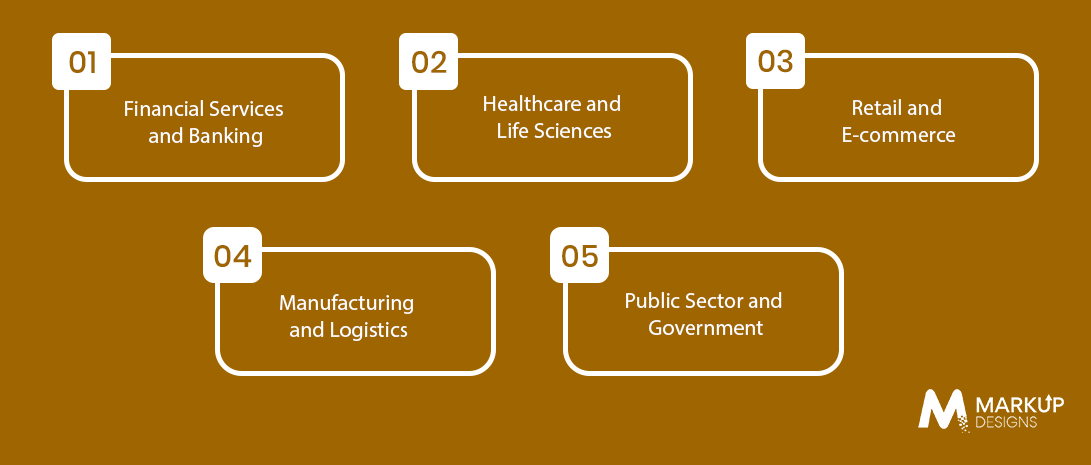
The regulations governing AI implementation differ according to the nature of AI application, the sensitivity of the data in use, and the potential risks arising out of automated decision-making. Businesses should tailor their governance approach to the specific risks of their industry and the relevant regulations, rather than adopting a one-size-fits-all governance solution.
Financial Services and Banking
The finance sector uses AI for fraud detection, lending and credit scoring, customer care, and transaction analysis. The governance framework therefore needs to account for the accuracy of the models used, risk of bias, protection of data, and transparency of the processes, among other issues, while conforming to relevant FCA and PRA requirements.
Healthcare and Life Sciences
The healthcare sector uses AI for decision-making in patient treatment, analyzing diagnostic results, and research. The rules for governing AI use in healthcare organizations should give priority to patient safety, security of confidential health information, and validation of the models used, as well as relevant legislation on data protection and medical devices.
Retail and E-commerce
Retailers use AI for product recommendations, pricing, stock management, demand forecasting, as well as for improving consumer experience. Their governance frameworks should address customer data privacy, potential discrimination, transparency, and consumer protection while ensuring AI-driven decisions are monitored for accuracy and fairness.
Manufacturing and Logistics Industry
Manufacturers and logistics enterprises utilize AI for the purposes of predictive maintenance, quality control, scheduling operations, and supply chain optimization. Governance of AI technology should revolve around the reliability of the systems, cybersecurity services, safety in operations, safeguarding of data, and implementation of human involvement practices in situations when AI malfunctions would lead to disruption of operations or introduce physical danger.
Public Sector and Government
Public sector institutions can implement AI for the purposes of resource allocation, provision of services to citizens, document processing, and making administrative decisions. Its governance system must focus on principles of transparency, accountability, fairness, protection of data, and necessary involvement of human review in the operations of AI systems in case of their influence on access to services and the rights of people.
Read Also: AI in UK Healthcare: Real-World Applications Transforming Patient Outcomes
How Can Markup Designs Help UK Enterprises Implement AI Governance?
Markup Designs provides support for UK enterprises in creating AI technologies with the interests of business, data protection, and cybersecurity taken into consideration. The AI development and implementation services allow organizations to create and implement AI applications, set up necessary technical control systems, as well as apply monitoring and supervision of AI processes.
Build Responsible AI Solutions With Confidence
Establish a practical AI governance framework that aligns with your business objectives, manages risks, and supports regulatory compliance. Partner with Markup Designs to develop secure, scalable AI solutions built for responsible innovation.

Conclusion
An effective AI governance framework helps UK enterprises manage AI-related risks while maintaining accountability, protecting sensitive data, and supporting responsible innovation. By establishing clear policies, assessing risks, implementing technical safeguards, and monitoring AI systems throughout their lifecycle, businesses can strengthen governance without unnecessarily restricting adoption.
Enterprises should begin by evaluating their existing AI systems, identifying applicable regulatory obligations, and prioritising controls according to risk. Regular reviews, employee training, and industry-specific safeguards will help organisations adapt their frameworks as AI technologies and regulatory expectations evolve.
FAQ
1. What is an AI governance framework?
An AI governance framework is based on a system organized of regulations, actions, accountabilities, and technical measures for efficiently developing, implementing, and monitoring AI systems. The purpose of the framework is to allow organizations to manage risks, enhance accountability, and comply with applicable laws and rules.
2. Do UK companies need to comply with an AI governance framework?
A universal regulatory framework is not required for all UK companies existing nowadays. Nevertheless, companies must adhere to various applicable regulations, including data protection and other laws relevant to certain sectors. Compliance with a framework is advantageous in terms of demonstrating accountability and risk management.
3. How can UK companies ensure their compliance with AI?
In order to guarantee that their AI operations comply with the applicable laws, UK companies can define the necessary regulations, develop an inventory of AI technologies, assess risks, and implement security measures. Regular audits and training of employees will help keep compliance under control.
4. How long does it take to implement an AI governance framework?
Implementation of an AI governance framework will take different amounts of time depending on the size of the company and type of governmental regulatory obligations.
5. What are the biggest risks of implementing AI incorrectly?
The major risks include the risk of data security breaches, biased outcomes, decisions that cannot be relied on, information security weaknesses, non-compliance with relevant laws, and harm to the company’s reputation. In case of application yet usage of AI where risk and impact are high, it may endanger citizens or disrupt crucial business processes.
6. What are the costs of implementing AI governance?
The prices for AI governance depend on the quantity and complexity of AI systems, the internal knowledge of the company, the laws which should be adhered to, and the necessity for using external consultants. It is better for companies to evaluate their current situation and spend their resources accordingly rather than estimate how much their budget should be.
7. Can AI governance help companies to be compliant with all regulations of the UK and EU?
Yes. Companies that are interested in being compliant can work out their governance frameworks in order to meet compliance standards in both jurisdictions. However, separate rewarding for compliance with laws and regulations in two different jurisdictions is required.
Author's Perspective
AI governance should be treated as an ongoing business capability, not simply a compliance checklist. UK enterprises that establish clear ownership, proportionate risk controls, and continuous monitoring will be better positioned to adopt AI responsibly while responding to changing regulatory expectations. The priority is to build governance into everyday decision-making so that innovation and accountability develop together.
Discuss Your Project NowGaurav Goyal
Global Sales- VP
Related Posts

AI Voice Agent for Real Estate: Features, Benefits,...

30+ Innovative AI Agent Startup Ideas for Entrepreneurs...

How Artificial Intelligence Is Changing Mobile Game Development
Insights Are Valuable & Execution is Priceless
You’ve read about the digital future. Now, let’s build the infrastructure to take you there. Move your strategy from the page to the product.
Design Your Solution Now
Contact Us
Schedule The Appointment At Your Convenience Date And Time.
30 Min
Web Conference
Time Zone
Indian standard time (08:30pm)

Thanks For Getting In Touch!
You’ve Taken The First Step Toward Transforming Your Digital Presence. Our Experts Will Reach Out Shortly To Take It Forward.
Launch Your Dream Project
Provide a brief overview of your project, and our specialists will evaluate your requirements. We will connect with you to explore how the right digital solutions can help you launch faster.