
In Brief
- The cost for the development of an AI-based nutrition application can vary between $50,000 and $300,000+ depending on the features and functions of the app.
- Food identification through artificial intelligence, personalized meal suggestions, and chatbot technology can increase the costs for developing the app significantly.
- Elements of the app development like development platform, third-party APIs, nutrition databases, cloud technology, and safety measures can determine the total amount of money needed for it.
- The ongoing expenses can include the cost of hosting of AI algorithms, the costs of APIs, and necessary maintenance and updates of the database.
- Thus, the experience with MVP development could give businesses time to validate their idea before making further investments in AI-powered apps.
AI applications in the nutrition sphere are changing the way people monitor their diets, get to know the nutritional value of the food, and obtain advice on nutrition matters. From recognizing images of food to creating meal plans and answering questions concerning nutrition, AI can create a simple food-tracking app.
The cost to build an AI-powered nutrition app depends on the complexity of its AI capabilities, features, technology stack, integrations, platform, and development team. A basic application with food logging and AI recommendations requires a very different investment from an advanced platform using computer vision, generative AI, wearable integrations, and personalized nutrition intelligence. Understanding these cost drivers can help businesses plan development around their budget, users, and long-term product goals.
How Much Does It Cost to Build an AI-Powered Nutrition App?
The cost to build an AI-powered nutrition app can range from $50,000 to $300,000+, depending on the app’s features, AI capabilities, platform, integrations, security requirements, and development complexity. A basic nutrition tracker may require considerably less investment, while an advanced platform with computer vision, personalised AI recommendations, predictive analytics, and wearable integrations can push development costs substantially higher.
For context, Markup Designs estimates that developing a FoodSwitch-like nutrition app in Australia can cost AUD 60,000–600,000+ (40,000–up to AUD 400,000+). Its feature-based estimates range from AUD 7,500–30,000 for basic features, AUD 30,000–60,000 for moderate features, and AUD 60,000–90,000+ for complex features involving AI-driven nutrition analysis, real-time food database updates, cloud services, and IoT integrations.
AI Nutrition App Development Cost by Complexity
| App Type | Key Capabilities | Estimated Cost |
| Basic | Food logging, calorie tracking, nutrition database, basic meal tracking | 50,000–80,000 |
| Mid-Level | AI recommendations, barcode scanning, personalised meal plans, nutrition insights, API integrations | 80,000–150,000 |
| Advanced | Computer vision, AI nutrition coaching, predictive insights, wearable integrations, real-time data processing | 150,000–300,000+ |
These ranges are indicative rather than fixed quotes. The final budget depends heavily on whether the AI capabilities are built using existing models and APIs or require custom model development and training.
What Features Affect the Cost of an AI Nutrition App?
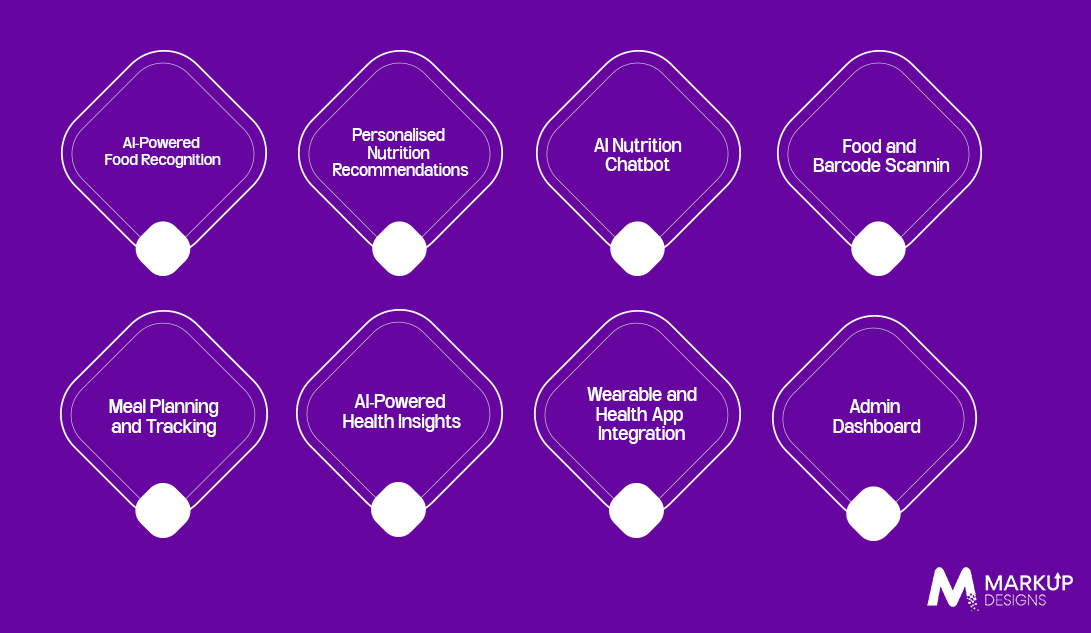
The feature set is one of the most significant determinants of the development budget. In general, AI features need more sophisticated model integration, processing of data, testing, infrastructure development, and a continual improvement process.
AI-Powered Food Recognition
Consumers can take a picture of food to get information about the detected food item, quantity, and nutritional value. Its technology includes computer vision models, image processing, food databases, and operation with uncertain or false classification results.
Cost impact: Advanced AI image recognition brings a significant increase of costs for development and infrastructure if compared to standard food recording methods.
Personalised Nutrition Recommendations
The app is capable of analysing user aims, preferences, food allergies, activity levels, and eating habits to create individual recommendations for food or meals.
The main components are:
– User aim and preferences
– Management of allergies and restrictions
– Nutritional profile creation
– AI recommendations for meals
– Individual food alternatives
FoodSwitch analysis by Markup Designs estimates the cost of implementing individual recommendations and dietary preferences filtering at AUD 30,000–60,000.
AI Nutrition Chatbot
The AI nutrition chatbot can assist users with their food queries, help them understand nutritional values, offer meal suggestions and give relevant advice accordingly.
Costs are determined by whether the app has integrated a third-party LLM API or has an entirely custom-built AI solution with proprietary data and retrieval systems, conversation memory, and customized model behavior.
Food and Barcode Scanning
Barcode scanning enables users to access packaged food details by using the nutrition database, while the label scanner can provide product information from the packaging itself.
The important aspects of this technology include:
- Barcode recognition
- Food database integration
- Nutrition label scanning
- Ingredient analysis
- Product matching
If we take a look at Markup Designs estimates, the cost for basic FoodSwitch features like barcode scanning, basic nutritional information displays, Health Star Ratings, and Traffic Light Labels could go from AUD 7,500 to AUD 30,000.
Meal Planning and Tracking
Meal planning features allow users to create or receive personalised meal schedules while tracking calories, nutrients, macros, and progress over time.
Typical capabilities include:
- AI-generated meal plans
- Calorie tracking
- Macronutrient tracking
- Meal history
- Progress monitoring
AI-Powered Health Insights
AI can analyse eating patterns and identify nutritional gaps or behavioural trends based on the data users provide.
Advanced implementations may require machine learning models, longitudinal user data, analytics infrastructure, and continuous model evaluation.
Wearable and Health App Integration
Integrating health platforms and wearable devices allows nutrition recommendations to consider activity, exercise, sleep, and other user-provided data.
Potential integrations include:
- Apple Health
- Google Health Connect
- Fitness trackers
- Activity data
- Sleep data
Markup Designs places IoT integrations, cloud-based storage, real-time food database updates, and AI-driven nutrition analysis within its complex feature category at AUD 60,000–90,000+.
Admin Dashboard
An administrative dashboard enables the business to manage users, nutrition content, food databases, AI-generated content, analytics, and application settings.
Common components include:
- User management
- Nutrition database management
- Content management
- Analytics and reporting
- AI recommendation monitoring
AI Technologies Used in Nutrition App Development
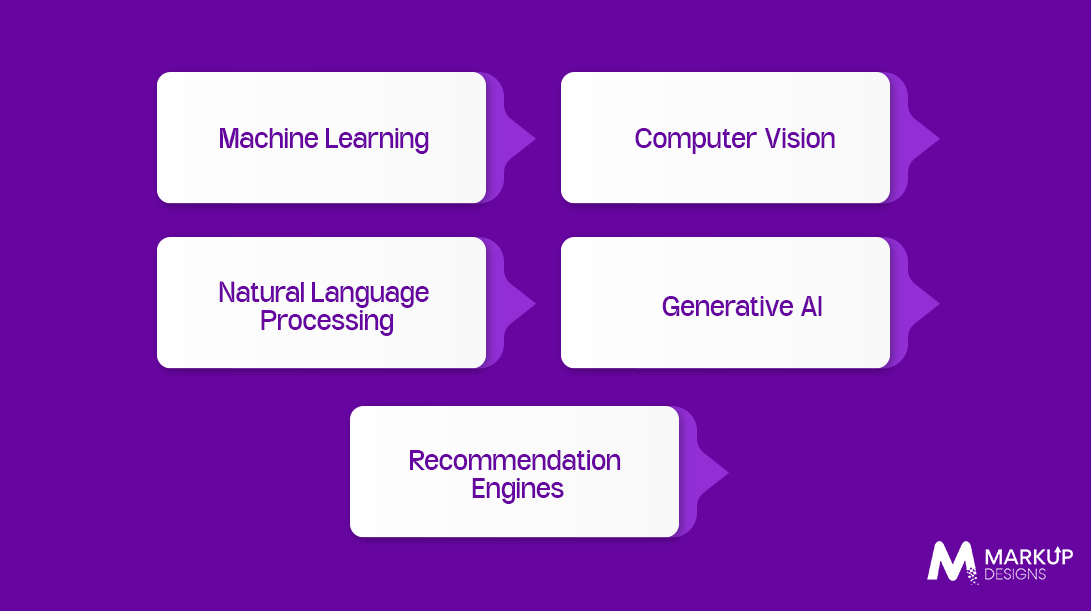
The use of AI technology influences the initial development process and subsequent operating expenses.
Machine Learning
Machine learning techniques enable the analysis of user data such as eating habits and preferences, and provide users with useful recommendations.
Computer Vision
Computer vision involves food identification and estimated portions based on pictures of food.
Natural Language Processing
NLP makes it possible for the app to process queries and make it interactive.
Generative AI
Generative AI is able to create personalized menus and answer nutritional questions based on the preferences of users.
Recommendation Engines
Recommendation engines analyze nutritional requirements and user preferences to specify the most suitable food.
Additional Factors Affecting the Cost of the Development of AI Nutrition Application
Apart from the functions and the use of AI technologies, there are several technical and operational factors that may largely influence the total cost of the project.
UI/UX Design
The simplest UI/UX implementation costs about AUD 7,500–15,000, while Markup Designs says that advanced UI with animation will cost somewhere between AUD 15,000 and AUD 60,000.
Backend Development
The backend handles user data, nutrition databases, authentication, AI processing, APIs, and real-time synchronisation. Markup Designs’s reference figures put basic backend development at AUD 7,500–45,000, with advanced real-time processing reaching AUD 45,000+.
AI Model Development and Training
Using an existing AI model or API generally requires less initial investment than developing, training, and maintaining a custom model. Custom computer vision or recommendation models also require suitable datasets, model evaluation, infrastructure, and ongoing optimisation.
Third-Party API Integrations
Nutrition databases, barcode services, LLM APIs, payment gateways, wearable app development, and analytics services can all add development and recurring usage costs. Markup Designs estimates AUD 7,500–15,000 for basic API integrations and AUD 15,000–45,000 for premium integrations.
Nutrition and Food Databases
A nutrition app needs reliable food and ingredient data. Database licensing, API access, data normalisation, updates, and regional food coverage can all affect the budget.
Cloud Infrastructure
AI processing, image storage, user profiles, food databases, analytics, and real-time recommendations require cloud infrastructure. Costs increase as the user base, data volume, and AI workload grow.
Data Security
Nutrition and health-related information requires appropriate security controls. Markup Designs estimates AUD 7,500–15,000 for basic security measures such as SSL and encryption, with advanced security implementations reaching AUD 15,000–45,000+.
Platform Selection
Building separately for iOS and Android generally requires more development effort than using a cross-platform approach. Markup’s reference estimates list AUD 7,500–45,000 for native development and AUD 45,000–75,000 for cross-platform development, although these figures should be treated as component-level estimates rather than complete app budgets.
Testing and Quality Assurance
AI nutrition apps require more than conventional functional testing. Food recognition accuracy, recommendation quality, API reliability, data security, performance, and edge cases all need to be validated before launch.
Maintenance and AI Model Optimisation
AI applications require continuous monitoring and improvement. Markup Designs estimates AUD 15,000–90,000 per year for app maintenance for FoodSwitch-like applications, while hosting is estimated at AUD 3,000–19,000 per year.
Hidden Costs of Building an AI-Powered Nutrition App
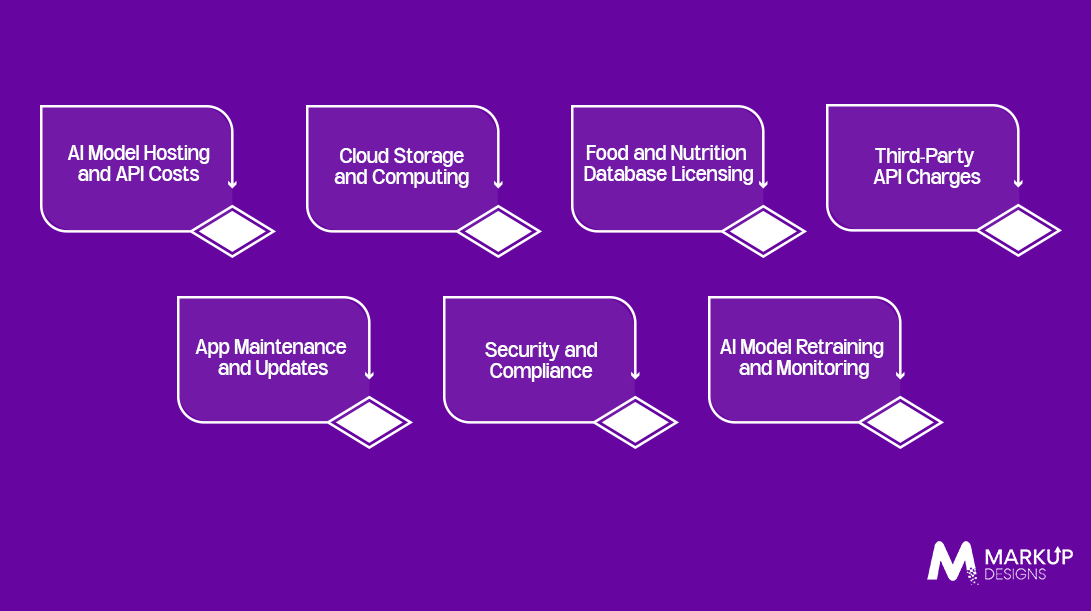
The initial development budget only covers part of the investment required for an AI-powered nutrition app. AI inference, cloud resources, food databases, APIs, security, and continuous model optimisation can create recurring expenses after launch. Planning for these costs early helps businesses avoid underestimating the total cost of ownership.
AI Model Hosting and API Costs
AI models require computing resources each time users generate recommendations, analyse food images, or interact with an AI nutrition assistant. Using third-party AI APIs can also introduce usage-based charges that increase with the number of users and requests.
Cloud Storage and Computing
User profiles, food images, nutrition records, meal histories, analytics, and AI processing require cloud infrastructure. Storage and computing costs generally increase as the app accumulates more users and processes larger volumes of data.
Food and Nutrition Database Licensing
Nutrition applications depend on accurate food, ingredient, calorie, and nutrient information. Paid databases or APIs may involve licensing fees, subscription charges, regional data costs, or usage-based pricing.
Third-Party API Charges
Barcode scanning, payment processing, wearable integrations, health platforms, maps, analytics, and AI services may require external APIs. Each provider can have its own subscription, transaction, or usage-based pricing structure.
App Maintenance and Updates
Operating system updates, bug fixes, dependency upgrades, performance improvements, database updates, and new device compatibility create recurring development costs after launch.
Security and Compliance
Security cannot be treated as a one-time development expense. Regular vulnerability assessments, security updates, access-control reviews, encryption management, and compliance requirements can create ongoing costs.
AI Model Retraining and Monitoring
AI performance can decline when food trends, datasets, user behaviour, or product databases change. Models may need monitoring, evaluation, retraining, and optimisation to maintain reliable results.
How Much Does It Cost to Maintain an AI Nutrition App?
Maintaining an AI nutrition app generally involves both technical maintenance and AI-specific operational costs. The actual annual expense depends on the number of users, AI usage, integrations, cloud architecture, and frequency of updates.
| Recurring Cost | What It Covers | Indicative Annual Cost |
| Technical Maintenance | Bug fixes, OS updates, performance improvements | 10,000–30,000+ |
| AI Model Maintenance | Monitoring, optimisation, retraining | 10,000–40,000+ |
| Cloud & API Costs | Hosting, AI inference, storage, external APIs | 5,000–25,000+ |
| Security Updates | Security testing, patches, monitoring | 5,000–20,000+ |
| Feature Enhancements | New features, integrations, UX improvements | 10,000–40,000+ |
Estimates AUD 15,000–90,000 annually for maintenance and approximately AUD 3,000–19,000 annually for hosting for a FoodSwitch-like application. An AI-powered nutrition platform with higher AI inference and data-processing requirements can have additional operational expenses depending on usage.
Development Cost vs Recurring Operational Cost
| Cost Category | When It Occurs | Examples |
| Initial Development | Before launch | UI/UX, backend, AI integration, app development |
| AI Setup | During development | Model integration, training, data preparation |
| Infrastructure | During and after launch | Cloud hosting, storage, computing |
| API Usage | After integration | AI, nutrition, barcode, wearable APIs |
| Maintenance | Ongoing | Bug fixes, updates, optimisation |
| AI Operations | Ongoing | Monitoring, evaluation, retraining |
Read Also: Enterprise AI for Australian Healthcare: Current Applications and What’s Next
How to Reduce the Cost of Building an AI Nutrition App?
Lowering the development expenditures does not mean omitting every technology. The best strategy is to handle the initial scope and implement complicated AI technologies when the product becomes popular among users.
Start With an AI-Powered MVP
Start with AI features necessary for a key nutrition use case: personalized recommendations, food logging, and basic nutrition analysis. It is possible to enhance a solution with sophisticated computer vision or predictive functionality later.
Prioritise High-Value Features
Rather than implementing every possible feature, detect functions that eliminate the major problems of the users. This decreases the number of hours spent on development, testing, and resources required at the initial stage of AI activities.
Use Pre-Trained AI Models Where Appropriate
Application of the ready-made computer vision, NLP, or generative AI solutions will decrease both time and resources involved into creation of models from scratch. At the same time, in case of a need for certain functionality or required accuracy, custom models may be implemented.
Choose Cross-Platform Development
Cross-platform app development allows developers to create apps for both iOS and Android from a single codebase and in this way, reduces duplicated development while keeping app compatibility with many platforms.
Use Third-Party APIs Strategically
Nutrition databases, barcode recognition, LLMs, payment systems, and health integrations can be accessed through established APIs rather than developed internally. However, businesses should compare usage costs and vendor dependencies before committing.
Build the Nutrition Database in Phases
Start with the food categories and regions most relevant to the target audience. Expand the database progressively instead of investing heavily in comprehensive global food coverage before product-market validation.
How Does an AI Nutrition App Make Money?
AI-based nutrition app can offer certain business models such as a combination of regular subscriptions with premium service and relevant business partnerships.
Freemium Subscription
Provide content including food and nutrition features for free with most advanced AI recommendations, personalized plans, analytics, or coaching services offered for subscription only.
Premium AI Nutrition Plans
For a fee, users can access tailored diet plans, nutritional recommendations, progress reviews, and relevant customized nutrition advice powered by AI.
In-App Purchases
Individual meal plans, recipe books, specialized nutrition programs, or premium development products can be available for a single purchase.
Personalized Coaching
The app can offer AI-generated recommendations together with access to a professional nutritionist under the premium service.
Affiliate Partnerships
The app can generate income by affiliate marketing while cooperating with grocery product suppliers, meal providers, kitchen appliance manufacturers, and others in the area of nutrition.
Brand and Product Partnerships
The platform can partner with nutrition brands and food producers and help them with sponsored content, product launches, marketing campaigns, etc., provided these deals are well-known and do not harm its reputation.
How to Build an AI-Powered Nutrition App?
Developing the app is actually going through a step-by-step procedure. The project must address many issues about the data used, AI application areas, architecture, accuracy criteria, and continuous monitoring of the developed app from the beginning.
Step 1: Define the Nutrition App Concept and Target Users
Determine who the end-users and the nutritional problem targeted by the application are. Depending on the product goals, it can be about weight reduction, meal planning, sports nutrition, or simply nutritional tracking.
Step 2: Identify AI Use Cases
Find out the problems where AI can help the most. This includes food recognition, giving personalized recommendations, implementing an AI chatbot, generating meals as a product of dietary pattern analysis, or predicting results.
Step 3: Plan Features and Data Requirements
Create a list of features necessary to achieve the set goal of the application and the data needed to implement them.
Step 4: Design the UI/UX
Make the design simple at all stages of application development so users won’t have any difficulty when using it.
Step 5: Develop the AI and Backend
Construct the backend of the app, application for users, databases, APIs, recommendation logic, AI integration, and necessary machine learning or computer vision features.
Step 6: Integrate Nutrition Databases and APIs
Incorporate reliable food databases, barcode services, healthcare platforms, wearable devices, payment gateways, and other necessary third-party services.
Step 7: Test AI Accuracy and App Performance
Check food recognition, portion estimation, nutritional calculations, responses of the AI, quality of recommendations, reliability of APIs, security, and performance of the app.
Checking the AI is very important because if the app identifies the food incorrectly or gives an unsuitable recommendation, this will negatively influence the usefulness of the app.
Step 8: Deploy and Monitor the App
Publish the app through relevant app stores and keep track of performance, AI outputs, user behavior, use of infrastructure, security, and quality of model.
Compliance and Security Considerations for AI Nutrition Apps
Nutrition apps can collect sensitive data as they may receive information about users’ health goals, dietary restrictions, food allergies, activity data, information from connected health services, etc. Therefore, privacy and security should be covered in the applied software rather than added at the end.
Data Privacy and User Consent
The app must state which data is being taken, what the data is going to be used for, and how it will be used. The user must give consent and receive proper user controls for privacy.
Secure Health and Nutrition Data
Data encryption, strong authentication, secure access, and data management protocols should be put in place for protecting sensitive information.
Encryption and Access Controls
Data must be secured while being transferred and when stored. Only authorized people, service providers, and administrators should have access to the data.
Third-Party API Security
Make sure to check the safety and permission protocols of third-party providers of AI, nutrition services via wearable devices, and health data handling.
AI Transparency and Data Governance
People should know that they are guided by AI and what information is used in the process.
For an Australia-focused application, the compliance approach should be aligned with applicable Australian privacy and health-data requirements rather than simply adding a generic list of international certifications.
How to Make Your AI Nutrition App Stand Out?
Simply adding AI to food tracking is unlikely to create meaningful differentiation. The product should use AI to solve specific nutrition problems that conventional tracking applications handle less effectively.
AI-Based Food Image Recognition
Allow users to photograph meals and receive food identification and nutritional estimates, while giving users the ability to correct inaccurate results.
Personalised Meal Recommendations
Generate recommendations based on dietary preferences, goals, allergies, eating patterns, and available nutritional information.
Conversational AI Nutrition Coach
Enable users to ask questions naturally and receive context-aware responses based on their preferences and previous interactions.
Smart Grocery Recommendations
Turn meal plans into shopping lists and suggest suitable products based on nutritional requirements and dietary preferences.
Dietary Restriction Intelligence
Account for allergies, intolerances, vegetarian or vegan preferences, religious dietary requirements, and other restrictions when generating recommendations.
Predictive Nutrition Insights
Analyse historical eating patterns to identify trends and provide users with relevant insights into their nutritional behaviour.
Wearable Data Integration
Combine nutrition information with activity, exercise, and other permitted health data to provide a broader view of user behaviour.
Gamification and Behaviour Tracking
Use goals, streaks, milestones, challenges, and progress tracking to encourage consistent engagement with nutrition habits.
Why Choose Markup Designs for AI Nutrition App Development?
Markup Designs utilizes AI/ML development, custom application development, secure backend architecture, and integration of third-party APIs to create nutrition applications that match the needs of the business and its users. Our experts can implement food recognition based on Artificial Intelligence, make innovative recommendation systems, integrate conversational AI features and nutrition tracking tools, ensure database integration and wearable connectivity, and provide scalable infrastructure while adhering to security and performance principles. We are capable of defining the initial MVP and choosing the AI technologies to be used for developing an application, designing its user interface, and performing various tests.
Build an AI-Powered Nutrition App Around Your Vision
Turn nutrition data into personalised digital experiences with AI-powered features, secure architecture, and scalable application development.

Conclusion
When developing an AI-based nutrition application, the costs cannot be determined merely by the number of screens and basic app functionality. It is because factors such as AI complexity, food recognition system functionality, ability of the app to provide personalized recommendations, data sources, APIs, cloud resources, the issue of security of the app, and the choice of platforms must be taken into account. The best approach is to launch the app with only the basic functionality to test its validity and to add useful features to the app gradually.
FAQs
1. How much does it cost to create an AI nutrition app?
The creation of an AI nutrition app may cost anywhere between $50,000 and $300,000+, depending on the features, AI functionality, integrations, platforms, and the complexity of the application. Apps with advanced features that involve predictive analytics, computer vision, and many integrations will cost significantly more.
2. How long does it take to build an AI-powered nutrition app?
Building an AI-powered nutrition app can take anywhere between 4 and 12 months or more depending on the complexity of the project. It would take less time to build an app with a focused minimum viable product (MVP) and more time to develop an app with unique AI algorithms, large data storage, smart wearables integration, and personalization.
3. What are the AI technologies used in nutrition apps?
There are a number of technologies typical for this type of apps including natural language processing, machine learning, computer vision, recommendation engines, and generative AI. The choice of technology will depend on whether the app needs to recognize food, hold conversations with users, give food recommendations, etc.
4. Can artificial intelligence recognize food in pictures?
Yes. Computer vision algorithms can recognize foods in pictures and analyse nutrition data. The accuracy depends on factors such as image quality, food database, computer program, method of portion calculation, and ability in dealing with unclear or mixed dishes.
5. Can artificial intelligence create a personalized meal plan?
Yes. Generative AI and recommendation systems can provide meal recommendations based on factors such as diet preferences, health goals, allergies, limitations, and eating habits. The AI system should use the appropriate methods and validation instead of providing the recommendations generated with AI without any restrictions.
Author's Perspective
While AI can enhance nutrition applications and make them more personalized, one cannot just add a chatbot or an image-recognition option to the application and expect to get a powerful tool. The most important influence lies in combining reliable nutritional information, strong AI technology, user-centered design, data privacy controls, and regular improvement of the model. Therefore, companies developing this kind of application should start with determining the nutritional issue they want to solve rather than making it advanced with various AI features.
Discuss Your Project NowJupinder Singh Arora
Founder and CEO
Insights Are Valuable & Execution is Priceless
You’ve read about the digital future. Now, let’s build the infrastructure to take you there. Move your strategy from the page to the product.
Design Your Solution Now
Contact Us
Schedule The Appointment At Your Convenience Date And Time.
30 Min
Web Conference
Time Zone
Indian standard time (08:30pm)

Thanks For Getting In Touch!
You’ve Taken The First Step Toward Transforming Your Digital Presence. Our Experts Will Reach Out Shortly To Take It Forward.
Launch Your Dream Project
Provide a brief overview of your project, and our specialists will evaluate your requirements. We will connect with you to explore how the right digital solutions can help you launch faster.