
In Brief
- The governance of artificial intelligence is the establishment of rules, responsibilities, and safeguards for the proper management of AI.
- AI risk management determines the risks present in a company’s use of AI technology, evaluates them, and finds a way to overcome these risks.
- Good governance practices ensure the safeguarding of private information, security, absence of bias, transparency, compliance, and reliability of statistics.
- Monitoring should be planned and enacted on an ongoing basis to spot the AI risks that arise after the introduction of AI technology into the company’s operations.
- Well-structured governance makes it possible for companies to develop their AI systems while assuring accountability and control over their operations.
Artificial intelligence is being adopted by businesses as a strategic technology, aimed at influencing people’s decisions, automating processes, and working with important data. With the wider business introduction of AI, companies need to not only take care of the performance of AI algorithms but also develop governance frameworks indicating owners, risk assessment practices, and risk management approach, as well as rules governing handling important decisions during the use of AI.
Nevertheless, authorizing an AI policy document is merely part of the process. Effective governance entails active implementation of the policy within such processes as use-case assessment, data management, development, testing, deployment, monitoring, and retirement of models. Organizations need to continuously analyze potential emerging risks, improve controls, and document their decisions.
This article explains several important aspects of AI governance and risk management and describes how organizations can proceed from AI governance strategy to the operational framework that supports their AI activities on a larger scale.
Understanding AI Governance and Risk Management
The use of AI brings with it a set of new opportunities as well as risks associated with such aspects as data, safety, compliance issues, decision-making, and operational efficiency. AI governance provides the tools for the management of those risks, while AI risk management relates to the processes necessary to control the risks throughout the life cycle of AI.
What Is AI Governance?
AI governance involves all approaches and engagements taken in relation to AI technologies by any organization. The essence of AI Governance is to provide more robust procedures to measure and oversee AI productions, leading to accountability in relation to AI decision-making processes and ensuring that AI technologies are working as per company requirements, compliance laws, moral principles, and security norms.
A good plan for governance is supposed to cover much more than the establishment of an AI policy that contains the names of those who can approve and use AI tools, including their ratings and evaluations necessary for operating AI technologies.
AI risk management means a systematic approach aimed at identifying, evaluating, reducing, and keeping track of possible risks connected with AI systems and technologies emerged because of training data, model development, system integration, or operating modes of the system and others.
Due to risk management approaches companies can define what level of supervision is needed in relation to different types of AI tools and how to control its effectiveness.
How Do AI Governance and Risk Management Work Together?
AI governance establishes the framework within which AI systems are managed, while risk management provides the practical mechanisms for identifying and controlling potential risks. Governance determines responsibilities, policies, approval requirements, and oversight structures; risk management applies these requirements to individual AI systems and use cases.
Together, they support oversight across the AI lifecycle—from initial use-case assessment and data validation to model testing, deployment, continuous monitoring, incident response, and retirement.
Why Does AI Governance Matter for Enterprise AI Adoption?
Enterprise AI systems can influence business operations, customer experiences, financial decisions, employee workflows, and access to sensitive information. Without appropriate governance, organizations may struggle to maintain visibility and accountability as the number of AI applications increases.
A structured governance approach helps organizations establish consistent controls around security, privacy, transparency, compliance, human oversight, and model performance. It also creates a repeatable foundation for scaling AI across business functions without treating every new AI initiative as an isolated project.
Building an Effective AI Governance Strategy
An effective AI governance strategy should translate organizational expectations into practical responsibilities, policies, workflows, and controls. It should also be flexible enough to accommodate different AI use cases while applying stronger oversight where the potential impact or risk is greater.
Define AI Governance Objectives and Scope
Start by establishing what the AI governance program is intended to achieve. Objectives may include improving accountability, protecting sensitive data, supporting regulatory compliance, managing model risks, strengthening transparency, and establishing consistent AI usage practices.
The scope should identify which AI systems, applications, business functions, teams, data environments, and third-party technologies are covered. Clearly defining the boundaries of the program helps prevent gaps in oversight as AI adoption expands.
Establish Roles, Ownership, and Decision-Making Authority
AI governance requires clear ownership across the organization. Leadership may establish strategic direction, while technology, data, cybersecurity, legal, compliance, risk, and business teams may have specific responsibilities throughout the AI lifecycle.
Organizations should document who evaluates AI use cases, who approves deployment, who owns identified risks, who monitors production systems, and who has authority to intervene when a system does not meet defined requirements.
Create an AI Governance Framework
An AI governance framework brings policies, processes, roles, risk controls, assessment methods, monitoring practices, and documentation requirements into a coordinated structure. It should provide a consistent approach for evaluating and managing AI systems across different departments.
The framework should also define how governance activities connect with existing software development, cybersecurity, data governance, compliance, procurement, and risk-management processes.
Align AI Governance With Business and Regulatory Requirements
AI governance should reflect both organizational priorities and the external requirements applicable to the business. This includes internal policies, contractual obligations, industry standards, data protection requirements, cybersecurity expectations, and relevant AI regulations.
Mapping these requirements to specific governance controls helps organizations avoid fragmented compliance efforts and provides a clearer basis for evaluating AI systems.
Read Also: LLM-as-a-Judge Explained: Improving Enterprise AI Governance and Evaluation
Identifying and Assessing AI Risks
AI risks can originate from multiple parts of an AI system and may change as the system moves from development into production. Organizations therefore need a structured approach to identifying risks before deployment and reassessing them as systems, data, and use cases evolve.
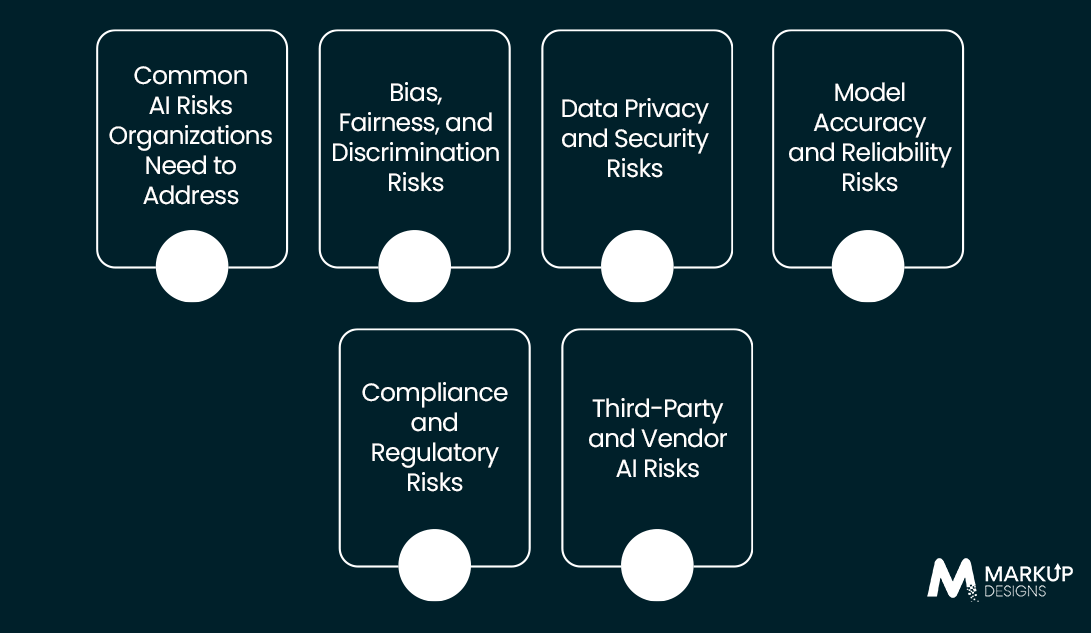
Common AI Risks Organizations Need to Address
Enterprise AI risks can include inaccurate outputs, biased results, privacy violations, cybersecurity vulnerabilities, intellectual property concerns, regulatory non-compliance, model drift, inadequate human oversight, and dependence on external AI providers.
The relevance and severity of these risks will vary according to the AI application’s purpose, the data involved, the degree of automation, and the potential consequences of incorrect or harmful outputs.
Bias, Fairness, and Discrimination Risks
AI systems can reproduce or amplify patterns present in their training or operational data. Bias can also emerge from how data is collected, how models are designed, or how outputs are interpreted and used within business processes.
Organizations should evaluate relevant datasets and model outputs for potential disparities and establish testing, review, and remediation processes appropriate to the system’s intended use and potential impact.
Data Privacy and Security Risks
AI systems may process large volumes of business, customer, employee, or other sensitive information. Poorly controlled data access, insecure integrations, inappropriate retention, or accidental disclosure can create significant privacy and security risks.
Data governance should therefore address what information an AI system can access, how it is processed and stored, who can access it, and what security controls protect it throughout its lifecycle.
Model Accuracy and Reliability Risks
AI outputs are not inherently accurate or consistent. Models can produce incorrect information, unexpected outputs, or degraded results when the underlying data or operating environment changes.
Organizations should establish appropriate validation and testing procedures and define performance thresholds for AI systems based on their intended use. Higher-impact applications may require more rigorous testing and ongoing human review.
Compliance and Regulatory Risks
AI systems can create regulatory obligations depending on their application, industry, geography, data usage, and potential impact. Regulatory expectations may also change as AI technologies and related laws develop.
Organizations should identify the requirements applicable to each use case and incorporate them into AI design, documentation, testing, deployment, monitoring, and review processes.
Third-Party and Vendor AI Risks
Organizations increasingly rely on external AI models, APIs, cloud, datasets, and software development providers. This creates additional risks around data handling, security, model transparency, service availability, contractual obligations, and changes made by the provider.
Third-party AI solutions should therefore be evaluated as part of the organization’s broader governance and vendor-risk processes rather than being treated as risk-free components.
Creating an AI Risk Management Framework
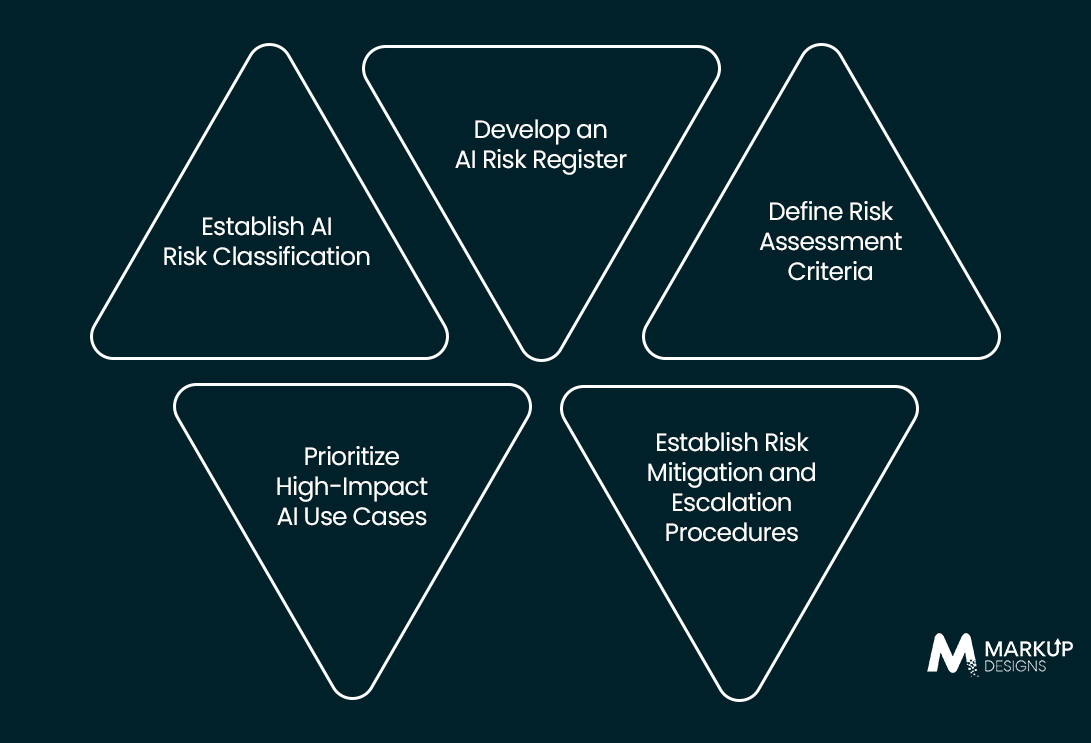
A formal AI risk management framework provides a repeatable method for determining which risks require attention and what controls should be applied. It allows organizations to move from ad hoc risk decisions toward consistent evaluation across AI initiatives.
Establish AI Risk Classification
AI systems can be classified according to factors such as business impact, data sensitivity, level of autonomy, number of affected users, decision-making authority, and potential consequences of failure.
Risk classification allows organizations to determine the level of assessment, approval, testing, monitoring, and human oversight required for different AI applications.
Develop an AI Risk Register
An AI risk register provides a centralized view of identified risks across AI systems and use cases. It can record the risk description, affected system, likelihood, potential impact, risk owner, mitigation measures, status, and review history.
Maintaining this information in a structured format makes it easier for governance teams to track unresolved issues and ensure that agreed mitigation measures are implemented.
Define Risk Assessment Criteria
Organizations should establish consistent criteria for evaluating AI risks rather than relying entirely on subjective judgments. Assessment criteria can consider factors such as likelihood, severity, data sensitivity, affected stakeholders, level of automation, and potential regulatory impact.
Defined criteria also make it easier to compare risks across different AI projects and determine when additional review or escalation is required.
Prioritize High-Impact AI Use Cases
Not every AI application presents the same level of risk. Systems that influence sensitive decisions, process highly confidential information, interact directly with customers, or operate with significant autonomy may require greater scrutiny.
Organizations can prioritize these use cases for more detailed assessments, stronger testing, additional approval requirements, and ongoing human oversight.
Establish Risk Mitigation and Escalation Procedures
Identifying a risk is only useful when the organization has a defined process for responding to it. Mitigation procedures should specify the controls, corrective actions, responsible owners, and timelines required to address identified risks.
Escalation procedures should also clarify when an issue requires additional review, temporary suspension, executive approval, or other intervention before an AI system can proceed.
Implementing AI Governance Controls
Governance becomes effective when policies and risk assessments are translated into controls that operate within everyday AI development services and business processes. These controls should address data, models, users, security, accountability, and ongoing oversight.
Establish AI Policies and Usage Guidelines
AI policies should define acceptable and prohibited uses of AI within the organization. They can address approved tools, sensitive data usage, employee responsibilities, security expectations, intellectual property, human oversight, and requirements for reporting AI-related incidents.
Clear usage guidelines also help employees understand where AI can be used independently and where additional approval or review is required.
Implement Data Governance and Access Controls
AI systems should only have access to the data necessary for their intended purpose. Organizations should establish appropriate controls for data classification, permissions, authentication, storage, transfer, retention, and deletion.
Strong data governance also helps maintain data quality and provides greater visibility into how information moves between AI models, applications, users, and external services.
Define Model Validation and Testing Procedures
AI systems should be evaluated against requirements established for their intended use before they are deployed. Testing may cover accuracy, reliability, robustness, security, fairness, explainability, and performance under different operating conditions.
Validation should not end at deployment. Organizations should establish procedures for reassessing models when they are significantly modified, retrained, integrated with new systems, or exposed to substantially different data.
Introduce Human Oversight and Intervention
Human oversight provides an additional control layer for AI applications where automated outputs could have significant consequences. Organizations should define when human review is mandatory and what authority reviewers have to reject, modify, or override AI-generated outputs.
The appropriate level of human involvement depends on the use case, risk level, system autonomy, and potential impact of incorrect decisions.
Maintain Documentation and Audit Trails
Documentation creates an evidence trail of how AI systems are designed, assessed, approved, deployed, monitored, and changed. Relevant records may include use-case assessments, datasets, model versions, testing results, approvals, risk decisions, incidents, and monitoring reports.
Maintaining reliable audit trails supports accountability, troubleshooting, internal reviews, and regulatory or contractual requirements where applicable.
Managing AI Risk Across the AI Lifecycle
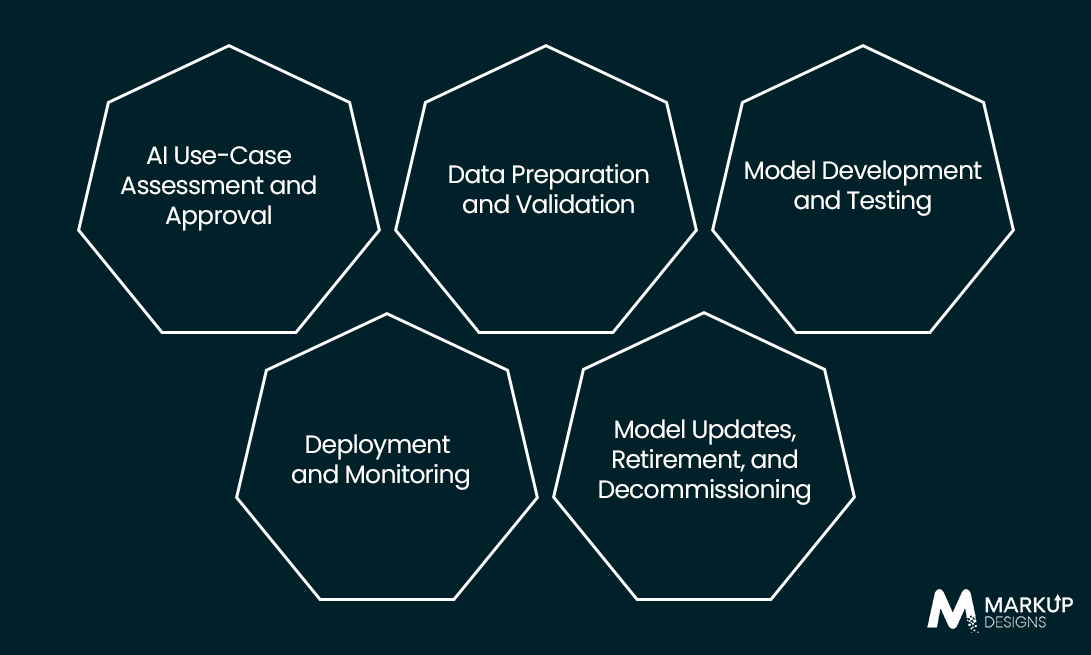
AI risks can change significantly as a system progresses from an initial concept to production and ongoing operation. Governance controls should therefore be applied throughout the lifecycle rather than concentrated only at the point of deployment.
AI Use-Case Assessment and Approval
Before development begins, organizations should evaluate the purpose, intended users, data requirements, business impact, level of automation, and potential risks associated with the proposed AI use case.
A formal approval process can determine whether the use case meets governance requirements and identify the controls that need to be implemented before development or deployment progresses.
Data Preparation and Validation
Data quality and suitability can directly influence AI system performance and risk. Organizations should assess data relevance, accuracy, provenance, privacy, security, and potential bias before using it to train or operate an AI system.
Data validation should also continue when datasets are updated, or new sources are introduced to ensure that changes do not introduce unexpected risks.
Model Development and Testing
AI models should be developed against clearly defined functional, security, reliability, and governance requirements. Testing should assess how the system behaves under normal conditions as well as relevant edge cases and adverse scenarios.
The results should be documented and reviewed against predefined acceptance criteria before the system moves toward production.
Deployment and Monitoring
Deployment should follow established approval, security, access, and configuration requirements. Once the system is operational, monitoring should provide visibility into performance, usage, outputs, incidents, and changes in risk.
This creates a feedback loop through which governance teams can identify emerging issues and determine whether additional controls or intervention are required.
Model Updates, Retirement, and Decommissioning
Model retraining, version changes, configuration updates, and significant modifications can alter an AI system’s behavior and risk profile. These changes should therefore be subject to appropriate review and validation before being introduced into production.
When an AI system reaches the end of its useful life, organizations should also define procedures for retiring the model, removing access, handling associated data, preserving required records, and securely decommissioning related infrastructure.
Monitoring AI Systems After Deployment
Deployment does not mark the end of AI governance. AI systems can change in performance, data patterns, usage, and risk after they enter production, making continuous monitoring an important part of responsible AI management.
Track Model Performance and Drift
Organizations should monitor model accuracy, output quality, response patterns, and other relevant performance indicators over time. Changes in input data or operating conditions can cause model performance to decline even when the underlying system has not been modified.
Monitoring for model and data drift can help identify when a model requires investigation, recalibration, retraining, or replacement.
Monitor Bias and Fairness
Fairness should be monitored throughout the operational lifecycle rather than assessed only during initial testing. Organizations can review relevant outputs and performance indicators for meaningful disparities and investigate unexpected changes.
Where issues are identified, organizations should document the findings and determine whether changes to data, models, workflows, or human review are required.
Detect Security and Privacy Issues
Production AI systems may face security and privacy threats that were not apparent during development. Monitoring should therefore account for unauthorized access, suspicious usage, data exposure, malicious inputs, insecure integrations, and other relevant attack or privacy scenarios.
Security monitoring should be connected to established incident-response processes so that identified issues can be investigated and contained.
Maintain Continuous Compliance Monitoring
AI governance requirements can change as regulations, organizational policies, contracts, and system functionality evolve. Continuous compliance monitoring helps determine whether deployed AI systems remain aligned with the requirements applicable to them.
Regular reviews can also identify gaps created by system updates, new data sources, changes in vendors, or expansion into new business processes.
Establish Incident Reporting and Response
Organizations should establish clear procedures for reporting and responding to AI-related incidents. These procedures should define how incidents are identified, documented, investigated, escalated, contained, and resolved.
Post-incident reviews can also help identify weaknesses in existing controls and inform updates to governance policies, risk assessments, and monitoring processes.
AI Governance, Compliance, and Regulatory Readiness
AI governance should provide evidence that an organization understands how its AI systems operate, what risks they present, and what controls are in place. Regulatory readiness therefore depends not only on having policies but also on consistently applying and documenting them.
Align AI Governance With Applicable Regulations
Organizations should identify the laws, regulations, standards, and industry requirements relevant to each AI application and operating environment. Governance controls can then be mapped to these requirements to establish clear accountability and evidence.
This approach is more practical than applying a generic compliance framework without considering the organization’s actual AI use cases and regulatory exposure.
Maintain Transparency and Explainability
Transparency involves documenting how AI systems are developed and used, what role they play in business processes, and what information or models contribute to their outputs.
Where appropriate to the use case, explainability mechanisms can also help users and other stakeholders understand the factors behind AI-generated recommendations or decisions.
Strengthen Accountability and Auditability
Clear ownership ensures that AI-related decisions do not fall between organizational teams. Organizations should maintain records showing who approved a use case, who owns its risks, what testing was performed, and how issues were addressed.
These records create an auditable trail that supports internal governance and relevant external requirements.
Prepare Documentation for Regulatory Reviews
Organizations should maintain organized documentation covering AI use cases, risk assessments, data practices, model information, testing, approvals, monitoring, incidents, and governance decisions.
Keeping these records current makes it easier to demonstrate how AI systems are managed and respond to requests for evidence without reconstructing the governance history after the fact.
Overcoming Common AI Governance Challenges
Implementing AI governance across an organization can expose practical challenges that are not always visible when frameworks are designed at a policy level. Addressing these challenges requires visibility, proportionate controls, cross-functional ownership, and regular review.
Managing Shadow AI and Unapproved AI Tools
Employees may adopt external AI tools without going through established approval processes, creating potential risks around confidential information, data privacy, security, and intellectual property.
Organizations can address this by establishing clear AI usage policies, maintaining visibility into approved tools, educating employees, and creating practical approval processes that do not encourage teams to bypass governance.
Balancing Governance With Innovation
Overly rigid governance processes can create unnecessary friction, particularly for low-risk experimentation. At the same time, insufficient oversight can expose the organization to avoidable risks.
A risk-based governance model can help address this tension by applying controls according to the potential impact and complexity of each AI use case.
Addressing Legacy Systems and Fragmented Data
Legacy Systems infrastructure and disconnected data environments can make it difficult to establish consistent AI controls. Organizations may struggle with inconsistent data quality, outdated security mechanisms, unclear ownership, and limited system visibility.
Governance initiatives should therefore account for the existing technology landscape and identify practical ways to improve data, integration, access, and monitoring controls.
Managing Third-Party AI Dependencies
External AI providers can introduce dependencies that extend beyond traditional vendor management. Organizations need visibility into how providers handle data, secure their platforms, update models, manage incidents, and support relevant contractual or compliance requirements.
Third-party AI assessments should therefore form part of the broader AI governance and vendor-risk process.
Keeping Governance Policies Current
AI technologies, organizational use cases, and regulatory expectations can change quickly. Policies that are not reviewed regularly can become disconnected from the systems and risks they are intended to govern.
Organizations should establish periodic governance reviews and update policies, controls, risk classifications, and training requirements when significant changes occur.
From AI Governance Strategy to Implementation
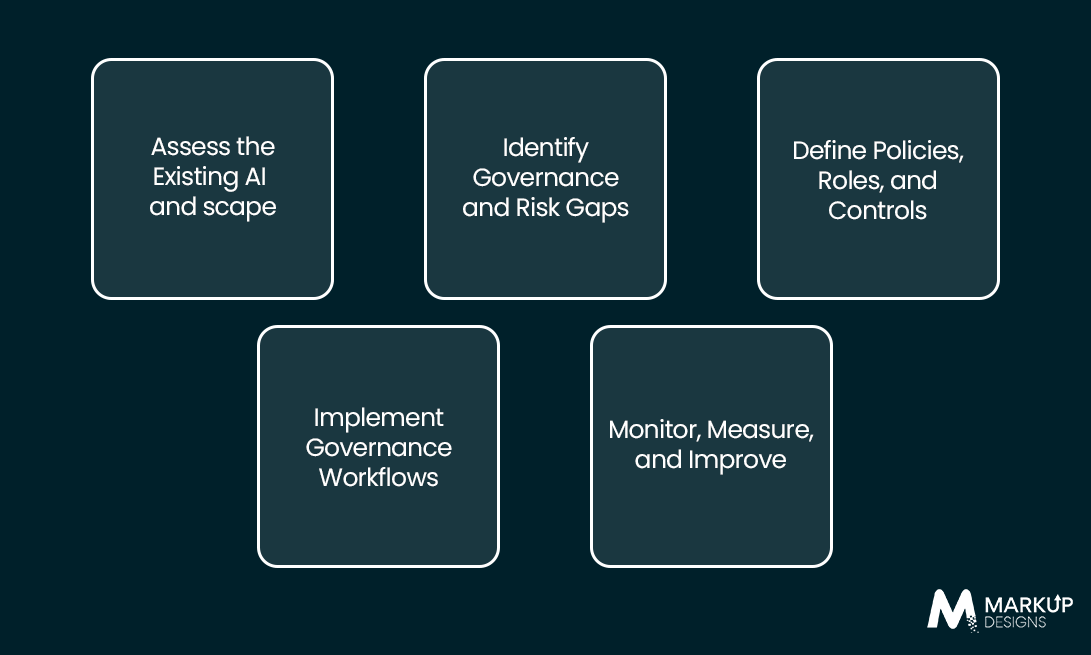
Step 1: Assess the Existing AI Landscape
Identify AI systems, use cases, models, vendors, data sources, and existing governance practices across the organization.
Step 2: Identify Governance and Risk Gaps
Compare the current AI environment against defined governance objectives, risk requirements, policies, and applicable obligations to identify areas requiring improvement.
Step 3: Define Policies, Roles, and Controls
Establish governance policies, assign ownership, classify AI risks, and define the controls required for different types of AI applications.
Step 4: Implement Governance Workflows
Integrate AI assessments, approvals, testing, documentation, monitoring, incident management, and review processes into existing business and technology workflows.
Step 5: Monitor, Measure, and Improve
Track governance performance, review AI risks and incidents, assess control effectiveness, and continuously refine the framework based on operational findings and changing requirements.
Measuring the Effectiveness of AI Governance
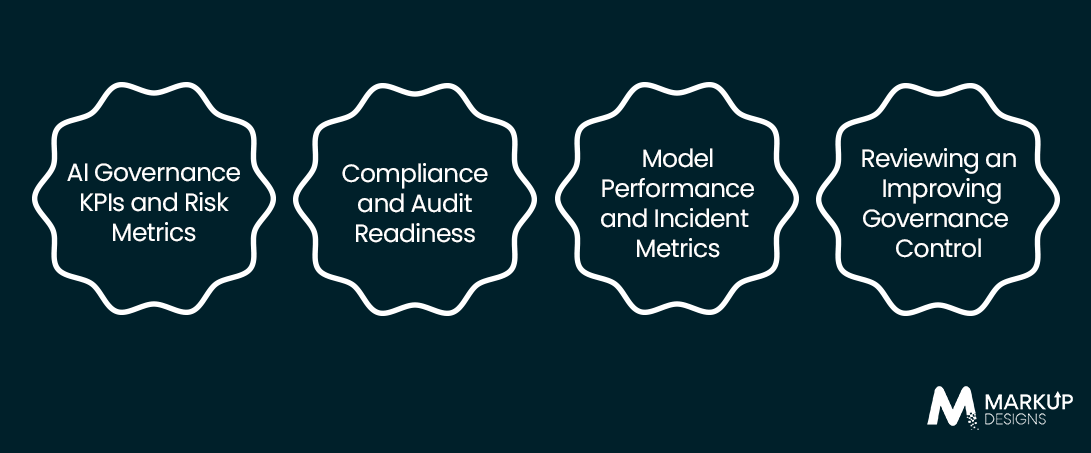
AI Governance KPIs and Risk Metrics
Track measurable indicators such as assessment completion, policy compliance, unresolved risks, control effectiveness, incident frequency, and remediation timelines.
Compliance and Audit Readiness
Measure the organization’s ability to maintain required evidence, demonstrate control effectiveness, respond to audits, and address identified compliance gaps.
Model Performance and Incident Metrics
Monitor model accuracy, drift, reliability, security events, privacy incidents, and other indicators relevant to individual AI systems.
Reviewing and Improving Governance Controls
Conduct periodic governance reviews to determine whether existing policies and controls remain effective as AI systems, business requirements, risks, and regulations evolve.
Build a Practical AI Governance Framework
Turn AI governance principles into measurable policies, risk controls, and lifecycle processes. Establish the right governance structure to manage AI risks, strengthen accountability, and support responsible AI adoption across your organization.

Conclusion
AI governance and risk management are not one-time compliance exercises. As organizations expand their use of AI, governance must operate throughout the AI lifecycle—from evaluating a proposed use case and validating its data to monitoring deployed models, managing incidents, and retiring systems responsibly. A structured framework gives organizations the processes, ownership, controls, and documentation needed to understand and manage AI-related risks as they evolve.
The practical objective is to build governance into everyday AI operations rather than treating it as a separate oversight layer. By establishing clear responsibilities, applying risk-based controls, maintaining continuous monitoring, and regularly reviewing governance practices, organizations can create an AI environment that is accountable, transparent, and adaptable. This approach allows businesses to scale AI initiatives while maintaining appropriate oversight of the risks associated with increasingly complex AI systems.
FAQs
1. What is AI governance and why is it important?
AI governance is the set of policies, processes, roles, and controls used to oversee how an organization develops, deploys, and uses artificial intelligence. It helps establish accountability and manage risks related to data privacy, security, bias, transparency, compliance, and model performance. Effective AI governance also provides a structured approach for scaling AI while maintaining appropriate human oversight and organizational control.
2. What are the key components of an AI governance framework?
An AI governance framework typically includes governance policies, defined roles and responsibilities, AI risk classification, use-case assessment and approval processes, data governance, model validation, security controls, human oversight, documentation, audit trails, continuous monitoring, and incident management. The specific controls should reflect the organization’s AI use cases, risk exposure, industry requirements, and regulatory obligations.
3. What are the most common AI risks for enterprises?
Common enterprise AI risks include inaccurate or unreliable outputs, algorithmic bias, data privacy violations, cybersecurity threats, unauthorized AI use, intellectual property concerns, regulatory non-compliance, inadequate transparency, model drift, and third-party technology risks. The significance of each risk depends on factors such as the AI system’s purpose, data sensitivity, level of autonomy, and potential impact on individuals or business operations.
4. How can organizations manage AI risks effectively?
Organizations can manage AI risks by establishing a structured risk-management process that covers the complete AI lifecycle. This includes assessing use cases before development, classifying risks, validating data and models, applying security and privacy controls, defining human oversight, monitoring deployed systems, documenting governance decisions, and establishing incident-response and remediation procedures.
5. How does AI governance support regulatory compliance?
AI governance helps organizations translate applicable legal and regulatory requirements into operational policies and controls. Maintaining documented risk assessments, data practices, model testing, approvals, monitoring activities, and audit trails can help demonstrate how AI systems are being managed. Organizations should map their governance framework to the specific regulations and industry requirements applicable to their operations rather than relying on a one-size-fits-all approach.
6. Who should be responsible for AI governance?
AI governance should be a cross-functional responsibility with clear ownership rather than being assigned entirely to one technical team. Leadership establishes direction and accountability, while functions such as IT, data, cybersecurity, legal, compliance, risk, and business teams contribute according to their responsibilities. Dedicated AI governance or risk committees can also coordinate oversight for organizations with extensive or high-impact AI use.
7. How can businesses monitor AI systems after deployment?
Businesses can monitor deployed AI systems by tracking model performance, data and model drift, output quality, bias and fairness indicators, security events, privacy risks, policy compliance, and operational incidents. Monitoring should be supported by defined thresholds, escalation procedures, periodic reviews, and documented remediation processes so that emerging issues can be addressed rather than discovered only during periodic audits.
8. How can organizations implement AI governance at scale?
Organizations can implement AI governance at scale by first creating visibility into their AI landscape and then establishing standardized risk classifications, policies, approval workflows, controls, documentation requirements, and monitoring processes. Governance can be integrated into existing development, security, compliance, and risk-management workflows and supported through automation where appropriate. A risk-based approach allows organizations to apply stronger oversight to high-impact AI systems without imposing the same level of controls on every use case.
Author's Perspective
AI governance becomes difficult when organizations treat it as a policy document instead of an operating framework. Writing guidelines is relatively easy; making those guidelines work across real AI use cases, teams, vendors, data environments, and production systems is where the real challenge lies.
A practical governance model should therefore be proportionate to risk and built into existing business and technology workflows. Organizations should start by gaining visibility into how AI is actually being used, identify their highest-priority risks, establish clear ownership, and then introduce controls that can be measured and improved over time. Governance should enable informed AI adoption—not become a disconnected process that slows every AI initiative.
Discuss Your Project NowAjit Kumar Jha
VP - Business Operations
Insights Are Valuable & Execution is Priceless
You’ve read about the digital future. Now, let’s build the infrastructure to take you there. Move your strategy from the page to the product.
Design Your Solution Now
Contact Us
Schedule The Appointment At Your Convenience Date And Time.
30 Min
Web Conference
Time Zone
Indian standard time (08:30pm)

Thanks For Getting In Touch!
You’ve Taken The First Step Toward Transforming Your Digital Presence. Our Experts Will Reach Out Shortly To Take It Forward.
Launch Your Dream Project
Provide a brief overview of your project, and our specialists will evaluate your requirements. We will connect with you to explore how the right digital solutions can help you launch faster.