
In Brief
- Artificial Intelligence helps businesses automate operations, improve decision-making, enhance customer experiences, and drive innovation. However, successful AI adoption requires more than implementing AI tools, it demands a clear strategy, quality data, skilled teams, and alignment with business objectives.
- Organizations often face challenges such as poor data quality, legacy system integration, talent shortages, employee resistance, security concerns, and governance issues. Addressing these barriers through proper planning and change management is essential for successful AI implementation.
- Businesses can improve AI adoption by defining measurable goals, building a strong data foundation, starting with pilot projects, integrating AI with existing systems, ensuring responsible AI governance, and continuously monitoring and optimizing AI performance.
- AI is transforming industries including healthcare, finance, retail, manufacturing, logistics, education, real estate, and human resources by increasing efficiency, reducing costs, improving customer experiences, and enabling data-driven decision-making.
- Measuring AI success through KPIs such as ROI, productivity, cost savings, customer satisfaction, accuracy, and employee adoption helps organizations maximize long-term value. As AI continues to evolve, businesses that embrace responsible and strategic AI adoption will gain a sustainable competitive advantage.
Artificial Intelligence is no longer a futuristic concept, it has become a powerful business tool that helps organizations automate processes, improve decision-making, enhance customer experiences, and drive innovation. From healthcare and finance to retail and manufacturing, businesses across industries are investing heavily in AI to stay competitive in an increasingly digital world.
However, while AI adoption continues to grow, many organizations still struggle to move beyond the planning or pilot stage. Challenges such as poor data quality, integration with legacy systems, lack of skilled talent, security concerns, and unclear business objectives often slow down successful implementation.
The good news is that these challenges can be resolved with the right strategy, planning, and technology partner. In this blog, we’ll explore the most common AI adoption challenges businesses face, practical implementation strategies to overcome them, best practices for long-term success, industry use cases, and key metrics to measure AI performance.
Whether you’re just starting your AI journey or looking to scale existing initiatives, this blog will help you adopt AI with greater confidence and achieve meaningful business outcomes.
What is AI Adoption?
AI adoption is the process of introducing artificial intelligence into business operations to improve efficiency, automate repetitive tasks, and support better decision-making. Instead of relying only on manual work, businesses use AI technologies such as machine learning, natural language processing, computer vision, and predictive analytics to solve problems and create new opportunities.
AI adoption is more than simply implementing an AI tool. It involves identifying the right business problems, preparing quality data, integrating AI with existing systems, training employees, and continuously monitoring performance. A successful AI adoption strategy ensures that AI aligns with business goals and delivers measurable value. When implemented correctly, AI helps organizations increase productivity, reduce costs, improve customer experiences, and gain a competitive advantage in today’s fast-changing digital landscape.
Why AI Adoption Matters for Modern Businesses
AI is changing the way businesses operate by making processes faster, smarter, and more efficient. It helps organizations automate repetitive tasks, analyze large amounts of data, and make informed decisions in less time.
As customer expectations continue to grow, AI also enables businesses to deliver personalized experiences, improve service quality, and respond quickly to changing market demands.
Adopting AI is no longer just about keeping up with technology, it is about staying competitive. Businesses that successfully implement AI can reduce operational costs, improve productivity, identify new growth opportunities, and make better strategic decisions.
AI also supports innovation by helping organizations develop smarter products and services while improving overall business performance. As industries continue to embrace digital transformation, AI adoption has become a key driver of long-term success, helping businesses stay agile, scalable, and prepared for future challenges.
Common AI Adoption Challenges
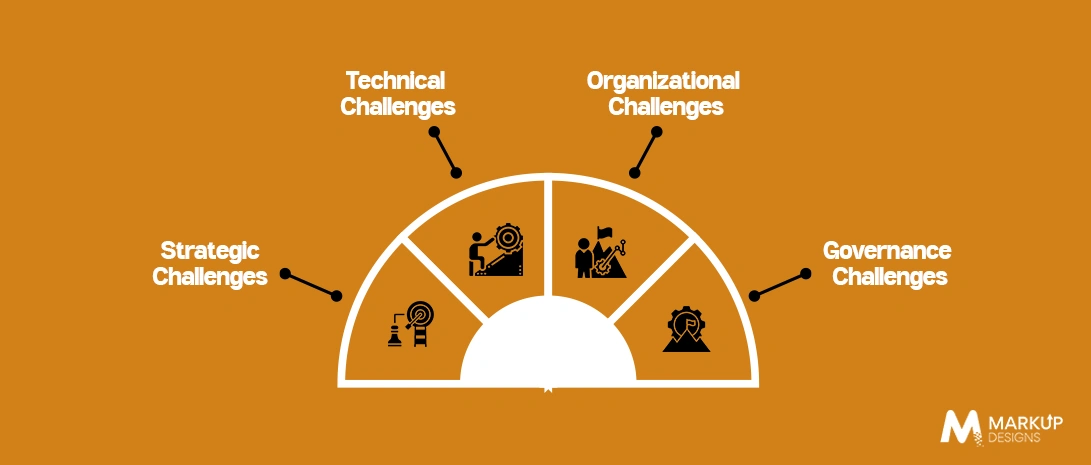
While AI offers many benefits, successfully adopting it comes with its own challenges. Many organizations invest in AI with high expectations but face several obstacles during implementation. These challenges can delay projects, increase costs, and reduce the overall value of AI initiatives. Understanding these barriers is the first step toward building a successful AI strategy.
Strategic Challenges
One of the biggest reasons AI projects fail is the lack of a clear business strategy. Many companies use AI just because it’s trending, not because they actually need it to fix a business problem. Without clear objectives, measurable goals, and a well-defined roadmap, AI initiatives often fail to deliver the expected results.
Another common challenge is unrealistic expectations. Some businesses expect AI to provide instant returns, while successful AI adoption usually requires continuous improvement, quality data, and long-term investment. Organizations also struggle to identify the right use cases, making it difficult to prioritize projects that deliver the highest business value.
Technical Challenges
AI systems rely on high-quality data. However, many organizations have incomplete, outdated, or inconsistent data stored across different systems. Poor data quality leads to inaccurate AI models and unreliable predictions.
Integrating AI with existing legacy systems is another major technical challenge. Older software and infrastructure may not support modern AI technologies, making implementation more complex and expensive. Businesses may also face scalability issues when expanding AI solutions across multiple departments. In addition, limited computing resources and outdated IT infrastructure can slow down AI deployment and affect performance.
Organizational Challenges
AI adoption is not just a technology project, it also requires people to embrace new ways of working. Employees may worry that AI will replace their jobs, leading to resistance and slow adoption. Without proper communication and change management, organizations often struggle to build trust in AI solutions.
Another challenge is the shortage of skilled AI professionals. Hiring experienced AI engineers, data scientists, and machine learning experts can be difficult and costly. Many organizations also lack internal knowledge about AI, which makes employee training and upskilling essential for long-term success.
Governance Challenges
As AI becomes more widely used, businesses must ensure it is secure, ethical, and compliant with regulations. AI systems often process large amounts of sensitive customer and business data, making privacy and cybersecurity top priorities.
Organizations also need strong AI governance to ensure transparency, fairness, and accountability in AI-driven decisions. Poor governance can lead to biased outcomes, compliance risks, and loss of customer trust. Establishing clear policies for data management, risk assessment, model monitoring, and regulatory compliance helps businesses use AI responsibly while protecting their reputation and maintaining long-term success.
Effective AI Implementation Strategies
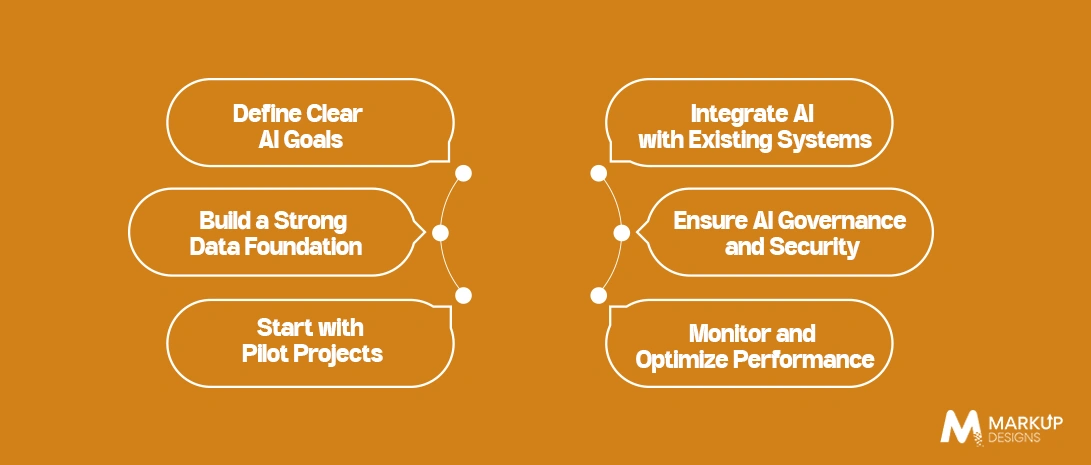
A successful AI implementation requires more than selecting the right technology. Businesses need a clear strategy, quality data, skilled teams, and continuous monitoring to ensure AI delivers measurable results. By following a structured implementation approach, organizations can reduce risks and maximize the value of their AI investments.
1. Define Clear AI Goals
Start by identifying the business problems AI should solve. Set measurable objectives that align with your business goals, such as improving customer service, reducing operational costs, or increasing productivity.
2. Build a Strong Data Foundation
AI performs best with accurate, complete, and well-organized data. Clean and standardize your data, eliminate duplicates, and establish proper data governance to improve AI model performance.
3. Start with Pilot Projects
Instead of deploying AI across the entire organization, begin with a small pilot project. This allows businesses to test AI solutions, measure results, identify challenges, and make improvements before scaling.
4. Integrate AI with Existing Systems
Ensure your AI solution works smoothly with your current software, databases, and business applications. Proper integration minimizes disruptions and improves overall operational efficiency.
5. Ensure AI Governance and Security
Create policies for data privacy, security, ethical AI usage, and regulatory compliance. Regularly monitor AI models to maintain transparency, reduce bias, and protect sensitive business information.
6. Monitor and Optimize Performance
AI implementation is an ongoing process. Track key performance indicators, collect user feedback, retrain AI models with new data, and continuously optimize performance to ensure long-term business value.
Ready to Overcome AI Adoption Challenges?
Transform your AI vision into measurable business results with tailored implementation strategies, seamless integration, and expert guidance designed to maximize ROI and accelerate enterprise innovation.

Best Practices for Successful AI Adoption
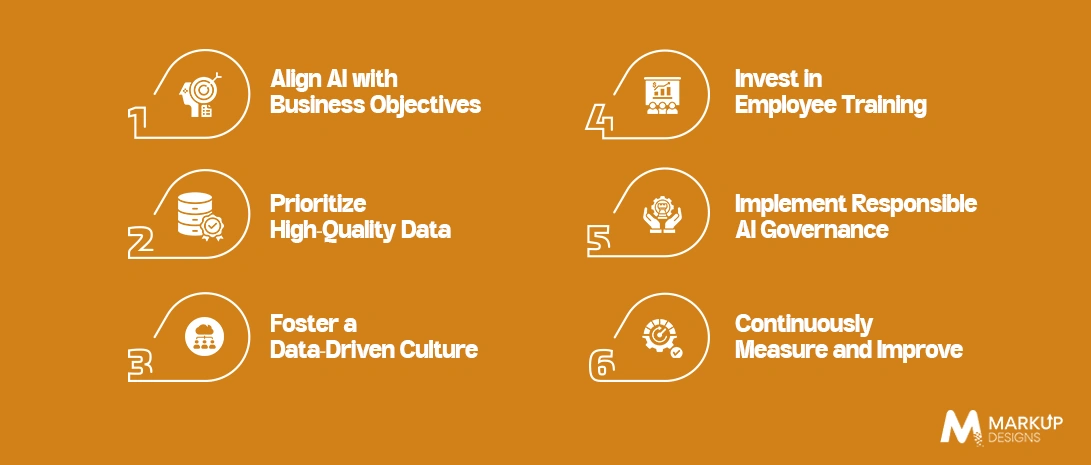
Implementing AI is only the beginning. To achieve long-term success, businesses need to follow best practices that ensure AI continues to deliver value as the organization grows. A well-planned approach helps improve adoption, reduce risks, and maximize return on investment.
1. Align AI with Business Objectives
Every AI initiative should support a specific business goal. Whether it’s improving customer service, reducing costs, or increasing productivity, AI should solve real business challenges rather than being adopted just because it’s a trending technology.
2. Prioritize High-Quality Data
The success of AI depends on the quality of the data it uses. Businesses should regularly clean, organize, and update their data to ensure AI models generate accurate and reliable insights.
3. Foster a Data-Driven Culture
Encourage employees to use data and AI insights when making decisions. Building a culture that values innovation and continuous learning helps improve AI adoption across the organization.
4. Invest in Employee Training
Provide employees with the knowledge and skills needed to work alongside AI tools. Regular training sessions and workshops help teams understand AI capabilities and reduce resistance to change.
5. Implement Responsible AI Governance
Establish clear policies for data privacy, security, ethical AI practices, and regulatory compliance. Responsible AI governance builds trust among customers, employees, and stakeholders.
6. Continuously Measure and Improve
AI is not a one-time investment. Regularly monitor performance, gather feedback, measure business outcomes, and update AI models to ensure they continue delivering accurate results and long-term value.
Read Also: Is Your Business Ready for AI Adoption? AI Readiness Guide
AI Adoption Use Cases Across Industries
AI is transforming industries by helping businesses automate tasks, improve decision-making, and deliver better customer experiences. While the implementation may vary from one industry to another, the goal remains the same-improving efficiency, reducing costs, and driving business growth.
Healthcare
Healthcare organizations use AI to support disease diagnosis, analyze medical images, predict patient risks, and automate administrative tasks. AI also helps doctors make faster decisions and improves patient care through personalized treatment recommendations.
Finance and Banking
Banks and financial institutions use AI to detect fraudulent transactions, assess credit risk, automate customer support through AI chatbots, and provide personalized financial advice. This improves security while enhancing the overall customer experience.
Retail and E-commerce
Retail businesses use AI to recommend products, manage inventory, forecast demand, and personalize marketing campaigns. AI-powered analytics also help businesses understand customer behavior and improve sales performance.
Manufacturing
Manufacturers use AI for predictive maintenance, quality inspection, production planning, and supply chain optimization. AI reduces equipment downtime, improves product quality, and increases operational efficiency.
Logistics and Transportation
AI helps logistics companies optimize delivery routes, predict shipment delays, automate warehouse operations, and improve fleet management. These capabilities reduce transportation costs and ensure faster deliveries.
Education
Educational institutions use AI to create personalized learning experiences, automate administrative processes, evaluate student performance, and provide virtual tutoring. AI makes learning more engaging and accessible for students.
Real Estate
Real estate companies use AI to analyze market trends, estimate property values, recommend suitable properties, and automate customer interactions. AI also simplifies property management and improves investment decisions.
Human Resources
HR teams use AI to screen resumes, match candidates with job requirements, automate interview scheduling, and improve employee engagement. This speeds up recruitment while helping businesses hire the right talent more efficiently.
As AI technology continues to evolve, more industries are discovering innovative ways to improve operations, enhance customer satisfaction, and stay competitive in an increasingly digital business environment.
Essential KPIs for Measuring AI Success
Implementing AI is only the first step. To understand whether your AI initiatives are delivering real business value, you need to measure their performance using the right Key Performance Indicators (KPIs). Tracking these metrics helps businesses identify what’s working, make improvements, and maximize the return on their AI investments.
ROI (Return on Investment)
ROI measures whether your AI investment is generating financial value. Compare the cost of implementing AI with the revenue generated or the expenses reduced to evaluate its overall impact.
Cost Savings
One of the biggest advantages of AI is reducing operational costs. Businesses can measure savings by tracking reductions in manual work, maintenance costs, customer support expenses, and process inefficiencies.
Productivity Gains
AI automates repetitive tasks, allowing employees to focus on higher-value work. Measuring improvements in employee productivity, task completion rates, and operational efficiency shows how AI is improving business performance.
Customer Satisfaction
AI-powered chatbots, recommendation engines, and personalized services can improve customer experiences. Businesses can monitor customer satisfaction through surveys, feedback scores, retention rates, and support response times.
Time Savings
AI helps complete tasks much faster than manual processes. Measuring the reduction in processing time, report generation, customer response time, or workflow completion helps demonstrate AI’s efficiency.
Accuracy
The accuracy of AI models directly affects business outcomes. Track prediction accuracy, error rates, quality improvements, and decision-making performance to ensure your AI system is delivering reliable results.
Employee Adoption
The success of AI also depends on how well employees use it. Monitor user adoption rates, employee feedback, training completion, and daily usage to understand how effectively AI has been integrated into business operations.
Revenue Growth
AI can contribute to higher sales through better customer targeting, personalized recommendations, and improved business decisions. Measuring revenue growth, conversion rates, and customer lifetime value helps determine AI’s contribution to overall business growth.
By regularly monitoring these KPIs, businesses can identify improvement opportunities, optimize AI performance, and ensure their AI initiatives continue to deliver measurable value over time.
Future Trends in Enterprise AI Adoption
AI is evolving rapidly, and businesses that stay ahead of emerging trends will be better positioned to compete in the future. One of the biggest trends is the growing use of Generative AI to automate content creation, software development, customer support, and knowledge management. Businesses are also adopting AI copilots that assist employees with everyday tasks, improving productivity across departments.
Another important trend is Responsible AI, where organizations focus on transparency, fairness, data privacy, and regulatory compliance. As AI becomes more integrated into business operations, explainable AI and strong governance frameworks will become essential.
Edge AI is also gaining popularity by processing data closer to where it is generated, reducing latency and improving real-time decision-making. At the same time, AI-powered automation will continue to streamline business processes, while predictive analytics will help organizations make smarter decisions based on data. In the coming years, AI will become a core part of enterprise operations, driving innovation, efficiency, and long-term business growth.
Why Choose Markup Designs for AI Implementation
Successfully adopting AI requires the right technology partner. At Markup Designs, we help businesses turn AI ideas into practical, scalable solutions that deliver measurable results. From AI consulting and strategy development to custom AI application development and enterprise integration, our team supports every stage of your AI journey.
We work closely with businesses to understand their goals, identify the right AI use cases, prepare data, and implement solutions that integrate seamlessly with existing systems. Our expertise covers machine learning, generative AI, computer vision, natural language processing, AI automation, and predictive analytics.
We also prioritize security, compliance, and responsible AI practices, ensuring your AI solutions remain reliable, scalable, and future-ready. Whether you’re launching your first AI initiative or expanding AI across your organization, Markup Designs provides the expertise needed to accelerate digital transformation and maximize your return on investment.
Turn AI Strategy into Business Success
From AI consulting and roadmap development to deployment and optimization, our experts help you implement scalable, secure, and future-ready AI solutions that drive long-term growth.

Conclusion
AI has become a key driver of business innovation, helping organizations improve efficiency, automate operations, and make smarter decisions. However, successful AI adoption requires more than advanced technology. Businesses need a clear strategy, high-quality data, skilled teams, effective governance, and continuous optimization to overcome implementation challenges.
By understanding the common barriers to AI adoption and following proven implementation strategies, organizations can reduce risks and unlock the full potential of AI. As AI continues to evolve, businesses that invest in responsible and well-planned AI adoption will be better prepared to improve customer experiences, increase productivity, and achieve sustainable growth in an increasingly competitive market.
FAQs
1. What is AI adoption?
AI adoption is the process of integrating artificial intelligence technologies into business operations to automate tasks, improve decision-making, and increase overall efficiency.
2. What are the biggest challenges in AI adoption?
Some of the most common challenges include unclear business goals, poor data quality, legacy system integration, skills shortages, employee resistance, and governance or compliance issues.
3. How can businesses successfully implement AI?
Businesses should define clear objectives, build a strong data foundation, start with pilot projects, integrate AI with existing systems, ensure proper governance, and continuously monitor performance.
4. Which industries benefit the most from AI?
AI is widely used across healthcare, finance, retail, manufacturing, logistics, education, real estate, and many other industries to improve efficiency and customer experiences.
5. How do you measure the success of AI implementation?
AI success can be measured using KPIs such as ROI, cost savings, productivity improvements, customer satisfaction, accuracy, employee adoption, time savings, and revenue growth.
Author's Perspective
Artificial intelligence is no longer an optional investment for businesses aiming to stay competitive. However, technology alone cannot guarantee success. The organizations that achieve the best results are those that treat AI as a long-term business strategy rather than a one-time technology project. They focus on solving real business problems, preparing quality data, training their workforce, and continuously improving their AI systems. As AI capabilities continue to advance, businesses that adopt a strategic and responsible approach will be better equipped to innovate, respond to market changes, and create lasting value. The future belongs to organizations that embrace AI with clear goals, strong governance, and a commitment to continuous learning and improvement.
Discuss Your Project NowAjit Kumar Jha
VP - Business Operations
Related Posts
How to Build Production-Ready Applications with AI Coding...
Cost, Benefits & Business Impact: Generative AI vs....
Enterprise AI Agents: Practical Use Cases Driving Business...
Insights Are Valuable & Execution is Priceless
You’ve read about the digital future. Now, let’s build the infrastructure to take you there. Move your strategy from the page to the product.
Design Your Solution Now
Contact Us
Schedule The Appointment At Your Convenience Date And Time.
30 Min
Web Conference
Time Zone
Indian standard time (08:30pm)

Thanks For Getting In Touch!
You’ve Taken The First Step Toward Transforming Your Digital Presence. Our Experts Will Reach Out Shortly To Take It Forward.
Launch Your Dream Project
Provide a brief overview of your project, and our specialists will evaluate your requirements. We will connect with you to explore how the right digital solutions can help you launch faster.