

In Brief
- Learn what an offshore development team is, how it works, and the key roles involved in building a successful remote software development team.
- Explore why businesses are increasingly hiring offshore developers in 2026, highlighting benefits such as cost savings, access to global talent, scalability, and faster product delivery.
- Understand the different offshore hiring models, including dedicated teams, IT staff augmentation, project-based outsourcing, and Build-Operate-Transfer (BOT), to choose the right approach.
- Follow a step-by-step guide to hiring an offshore development team, along with the essential qualities to look for in a reliable offshore development partner.
- Discover offshore development costs, common hiring mistakes to avoid, best practices for successful collaboration, and how the right offshore partner can drive long-term business growth.
As businesses continue to embrace digital transformation, the demand for skilled software developers is growing faster than ever. However, hiring and maintaining an in-house development team can be expensive, time-consuming, and challenging, especially when there is a shortage of specialized talent. This is why many organizations are choosing to hire an offshore development team to accelerate product development, reduce operational costs, and gain access to a global pool of experienced professionals.
Whether you’re a startup building your first product, a growing business scaling your engineering capabilities, or an enterprise looking to speed up innovation, offshore software development offers a flexible and cost-effective solution tailored to your needs.
In this blog, we’ll explain what an offshore development team is, how offshore development works, its key benefits, hiring models, costs, best practices, and common mistakes to avoid. By the end, you’ll have a clear understanding of how to hire offshore developers and choose the right offshore development partner for your business goals in 2026.
What is an Offshore Development Team?
An offshore development team is a group of software professionals located in another country who work remotely to design, develop, test, and maintain software applications for your business. Companies choose offshore software development to access skilled talent, reduce development costs, and accelerate project delivery without the challenges of expanding an in-house team.
Offshore development works by partnering with an offshore software development company that provides dedicated professionals based on your project requirements. These experts collaborate with your in-house team using agile methodologies, project management tools, video conferencing, and real-time communication platforms. This enables businesses to maintain transparency, track progress, and ensure smooth collaboration despite geographical differences.
A typical dedicated offshore development team consists of specialists with different technical and business expertise, each playing a crucial role throughout the software development lifecycle.
| Team Role | Responsibilities |
| Project Manager | Oversees project planning, timelines, resource allocation, communication, and ensures successful project delivery. |
| Business Analyst | Understands business objectives, gathers requirements, and translates them into detailed technical specifications. |
| UI/UX Designer | Designs intuitive, user-friendly interfaces and creates engaging user experiences that align with business goals. |
| Frontend Developer | Builds responsive and interactive user interfaces using modern web technologies and frameworks. |
| Backend Developer | Develops server-side logic, APIs, databases, and ensures application performance, scalability, and security. |
| Mobile Developer | Creates native or cross-platform mobile applications for Android and iOS devices with seamless functionality. |
| QA Engineer | Performs manual and automated testing to identify bugs, verify quality, and ensure reliable software performance. |
| DevOps Engineer | Manages cloud infrastructure, CI/CD pipelines, deployment automation, monitoring, and system reliability. |
Depending on your project scope, you can hire the entire team or select specific specialists to build an offshore development team that perfectly matches your business needs. This flexibility makes offshore development services an ideal choice for startups, SMEs, and enterprises looking to scale efficiently while maintaining high-quality software development.
Why Businesses are Choosing Offshore Development Teams in 2026
In 2026, businesses are under constant pressure to innovate faster, launch products quickly, and optimize development costs while maintaining high-quality standards. At the same time, finding experienced software developers locally has become increasingly difficult due to rising salaries, talent shortages, and intense competition. As a result, more organizations are choosing offshore development teams as a strategic solution to meet their technology goals.
One of the biggest reasons companies invest in offshore software development is access to a global talent pool. Instead of limiting hiring to a single location, businesses can work with highly skilled developers who specialize in modern technologies such as AI, cloud computing, blockchain, IoT, and mobile app development.
Cost efficiency is another major advantage. By partnering with an experienced offshore software development company, businesses can significantly reduce recruitment, infrastructure, employee benefits, and operational expenses without compromising on quality.
Offshore development also offers greater flexibility and scalability. Whether you need a dedicated offshore development team for a long-term product or additional developers to support an ongoing project, you can quickly scale your team up or down based on changing business requirements.
Furthermore, modern collaboration tools, agile methodologies, cloud platforms, and overlapping work schedules have made remote collaboration more efficient than ever. With the right offshore development partner, businesses benefit from transparent communication, faster development cycles, continuous delivery, and round-the-clock productivity.
As organizations continue to prioritize digital transformation, offshore IT outsourcing has become more than a cost-saving strategy, it’s a competitive advantage that helps businesses innovate faster, access specialized expertise, and accelerate business growth.
Key Benefits of Hiring an Offshore Development Team
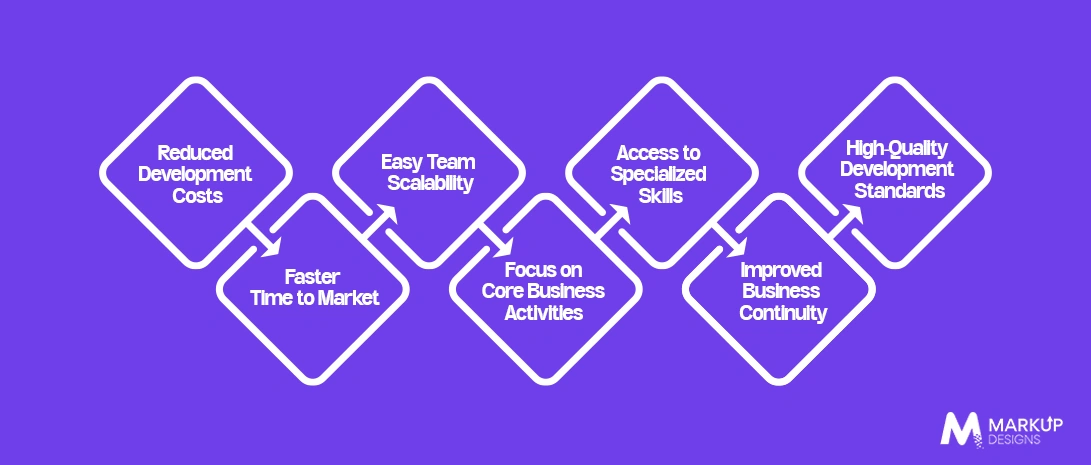
Hiring an offshore development team offers more than just cost savings. It enables businesses to access specialized expertise, accelerate software delivery, and scale development resources based on project needs. Here are some of the key benefits of offshore software development:
| Benefit | How It Helps Your Business |
| Access to Global Talent | Hire offshore developers with expertise in the latest technologies, frameworks, and industry-specific solutions from a worldwide talent pool. |
| Reduced Development Costs | Save on recruitment, salaries, office infrastructure, employee benefits, and operational expenses while maintaining high-quality software development. |
| Faster Time to Market | Expand your development capacity and complete projects more quickly, helping you launch products and features ahead of competitors. |
| Easy Team Scalability | Scale your dedicated offshore development team up or down based on project requirements without the complexities of traditional hiring. |
| Focus on Core Business Activities | Delegate software development to experienced professionals while your internal team concentrates on business strategy, innovation, and customer growth. |
| Access to Specialized Skills | Work with experts in AI, cloud computing, DevOps, cybersecurity, mobile app development, blockchain, and other emerging technologies. |
| Improved Business Continuity | Distributed teams and flexible working hours enable continuous development, faster issue resolution, and reduced project downtime. |
| High-Quality Development Standards | Established offshore development partners follow agile methodologies, coding standards, quality assurance processes, and security best practices to deliver reliable software. |
Whether you’re building a new digital product, modernizing legacy systems, or expanding your engineering capabilities, offshore development services provide the flexibility, expertise, and efficiency needed to achieve your business objectives. With the right offshore development partner, you can accelerate innovation while optimizing both development costs and project outcomes.
Different Offshore Hiring Models
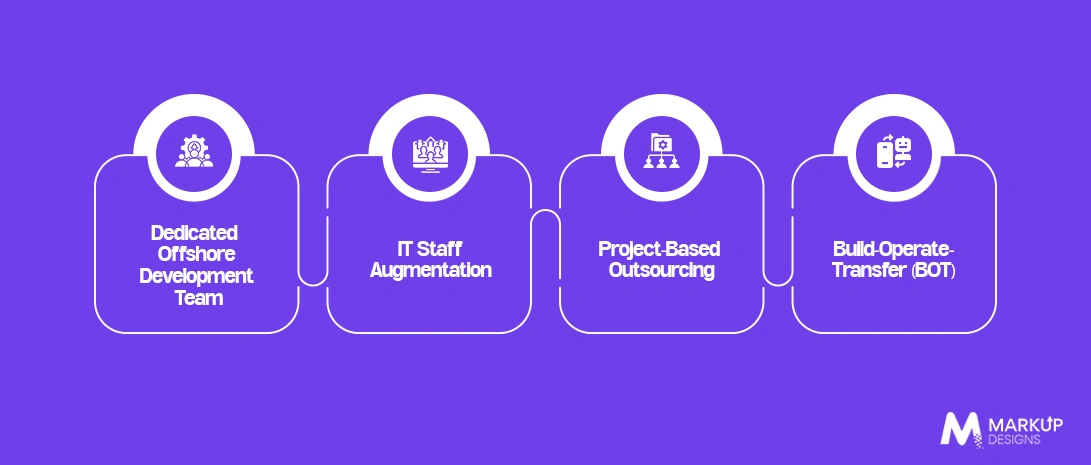
Choosing the right offshore hiring model is just as important as selecting the right development partner. Every business has unique project requirements, budget considerations, and scalability needs. Whether you’re building a new product, extending your existing team, or outsourcing an entire project, selecting the appropriate engagement model ensures better collaboration and successful project delivery.
1. Dedicated Offshore Development Team
A dedicated offshore development team works exclusively on your project and functions as an extension of your in-house team. This model is ideal for long-term projects, product development, and businesses that require complete control over the development process. You can scale the team as your project evolves while maintaining consistent collaboration.
2. IT Staff Augmentation
IT staff augmentation allows you to hire offshore developers with specific skills to strengthen your existing team. It’s a flexible option for businesses that need additional expertise, want to fill temporary skill gaps, or require extra resources during peak development phases without hiring full-time employees.
3. Project-Based Outsourcing
In this model, the offshore software development company takes complete responsibility for delivering the project based on predefined requirements, timelines, and budgets. It’s best suited for businesses with clearly defined project scopes that prefer minimal involvement in day-to-day development activities.
4. Build-Operate-Transfer (BOT)
The Build-Operate-Transfer model is designed for organizations planning long-term offshore operations. The offshore development partner builds and manages the development center, recruits the team, establishes processes, and handles operations. Once the setup is fully operational, ownership of the team and infrastructure is transferred to your organization.
| Hiring Model | Best For | Level of Control | Scalability |
| Dedicated Development Team | Long-term product development | High | High |
| IT Staff Augmentation | Skill gaps and resource expansion | High | Very High |
| Project-Based Outsourcing | Fixed-scope projects | Medium | Medium |
| Build-Operate-Transfer (BOT) | Establishing offshore operations | Very High | High |
Selecting the right offshore hiring model depends on your business goals, project complexity, budget, and long-term growth strategy. Evaluating these factors will help you build an offshore development team that delivers maximum value and supports sustainable business growth.
Looking to Hire an Offshore Development Team That Delivers Results?
Partner with Markup Designs to access experienced offshore software developers, reduce development costs, and accelerate your digital transformation journey with confidence.

Step-by-Step Process to Hire an Offshore Development Team
Hiring the right offshore development team requires a structured approach to ensure successful collaboration and high-quality outcomes. Follow these essential steps:
1. Define Your Project Requirements
Clearly outline your business goals, project scope, technology stack, budget, timeline, and expected deliverables before beginning the hiring process.
2. Choose the Right Hiring Model
Select between a dedicated offshore development team, IT staff augmentation, project-based outsourcing, or BOT based on your business objectives.
3. Research Offshore Development Companies
Evaluate companies based on their industry experience, technical expertise, client reviews, portfolios, certifications, and successful project delivery.
4. Assess Technical Capabilities
Review developers’ technical skills, communication abilities, development methodologies, and experience with technologies relevant to your project.
5. Verify Security & Compliance
Ensure your offshore development partner follows NDA agreements, IP protection, secure coding standards, and international compliance requirements.
6. Conduct Interviews
Interview key team members to evaluate technical knowledge, problem-solving skills, communication, and cultural compatibility.
7. Start with a Pilot Project
Begin with a small project to assess collaboration, quality standards, responsiveness, and delivery performance before scaling the engagement.
8. Establish Communication & Governance
Set clear communication channels, reporting structures, project management tools, sprint planning, and performance metrics for seamless collaboration.
Essential Skills and Qualities to Look for in an Offshore Development Partner
Choosing the right offshore development partner is crucial for long-term project success. Here are the qualities you should evaluate before making a decision.
| Quality | Why It Matters |
| Technical Expertise | Strong experience in modern technologies, frameworks, cloud platforms, AI, mobile, and web development. |
| Proven Industry Experience | A successful portfolio demonstrates the ability to deliver projects across multiple industries. |
| Transparent Communication | Regular updates, dedicated project managers, and clear documentation ensure smooth collaboration. |
| Agile Development Process | Agile methodologies improve flexibility, transparency, and faster product delivery. |
| Scalability | The ability to quickly expand or reduce team size as project requirements evolve. |
| Security & Compliance | Strong data protection, NDA policies, IP security, and compliance with international standards. |
| Quality Assurance | Well-defined testing processes ensure reliable, bug-free, and high-performing software. |
| Post-Launch Support | Ongoing maintenance, monitoring, updates, and technical support after deployment. |
Factors Affecting Offshore Development Costs
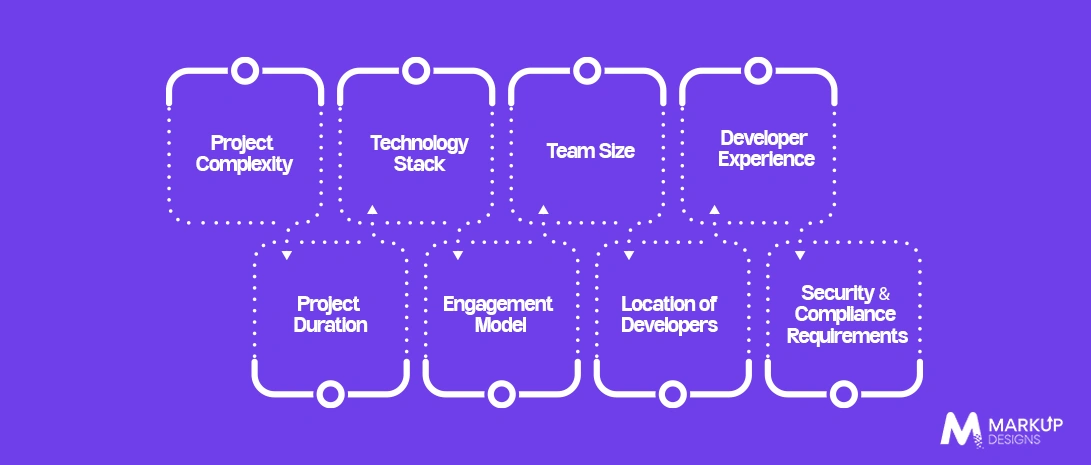
Several factors influence the overall offshore development team cost:
- Project Complexity – Advanced features, third-party integrations, and custom functionality require more development effort.
- Technology Stack – Emerging technologies such as AI, blockchain, cloud computing, and IoT increase development costs.
- Team Size – Larger teams require greater investment but enable faster project execution.
- Developer Experience – Senior developers and specialized architects generally command higher rates.
- Project Duration – Long-term projects involve ongoing development, maintenance, and support costs.
- Engagement Model – Dedicated teams, staff augmentation, and fixed-price projects have different pricing structures.
- Location of Developers – Development rates vary significantly across countries and regions.
- Security & Compliance Requirements – Projects requiring advanced security measures and regulatory compliance increase implementation costs.
Mistakes to Avoid When Hiring an Offshore Development Team
Avoiding common mistakes can save both time and money while ensuring successful collaboration.
- Choosing a partner based only on the lowest price.
- Not clearly defining project goals and deliverables.
- Ignoring communication processes and reporting structures.
- Skipping technical interviews and capability assessments.
- Overlooking security, compliance, and NDA agreements.
- Failing to check client testimonials and project portfolios.
- Not starting with a pilot project.
- Micromanaging instead of building trust.
- Neglecting cultural compatibility and time-zone planning.
- Choosing a partner that cannot scale with your business.
Why Choose Markup Designs as Your Offshore Development Partner
At Markup Designs, we help businesses hire offshore development teams that combine technical excellence, business understanding, and agile execution. Whether you need a dedicated development team or specialized experts, we deliver scalable offshore development services tailored to your business objectives.
What Makes Us Different?
- Experienced software engineers across modern technologies.
- Flexible hiring models tailored to your business.
- Agile development methodology with transparent reporting.
- Dedicated project managers for seamless communication.
- Strong focus on security, IP protection, and compliance.
- Scalable teams that grow with your business.
- Industry expertise across startups, SMEs, and enterprises.
- End-to-end support from consultation to post-launch maintenance.
Ready to Build Your Offshore Development Team?
Partner with Markup Designs to access experienced offshore software developers, reduce development costs, and accelerate your digital transformation journey with confidence.

Conclusion
Hiring an offshore development team has become one of the most effective strategies for businesses looking to innovate faster, optimize costs, and access global technology talent. By choosing the right hiring model, evaluating experienced offshore development partners, and following proven best practices, organizations can successfully build high-performing software teams that support long-term business growth. Whether you’re launching a new product or expanding an existing engineering team, offshore software development provides the flexibility and expertise needed to stay competitive in 2026.
FAQs
1. What is an offshore development team?
An offshore development team is a group of software professionals located in another country who work remotely to develop, test, and maintain software applications for your business.
2. How do I hire an offshore development team?
Define your project requirements, choose a hiring model, evaluate offshore development companies, assess technical expertise, verify security standards, and begin with a pilot project.
3. How much does an offshore development team cost?
Costs vary depending on region, team size, technologies, and project complexity. Hourly rates typically range from $20 to $80 in leading offshore destinations.
4. Offshore vs nearshore vs onshore: Which is better?
The best model depends on your goals. Offshore offers maximum cost savings, nearshore provides easier collaboration, while onshore offers local communication with higher development costs.
5. Is offshore development secure?
Yes. Reputable offshore software development companies implement NDA agreements, IP protection, secure development practices, and compliance standards to safeguard your business.
6. Which country is best for offshore software development?
India remains one of the leading destinations due to its large talent pool, competitive pricing, technical expertise, and strong English communication skills.
7. How long does it take to hire an offshore team?
Depending on project complexity and hiring requirements, businesses can typically onboard an offshore development team within one to four weeks.
8. Can offshore developers work in my time zone?
Yes. Most offshore development companies offer flexible working hours and overlapping schedules to ensure effective communication and collaboration.
9. Why choose Markup Designs for offshore development?
Markup Designs provides experienced developers, flexible engagement models, transparent communication, agile development processes, and end-to-end offshore development services tailored to your business needs.
Author's Perspective
Building a successful offshore development team is no longer just about reducing costs—it’s about finding the right strategic partner who understands your business objectives and can deliver long-term value. Organizations that focus on technical expertise, transparent communication, security, and scalability are more likely to achieve successful outcomes from offshore software development. As digital transformation continues to accelerate, partnering with an experienced offshore development company can help businesses innovate faster, remain competitive, and confidently navigate the evolving technology landscape.
Discuss Your Project NowGaurav Goyal
Global Sales- VP
Insights Are Valuable & Execution is Priceless
You’ve read about the digital future. Now, let’s build the infrastructure to take you there. Move your strategy from the page to the product.
Design Your Solution Now
Contact Us
Schedule The Appointment At Your Convenience Date And Time.
30 Min
Web Conference
Time Zone
Indian standard time (08:30pm)

Thanks For Getting In Touch!
You’ve Taken The First Step Toward Transforming Your Digital Presence. Our Experts Will Reach Out Shortly To Take It Forward.
Launch Your Dream Project
Provide a brief overview of your project, and our specialists will evaluate your requirements. We will connect with you to explore how the right digital solutions can help you launch faster.