

In Brief
Mobile ecosystems and wearable hardware process customers’ personal information deeply every second, making frictionless interaction models a critical business priority rather than a technical luxury.
In this blog, we’ll read:
- The Shift to Ambient Intelligence: Discover how the global wearable AI market is scaling toward a projected $207 billion by 2030, driven by a migration away from rigid, phone-centric screens to voice-first, body-worn ecosystems.
- The Hybrid Tech Stack Behind Wearables: A deep technical look at how Small Language Models (SLMs) on the edge combine with cloud-hosted Retrieval-Augmented Generation (RAG) pipelines to deliver quick, conversational insights without draining local battery life.
- Transformative Use Cases Across Industries: Real-world examples highlighting how sensor fusion, real-time context mapping, and low-latency voice engines optimize productivity in executive coaching, medical trials, and industrial field operations.
- Comprehensive Project Cost Analysis: A categorized breakdown detailing exactly how development budgets are allocated across UI/UX engineering, data compliance (HIPAA/GDPR), and back-end integration across three tiers of product scale.
- Common Execution Mistakes and Strategic Roadmap: An honest look at the development traps that cause hardware latency or security leaks, coupled with a step-by-step framework to launch an enterprise-ready wearable application with the right development partner.
Consider the huge amount of intimate information your body produces on a daily basis. Whether you own a high-end health tracking platform, an enterprise logistics system, or an advanced industrial app, wearables serve as the point of contact between the physical and digital entities, constantly monitoring physiological telemetry, locating the users’ coordinates, and processing environmental inputs.
But for many years now, that potent data generator has been severely limited by legacy forms of interactions. Should a user require some information from an alert or need to record a specific event, they would have to interrupt their physical activity, retrieve their phone, unlock it, launch the app, and navigate through its miniature UI.
That is a process of wasted energy and time, as any traditional wearable app based on a downsized mobile dashboard often turns out to be a source of frustration with the constant missing of taps and partial notifications. Rather than promoting useful action, wearable apps have remained largely passive in terms of monitoring heart rate bursts, steps taken, and sleep patterns of users. Embedding AI chatbots in smartwatches, rings, and voice-first earware helps get rid of the screen altogether.
The software transitions from a reactive tool to an ambient, proactive digital companion that works seamlessly alongside human movement.
The Paradigm Shift: From Mobile First to Ambient Intelligence
Mobile application development used to follow one simple rule: software was confined within flat glass screens, and hardware had to be activated by human commands. Conversational artificial intelligence in wearables turns this paradigm on its head.
As wearables evolve toward ambient computing, where the technology disappears into the background of daily use, relying on natural voice, intuitive touch, and automation of context becomes crucial.
When implementing an AI-powered chatbot in a wearable platform, the company is stepping beyond the boundaries of traditional software applications. It is creating a channel of continuous communication that is not dependent on user action. Unlike conventional applications, the new technology does not demand that the runner, the field engineer, and the medical expert interrupt their workflow and type something on their phone or analyze raw data. Rather, the application analyzes the data and translates it into useful conversational feedback precisely when it is needed.
Technical Architecture: Developing a Stack for Wearable AI
Designing a conversational interface for a technology that has limited battery power and limited physical space requires reconsideration of the entire back-end architecture.
Developers cannot simply point an enterprise-grade, multi-billion-parameter cloud model at a smartwatch and expect it to function without draining the device’s battery in under an hour.
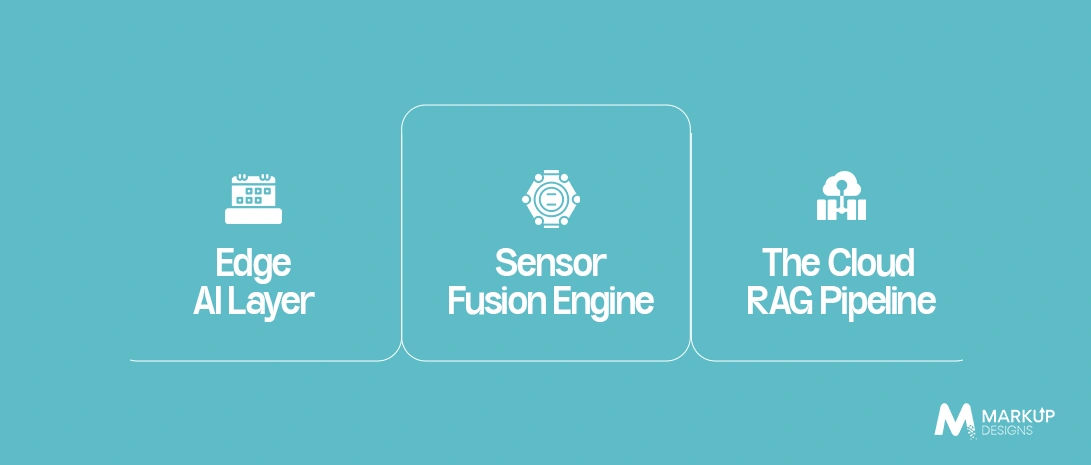
To achieve zero-latency performance while preserving power, elite development frameworks deploy a sophisticated, multi-tiered hybrid processing engine:
1. Edge AI Layer
The small, wearable computing devices carry an efficient SLM that works with the DSP processors for the purpose of performing all the basic functions directly through the device without contacting the remote server. This layer is responsible for the detection of the continuous wake words, local audio filtering, and intent classification of the user’s query to see if it should be processed directly at the device or transferred to the cloud.
2. Sensor Fusion Engine
Before any information leaves the device, there is always a separate normalization engine constantly fusing raw sensors’ data. Sensor fusion is the name of the technique that builds a highly reliable picture of the current environment of the wearer using multiple channels of processing simultaneously:
- Biometric Telemetry: Monitoring Heart Rate Variability (HRV), skin temperature, and galvanic skin reaction to check the person’s stress levels and level of exertion.
- Inertial Tracking: Utilizing 6-axis accelerometers and a gyroscope to detect the exact state of motion the user is in at that particular moment (sitting, moving around, driving, and handling equipment).
- Environmental Audio: Determining the decibels and barometric pressure to establish the location profile (office, transit, or nature trails).
3. The Cloud RAG Pipeline
When the local layer detects a complex query, it packages the request along with the unified data snapshot from the sensor fusion engine. This compressed package is transmitted via a secure API to a cloud-hosted Retrieval-Augmented Generation (RAG) framework. The cloud engine cross-references the user’s immediate physical context with deep enterprise knowledge bases, returning a highly customized answer as a lightweight text or voice snippet.
5 Core Benefits of Wearable AI Chatbots
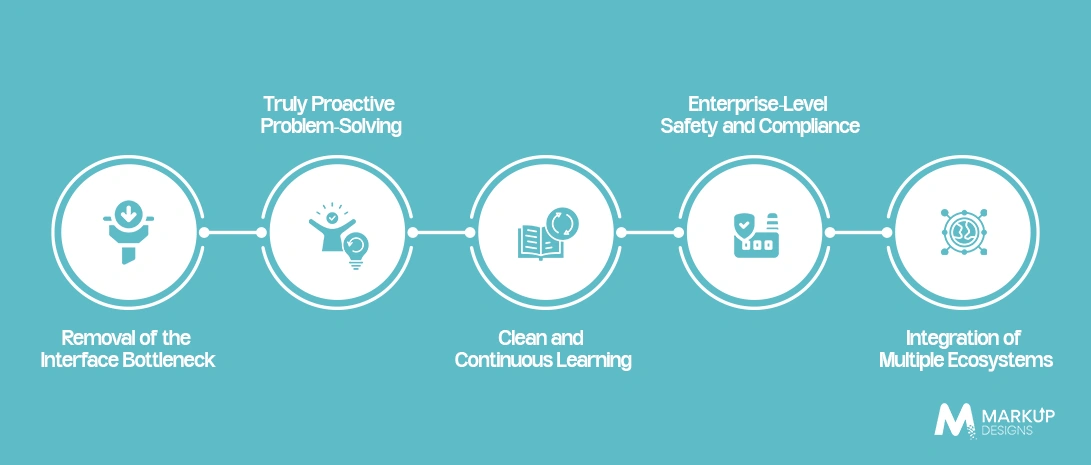
The application of AI-powered conversation to human hardware provides several competitive advantages over conventional mobile/desktop solutions.
1. Removal of the Interface Bottleneck
With the adoption of conversational AI over traditional UI elements, one can remove multiple steps that occur before reaching an outcome. Instead of having to navigate around the application, one will be able to communicate directly with the device. Moreover, the user will be able to engage in conversation while being totally immersed in their current context.
2. Truly Proactive Problem-Solving
A conventional app works only when actively launched by the user. However, thanks to wearable technology, one will be able to have a proactive solution that analyzes environmental and physiological data to determine what needs to be said at any moment.
3. Clean and Continuous Learning
Due to the fact that one always wears the device on their body, it collects a continuous flow of highly accurate data that will help the model improve its recommendations based on actual data collected, not just what the person is telling it about themselves.
4. Enterprise-Level Safety and Compliance
Voice-powered chatbots embedded in wearable devices enable field service staff, healthcare professionals, and industrial workers to search through extensive technical documentation, report safety incidents, or update patient files without lifting a finger.
5. Integration of Multiple Ecosystems
The wearable chatbot becomes an ever-present controller for the entirety of your digital world. Given its perpetual proximity to the wearer, it can tune to your smart home devices, company security checkpoints, or even other software applications through basic voice instructions or discreet signals.
Real-World Applications within Various Industries
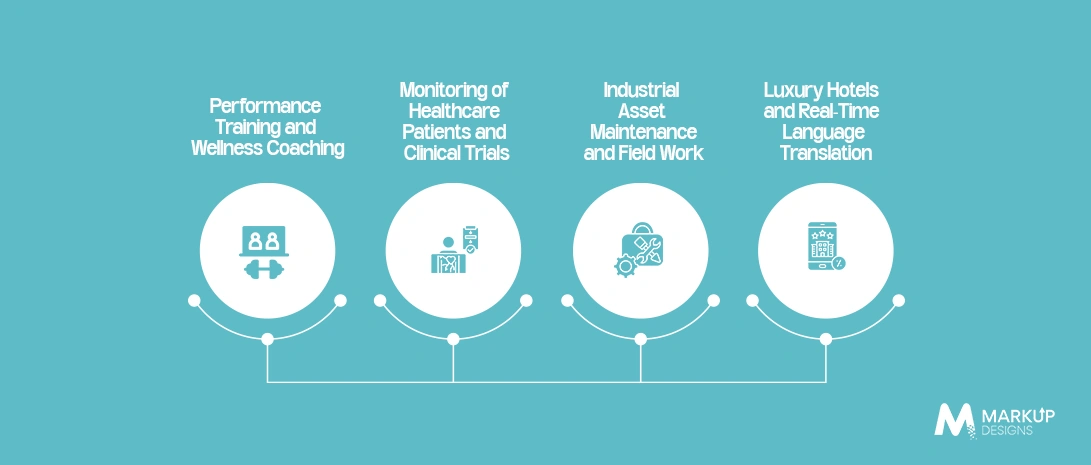
In order to see how these ideas work in practical scenarios, we shall examine the ways that diverse industries make use of wearable conversational AI to generate genuine value for their customers.
1. Performance Training and Wellness Coaching
In high-end wellness facilities and executive performance coaching environments, important indicators such as “stress level” or “activity counts” are not enough to provide guidance to the user.
This is where a conversational AI chatbot can be integrated into the process. If both heart rate and skin temperature increase during a corporate meeting, two evident signs of heightened stress, the wearable can gently encourage you to perform a breathing exercise for 60 seconds or modify the existing plan for post-meeting relaxation.
2. Monitoring of Healthcare Patients and Clinical Trials
Clinical trials in medicine and pharmaceuticals often become problematic due to patient non-compliance and inconsistent data collection. Utilizing a HIPAA-compliant chatbot integrated within medical devices could help change this for the better.
The bot will be able to notice any changes within the biometric parameters, ask patients questions at just the right time (“I’ve noticed a slight increase in your resting heart rate after taking your medication in the afternoon; on a scale of 1-10, how bad does your nausea feel?”), and identify critical data that should be reviewed by doctors.
3. Industrial Asset Maintenance and Field Work
It is impractical and even potentially hazardous to have field engineers pull out tablets in order to access schematics while hanging off a wind turbine or working in a high-voltage electrical grid.
An integration of voice-based chatbots into industrial headsets or smartwatches would allow engineers to work with schematics verbally:
Field Engineer: “Show me the maintenance history of hydraulic valve three.
Wearable AI: Valve three had been replaced by technician team B fourteen months ago. It is producing pressure at 4% above nominal values. I’d suggest examining its secondary seal first.
4. Luxury Hotels and Real-Time Language Translation
In luxury hotels and logistics operations, language barriers are common in operations. A wearable audio chatbot could use local ML models on the go to enable real-time translation during face-to-face interaction. Thus, customers and logisticians can easily interact with international suppliers without the need to hold a phone or a display to view translated text.
Cost Matrix for Project
Creating an enterprise-level AI chatbot for wearable devices requires specific engineering expertise. The budget depends on three main parameters of project development: data processing requirements (sensor fusion), AI model design (Edge vs. Cloud RAG), and security requirements (compliance).
The following cost matrix demonstrates typical enterprise-level development budget allocation depending on three project tiers:
| Cost Center Allocation | Prototype / MVP Tier | Custom Enterprise Tier | High-Octane Bespoke Tier |
| System Architecture & UI/UX | $8,000 – $12,000 • Standard layout conventions • Basic watch face frameworks • Core voice-to-text inputs | $15,000 – $25,000 • Custom context layouts • Detailed micro-interactions • Advanced multi-platform UI | $35,000 – $50,000+ • Proprietary design systems • Custom hardware interfaces • Immersive audio design |
| AI Integration & NLP Engine | $12,000 – $18,000 • Public cloud APIs (OpenAI/Claude) • Standard system prompts • Basic text response loops | $25,000 – $45,000 • Custom RAG data pipelines • Advanced sensor parsing • Intent optimization engines | $60,000 – $90,000+ • On-device model distillation • Proprietary model fine-tuning • Custom phonetic voice engines |
| Backend, Security & Compliance | $6,000 – $10,000 • Standard cloud hosting • Basic HTTPS data encryption • Standard user authentication | $15,000 – $35,000 • Full HIPAA / GDPR alignment • Secure real-time web sockets • Multi-source data pipeline | $40,000 – $70,000+ • End-to-end data tokenization • Distributed edge sync networks • Military-grade security stacks |
| QA Testing & Optimization | $4,000 – $10,000 • Basic emulator validation • Manual functional testing • Standard bug remediation | $10,000 – $20,000 • Comprehensive hardware tests • Real-world battery testing • High-volume load validation | $25,000 – $45,000+ • Automated hardware test labs • Advanced network stress tests • Long-term thermal profiles |
| Estimated Total Budget Range | $30,000 – $50,000 | $65,000 – $125,000 | $160,000 – $255,000+ |
| Estimated Development Timeline | 6 – 8 Weeks | 3 – 5 Months | 6 – 9+ Months |
Addressing Major Challenges in Wearable AI Engineering
For a product team to succeed in the creation of a viable wearable AI technology, three major foundational engineering problems need to be resolved methodically from the start. Not addressing them early will surely result in high battery usage or users abandoning their wearables.
1. Thermal Control and Battery Management
An always-on wearable AI app is likely to cause overheating and drain the battery fast if it communicates with remote servers at all times or does continuous acoustic processing. To avoid this, an engineer needs to implement dynamic duty-cycling by keeping the chips that use lots of power asleep until motion patterns or voice commands trigger them via algorithmic analysis.
2. Protection of Personalized Biometric Data
Wearables gather very sensitive biometric data, like information about your heart and current location. In order to gain user trust, you need to adopt decentralized data handling by encrypting biometric data on the hardware level and securely tokenizing data sent to the cloud.
3. Isolation of Voice Commands in Noisy Conditions
The voice-enabled wearable must work flawlessly regardless of conditions, from the bustling environment of an airport terminal to the gusting outdoors or noisy gym. The combination of sophisticated hardware-based microphones with intelligent software algorithms is key here. Local deep learning models could be used to isolate the distinct frequency spectrum of the user’s voice, blocking out all other noise and voices.
Blueprint for Executing Enterprise Strategy in This Market
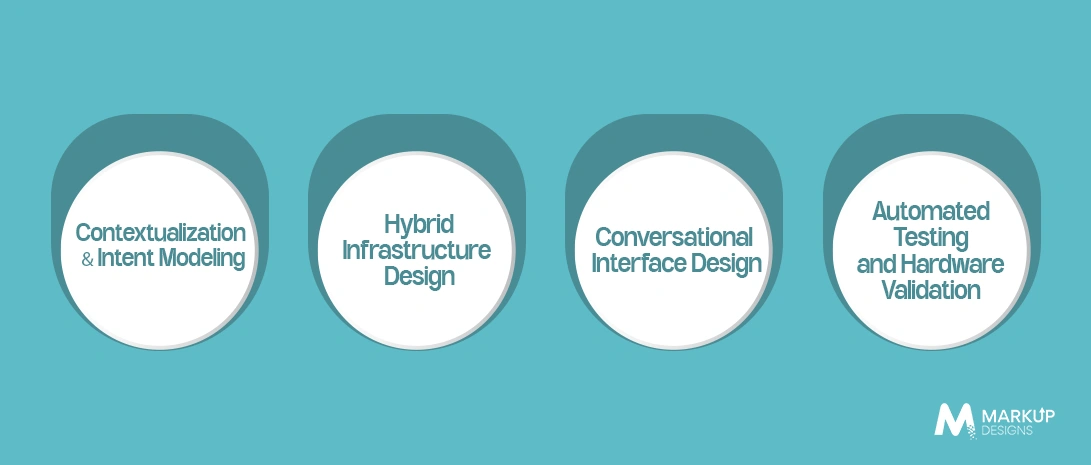
The wearable AI market size is expected to see exponential growth in the next few years. It will grow to $207.81 billion in 2030. Businesses have an unprecedented opportunity to innovate, optimise operations, and create connected digital experiences.
For companies aiming to capitalise on this growth, success depends on adopting a structured development approach. Careful planning, robust architecture, and disciplined execution are essential to maximise efficiency, reduce development risks, and avoid unnecessary engineering costs throughout the product lifecycle.
Phase 1: Contextualization & Intent Modeling
Analyze the user’s existing datasets to determine what metrics (biometrics, calendar data, geographical location, etc.) are necessary for the use case.
Define a comprehensive taxonomy of interactions that will be possible within the interface and distinguish between local processing and cloud processing of small language models.
Phase 2: Hybrid Infrastructure Design
Set up a distributed cloud network that uses the Retrieval-Augmentation-Generation model to control company data.
Integrate the local device application to allow direct access to the voice processor chip on the device.
Phase 3: Conversational Interface Design
Build a flexible fallback system that can instantly shift from a voice interface to short, tap-optimized confirmation screens if background noise becomes too loud.
Phase 4: Automated Testing and Hardware Validation
Run the software through automated hardware emulation labs to measure exact battery consumption and thermal behavior across different device profiles.
Test voice-recognition performance in real-world scenarios across diverse accents, speech volumes, and background noise levels to ensure high accuracy before launch.
Launching Your App: The 4-Step Strategy
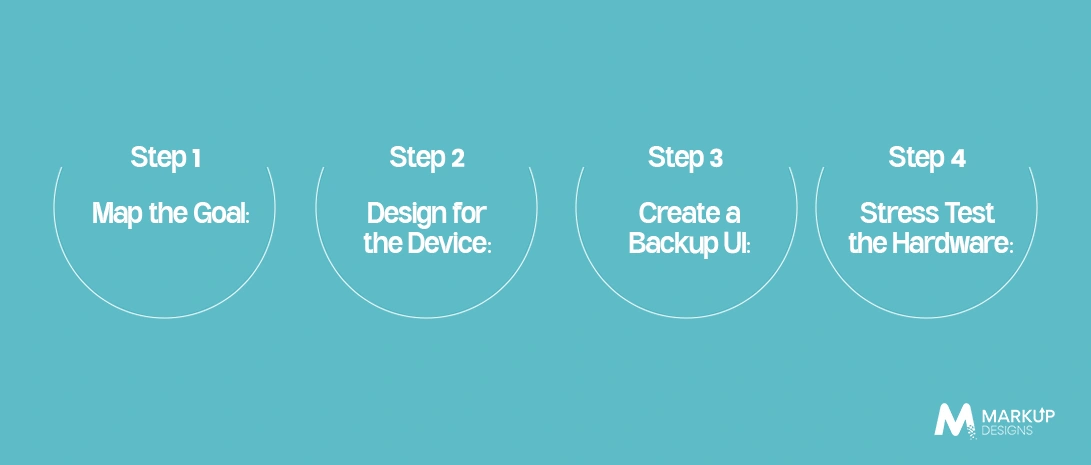
1. Map the Goal
Decide exactly what data your app needs to track (location, heart rate, voice) and what problems it will solve.
2. Design for the Device
Build a system that uses lightweight AI on the device so it doesn’t drain the battery or overheat in under an hour.
3. Create a Backup UI
Make sure the app can smoothly switch from voice commands to quick screen-taps if the user is in a noisy area.
4. Stress Test the Hardware
Test the app on real devices to check battery usage, heating profiles, and how well it understands different accents in noisy rooms.
Scale Your Innovation with Markup Designs
Building for smart hardware requires a unique balance of advanced AI engineering and lightweight design. You cannot simply force an old desktop or mobile website layout onto a smartwatch screen.
At Markup Designs, we specialize in driving true digital transformation for growing businesses and tech innovators. We help you cut through the technical complexity to build high-performance, secure, and intuitive mobile, enterprise, and wearable AI solutions. Whether you want to upgrade your current product line or build a brand-new voice assistant from scratch, our team delivers software engineered directly for growth.
Transform Your Product Line
Squeezing an old mobile layout into a smartwatch display or smart earbuds doesn’t work. True innovation requires custom architecture built specifically for human movement.We engineer high-performance mobile software, enterprise systems, and bespoke AI solutions that eliminate friction, protect user privacy, and generate entirely new revenue streams for your brand.

Conclusion
The long-term value of digital product design is simple: the brand that removes the most friction from a user’s day wins. By shifting software away from distracting mobile screens and transforming it into an intelligent, ambient assistant that lives naturally on the body, wearable AI chatbots represent a massive leap forward in user experience design.
For progressive enterprises, tech founders, and luxury lifestyle brands, building in this space is no longer about keeping up with a trend. It is a vital strategic move to capture the most valuable digital real estate available today: a continuous, frictionless, and deeply personal connection with your user.
FAQ
1. How do wearable AI chatbots manage data processing when the device loses internet connectivity?
Modern wearable AI systems rely on an optimized hybrid edge-cloud architecture. When a device is completely offline, an on-device Small Language Model (SLM) paired with localized digital signal processors handles all basic operations, such as logging biometrics, running local voice triggers, and queuing up actionable notifications. The moment data connection is re-established, the local cache smoothly syncs with the primary cloud RAG infrastructure to handle deeper, more complex reasoning tasks.
2. What specific regulations must an organization comply with when collecting biometric data via wearables?
Any product collecting real-time health or physiological metrics must strictly follow regional data privacy frameworks. If your software handles patient health information in the United States, your entire back-end system must be fully HIPAA-compliant. For applications deployed in the European Union, the system must adhere to strict GDPR mandates, requiring explicitly clear data consent, end-to-end encryption, and robust “right to be forgotten” protocols that allow users to permanently wipe their data trails.
3. Can an existing web or mobile chatbot API be directly ported over to smartwatch environments?
No. Web or desktop conversational frameworks are built around the assumption of consistent power, stable high-bandwidth connections, and large visual spaces. Directly porting these models onto a wearable will quickly drain the battery and cause critical lag. The conversational engine must be completely re-architected, compressing the natural language understanding loops, using highly efficient data protocols, and replacing long text outputs with short, glanceable summaries or precise voice clips.
4. How do wearable AI chatbots deliver value without a screen?
They rely heavily on context-aware ambient intelligence and voice-first interaction. Instead of making you read long blocks of text, the AI uses sensor data to track exactly what you are doing (like walking, sitting in a meeting, or driving) and gives you short, precise audio snippets or subtle vibrations. If a situation requires a deep visual breakdown, the wearable acts as a smart filter, processing the hard work in the background and pushing only the most critical, actionable takeaways to a primary screen when it is safe to look.
5. How do you optimize AI models so they don’t overheat the hardware?
We use a specialized development method called model distillation and edge intelligence. Instead of running a massive, power-hungry cloud AI that forces the device to constantly transmit data back and forth, which rapidly drains the battery and causes severe overheating, we shrink the software. By packing a highly optimized Small Language Model (SLM) directly onto the wearable’s local microchips, the device can process voice triggers and handle basic tasks completely offline, only waking up heavy cloud connections for deeply complex requests.
Author's Perspective
Having spent years guiding brands through extensive digital transformations and website overhauls, I have noticed a recurring pattern: companies often waste significant budget trying to force outdated desktop or mobile design conventions onto entirely new types of technology. When business leaders look at the wearable AI market, their first instinct is often to figure out how to take their existing mobile dashboard and fit it onto a smartwatch screen. This approach is fundamentally flawed and misses the true value of the technology.
The real magic of wearable AI does not come from giving users another screen to look at. Its true value lies in ambient intelligence, building a software architecture that is so deeply integrated with physical sensors and natural language processing that it can predict exactly what a user needs before they even think to ask. The future belongs to companies that understand how to build software that respects human focus rather than constantly trying to steal it. Moving your digital presence onto wearable ecosystems with specialized, highly contextual conversational AI is the single most powerful way to stay ahead of the curve as user behavior evolves.
Discuss Your Project NowJupinder Singh Arora
Founder and CEO
Related Posts

How AI is Revolutionising Industrial Automation in Australia

How UK Enterprises Can Build an Effective AI...

AI Voice Agent for Real Estate: Features, Benefits,...
Insights Are Valuable & Execution is Priceless
You’ve read about the digital future. Now, let’s build the infrastructure to take you there. Move your strategy from the page to the product.
Design Your Solution Now
Contact Us
Schedule The Appointment At Your Convenience Date And Time.
30 Min
Web Conference
Time Zone
Indian standard time (08:30pm)

Thanks For Getting In Touch!
You’ve Taken The First Step Toward Transforming Your Digital Presence. Our Experts Will Reach Out Shortly To Take It Forward.
Launch Your Dream Project
Provide a brief overview of your project, and our specialists will evaluate your requirements. We will connect with you to explore how the right digital solutions can help you launch faster.