

In Brief
- AI-powered banking apps are transforming financial services across the Middle East through automation, personalization, and enhanced security.
- UAE and Saudi Arabia are leading digital banking growth with strong fintech adoption and AI-driven financial innovation.
- Key AI banking features include fraud detection, biometric authentication, AI chatbots, predictive analytics, and smart financial insights.
- The Middle East digital banking market is rapidly expanding, supported by government initiatives, increasing smartphone usage, and rising fintech investments.
- Despite challenges like compliance, cybersecurity, and legacy system integration, AI is shaping the future of intelligent and customer-focused banking ecosystems.
The banking industry in the Middle East is undergoing a major shift, moving rapidly from traditional systems to intelligent digital ecosystems. At the center of this change is the rise of AI-powered financial services, which are reshaping how customers interact with banks on a daily basis.
Today, users expect instant access, smarter recommendations, and secure transactions directly from their mobile devices. This expectation has pushed financial institutions across the Middle East to invest more in AI banking apps, which combine automation, intelligence, and personalization within a single platform.
From UAE to Saudi Arabia, digital transformation initiatives are accelerating the adoption of digital banking transformation, making mobile-first experiences the new standard rather than an option.
Unlike earlier banking models that were slow and process-heavy, modern systems are designed to learn user behavior, detect risks early, and offer real-time financial insights. This shift is not just technological-it is redefining customer expectations across the entire financial ecosystem.
As a result, the future of banking in the Middle East is becoming deeply connected with artificial intelligence, where apps are no longer just tools for transactions but intelligent financial companions that support decision-making.
Growth of Digital Banking in the Middle East
The Middle East is experiencing one of the fastest shifts toward digital-first financial systems. Over the last few years, banking behavior has changed significantly, mainly driven by smartphone adoption, improved internet access, and strong government-backed digital initiatives.
One of the biggest drivers of this transformation is the increasing reliance on mobile-first experiences. Customers no longer prefer visiting branches for routine tasks-they expect everything to be available instantly through apps. This change has accelerated the demand for mobile banking apps, which are becoming the primary channel for everyday financial activities.
Countries like UAE are leading this shift with aggressive digital adoption strategies, supported by initiatives that promote cashless transactions and smart services. This has directly boosted digital transformation in the banking sector in UAE, where banks are rapidly upgrading legacy systems into agile, app-based platforms.
Similarly, Saudi Arabia is witnessing strong momentum in financial digitization, with a focus on innovation, fintech partnerships, and AI integration. This environment is fueling growth in AI in banking across Saudi Arabia, as financial institutions explore smarter ways to improve customer experience and operational efficiency.
Another important trend is the rise of fintech collaboration across the GCC region. Banks are no longer working in isolation-they are partnering with technology providers to build smarter ecosystems powered by automation and data intelligence. This has significantly strengthened fintech innovation GCC, creating a more competitive and customer-focused financial landscape.
Overall, the region is not just adopting digital banking, it is actively redefining it, setting the foundation for a fully intelligent financial ecosystem.
How AI is Transforming Banking Apps
Artificial Intelligence is rapidly transforming modern banking applications across the Middle East. What was once considered an additional feature has now become the core technology driving personalization, security, and automation in digital banking platforms.
Today, banks are using AI to deliver faster and smarter financial experiences. Modern apps can analyze customer behavior, spending patterns, and transaction history to offer personalized recommendations and financial insights. This is where AI-powered financial services are helping users make better financial decisions with minimal effort.
Some major AI-driven banking capabilities include:
- Real-time fraud detection and risk monitoring
- AI chatbots for instant customer support
- Predictive analytics for financial planning
- Personalized spending and savings insights
- Automated banking operations and workflows
Security has also improved significantly with AI integration. Intelligent systems continuously track suspicious activities and help prevent fraud before it impacts users. This has increased the importance of secure fintech app development for financial institutions operating in digital-first markets.
At the same time, AI-driven automation is streamlining customer support and reducing operational delays. The growing adoption of banking automation AI is allowing banks to improve efficiency while delivering more responsive services.
Read: Also: How AI Is Transforming UAE Businesses in 2026
Real Stats & Market Insights
The adoption of AI in banking across the Middle East is accelerating rapidly, supported by strong government initiatives, rising fintech investments, and increasing demand for digital-first financial experiences. Recent industry reports clearly show how artificial intelligence is becoming a major growth driver for the regional financial ecosystem.
Here are some important statistics shaping the future of AI-powered banking in the region:
- According to PwC Middle East, AI is expected to contribute nearly US$320 billion to the Middle East economy by 2030. The report also highlights that the financial services sector could see one of the strongest impacts from AI adoption.
- UAE is emerging as one of the fastest-growing AI adoption hubs globally. A recent KPMG UAE Report found that 49% of UAE organizations already have active AI implementation plans, while 59% are running AI pilot programs within finance operations.
- The regional digital banking market is also expanding at a significant pace. According to Grand View Research, the Middle East digital banking platform market is projected to grow from USD 2.65 billion in 2025 to USD 9.72 billion by 2033, growing at a CAGR of 17.8%.
- Saudi Arabia accounted for nearly 41.3% of the regional digital banking platform market in 2025, mainly driven by AI-enabled customer support, mobile banking growth, and strong digital transformation initiatives.
- Mobile banking adoption is growing aggressively across GCC countries due to increasing smartphone penetration and demand for seamless financial experiences. Reports show that the mobile banking segment in the Middle East is expected to grow at a CAGR of 21.4% during the forecast period.
These insights clearly show that AI is no longer just an innovation layer in banking. It is becoming the foundation of modern financial services across the Middle East, especially as institutions continue investing in smarter and more scalable digital ecosystems..
Key Features of AI-Powered Banking Apps
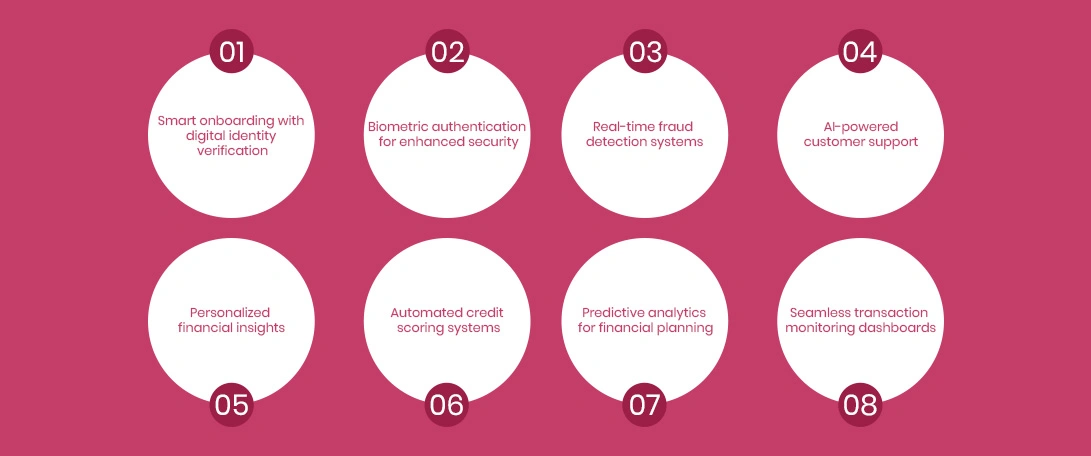
AI-powered banking apps are designed to make financial services faster, smarter, and more secure. In the Middle East, where digital adoption is growing rapidly, these features are becoming essential rather than optional.
Here are the key capabilities shaping modern banking apps:
- Smart onboarding with digital identity verification
AI simplifies user registration by verifying identity through biometrics, documents, and automated validation systems, reducing manual effort and delays.
- Biometric authentication for enhanced security
Features like face recognition and fingerprint scanning ensure secure access, strengthening the foundation of secure fintech app development.
- Real-time fraud detection systems
AI continuously monitors transactions and flags suspicious activity instantly, helping prevent financial fraud before it impacts users.
- AI-powered customer support
Intelligent assistants provide 24/7 support, handling queries instantly and improving response time without human dependency.
- Personalized financial insights
Apps analyze spending behavior to offer smart suggestions, budgeting tips, and savings recommendations, strengthening AI-powered mobile apps for financial services.
- Automated credit scoring systems
AI evaluates financial history and behavior to generate faster, more accurate credit decisions with minimal manual intervention.
- Predictive analytics for financial planning
Users receive forecasts for expenses, savings potential, and investment opportunities based on real-time data analysis.
- Seamless transaction monitoring dashboards
Users get a clear, real-time view of all financial activities in one place, improving transparency and control.
These features are collectively transforming traditional banking systems into intelligent digital ecosystems, especially across rapidly evolving markets like the Middle East.
Cost of Developing AI Banking Apps
The cost of building AI-powered banking applications in the Middle East depends on several factors such as feature complexity, security requirements, integrations, scalability, and AI capabilities. A simple app with basic features will cost significantly less than a fully advanced, enterprise-grade financial platform.
Below is a clear breakdown to help understand different cost ranges:
Cost Breakdown of AI Banking App Development
| App Type | Key Features | Estimated Cost (USD) |
| Basic AI Banking App | User login, account management, basic transactions, simple chatbot support | $30,000 – $80,000 |
| Mid-Level AI Banking App | AI recommendations, fraud detection, analytics dashboard, biometric login | $80,000 – $200,000 |
| Advanced Enterprise AI Banking Platform | Full AI integration, predictive analytics, real-time fraud prevention, multi-layer security, cloud scalability | $200,000 – $500,000+ |
What Influences the Cost?
- AI complexity level
- Security requirements
- Third-party integrations
- Design and user experience quality
- Scalability for high user traffic in regions like GCC
- Compliance with financial regulations in the Middle East
Additional Cost Considerations
Apart from development, there are ongoing investments required:
- Cloud infrastructure and hosting
- AI model training and updates
- Security audits and compliance checks
- Maintenance and feature enhancements
In fast-growing regions like UAE and Saudi Arabia, banks are increasingly investing in mobile banking apps that are scalable and AI-driven from the ground up, ensuring long-term digital growth and customer satisfaction.
Read More: The Ultimate Guide of Building a Mobile App Pricing & ROI
Challenges Slowing Down AI Adoption
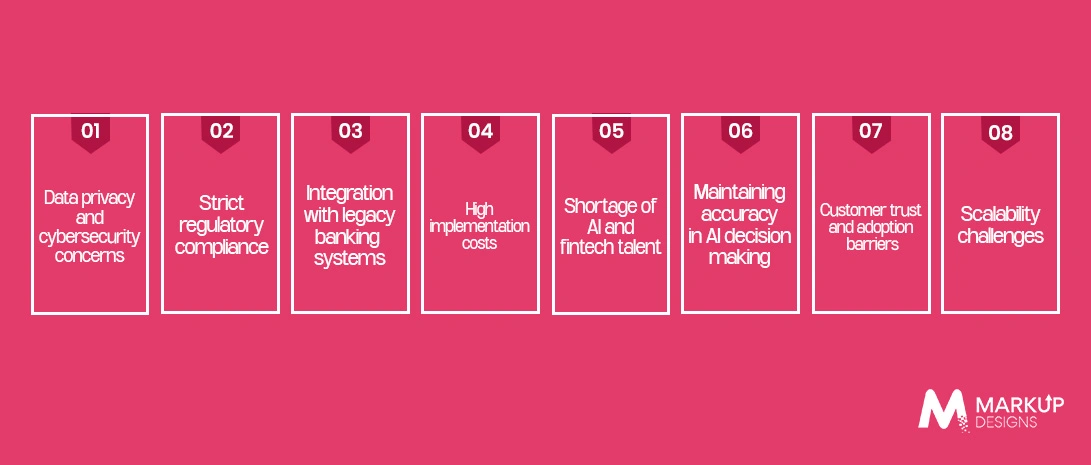
While AI innovation is transforming financial services rapidly, implementing intelligent banking systems also comes with several challenges. Financial institutions across the Gulf countries must balance innovation with security, compliance, and operational efficiency.
Here are some of the major challenges affecting AI adoption in banking:
- Data privacy and cybersecurity concerns
Banking applications handle highly sensitive financial information. Ensuring strong security frameworks is essential for maintaining user trust and supporting secure fintech app development.
- Strict regulatory compliance
Financial regulations in countries like UAE and Saudi Arabia are continuously evolving. Banks must ensure AI systems align with local compliance standards and data protection laws.
- Integration with legacy banking systems
Many traditional banks still operate on outdated infrastructure, making AI integration complex and time-consuming.
- High implementation costs
Advanced AI systems require significant investment in infrastructure, development, security, and ongoing optimization.
- Shortage of AI and fintech talent
The rapid rise of fintech innovation GCC has increased demand for AI engineers, cybersecurity experts, and financial technology specialists.
- Maintaining accuracy in AI decision-making
AI models require continuous training and monitoring to avoid inaccurate predictions or biased financial recommendations.
- Customer trust and adoption barriers
Some users are still hesitant to fully rely on AI-driven financial systems, especially for high-value transactions or financial planning.
- Scalability challenges
As user demand grows, banking platforms must handle increasing transaction volumes while maintaining speed and security.
Despite these challenges, financial institutions are continuing to invest in AI because of its long-term potential to improve operational efficiency and customer experience.
Future of AI Banking in the Middle East
The future of banking in the Middle East is becoming increasingly intelligent, automated, and customer-focused. As digital adoption continues to grow, financial institutions are moving beyond traditional mobile banking and investing in advanced AI solutions that deliver faster, smarter, and more personalized financial experiences.
One of the biggest transformations will be the rise of hyper-personalized banking services. AI automation systems are expected to analyze customer behavior in real time to provide more accurate financial recommendations and predictive insights.
Some major trends shaping the future of AI banking include:
- Hyper-personalized financial experiences
- AI-driven budgeting and investment guidance
- Expansion of fully digital banks and fintech platforms
- Predictive banking technologies for smarter financial planning
- Automation-driven banking operations and customer support
The rapid growth of mobile banking apps in the Middle East is transforming how users access financial services. Customers now expect secure, fast, and seamless digital experiences. Governments in UAE and Saudi Arabia are also supporting innovation through fintech-friendly initiatives and digital transformation strategies.
At the same time, the rise of open banking and embedded finance is creating connected financial ecosystems, further strengthening banking automation and making financial services more efficient, accessible, and user-friendly.
Ready to Transform Your Banking Experience With AI?
Empower your bank with intelligent automation, smarter customer experiences, fraud detection, and data-driven decision-making. Build secure, scalable, and future-ready AI banking solutions tailored to your business goals.

Conclusion
Artificial intelligence is redefining the financial landscape across the Middle East. From intelligent fraud prevention to personalized banking experiences, AI is helping financial institutions deliver faster, safer, and more efficient digital services.
The rapid growth of digital banking trends in the Middle East clearly shows that customers now expect convenience, automation, and real-time financial support from their banking platforms. At the same time, governments and fintech ecosystems across UAE and Saudi Arabia are creating strong foundations for long-term digital innovation.
As adoption continues to rise, AI-powered banking applications will become more intelligent, predictive, and customer-focused. Financial institutions that invest early in modern AI technologies will be better positioned to lead the next phase of digital transformation in the region.
FAQs
1. What are AI-powered banking apps?
AI-powered banking apps are digital financial applications that use artificial intelligence to automate services like fraud detection, customer support, financial recommendations, and transaction monitoring.
2. How is AI improving banking services in the Middle East?
AI is improving banking by enhancing security, automating customer support, personalizing financial experiences, and making transactions faster and more efficient across the region.
3. Why are banks investing in AI-powered financial solutions?
Banks are investing in AI to improve operational efficiency, reduce fraud risks, deliver better customer experiences, and stay competitive in rapidly evolving digital markets.
4. Are AI banking apps secure?
Yes, modern banking apps use advanced security technologies such as biometric authentication, encryption, and AI-driven fraud detection systems to ensure safe transactions and user protection.
5. What is the future of AI in banking?
The future of AI in banking includes hyper-personalized financial services, predictive analytics, intelligent automation, digital-only banks, and fully connected financial ecosystems.
Author's Perspective
The Middle East is entering a new era where artificial intelligence is becoming central to financial innovation. AI-powered banking apps are no longer experimental technologies-they are shaping how modern financial services operate and evolve. From improving security to delivering personalized experiences, AI is helping institutions create smarter and more efficient digital ecosystems. As fintech adoption continues growing across the region, businesses investing in AI-driven banking solutions today will play a major role in defining tomorrow’s financial landscape.
Discuss Your Project NowJupinder Singh Arora
Founder and CEO
Related Posts

How Artificial Intelligence Is Changing Mobile Game Development

How to Build Production-Ready Applications with AI Coding...

Cost, Benefits & Business Impact: Generative AI vs....
Insights Are Valuable & Execution is Priceless
You’ve read about the digital future. Now, let’s build the infrastructure to take you there. Move your strategy from the page to the product.
Design Your Solution Now
Contact Us
Schedule The Appointment At Your Convenience Date And Time.
30 Min
Web Conference
Time Zone
Indian standard time (08:30pm)

Thanks For Getting In Touch!
You’ve Taken The First Step Toward Transforming Your Digital Presence. Our Experts Will Reach Out Shortly To Take It Forward.
Launch Your Dream Project
Provide a brief overview of your project, and our specialists will evaluate your requirements. We will connect with you to explore how the right digital solutions can help you launch faster.