
On-Demand App Development in UAE Business Models That Drive Real Growth
In Brief
- On-demand app development is rapidly expanding in the UAE due to rising demand for fast, tech-enabled services.
- These apps connect users with service providers in real time for booking, tracking, communication, and payments.
- Growth is driven by high smartphone usage, digital adoption, and evolving customer expectations.
- Businesses face challenges like intense competition, service quality control, logistics, security risks, and development costs.
- Choosing the right business model is critical for profitability and long-term scalability.
- Popular models include B2C, B2B, and peer-to-peer (P2P), each serving different market needs.
- On-demand apps provide benefits such as wider customer reach, improved user experience, and data-driven insights.
- Emerging trends include AI-powered automation, faster delivery systems, voice-enabled features, and personalized user experiences.
- The rise of super apps and integrated platforms is shaping the future of on-demand ecosystems in the UAE.
Overview of the On-Demand App Development Market
The demand for on-demand app development in the UAE is increasing rapidly as businesses prioritize faster, more efficient, and technology-driven service delivery. From ride-sharing and food delivery to home services and healthcare, consumers across the UAE now expect instant access to services through mobile applications. This shift in user behavior has prompted businesses to invest in on-demand app solutions that enhance accessibility, optimize operations, and improve overall customer experience.
On-demand mobile development creates mobile/web applications that provide immediate access to goods and services, bridging users with providers via geolocation and real-time tracking (e.g., Uber, DoorDash). The market is booming and expected to reach roughly $335B-$448B by 2025–2033, driven by convenience-focused consumer behavior.
Core Challenges of On-Demand App Development
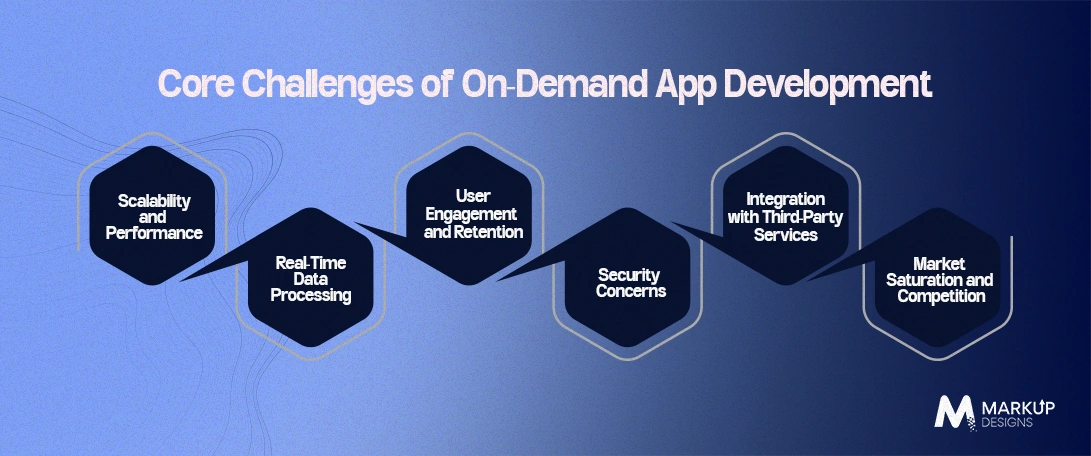
Scalability and Performance
As your on-demand app grows and attracts thousands or even millions of users, maintaining high performance becomes critical. Without proper scalability, apps often face slow loading speeds, server overload, and unexpected crashes, which can negatively impact user experience and retention.
Real-Time Data Processing
On-demand applications rely heavily on real-time data processing for features like live tracking, instant notifications, and updates. Delays or inaccuracies in processing this data can lead to a poor user experience.
User Engagement and Retention
With intense competition in the on-demand app market, retaining users and encouraging repeat usage can be difficult. High churn rates can directly impact growth and revenue.
Security Concerns
On-demand apps handle sensitive user information, including personal data and payment details. Any security breach can damage user trust and brand reputation.
Integration with Third-Party Services
On-demand apps often depend on third-party integrations like payment gateways, GPS tracking, and SMS services. Ensuring seamless integration without data inconsistencies or performance issues can be complex.
Market Saturation and Competition
The on-demand app industry is highly competitive, making it challenging for new businesses to establish a strong presence.
Benefits of On-Demand Applications
Expanded Customer Reach
On-demand apps broaden a business’s reach by providing instant access to services through mobile devices. Users can book or order services anytime and from anywhere, making it easier to attract new customers. Consistent usage and repeat orders further contribute to steady growth in the user base.
Smart Data Insights
On-demand platforms collect valuable data on user behavior, preferences, and transaction trends. With cloud-based storage and analytics, businesses can turn this data into actionable insights, helping them refine services and improve operational efficiency.
Enhanced Customer Experience
From seamless service delivery to real-time tracking and communication, on-demand apps are designed to elevate the user experience. Well-developed applications make accessing services simple and convenient, resulting in higher satisfaction, stronger loyalty, and increased word-of-mouth referrals.
Scalable Business Growth
On-demand apps are built to handle growing demand without compromising performance. With robust cloud infrastructure, businesses can easily expand their services, accommodate more users, and enter new markets as they grow.
Stronger Market Advantage
In a competitive landscape, on-demand apps give businesses a clear edge. Delivering fast, reliable, and personalized services helps build customer trust and retention, while outdated solutions can limit growth and competitiveness.
How On-Demand Apps Work
- On-demand app development enables users to connect with service providers quickly through a digital platform, making services more accessible and convenient.
- Users can place service requests directly within the app, which are instantly matched with nearby and available providers.
- The application manages the entire process, including booking confirmation, real-time tracking, and seamless communication between users and providers.
- A strong backend system integrates essential technologies such as APIs, geolocation services, secure payment gateways, and cloud platforms like Amazon Web Services.
- This technology stack ensures smooth app performance, operational efficiency, and scalability as user demand increases.
- Popular on-demand solutions like taxi booking and food delivery apps operate through a streamlined process where users place a request, the system connects them with a suitable provider, the service is completed efficiently, and users can then share feedback based on their experience.
- Advanced AI-powered matching algorithms enhance service efficiency by connecting users with the most suitable providers.
Business Models of On-Demand Apps
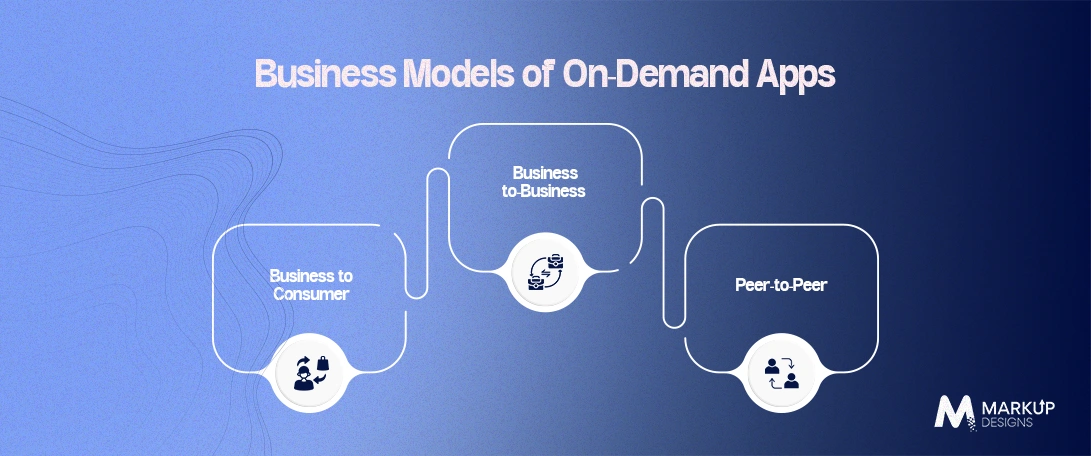
Choosing the right business model plays a key role in the success of an on-demand app. A business model explains how an app makes money while delivering value to users. In the UAE, companies often select models that match customer needs, market demand, and competition. Below are the most common business models used in on-demand app development.
1. Business to Consumer
In the B2C model, on-demand apps directly serve end users by enabling businesses to offer products and services to customers in a quick and convenient way.
A well-known example is Starbucks, whose app allows users to order and pay in advance, avoiding queues and receiving their orders efficiently. Other popular B2C platforms include Domino’s, Uber, and Booking.com, all of which provide services on demand.
2. Business-to-Business
B2B on-demand apps are designed to connect businesses with other businesses. These platforms are typically more feature-rich and capable of handling complex operations, including large-scale and global transactions.
For instance, Eventio is a platform that helps individuals and organizations find suitable venues for events. It allows users to choose options such as security, catering, and other services based on their needs.
B2B apps can be further categorized into:
- Vertical B2B: Focused on a specific industry or sector
- Horizontal B2B: Serving multiple industries across different sectors
3. Peer-to-Peer
P2P apps allow users to connect and transact directly with each other, eliminating the need for intermediaries. These applications are typically easier to build and include essential features like user registration, location tracking, ratings and reviews, and secure payment systems.
Businesses can use custom app development to create reliable, scalable, and user-friendly P2P on-demand platforms.
Examples: Home-sharing (Airbnb), money transfers (Venmo), peer-to-peer delivery, and second-hand marketplace apps.
What Types of Businesses Need On-Demand Applications?
- Housekeeping Services – On-demand apps help users quickly book cleaning and home maintenance services at their convenience.
- Salon Services – Customers can schedule beauty and grooming services at home or nearby salons with just a few taps.
- Hospitality Services – Hotels and travel businesses use on-demand apps to manage bookings, check-ins, and guest services efficiently.
- Retail on Demand – These apps enable instant ordering and fast delivery of everyday products, improving customer convenience.
- Pharmacy Services – Users can order medicines online and get them delivered quickly with prescription management features.
- Telemedicine – Patients can consult doctors remotely, book appointments, and access healthcare services anytime.
- Repair and Fuel – On-demand platforms allow users to request vehicle repair, maintenance, or fuel delivery at their location.
- Dry Cleaning and Laundry – Customers can schedule pickup and delivery for laundry services without visiting a physical store.
Step-by-Step Development Process of On-Demand Applications
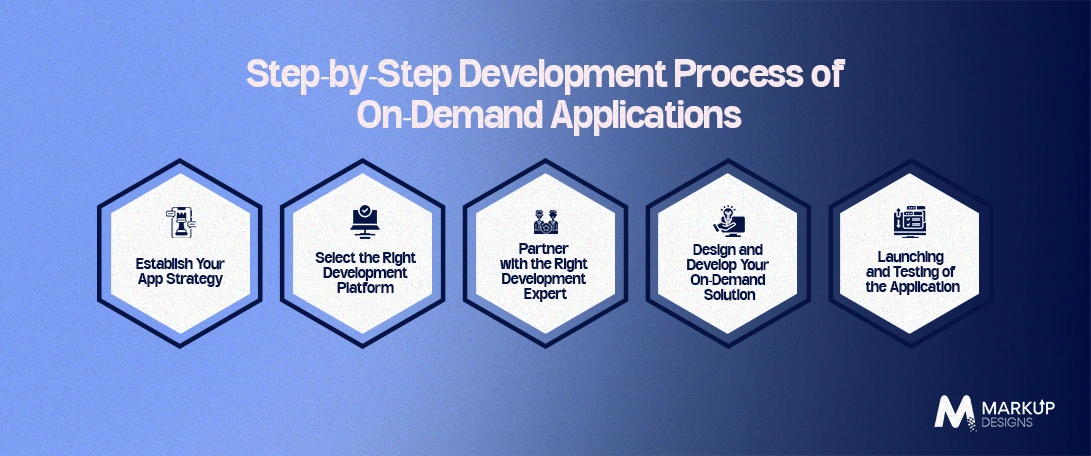
So, let’s understand the key development process for on-demand applications.
Establish Your App Strategy
Start by understanding market demand and identifying your target audience. Clearly outline your business objectives, evaluate competitors, and focus on building unique features that help your app stand out in the competitive on-demand app development landscape.
Select the Right Development Platform
Select a reliable and scalable development platform that supports easy updates and future enhancements. This choice plays a crucial role in determining the long-term performance, scalability, and profitability of your on-demand application.
Partner with the Right Development Expert
Decide whether to build your app in-house or outsource it to an experienced custom mobile app development company. While partnering with a professional firm may involve higher initial costs, it ensures flexibility, expert guidance, and a more efficient development process for high-quality results.
Design and Develop Your On-Demand Solution
Begin with wireframes and prototypes to map out the app’s structure and user journey. Create a consistent and engaging UI/UX by choosing design elements such as colors, fonts, and layouts that reflect your brand identity.
Focus on intuitive navigation to enhance usability, while keeping scalability and security at the core of your development strategy. Integrate essential features like real-time tracking, secure payment gateways, and in-app communication to build a strong and functional app foundation.
Launching and Testing of the Application
Conduct comprehensive testing across multiple devices and platforms to ensure optimal performance and compatibility. Identify and fix bugs, and validate the app’s security, responsiveness, and connectivity.
Leverage beta testing to gather real user feedback and make necessary improvements. Once the app meets all quality standards, finalize it and proceed with a successful launch on major app stores.
Features of On-Demand Applications
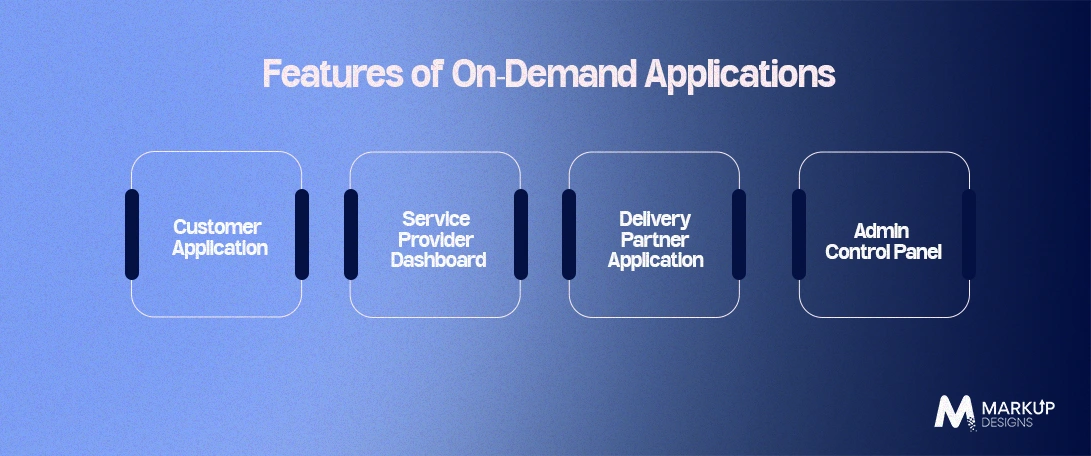
Before developing your on-demand app, it’s important to identify and structure the core user roles, such as customers, service providers, delivery partners, and administrators. Clearly outlining these roles ensures a streamlined development process, whether you’re building a native, hybrid, or outsourced solution.
Customer Application
The customer-facing app should prioritize simplicity and seamless navigation. Essential features include quick sign-up and secure login, personalized profiles, flexible payment options, and live order tracking powered by GPS.
Features like ratings and reviews build trust, while push notifications keep users informed about order updates. In-app chat improves communication with service providers, and additions like loyalty programs and order history encourage repeat usage.
Service Provider Dashboard
This app is designed to help service providers efficiently manage their tasks. Key functionalities include accepting or declining requests, updating availability status, tracking earnings, and reviewing customer feedback.
Delivery Partner Application
The delivery module enables agents to handle orders smoothly from pickup to completion. Features typically include route optimization through GPS, order status updates (such as picked up or delivered), secure user profiles, and direct communication with customers.
Admin Control Panel
The admin panel acts as the central hub for managing the entire platform. It allows businesses to oversee users and service providers, manage orders, set pricing and commissions, and access detailed analytics and reports.
This centralized control ensures smooth day-to-day operations and supports informed decision-making, especially when working with experienced development teams.
Building a Scalable and Future-Ready App
Incorporating these core components into your development strategy helps you create a strong minimum viable product (MVP). It also ensures your platform is scalable, adaptable, and capable of meeting evolving user expectations as your business grows.
Cost to Develop an On-Demand Application
| Component | Description | Estimated Cost (USD) |
| UI/UX Design | App design and user experience | $3,000 – $8,000 |
| App Development | Frontend and backend development | $15,000 – $40,000 |
| Admin Panel | Dashboard for managing app operations | $4,000 – $10,000 |
| Integrations | Payment, GPS, notifications | $2,000 – $5,000 |
| Testing & Launch | QA testing and deployment | $3,000 – $8,000 |
| Maintenance | Updates and support (annual) | $3,000 – $10,000/year |
Why Should Businesses Partner with Markup Designs for an On-Demand Application?
Choosing the right development partner plays a key role in the success of an on-demand app. At Markup Designs, we bring strong expertise in building scalable and user-friendly on-demand applications.
We focus on understanding business goals and delivering customized solutions that match market needs. Our team uses modern technologies to build fast, secure, and high-performing apps. We design intuitive UI/UX to ensure every app stays simple, clean, and easy to use.
We provide end-to-end services, including planning, development, testing, and post-launch support. This approach helps businesses launch smoothly and grow without technical issues. With a strong focus on quality and innovation, we help businesses succeed in the competitive UAE market.
FAQs
1. What is an on-demand app?
An on-demand app allows users to book services instantly through their mobile devices. It connects users with service providers in real time.
2. How long does it take to develop an on-demand app?
The development time usually ranges from 2 to 6 months, depending on the features and complexity of the app.
3. What is the best business model for on-demand apps?
The best model depends on the business type. Many apps use a hybrid model that combines commission, subscription, and service fees.
4. How much does it cost to build an on-demand app?
The cost can range from $20,000 to $100,000 or more, based on features, design, and technology used.
5. Why are on-demand apps popular in the UAE?
On-demand apps are popular because they offer convenience, fast service, and easy access to daily needs.
Conclusion
On-demand app development continues to grow rapidly in the UAE due to increasing digital adoption and changing customer expectations. These apps make everyday services faster, easier, and more accessible.
Choosing the right business model remains essential for long-term success. A well-planned model helps businesses generate steady revenue and scale effectively in a competitive market.
Investing in on-demand app development offers strong growth opportunities. Businesses that focus on innovation, user experience, and the right technology will continue to succeed in the evolving UAE market.

Author's Perspective
From our experience, on demand app development has become a key growth strategy in the UAE, driven by rising expectations for speed and accessibility. Success goes beyond launching an app, it depends on choosing the right business model, focusing on user experience, and building scalable technology. Businesses that plan for the future and adapt to changing trends are more likely to succeed. Ultimately, the real value lies in creating platforms that build strong user relationships and support long term growth.
Discuss Your Project NowDeepak Tripathi
Product Manager
Related Posts
How to Build an App Like Yuka: Features,...

10 Key Factors to Choose the Right Mobile...
Mobile App Development in Kuwait: Cost, Process, Features...
Insights Are Valuable & Execution is Priceless
You’ve read about the digital future. Now, let’s build the infrastructure to take you there. Move your strategy from the page to the product.
Design Your Solution Now
Contact Us
Schedule The Appointment At Your Convenience Date And Time.
30 Min
Web Conference
Time Zone
Indian standard time (08:30pm)

Thanks For Getting In Touch!
You’ve Taken The First Step Toward Transforming Your Digital Presence. Our Experts Will Reach Out Shortly To Take It Forward.
Launch Your Dream Project
Provide a brief overview of your project, and our specialists will evaluate your requirements. We will connect with you to explore how the right digital solutions can help you launch faster.