
Healthcare App Development in Oman: Features, Cost & Trends 2026
In Brief
- Driven by Vision 2040, Oman is actively investing in AI diagnostics, telemedicine, and the Al-Shifa platform to modernize its entire healthcare system.
- Over 40% of institutions lack digital governance, 50% have no data encryption, and 80% provide no digital training — hurdles that developers and investors must plan around carefully.
- From telemedicine platforms and patient portals to AI diagnostic tools and remote patient monitoring, Oman’s healthcare app market is diversifying rapidly across multiple categories.
- Arabic RTL interfaces, bilingual medical terminology, and Al-Shifa integration are baseline requirements, not optional features for any app targeting the Omani market.
- Development investment ranges from $15,000 for a basic patient portal to $200,000+ for an AI diagnostic platform, with annual maintenance adding 15–20% of the original build cost.
- For startups, a focused MVP reduces risk, accelerates time-to-market, and builds the traction needed to attract early-stage investors and institutional partners.
- A healthcare-specialized development partner with EHR/EMR experience, Arabic localization capability, and deep knowledge of Oman’s regulatory environment is critical to long-term product success.
The rapid evolution of healthcare app development in Oman has transformed the landscape of health service delivery. By 2026, this transformation is expected to bring increased complexity, greater accountability, and significant opportunities for growth in how digital health solutions are implemented in Oman.
What was once considered an optional way of enhancement to traditional primary care has now become a cornerstone of modern healthcare systems. Today, digital applications play a major role in shaping how care is delivered and how patients interact with providers, making them central to the overall patient experience.
Through capabilities such as telehealth, remote patient monitoring, AI-assisted diagnostics, and seamless integration with electronic health records (EHRs), these applications are redefining both access to healthcare and the way services are delivered.
As a result, healthcare app development in Oman demands a more strategic and forward-thinking approach. It must navigate increasingly stringent regulatory frameworks while meeting elevated user expectations for usability, security, and scalability.
This guide provides a comprehensive overview of healthcare application development in 2026. It covers the end-to-end development process, outlines the essential features expected in modern healthcare applications, and presents a detailed analysis of the associated development costs.
What Do You Mean By Digital Transformation in Healthcare?
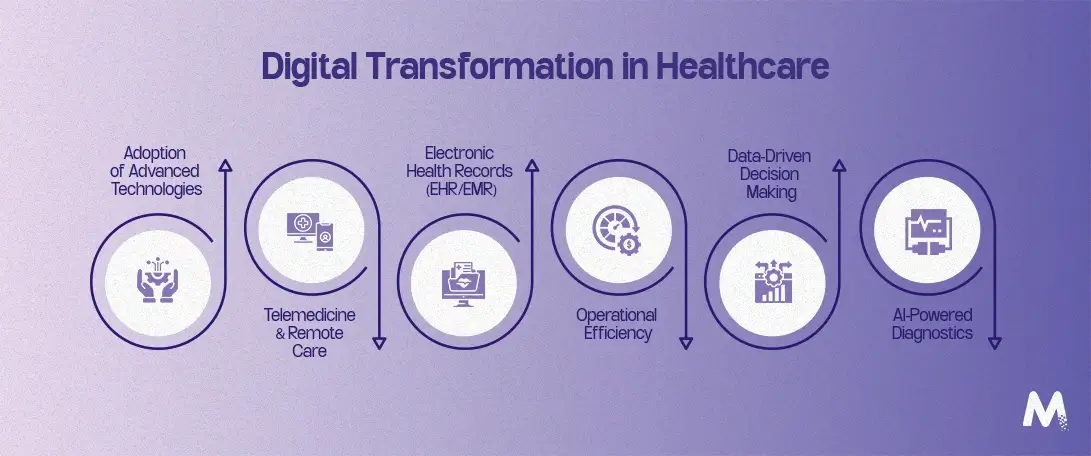
Digital transformation in healthcare is leading to the evolution of this industry, bringing up new possibilities for improving the patient experience and making the processes more efficient. With technological advancements, there are many approaches that facilitate more precise diagnosis, personalization, and efficiency in healthcare organizations. Digital transformation in healthcare utilizes technologies such as artificial intelligence, machine learning, and IoT.
Adoption of Advanced Technologies
Includes AI, cloud computing, IoT, and big data to enable smarter diagnostics, predictive analytics, and real-time monitoring. These technologies help healthcare providers detect diseases earlier and deliver more accurate, data-backed treatments.
Telemedicine & Remote Care
Enables virtual consultations, reducing the need for physical visits and improving access, especially in remote areas. It ensures continuity of care for patients with chronic conditions through regular remote monitoring and follow-ups.
Electronic Health Records (EHR/EMR)
Digitization of patient records for better data management, faster access, and improved coordination among healthcare providers. It eliminates paper-based inefficiencies and ensures that patient data is consistently updated and easily retrievable. EHR/EMR systems also improve clinical decision-making.
Operational Efficiency
Automates administrative tasks like scheduling, billing, and patient management, reducing errors and saving time. It allows healthcare staff to focus more on patient care rather than routine manual processes. Improved workflows and resource utilization lead to faster service delivery and better overall hospital performance.
Data-Driven Decision Making
Uses analytics to improve clinical outcomes, optimize resources, and support evidence-based treatments. Healthcare providers can analyze large datasets to identify trends, predict risks, and enhance treatment strategies. It also helps in policy-making, operational planning, and improving population health management.
AI-Powered Diagnostics
Leverages artificial intelligence to analyze medical data such as imaging, lab results, and patient history for faster and more accurate diagnosis. AI algorithms can detect patterns that may be missed by human analysis, improving early disease detection and reducing diagnostic errors.
This leads to quicker treatment decisions, better patient outcomes, and increased efficiency in clinical workflows.
Key Challenges in Healthcare App Development in Oman
Despite the strong momentum behind Oman’s digital health agenda, the path to scalable healthcare app deployment is far from straightforward. As of 2025, over 40% of healthcare institutions lack formal digital health governance structures, and more than half operate without comprehensive cybersecurity protocols, gaps that present real risk for developers, investors, and institutional buyers building in this market.
1. Technology and Infrastructure Hurdles
Over 60% of healthcare facilities lack adequate IT infrastructure, with internet speeds often falling below 500 Mbps and unreliable Wi-Fi connectivity. This significantly restricts the adoption of telehealth services and real-time patient monitoring, particularly in remote and underserved regions.
2. Data Security and Privacy
Roughly 50% of health institutions lack patient data encryption, posing high risks of data breaches. Developing solutions that align with local regulations while maintaining robust cybersecurity is a major challenge.
3. Workforce and User Adoption
- Nearly 80% of health institutions do not provide formal training for new staff on digital systems, which limits the effective use of apps and increases human error.
- Resistance to Change: Both patients and medical staff often resist moving from traditional, paper-based, or manual systems to new digital platforms.
Why is Oman Becoming a Hub for Digital Health Innovation?
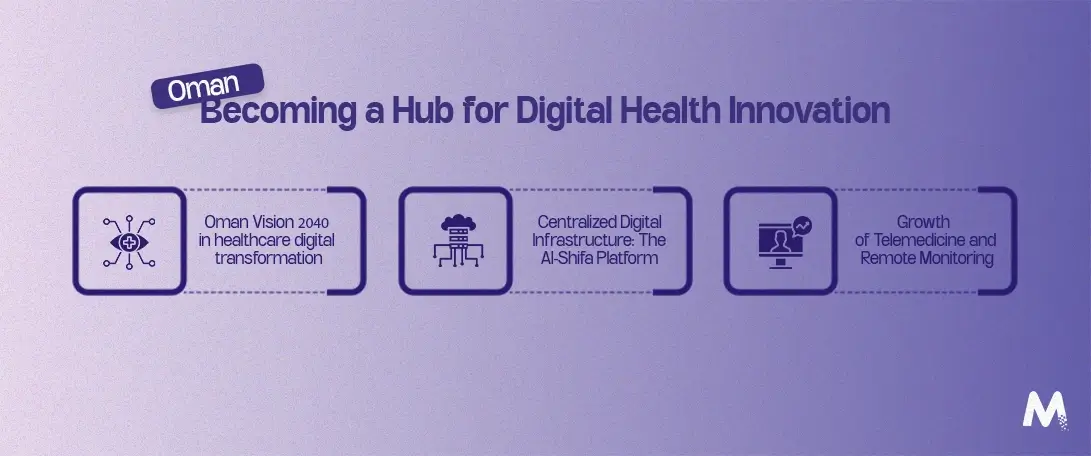
Oman is establishing itself as a regional leader in digital health innovation and the momentum is accelerating faster than most anticipated. By anchoring its healthcare transformation within the broader Oman Vision 2040 framework, the Sultanate is making a policy-backed push to modernize its health sector.
Oman Vision 2040 in healthcare digital transformation
The foundation of Oman’s digital health ambition lies in Vision 2040, which identifies healthcare as a core pillar of national development. The government is channeling investment into AI, cloud computing, and IoT infrastructure, and not to modernize for modernization’s sake, but to transition the entire health system toward predictive, data-driven medicine.
Centralized Digital Infrastructure: The Al-Shifa Platform
No conversation about Oman’s digital health ecosystem is complete without acknowledging the Al-Shifa national health platform. It is developed by the Ministry of Health (MOH) in the Sultanate of Oman to manage clinical workflows and electronic health records (EHR) across public healthcare institutions. By consolidating fragmented systems into a single, interoperable infrastructure, Al-Shifa is already reducing wait times, streamlining care coordination, and enhancing patient experiences.
Growth of Telemedicine and Remote Monitoring
Telemedicine has moved well past its role as a supplementary service in Oman; it is now a critical pillar of the country’s healthcare delivery model. Two distinct realities are driving this shift:
- The need to improve specialist care accessibility in remote and geographically dispersed regions.
- The growing burden of chronic conditions such as diabetes, hypertension, and cardiovascular disease demands continuous care rather than isolated clinical visits.
Read Also: Digital Transformation in Healthcare: Building Smarter, Connected Care Systems
Types of Healthcare Apps Being Built in Oman
Oman’s digital health landscape is no longer limited to basic appointment booking tools or patient information portals. As investment flows in and regulatory frameworks mature, a diverse range of sophisticated healthcare applications are being developed, each addressing a specific gap in the country’s care delivery model.
Telemedicine Platforms
Telemedicine platforms represent the fastest-growing segment of healthcare app development in Oman today. Accelerated by post-pandemic behavioral shifts and the Ministry of Health’s push toward remote care, these platforms are being built to serve both urban professionals and patients in geographically underserved regions.
What distinguishes a market-ready telemedicine solution in Oman is its depth of localization. The right telemedicine app features for the Omani market extend well beyond video consultations.
- Bilingual (Arabic-English) interface with full RTL support
- AI-assisted triage and symptom assessment before connecting patients to physicians
- Secure e-prescription and pharmacy integration compliant with MoH guidelines
- Asynchronous consultation options — text and image-based reviews for non-urgent cases
- Chronic disease monitoring modules with remote vitals tracking
- Al-Shifa platform integration for seamless access to patient health records
- Offline functionality to maintain service continuity in low-connectivity areas
AI-Powered Diagnostic and Support Apps
- AI Radiology: Systems deployed at institutions such as Sultan Qaboos University Hospital (SQUH) assist doctors by analyzing X-rays and MRIs to improve diagnostic speed.
- Virtual Health Assistants: AI chatbots, such as Tibbi, are used by the Ministry of Health to answer general health questions, provide guidance on symptoms, and find the nearest clinic.
- Clinical Decision Support: Apps are being developed to assist physicians with clinical decision-making, including AI-enabled diabetic retinopathy screening and stroke assessment tools.
Remote Patient Monitoring (RPM) and Wearable Integration
- These applications are designed for managing chronic conditions (e.g., diabetes) by allowing patients to wear sensors that track glucose levels, blood pressure, and vitals.
- Smart Alerts: AI platforms analyze this real-time data to alert doctors or families when a patient is at risk, such as reducing hypoglycemia incidents.
Top Trending Features of Healthcare App Development in Oman
Top trending healthcare app development features in Oman focus on improving patient convenience, remote care, and security through AI, IoT, and telemedicine.
- Telemedicine and Virtual Care: Enhanced video consultation platforms, secure in-app chat with specialists, and instant digital prescription generation are crucial for extending care reach.
- AI-Powered Diagnostics & Analytics: Machine learning algorithms are used for predictive insights, analyzing symptom trends, and providing AI chatbots for 24/7 triaging.
- Remote Patient Monitoring (RPM) & IoT Integration: Apps connect with wearables or IoT devices to track vital signs such as heart rate, glucose levels, and blood pressure, providing real-time data to doctors.
- Secure EMR & Data Privacy: Implementation of robust security standards (often HIPAA compliant) and blockchain technology to ensure secure, tamper-proof sharing of medical records.
Healthcare App Compliance Requirements in Oman
When building a cloud-native healthcare application for Oman, compliance is not optional; it’s foundational. Healthcare platforms handle highly sensitive patient data, making regulatory adherence critical for both legal operations and user trust.
Key compliance areas to consider:
- Personal Data Protection Law (PDPL):
Oman’s PDPL governs how personal data is collected, processed, stored, and shared. Healthcare apps must obtain explicit user consent, ensure data minimization, and implement strong data protection measures such as encryption and access controls. - Ministry of Health (MoH) Regulations:
Any healthcare-related platform must align with guidelines set by Oman’s Ministry of Health. This includes patient data confidentiality, integration standards for health systems, and approval requirements for digital health solutions. - Data Localization & Hosting Rules:
Depending on the type of healthcare data, certain information may need to be stored within Oman or in approved jurisdictions. Choosing the right cloud provider with regional data centers or compliant hosting options is essential. - Security & Access Management:
Implement role-based access control (RBAC), multi-factor authentication (MFA), and audit logs to ensure only authorized personnel can access patient data. - Audit & Compliance Readiness:
Regular audits, documentation, and compliance reporting should be part of your development lifecycle to meet regulatory expectations and avoid penalties.
Medical App Development Cost in Oman 2026
For decision-makers evaluating a healthcare app investment, cost is rarely a single number; it is a range shaped by strategic choices made long before a single line of code is written. Understanding the true medical app development cost in Oman requires looking beyond the initial build estimate and accounting for app complexity, integration depth, platform strategy, and localization requirements.
Cost Breakdown by App Type
Development costs of applications in Oman’s healthcare sector vary depending on the nature and complexity of the application being built:
| App Type | Estimated Cost Range |
| Basic Patient Portal | $15,000 – $30,000 |
| Telemedicine App (MVP) | $25,000 – $60,000 |
| Full EHR/EMR Integration | $50,000 – $150,000+ |
| AI Diagnostic Platform | $80,000 – $200,000+ |
Key Factors That Influence Development Cost
While the table above provides a reliable baseline, several variables can meaningfully shift the final investment figure in either direction:
Team Location and Engagement Model: Partnering with a local Oman-based development company commands a higher day rate than engaging an offshore team, but offers tangible advantages. For enterprise-grade or government-facing products, local partnership is often not just preferred but expected.
Feature Complexity and Third-Party Integrations: Every additional integration, such as insurance APIs, pharmacy networks, laboratory systems, and wearable device connectivity, adds both development time and ongoing maintenance overhead. Mapping integration requirements exhaustively during the scoping phase is one of the most effective ways to control costs.
Platform Strategy: Building natively for both iOS and Android increases reach but also increases cost. Cross-platform frameworks such as Flutter or React Native offer a pragmatic middle ground for most healthcare app use cases, delivering near-native performance at a meaningfully lower development investment.
How to Choose the Right Healthcare App Development Partner in Oman
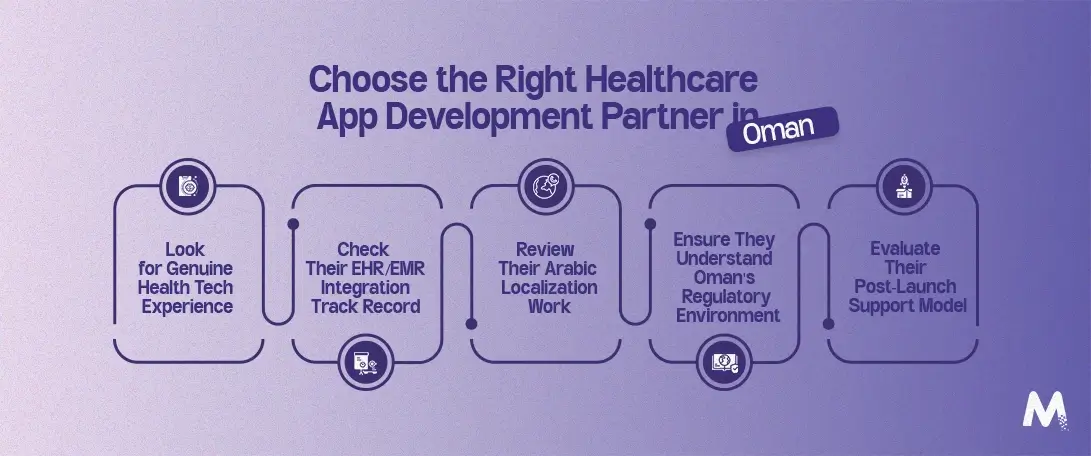
Choosing the right development partner is as important as the product idea itself. In a regulated and culturally specific market like Oman, a generalist mobile development agency will rarely meet the bar. Here is what to evaluate before making your decision.
Look for Genuine Health Tech Experience
There is a significant difference between a team that builds mobile apps and a team that builds healthcare products. Your right development partner should have direct, demonstrable experience with clinical workflows, patient data handling, and medical-grade UX, and not just a healthcare logo or two in their portfolio.
Check Their EHR/EMR Integration Track Record
EHR and EMR integration is technically complex and easy to get wrong. Your right development partner should have hands-on experience working with interoperability standards like HL7 and FHIR, and ideally, prior integration experience with the Al-Shifa platform or similar national health systems.
Ask for case studies, not just capability claims.
Review Their Arabic Localization Work
Arabic localization in healthcare is far more than translation. Look for a development partner who has shipped live products with full RTL interface support and bilingual medical terminology — built in from the start, not added at the end.
Review actual live products where possible. The quality of their localization work reflects how well they understand the Omani user.
Ensure They Understand Oman’s Regulatory Environment
Your development partner should be familiar with MoH guidelines, OHI data standards, patient consent requirements, and Al-Shifa compatibility protocols. If they cannot speak to these confidently, the compliance burden falls entirely on your team — adding cost and risk to the project.
Evaluate Their Post-Launch Support Model
Healthcare apps require ongoing maintenance, typically 15–20% of the build cost annually — covering security updates, compliance patches, performance fixes, and OS compatibility. A reliable development partner stays invested in the product’s performance well beyond the launch date.
Why Partner with Markup Designs for Healthcare App Development in Oman?
At Markup Designs, we specialize exclusively in healthcare app development, meaning you work with a team that understands clinical workflows, patient data compliance, and the regulatory demands of the Omani market. From EHR/EMR integration and Arabic localization to Al-Shifa compatibility and MoH guidelines, we build specifically for healthcare, and not borrow from general mobile development experience.
Beyond the build, we support the full product lifecycle, such as MVP scoping, deployment, post-launch maintenance, and compliance updates. For health-tech startups and hospital networks alike, our end-to-end commitment makes us a reliable long-term partner in Oman’s digital health landscape.
FAQs
What is the cost of healthcare app development in Oman?
The cost typically ranges from $15,000 for basic apps to over $200,000 for advanced AI-powered platforms, depending on complexity, integrations, and features.
What are the must-have telemedicine app features for the Omani market?
Essential features include bilingual (Arabic-English) support with RTL, video consultations, e-prescriptions, AI triage, remote monitoring, and integration with national systems like Al-Shifa.
Why is EHR/EMR integration important in healthcare apps?
EHR/EMR integration ensures seamless access to patient data, improves care coordination, and enhances clinical decision-making across healthcare providers.
How are AI-powered diagnostic tools used in Oman?
AI tools are used for radiology analysis, predictive diagnostics, virtual health assistants, and clinical decision support to improve accuracy and efficiency.
What is the cost of patient portal development in Oman?
A basic patient portal typically costs between $15,000 and $30,000, depending on features and integrations.
Why should startups focus on MVP development for healthcare apps?
An MVP helps validate the idea, reduce initial costs, accelerate time-to-market, and attract investors with a functional prototype.
What is the annual maintenance cost of a healthcare mobile app?
Maintenance usually costs around 15–20% of the initial development cost, covering updates, security, and performance improvements.
Conclusion
Healthcare app development in Oman is entering a transformative phase, driven by Vision 2040, government-backed initiatives, and demand for digital health solutions. From telemedicine and AI diagnostics to remote patient monitoring and integrated health records, the ecosystem is evolving rapidly, creating both opportunities and challenges for businesses.
However, success in this market requires more than just technical execution. It demands a deep understanding of local regulations, such as Arabic localization, and the ability to integrate with national platforms like Al-Shifa. Organizations must also account for infrastructure limitations, cybersecurity gaps, and user adoption barriers while planning their digital health strategies.

Author's Perspective
From my experience working with digital product teams, one thing is clear: cost should never be the only deciding factor. Many companies try to cut corners by choosing the cheapest option, only to face scalability issues, compliance risks, and poor user experience later. In healthcare, where data security and reliability are critical, these compromises can be costly, and not just financially but also in terms of reputation.
Discuss Your Project NowGaurav Goyal
Global Sales- VP
Related Posts
How to Build a Compliant HealthTech App in...

Complete Guide to Healthcare App Development in Saudi...
Remote Patient Monitoring App Development in the UAE:...
Insights Are Valuable & Execution is Priceless
You’ve read about the digital future. Now, let’s build the infrastructure to take you there. Move your strategy from the page to the product.
Design Your Solution Now
Contact Us
Schedule The Appointment At Your Convenience Date And Time.
30 Min
Web Conference
Time Zone
Indian standard time (08:30pm)

Thanks For Getting In Touch!
You’ve Taken The First Step Toward Transforming Your Digital Presence. Our Experts Will Reach Out Shortly To Take It Forward.
Launch Your Dream Project
Provide a brief overview of your project, and our specialists will evaluate your requirements. We will connect with you to explore how the right digital solutions can help you launch faster.