
In Brief
- Currently, the iOS app development process includes everything that happens from the verification of the app idea to its release to the App Store and further maintenance.
- The article will discuss all main elements, important technologies, and advanced solutions necessary for the creation of high-quality iOS applications.
- Readers will also find out information related to the factors influencing the cost of iOS app development.
- The guide describes the best practices of iOS application development and potential challenges that customers may face.
- In addition, readers will find out how working with a partnered professional iOS app development organization can help in the creation of a secure, qualitative, and user-oriented app.
As digital transformation continues to accelerate in 2026, the demand for high-quality iOS applications is growing across industries. Apple’s ecosystem remains the preferred choice for businesses seeking secure, high-performance, and scalable mobile solutions. With over 2.35 billion active Apple devices worldwide, a thriving App Store hosting millions of applications, and billions of dollars in annual developer revenue, the platform offers immense opportunities for businesses to reach a premium audience. Moreover, iOS users consistently spend more on apps and in-app purchases than Android users in many markets, while the continued global adoption of Apple Pay further strengthens the platform’s value for businesses looking to deliver seamless digital experiences.
However, building a successful iOS application involves much more than turning an idea into reality. From defining clear business objectives and selecting the right technology stack to designing intuitive user experiences, integrating advanced features, and meeting Apple’s strict App Store guidelines, every stage plays a vital role in an app’s success.
In this guide, we will explore the complete iOS app development process, essential features, technology stack, development costs, timelines, latest trends, and industry best practices to help you build a secure, scalable, and future-ready iOS application.
What Is iOS App Development?
iOS app development stands for making an application for the Apple ecosystem and various devices, including iPhone, iPad, Apple Watch, Apple TV, and Vision Pro. The applications use technologies such as Swift, SwiftUI, Objective-C, and Xcode, which make them quick, safe, intuitive, easy to use, and integrated with other devices.
The demand for a good digital experience has made iOS development a smart option for businesses boosting their processes.
Understanding iOS App Development Ecosystem
The Apple development ecosystem consists of advanced software, powerful hardware, and a huge range of development tools. Thanks to this ecosystem, developers can develop applications with a smooth user experience, using modern technologies such as Swift, SwiftUI, Xcode, CloudKit, Core ML, ARKit and Apple software development kits (SDKs).
The ecosystem also allows integration with such services as Face ID, Apple Pay, Siri, iCloud and Apple Maps, which help companies create a secure, easily connected, and user-friendly user experience along with relevant regulatory compliance standards.
Native vs. Cross-Platform vs Hybrid iOS Development
There are a few different iOS development approaches available to companies depending on their specific needs, available budget, and target audience.
Thanks to native iOS development, one can get applications created for Apple devices exclusively with the help of Swift or Objective-C. It provides the best level of performance and security.
Cross-platform development is an option to get applications created for both iOS and Android platforms to save time and costs.
A hybrid development approach combines the advantages of both web and native technologies to make it suitable for simple applications and MVPs.
Choosing the right approach depends on your performance expectations, scalability goals, and long-term business requirements.
Why Companies Prefer iOS App Development Services
Many mobile app development companies have switched to iOS app development services due to their capability to create applications with a high-quality user base, exceptional security, and outstanding user experience. The rigorous quality regulations by Apple and its ongoing updates guarantee greater reliability and stability of apps.
Moreover, unsurpassed integration with Apple’s ecosystem and cutting-edge technologies like artificial intelligence, augmented reality, and cloud computing allow businesses to create one-of-a-kind applications meeting customers’ needs and increasing customer satisfaction and returns on investment.
Industries Investing in iOS Applications
Mobile applications on iOS have become a driving force behind digital transformation in numerous industries, as they facilitate the development of reliable, scalable, and customer-oriented solutions.
Among the industries willing to invest in iOS applications are:
- Healthcare: Telemedicine applications, patient monitoring, and healthcare systems
- Fintech: Mobile banking, digital payments, and investment websites
- Retail: E-commerce-based websites, loyalty programs, and personalized shopping
- Transportation: Fleet supervision applications, shipment control, and warehouse oversight
- Education: E-learning applications, virtual classrooms, and student portals
- Travel: Applications for bookings, itineraries, and navigation services
- Real Estate: Property listings, virtual tours, and CRM software
- Entertainment: Streaming services, gaming applications, and media services.
As Apple’s ecosystem continues to evolve, organizations across these sectors are leveraging iOS applications to enhance user experiences, improve operational efficiency, and accelerate digital innovation.
Why Businesses Should Invest in iOS App Development
iOS has earned the status of one of the most profitable platforms for businesses due to it already established loyal customer base, high standards of security, and a reputation for quality digital experience. Investing in iOS app development will boost engagement with clients, increase the value of the branding, and ensure a successful business launch or upgrade, whichever you choose.
High-Value Customer Base
Apple users are known for their purchasing power and loyalty to brands. This makes iOS a very beneficial platform for companies willing to reach out to premium customers who are ready to use various digital services, subscribe to paid options, and make in-app payments.
Enhanced Security and Privacy
Security is one of Apple’s main points of differentiation. The company’s advanced security features such as end-to-end encryption, biometric identification, application sandboxing, and constant updates guarantee the safety of users’ data and minimal cybersecurity threats. For this reason, iOS is extremely beneficial for industries that deal with sensitive information, including banks, the healthcare industry, and enterprise services.
Superior User Experience
Apple’s Human Interface Guidelines ensure that the application will always offer a simple, understandable, and consistent user experience. Combined with high-quality hardware and software optimization, businesses can create applications that offer smooth navigation, faster interactions, and higher customer satisfaction.
Better Revenue Generation
iOS apps usually create extra revenue through paid downloads, subscriptions, and in-app purchases. The engaged user base and secure payment process allow developers to take advantage of to maximize monetization and build long-term customer relations.
Faster Performance
Due to the fact that Apple produces both hardware and software, iOS applications experience better optimization and good performance. The application thus works faster and offers a better overall user experience due to the improved responsiveness and ease of use.
Seamless Apple Ecosystem Integration
iOS apps can integrate easily into the Apple ecosystem, including Apple Watch, Mac, iPad, Apple TV, Siri, Apple Pay, Face ID, and iCloud, thus providing users with a better experience.
Long-Term Scalability
iOS applications are built on a stable and continuously evolving ecosystem that supports regular updates, advanced technologies, and enterprise growth. Businesses can easily scale applications by adding new features, integrating emerging technologies such as AI and AR, and expanding to new markets without compromising performance.
Types of iOS Applications
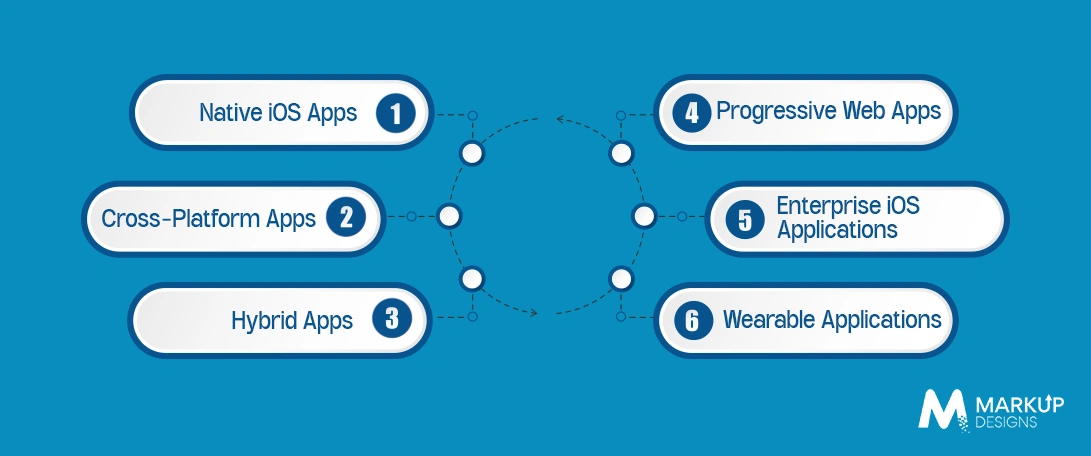
Different types of iOS applications are created by businesses based on their business aims, audience, budget, and performance specifications. Knowing these differences helps companies find the right development approach to ensure long-term success.
Native iOS Apps
Native applications are developed for iOS only and can be created in Swift or Objective-C. They ensure the highest level of performance and security as well as allow applications to make use of all device features, making them suitable for applications that need speed and reliability.
Cross-Platform Apps
Cross-platform apps are created using Flutter or React Native, so the same code can be used for both iOS and Android. This approach saves lots of time and money and allows providing the same functionality for both platforms.
Hybrid Apps
Hybrid applications represent the combination of web-based technologies with native components. They are suitable for businesses looking to launch simple applications or MVPs quickly with a lower initial investment.
Progressive Web Applications
Progressive Web Applications (PWAs) are accessible through the web but function like apps. They do not need to be downloaded from any app store, and allow capabilities such as running when offline, quick load times, and being used easily on any device.
Enterprise iOS Applications
Corporate applications are designed to achieve efficiency of enterprise operations. The applications help to achieve many functions that are related to business activities like facilitating employee communications, workflow management, inventory system management, use of Shopify, integration with ERP, and secure communication methods.
Wearable Applications
Wearable applications are meant to support smart gadgets such as the Apple Watch in doing different types of tasks. They help companies to engage customers by giving them the opportunity to track their movements, fitness, receive notifications, and use services based on their location.
Comparison of Different Types of iOS Applications
| Application Type | Best For | Key Advantage | Consideration |
| Native iOS Apps | High-performance consumer and enterprise apps | Excellent performance and full access to Apple features | Higher development investment |
| Cross Platform Apps | Businesses targeting iOS and Android | Shared codebase reduces development time and cost | Some advanced native capabilities may require custom development |
| Hybrid Apps | MVPs and simple business applications | Faster development and lower initial cost | Lower performance compared to native apps |
| Progressive Web Apps | Content platforms and service businesses | No installation required and easy accessibility | Limited access to native device features |
| Enterprise iOS Apps | Internal business operations | Improves productivity and operational efficiency | Requires integration with existing enterprise systems |
| Wearable Applications | Health, fitness, and real-time services | Delivers instant and personalised user experiences | Limited screen size and functionality compared to mobile apps |
Essential Features Every Modern iOS App Should Include
The success of an iOS application depends not only on its design but also on the features it offers. Modern users expect fast, secure, and personalised experiences that simplify everyday tasks while ensuring seamless performance across Apple devices.
Secure User Authentication
Ensure that user accounts are secured with reliable ways of logging in, such as Face ID, Touch ID, two-factor verification, and single sign-in (SSO). Such technologies have increased safety and simplified user account access.
AI-Powered Personalisation
Artificial Intelligence technology enables the analysis of users’ activities, providing them with personalised suggestions, tailored information, proactive search, and easier interfaces.
Push Notifications
Properly timed push messages can provide users with the required information, as well as announcements, deals, and events, thus contributing to higher engagement without hampering the user experience.
In-App Payments
Implement Apple Pay and other secure payment systems to enable users to perform quick and seamless transactions.
GPS and Location Tracking
Location-based services allow for features such as navigation, tracking deliveries, referring to the closest restaurants, geofencing, and real-time route optimisation.
Real-Time Chat
Instant messaging is a tool that allows for immediate communication between users, and customer service representatives, thus ensuring communication is essential in healthcare, retail, education, and service applications.
Analytics Dashboard
Installed analytics enable companies to understand users’ behaviour and measure application performance and the successes of various features.
Offline Functionality
In case of unavailability of the internet, offline access makes certain important functionalities available in low connectivity settings.
Social Media Integration
Embedding login, sharing, or inviting functions with social media platforms helps to achieve a higher level of accessibility and enhance consumer engagement.
Cloud Synchronisation
Cloud synchronisation allows users to save files on their Apple devices securely, restore deleted information automatically, and access it with ease.
Multilingual Support
Multilingual support enables attracting customers from different countries while creating a unique customer experience for each market.
Advanced Search
Smart search options provide users with filtering, predictive guessing, and voice search opportunities.
Dark Mode Support
Dark Mode support ensures the comfort of use, less battery consumption, and more flexibility of the interface.
Accessibility Features
Accessibility features provide opportunities for users with disabilities to utilize applications in accordance with Apple’s requirements.
Latest Technologies Powering iOS App Development
Today’s iOS applications depend on modern technologies that improve functioning, enhance user satisfaction, and speed up the process of development. Selecting the appropriate technology stack ensures that applications are secure, scalable, and future-proof.
Swift: The main programming language used by Apple to create high-performance iOS apps that have clean and manageable code.
SwiftUI: A modern interface building framework allowing developers to create responsive, interactive, and consistent user interfaces for Apple devices.
Objective-C: An old programming language that is still in use for updating older iOS apps and maintains old Apple technology.
Xcode: Apple’s official development environment used for creating iOS apps, debugging, and testing.
Firebase: An additional backend platform with services such as authentication, cloud databases, analytics, crash reporting, and push messages that expedite the app development process.
AI and Machine Learning: Artificial Intelligence improves apps by providing personalized recommendations, predictive analytics, intelligent automation, image recognition, and chatbot development.
Core ML: Apple’s machine-learning platform that helps software engineers integrate AI models in the apps quickly and securely.
ARKit: A powerful software for creating augmented reality applications across retail sphere, healthcare, gaming, education, and real estate.
Cloud Integration: Cloud technologies provide mechanisms for safe storage of data, synchronization of data, storage of backups, and infrastructure for developing applications that can be scaled up whenever necessary.
APIs and Third Party Services: Using APIs we can easily connect with different apps for processing payments, mapping, social media communication, messaging, CRM software, and other similar applications.
The Complete iOS App Development Process
Creating a successful app for the iOS environment is only possible with a well-structured process of development that combines business interests, user requirements, and technical aspects.
Step 1: Business Requirement Analysis
It is important to know what goals need to be accomplished, what target audience, business challenges, budget, and expected results we are going to achieve, so that we can develop a clear plan.
Step 2: Market and Competitor Research
It is important to analyze market trends in order to understand what customers expect and how competitors’ apps work.
Step 3: Feature Planning and MVP Definition
Identify the actual features for the application and develop the Minimum Viable Product (MVP) needed for a faster launch, user feedback collection, and further development.
Step 4: UI UX Design
Design intuitive user journeys, attractive interfaces, and seamless interactions that align with Apple’s Human Interface Guidelines.
Step 5: Wireframing and Prototyping
Create wireframes and interactive prototypes to validate workflows, improve usability, and gather stakeholder feedback before development begins.
Step 6: Technology Stack Selection
Selecting the right technology stack ensures better scalability, security, and long term application performance.
| Component | Common Technologies |
| Frontend | Swift, SwiftUI, UIKit |
| Backend | Node.js, Laravel, .NET, Java |
| Database | PostgreSQL, MySQL, MongoDB, Firebase |
| Cloud | AWS, Microsoft Azure, Google Cloud, CloudKit |
| Analytics | Firebase Analytics, Google Analytics, Mixpanel |
| APIs | REST APIs, GraphQL, Payment APIs, Social APIs |
Stage 7: Frontend Development
Develop interface, animations, navigation, and user experience of the application while assuring responsiveness to Apple devices.
Stage 8: Backend Development
Build a server-side architecture that is safe and secure, build APIs, set up the database, create the authentication system, and create the business logic with all the required functionality.
Stage 9: Third Party Integration
Integrate services into the application, for example, payment gateways, maps, cloud storage, and notifications to expand the application’s capacities.
Stage 10: Quality Assurance Testing
Prior to the deployment of the application, various types of tests are conducted to ensure its quality.
- Functional tests: Check whether all the features function properly.
- Performance tests: Run evaluations of speed and reliability in different conditions.
- Security tests: Identify locations of vulnerabilities and estimate how well the data protection system works.
- Compatibility tests: Check whether the application runs properly on different Apple devices and iOS versions.
- Usability tests: Determine how convenient it is to work with the application.
Stage 11: App Store Deployment
Prepare the application for submission according to Apple’s Review Guidelines and have it tested prior to launch.
Stage 12: Post-Launch Maintenance and Updates
Continuously monitor application performance, fix bugs, release feature updates, strengthen security, and optimise the user experience to keep the application competitive and aligned with evolving business needs.
Technology Stack Required for iOS App Development
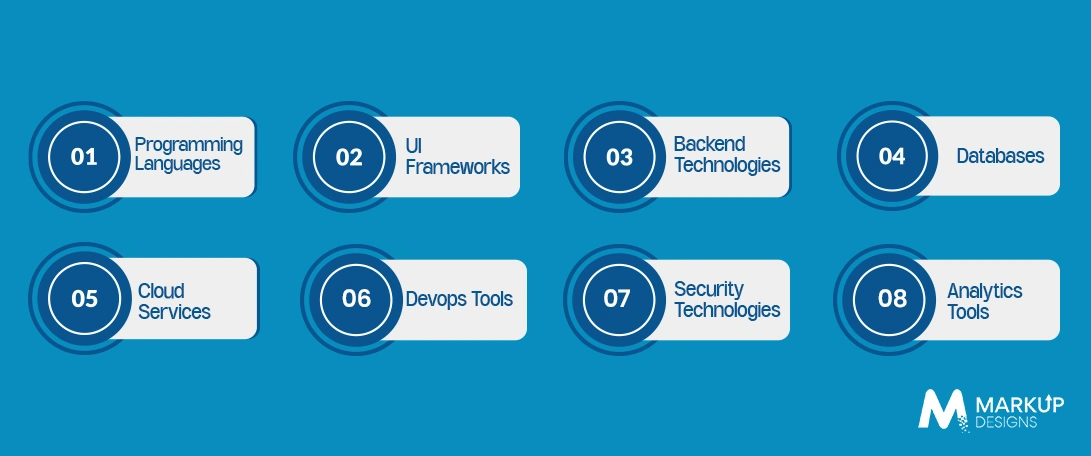
Picking the right technology stack is crucial in effective development of secure, stable, and reliable iOS apps. A well-thought-out choice will facilitate development processes, allow for improved customer satisfaction, and guarantee that the app could be adapted to the growing needs of a company.
Programming Languages
Swift is the fastest, safest, and most clear language for iOS programming. Objective C is still used to support older software.
User Interface Frameworks
SwiftUI and UIKit provide developers with tools for creating functional, beautiful, and understandable interfaces that meet all requirements from Apple.
Backend Technologies
Backend programming languages such as Node.js, Laravel, .NET, Java and Python allow handling all logic of the project and creating different services.
Databases
Databases such as PostgreSQL, MySQL, MongoDB, Firebase Firestore, SQLite are used in applications for user data management.
Cloud Solutions
Cloud providers like AWS, Azure, Google Cloud and CloudKit offer different infrastructures and storage avenues.
DevOps Tools
Tools like GitHub, GitLab, and Jenkins are used for teams’ collaboration with ease; they help automate various processes.
Security Technologies
Security is provided by Face ID, Touch ID, Keychain Services, SSL encryption, and OAuth authentication.
Analytics Tools
Solutions such as Firebase Analytics, Google Analytics, Mixpanel, and Crashlytics help businesses monitor user behaviour, application performance, and feature adoption.
Read More: AWS vs Google Cloud for Mobile Apps: Which is Better in 2026?
How Much Does iOS App Development Cost in 2026?
The price tag of iOS application development solutions largely depends on the complexity of a mobile application, its characteristics, design requirements, integrations with third-party apps, and a developer team. For instance, a simple app may need just a small budget, whereas the creation of an enterprise-level or AI-based application would take extra time and efforts.
Simple Applications
Basic applications that have simple features, standard UI, and little backend functionality are well suited for startups and MVPs.
Estimated price: USD 15,000-35,000
Medium Complexity Applications
Such applications provide customized UI, user authentication, payment gateways, APIs, and cloud integration, making them a good choice for expanding businesses.
Estimated price: USD 35,000-80,000
Enterprise Applications
Innovative technology solutions involve complex corporate processes, an advanced level of security, third-party integrations, and scalable architecture that meet the requirements of big companies.
Estimated price: USD 80,000-200,000+
AI-Enabled Applications
Apps that utilize AI and machine learning technologies demand smart features that include recommendation systems, predictive analytics, and chatbots, which makes them very complex to develop.
Estimated price: USD 70,000-250,000+
On-Demand Applications
On-demand applications such as food delivery or taxi-hailing ones, healthcare applications, or services marketplaces require advanced backend systems and include real-time tracking and multiple user panels.
Estimated Cost: USD 60,000 to USD 180,000+
Estimated iOS App Development Cost
| Application Type | Estimated Cost (USD) |
| Simple Applications | $15,000 to $35,000 |
| Medium Complexity Applications | $35,000 to $80,000 |
| Enterprise Applications | $80,000 to $200,000+ |
| AI Enabled Applications | $70,000 to $250,000+ |
| On Demand Applications | $60,000 to $180,000+ |
Note: The final development cost depends on project scope, feature set, technology stack, and business requirements.
Factors Affecting iOS App Development Cost
Different technical and commercial elements impact the total price a business encounters while creating an iOS app. Knowledge of these elements enables one to efficiently develop a budget for the entire operation and properly allocate their resources.
Application Complexity
Apps with sophisticated features, special capabilities, and intricate reasoning will require more effort compared to simple applications.
Number of Features
Developing features, such as live messaging, payment systems, artificial intelligence functions, and location tracking prolongs the development and increases costs.
UI UX Design
Customized animation, active interfaces, and high-quality user experience contribute to the overall development complexity.
Third Party Integrations
Integrating payment systems, CRMs, maps, cloud services, and other APIs into the app is responsible for the increase of the total volume of work.
AI Features
Using AI solutions in the app is connected with constantly growing costs and complex tasks.
Cloud Infrastructure
The selected cloud platform, amount of storage, ability to synchronize the app in real-time, and server performance have a direct impact on overall operational costs.
Security Requirements
Applications with transactions in finance, healthcare, or the corporate sector necessitate unique encryption, authentication, and adherence to state regulations, which leads to increased costs.
Development Team Location
Development rates vary across regions based on expertise, labour costs, and market demand, making team location an important pricing factor.
Testing Requirements
Comprehensive functional, performance, security, compatibility, and usability testing improves application quality but also contributes to the overall project budget.
Maintenance Costs
Post-launch expenses such as bug fixes, feature enhancements, OS updates, security patches, and performance optimisation should be considered as part of the application’s long-term investment.
Estimated Timeline for iOS App Development
The duration of developing an iOS application is contingent on its complexity, the set of features and integrations to be done, and the tests to undergo. While simple app can be deployed in a matter of months, more complicated systems like enterprise apps or AI-powered solutions take much longer to finish and test.
Discovery phase
The stage includes studying the goals of the client’s business, outlining the requirements and the budget, reviewing the users’ needs, and creating a plan of actions.
Estimated Duration: 1 to 2 weeks
Design Phase
At this stage the designers create wireframes, plans for user actions, prototypes, and high-quality designs in accordance with Apple’s Human Interface Guidelines.
Estimated Duration: 2 to 4 weeks
Development Phase
The developers prepare front-end and back-end applications, APIs, data, and core functionality while connecting external services where needed.
Estimated Duration: 8 to 20 weeks
Testing Phase
The application is carefully tested for its functionality, usability, speed, security, and compatibility.
Estimated Duration: 2 to 4 weeks
Deployment Phase
When testing is done, the product is sent to the App Store, and the process of acceptance by Apple and a subsequent deployment to users begins.
Estimated Duration: 1 to 2 weeks
Typical iOS App Development Timeline
| Development Phase | Estimated Timeline |
| Discovery & Planning | 1 to 2 Weeks |
| UI UX Design | 2 to 4 Weeks |
| Development | 8 to 20 Weeks |
| Testing & QA | 2 to 4 Weeks |
| App Store Deployment | 1 to 2 Weeks |
| Overall Timeline | 3 to 7 Months |
Common Challenges in iOS App Development and Their Solutions
Creating an iOS application poses many technical and business difficulties. By making sure the problems are resolved early, companies can experience fewer delays, better quality application, and a successful launch.
Device Compatibility
There are many iPhone and iPad models to be supported, including those with differing screen sizes and iOS versions.
Solution: Use responsive design principles and test the application on all versions of Apple devices.
App Store Approval
All the applications that are not compliant with Apple review guidelines may risk rejection or delays in approval.
Solution: Make sure to comply with Apple’s App Store Review Guidelines, keep up the quality standards and check for compliance prior to submission.
Performance optimisation
Poor performance and long loading times can harm the user experience.
Solution: Optimise the code and avoid excessive use of resources, while monitoring application performance regularly.
Security compliance
Applications dealing with private information must ensure data safety from the newly emerging security threats.
Solution: Implement secure authentication methods and encryption, perform regular security checks and comply with the industry regulations.
User retention
Businesses should not only attract users but also retain their interest, ensuring they keep coming back to the app.
Solution: Offer users personalized experience, constant updates, and engaging strategies.
Scalability
Applications should be able to accommodate increasing users and growing business requirements without compromising performance.
Solution: Build a scalable architecture supported by cloud infrastructure and modular development practices.
Continuous Updates
Frequent iOS releases require applications to remain compatible with new devices and operating system updates.
Solution: Monitor platform updates, release timely enhancements, and maintain an ongoing support strategy.
Best Practices for Successful iOS App Development
By adopting techniques that have been proven to work, businesses may develop trustworthy software that is scalable and user-friendly while minimizing risks and guaranteeing the longevity of their efforts.
Follow Apple’s Human Interface Guidelines
Design the interface of your product to make it user-friendly at all times, so that it follows Apple’s principles and suits the customers’ needs.
Focus on Performance
Speed up the performance of your application, make it more responsive, and use all the resources in a more efficient way.
Prioritise Security
Use the right techniques to safeguard important information.
Optimise Battery Consumption
Be ready to maximize your hardware to ensure that your gadget used battery at minimum rates.
Build Scalable Architecture
Use logic in your architecture and cloud computing technologies.
Leverage Agile Development
Choose the iterative ways of development that help you receive constant feedbacks faster.
Conduct Continuous Testing
Carry out continuous testing of your app throughout its entire lifecycle.
Monitor User Behaviour
Analyse user interactions, feature adoption, and performance metrics to continuously improve the application and user experience.
Emerging Trends Shaping iOS App Development in 2026
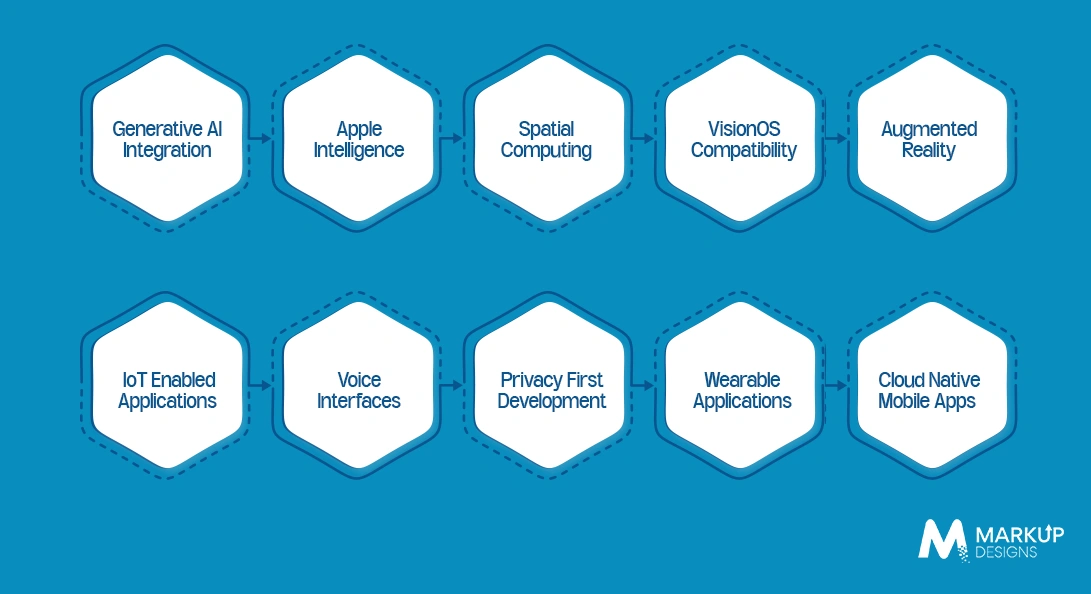
The rapid development of technologies is changing approaches to the development and design of iOS applications. Organizations that follow and apply the trends of progress secure themselves with a competitive advantage and a chance to create a digital experience in a modern way.
Generative AI Integration
Generative AI allows for the creation of powerful chatbots, content production, programming assistance, and personalization, which enhances user experience.
Apple Intelligence
Apple Intelligence incorporates onboard AI solutions, enhancing productivity, personalization, privacy as well as reducing dependency on processing in the cloud.
Spatial Computing
Spatial computing allows for the interaction of users between the physical and virtual world when using immersive applications.
VisionOS Compatibility
With the advent of Apple Vision Pro there’s a growing need for developing applications that are compatible with VisionOS in order to enable physical interaction.
Augmented Reality
Augmented reality keeps changing businesses in such sectors as retail, healthcare, education, production, real estate, and property management by creating immersive experience.
IoT Enabled Applications
The connection to smart devices renders the opportunity for real-time control, automation, predictive maintenance, as well as user experience.
Voice Interfaces
Voice-activated features driven by AI and Siri improve accessibility of mobile applications while giving more opportunities to users.
Privacy First Development
There has been a change in privacy regulations. Now, companies are giving priority to data that is processed in secure ways, easy permissions, and processing of personal data on users’ devices in order to create their trust.
Wearable Applications
There has been an increased interest in the Apple Watch, which has led to the rise in demand of apps related to fitness and health as well as productivity and notifications that are real-time.
Cloud Native Mobile Apps
Cloud-native technologies make it possible to create scalable apps that can be deployed fast and can work smoothly on different gadgets.
How to Choose the Right iOS App Development Company
It is vital to select a good iOS app development company for the success of your application. Make sure such a partner has enough experience, knowledge of technologies as Swift, Swift UI, AI, cloud services, as well as a good portfolio.
Evaluate their development process, communication practices, security standards, pricing transparency, client reviews, and post-launch support to ensure they can deliver a secure, scalable, and high-performing application that aligns with your business goals.
Why Choose Markup Designs for iOS App Development?
With over 12+ years of experience, 300+ technology experts, and 10,000+ successful projects delivered worldwide, Markup Designs is a trusted partner for end-to-end iOS app development. We combine agile development methodologies, intuitive UI UX design, enterprise-grade security, AI-driven innovation, and continuous post-launch support to build scalable, high-performance iOS applications that help businesses accelerate growth and stay ahead in a competitive digital landscape.
Transform Your App Idea into a High-Performing iOS Application
Whether you’re building a new iOS app or modernising an existing one, Markup Designs delivers secure, scalable, and feature-rich solutions tailored to your business goals. From strategy and UI UX design to development, App Store deployment, and ongoing support, our experts help you launch future-ready applications that drive growth and deliver exceptional user experiences.

Conclusion
Despite its popularity among businesses, developing an outstanding iOS application needs a little more than just a good concept. The selection of its features, technical stack, approach for development, as well as hiring a reliable development partner are all the factors to consider while making a long-lasting and effective product.
Markup Designs offers professional iOS application development services no matter what scale of business you have, we apply our technological skills and creative minds to design wonderful iOS applications that meet your users’ expectations as well as business goals.
FAQs
1. What is the cost of iOS application development?
Cost may reach USD 15,000 to USD 250,000+ depending on the complexity, features, integrations, and some other aspects of the application.
2. How long does the process of iOS application development take?
The development of most of the applications takes from 3 to 7 months, while enterprise applications may take even more time because of their complexity level.
3. Which programming language should be used for iOS application development?
Swift is regarded as the best programming language for developing apps for iOS, as it is fast, secure, and also stable with the latest Apple technologies.
4. What are the important features of an iOS application?
Some of the features are secure log-in, AI-driven customisation, push notifications, making payments, cloud sync, real-time communication, analytics, and functioning offline.
5. Is Swift superior to Objective-C?
Indeed. Swift has more efficiency, better security, easier use, and modern structure that makes it the best choice for creating new apps.
6. Can Artificial Intelligence be implemented in iOS applications?
Of course! AI can be used in apps with the help of tools like Core ML, to create intelligent features like custom recommendations, predictive analytics, chatbots, and image recognition.
7. How to publish an application on the App Store?
The steps that need to be followed are registering at the Apple Developer Program, submitting an app according to the App Store Review Guidelines, sending the app for approval, and then getting an approval after reviewing the submitted product.
8. What are the reasons to work with a professional iOS development company?
There are many reasons to hire a professional ios app development company. They are expert with the technicalities related to the industry. They can help plan the strategies efficiently and offer quality assurance, compliance with the necessary security protocols, and provide the support necessary for the application.
Author's Perspective
The development of iOS apps has changed greatly and got the character of building a complex ecosystem around simple mobile applications. The companies are developing intelligent and connected ecosystems based on technologies ‘AI’, Apple intelligence, spatial computing, and cloud computing which allow the creation of personalized digital experience for users. The expectations of users are increasing constantly, and all the technologies are solely based on the principles of privacy by default, scalable architecture, and seamless experience.
Discuss Your Project NowGaurav Goyal
Global Sales- VP
Related Posts
How to Hire Mobile App Developers in the...

How Much Does It Cost to Build a...

How to Build a Secure Payment Gateway Integration...
Insights Are Valuable & Execution is Priceless
You’ve read about the digital future. Now, let’s build the infrastructure to take you there. Move your strategy from the page to the product.
Design Your Solution Now
Contact Us
Schedule The Appointment At Your Convenience Date And Time.
30 Min
Web Conference
Time Zone
Indian standard time (08:30pm)

Thanks For Getting In Touch!
You’ve Taken The First Step Toward Transforming Your Digital Presence. Our Experts Will Reach Out Shortly To Take It Forward.
Launch Your Dream Project
Provide a brief overview of your project, and our specialists will evaluate your requirements. We will connect with you to explore how the right digital solutions can help you launch faster.