

In Brief
- AI-Powered Insurance Software UK is becoming a strategic investment as insurers embrace automation, predictive analytics, detect fraud, and deliver more personalised customer experiences
- Know the procedure for developing insurance software step by step, starting from determining needs to deployment and maintaining it even after implementation.
- Be aware of all the modules that modern insurance platforms consist of, such as AI-based fraud detection and claims processing, insurance chatbots, etc.
- Get the total number of charges, the time it will take to implement the software, and learn how to make a custom insurance software project successful.
- Understand how using the assistance of a professional team in developing AI-powered insurance software in the UK can help insurance companies develop safe, reliable software that meets the latest standards and helps to effectively operate in the market.
The UK insurance industry is undergoing transformation as insurance companies increasingly need to optimize their operations and deliver better services to their clients.
The traditional insurance process, which heavily relies on manual underwriting, document verification, and lengthy claims processing, has become outdated for modern customers who have become used to digitalized ways of doing business and expect more from the provider. As reported by CityAM, approximately 72% of insurance companies in the UK believe that the lack of structured data is one of the most important obstacles to successful AI implementation in practice, thus demonstrating the growing need for efficient data management and automation processes.
Simultaneously, the Financial Conduct Authority (FCA) keeps on promoting responsible innovations without compromising the transparency and fairness of the introduced AI technologies. Hence, investments into AI-based insurance software solutions in the UK are on the rise since it has now become a strategic necessity for insurers to adjust their work.
AI transforms various stages of the insurance business, such as claims automation, predictive underwriting, fraud detection, AI insurance chatbots, and policy recommendation systems. In this article, one can find out everything about AI-powered insurance software, including its advantages, challenges, specific aspects of development, compliance frameworks, pricing policies, and the best practices in terms of modern insurance software development companies that can help in hiring necessary specialists.
Why the UK Insurance Industry is Embracing AI

Artificial intelligence is revolutionizing the UK insurance industry as insurance companies are working on bringing operational efficiency, reducing fraud, and providing faster and personalized services. With the growing regulatory requirements and competition in the digital space, the use of AI in the boardrooms of insurance companies has become a priority strategy.
Switch to Digital Transformation in the UK Insurance Market
The UK is now the second-largest InsurTech center in the world, and the market is growing with a projected annual growth rate of 31.6%. This growth is pushing insurance companies to adopt smart technology that automates operations and service provision.
The use of AI in claims processing, underwriting, policy management, and customer engagement gives insurance firms the ability to offer high-quality services at a lower cost. For this reason, many companies are teaming up with an AI insurance software development company to speed up their digital transformation journey.
Challenges Facing Traditional Insurance Providers
Many insurers continue to struggle with legacy systems, manual processes, and disconnected data, leading to slower claims handling and higher operational costs. These limitations make it difficult to deliver the seamless digital experiences customers now expect.
According to CityAM, 72% of insurers in the UK consider the fragmented and non-standardized data as one of the main obstacles that need to be addressed in order to use AI. At the same time, they should comply with the regulatory requirements of FCA, PRA, and GDPR.
Growing AI Adoption in the UK Insurance Market
Expansion of AI in the market is happening fast, and it is expected that nearly 95% of insurance companies in the UK will use AI within the next several years. At the same time, there is an increase in customer trust in AI and in the acceptance of AI solutions; for example, acceptance of AI-based pricing in 2024 was around 31%, and in 2025, around 37%.
As Aon points out, insurance companies have already invested in advanced AI technologies in order to implement various aspects of business such as underwriting, claims processing, fraud detection, and customer service.
Business Benefits of AI-Powered Insurance Software
AI-powered insurance software allows companies to automate all processes related to claims handling, as well as improve the underwriting process and reject fraudulent claims. Software solutions of this type typically have different functions, including the ability to use predictive analytics and implement intelligent insurance chatbot assistance for their customers.
By investing in custom AI insurance software, UK insurers can reduce costs, improve compliance, and build insurance software that supports long-term growth and innovation.
How to Develop AI Insurance Software: A Step-by-Step Roadmap
To create AI-Powered Insurance Software UK, you will need to look beyond just putting AI models on an existing platform. This is a process that needs to be done in an efficient way that will look into all aspects of this development. There are a number of steps that will help you make sure the created software is functioning in the right way.
Step 1: Define Your Business Goals and Insurance Niche
Identify where you are going and whom you are targeting in your plans. Be precise and pick up one particular area among the existing ones – health, motor, life, travel, etc. It is important to create your own measurable KPIs for this case as a faster claims process, lower fraud, etc., and link the whole process of software creation with your business results and expectations.
Step 2: Identify High Value AI Use Cases
Find out the most efficient ways to apply AI in your business. Based on your preliminary analysis, you should choose between such options as automated claims processing, predictive underwriting, fraud detection, personalized products and services, mobile application, and intelligent insurance chatbot, etc.
Step 3: Choose the Right Technology Stack and Architectur
Pick the technology stack which can be used for your insurance-related processes based on your goals. Cloud platforms like AWS, Microsoft Azure, and Google Cloud provide infrastructure for secure and reliable AI-Powered Insurance Software in the UK.
Step 4: Design an Intuitive and Customer-Centric User Experience
Build an easy-to-use dashboard for policyholders, agents, underwriters, and administrators. An intuitive platform with clear AI recommendations and smooth navigation fosters user adoption while improving customer experience.
Step 5: Build Secure Data Pipelines and Train AI Models
Implement secure data pipelines that offer the collection, cleaning, and processing of structured and unstructured insurance data. Machine learning models are trained with quality data sets to allow for automated claims processing, risk assessment, and predictions, and informed decisions while ensuring continuous in-model learning.
Step 6: Ensure Regulatory Compliance and Data Security
Incorporate compliance into the platform from the ground up, ensuring alignment with FCA guidelines, PRA requirements, and GDPR. Protect sensitive customer data by implementing encryption, access control mechanisms, audit logs, and consent management.
Step 7: Test, Validate, and Optimise the AI Models
Implement the platform’s functionality test for performance, security, and accuracy in AI. Assess fairness, bias, explainability, and compliance of the models to guarantee the reliability of their outputs before deployment.
Stage 8: Deploy, Monitor, and Continuously Improve the Platform
Implement the system using phased implementation and continuously follow system performance, AI validation, and customer behaviour. Continuous updates and retraining of AI ensure effective operation of the platform, considering the needs of the time.
Stage 9: Drive User Adoption and Ongoing AI Optimisation
Train the employees for the purpose of using the system and create a clear governance system for supporting wider application of AI in the insurance company. At some moment in time, cooperation with any highly experienced AI-based insurance software provider can help to ensure further efficiency improvement, opening of new AI functions, and expansion of the system, together with the growing needs.
Essential Features of AI-Powered Insurance Software
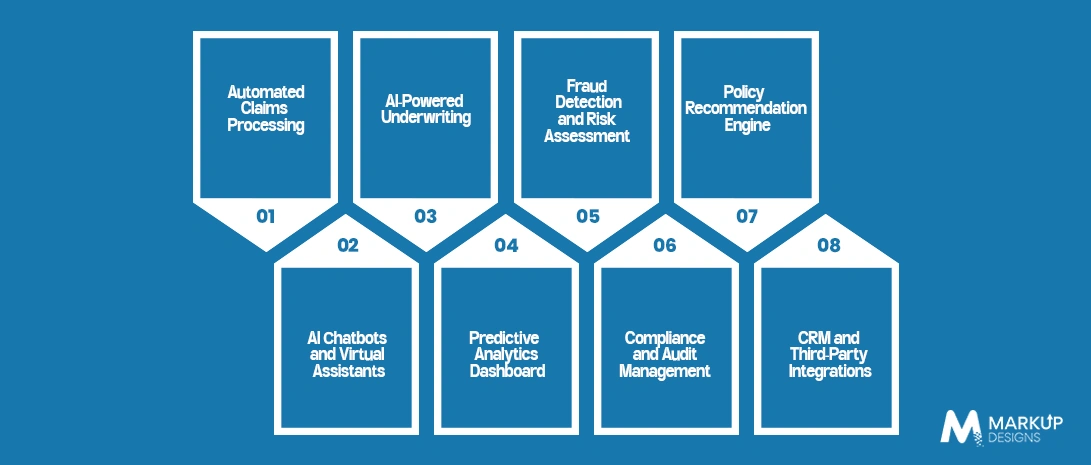
In order for the company to be competitive, it has to use smart systems that automate processes, make better decisions, and provide an unbeatable customer experience. Necessary features of any AI-based insurance software solution are considered in the text below.
Automated Claims Processing
Claims submission, document verification, and markup are being processed through the application of techniques such as OCR and Computer Vision. It eases the process of claims processing, cuts down on human errors, and provides fast processing time.
AI-Powered Underwriting
The implementation of the Machine Learning techniques enables fast credit decision-making using a combination of factors such as the customer profile, medical and driving history, as well as credit report data.
Fraud Detection with the Use Of AI
Fraud detection process is performed through continuously monitoring the attitudes of the customers during the entire process of claims submission, checking the claims to find out whether there are any irregularities, and making deductions.
Policy Suggestions from AI Systems
The AI-enabled system, by exploring customers’ preferences, insurance policies, and claims, provides personalized recommendations for insurance policies and makes the processes of cross-selling easier.
Virtual Assistants and Chatbots for Insurance
Having had access to the AI-based technologies, insurance companies have been able to introduce virtual assistants and chatbots in the sphere of insurance that assist whenever it is required.
Predictive Analytics Tools
With the help of real-time analytical tools, it is possible to monitor various aspects of both claims and customers, which lets the insurers perform their operations in an effective manner.
Compliance and Audit Management
Built-in compliance tools help insurers maintain adherence to Financial Conduct Authority (FCA) regulations, GDPR, and other regulatory standards through automated audit trails, consent management, and secure record keeping.
CRM and Third-Party Integrations
Modern AI-powered insurance software in the UK integrates seamlessly with CRM platforms, policy management systems, payment gateways, underwriting tools, and external databases to create a connected insurance ecosystem.
Real World Applications of AI in the UK Insurance Industry
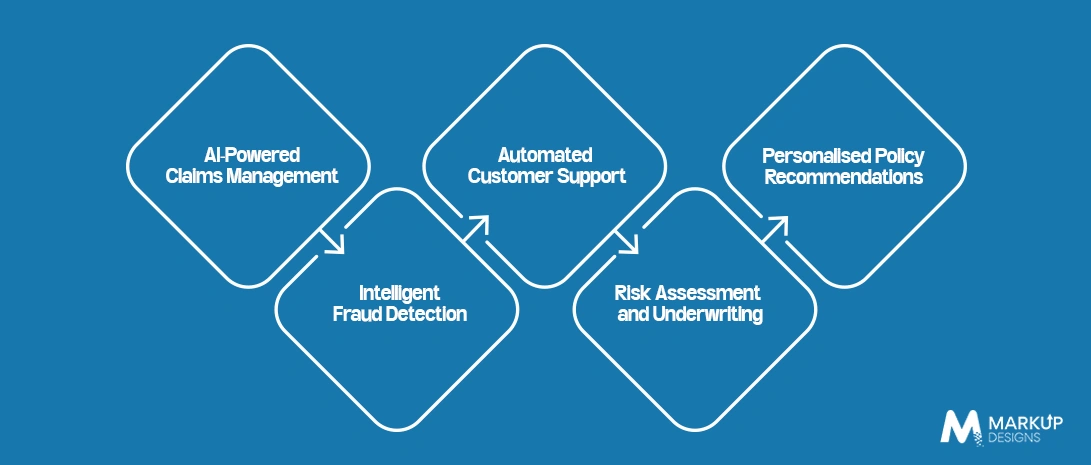
Artificial intelligence is transforming every stage of the insurance lifecycle, helping insurers improve efficiency, reduce costs, and enhance customer satisfaction through intelligent automation.
AI-Powered Claims Management
AI accelerates claims handling by automatically validating documents, assessing damage, and processing settlements, enabling insurers to deliver faster and more accurate claim resolutions.
Intelligent Fraud Detection
Using Machine Learning and behavioural analytics, AI identifies unusual claim patterns, fake documents, and suspicious transactions before they result in financial losses.
Automated Customer Support
AI-powered virtual assistants and insurance chatbot solutions provide instant support for policy enquiries, claims updates, renewals, and policy changes, ensuring round-the-clock customer service.
Risk Assessment and Underwriting
AI analyses historical claims, customer behaviour, lifestyle data, and external risk factors to improve underwriting accuracy, optimise pricing, and support better risk management.
Personalised Policy Recommendations
AI recommends customised insurance products based on customer profiles, purchase history, and coverage requirements, enabling insurers to improve customer retention while creating new revenue opportunities through personalised offerings.
Technologies Powering AI Insurance Software
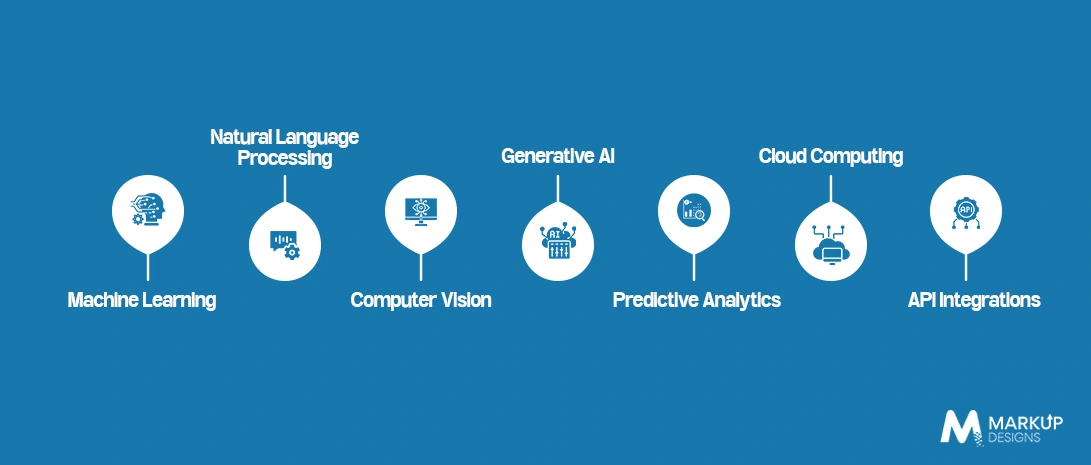
The success of AI-Powered Insurance Software UK depends on the right combination of AI technologies, cloud infrastructure, and system integrations. Together, these technologies help insurers automate processes, improve decision-making, and deliver secure digital experiences.
Machine Learning
Machine Learning analyses historical insurance data to improve underwriting, claims processing, fraud detection, and risk prediction through continuous model learning.
Natural Language Processing
NLP enables AI to understand customer queries, process policy documents, analyse claims, and power intelligent insurance chatbot solutions for faster customer support.
Computer Vision
Computer Vision uses AI to analyse images and documents for damage assessment, identity verification, and automated claims validation using OCR technology.
Generative AI
Generative AI assists insurers by creating policy summaries, generating customer responses, automating documentation, and supporting insurance agents with intelligent recommendations.
Predictive Analytics
Predictive Analytics forecasts claim trends, customer behaviour, and potential risks, helping insurers make proactive business decisions and improve operational planning.
Cloud Computing
Cloud platforms such as AWS, Microsoft Azure, and Google Cloud provide the scalability, security, and computing power required to develop AI-powered insurance software in UK.
API Integrations
APIs enable seamless integration with CRM platforms, payment gateways, policy administration systems, third-party databases, and external services, creating a connected insurance ecosystem.
UK Regulations and AI Governance Requirements for Insurance Software
Building compliant AI Powered Insurance Software UK requires insurers to balance innovation with transparency, security, and responsible AI governance while complying with UK regulatory standards.
FCA Expectations and Consumer Duty
The Financial Conduct Authority (FCA) requires insurers to ensure AI-driven decisions are fair, transparent, and focused on delivering positive customer outcomes.
PRA Requirements and Model Risk Management
The Prudential Regulation Authority (PRA) expects insurers to implement robust model governance, continuous monitoring, and effective risk management throughout the AI lifecycle.
UK GDPR and Automated Decision Making
Under UK GDPR, insurers must protect personal data, obtain appropriate consent where required, and provide safeguards when AI is used for automated decision-making.
Data Protection Act Requirements
The Data Protection Act 2018 complements UK GDPR by establishing legal obligations for collecting, storing, processing, and securing customer information.
Equality, Bias, and Fairness Considerations
AI models should be regularly tested to identify and minimise bias, ensuring fair underwriting, pricing, and claims decisions for all customers.
Explainability and Customer Communication
Insurers should be able to explain how AI influences important decisions, helping customers understand outcomes and strengthening trust in automated systems.
Human Oversight for High Impact Decisions
Critical decisions such as claim rejections or policy cancellations should include appropriate human review to ensure fairness and regulatory compliance.
Third-Party AI Vendor Risk
Businesses working with an AI insurance software development company should assess vendor security, compliance practices, and governance standards before implementation.
AI Audit Trails and Model Documentation
Maintaining audit logs, model documentation, and version histories supports regulatory compliance while improving transparency, accountability, and ongoing AI optimisation.
Cost to Build AI-Powered Insurance Software in the UK
The cost of developing AI Powered Insurance Software depends on factors such as AI capabilities, compliance requirements, system integrations, and platform complexity. A basic AI-enabled solution may cost £40,000, while a feature-rich enterprise platform with advanced AI functionality can exceed £235,000. Partnering with an experienced AI insurance software development company helps optimise both development costs and long-term scalability.
Estimated Development Cost Breakdown
The overall budget is typically distributed across multiple development phases. Discovery and planning generally cost £15,000–£25,000, while UI and UX design range from £10,000–£20,000. AI model development is one of the largest investments at £35,000–£60,000, followed by backend development and API integrations costing £25,000–£50,000. Security, regulatory compliance, testing, deployment, and first-year maintenance further contribute to the total project cost.
Factors Affecting Development Cost
Several factors influence the overall investment, including AI model complexity, number of features, quality of training data, integration with legacy insurance systems, and compliance with Financial Conduct Authority (FCA) and GDPR requirements. The choice of technology stack, cloud infrastructure, and development partner also significantly impacts project costs.
Estimated Development Timeline
A standard AI-powered insurance software project typically requires 6 to 10 months, while enterprise-grade platforms with advanced AI capabilities, third-party integrations, and regulatory requirements may take 12 months or longer to complete.
Common Challenges in AI Insurance Software Development
While AI offers significant advantages, insurers must overcome several technical and regulatory challenges to successfully build AI insurance software that is secure, scalable, and compliant.
Data Quality and Availability
According to CityAM, 72% of UK insurers identify fragmented and unstructured data as one of the biggest barriers to AI adoption. High-quality, well-governed data is essential for accurate underwriting, fraud detection, and predictive analytics.
Regulatory Compliance
Insurance platforms must comply with Financial Conduct Authority (FCA) guidelines, Prudential Regulation Authority (PRA) standards, and UK GDPR requirements. Embedding compliance throughout the development lifecycle reduces regulatory risks and builds customer trust.
Legacy System Integration
Many insurers continue to rely on outdated policy administration and claims management systems. Integrating modern AI solutions for insurance companies with legacy infrastructure requires robust APIs and a scalable system architecture.
AI Bias and Explainability
AI models should be regularly tested for fairness, accuracy, and explainability to ensure underwriting and claims decisions remain transparent, unbiased, and aligned with regulatory expectations.
Cybersecurity and Data Privacy
Insurance platforms handle highly sensitive customer and financial data, making cybersecurity a top priority. Strong encryption, access controls, continuous monitoring, and secure cloud environments are essential for protecting data while supporting custom AI insurance software UK deployments.
Why Choose Markup Designs for AI Insurance Software Development
At Markup Designs, we help insurers accelerate digital transformation by developing secure, scalable, and intelligent AI-powered insurance software tailored to evolving business and regulatory needs. As an experienced software development company, we combine expertise in Artificial Intelligence, Machine Learning, cloud technologies, and enterprise software engineering to build solutions that automate claims processing, strengthen fraud detection, optimise underwriting, and enhance customer engagement. From strategy and UI/UX design to AI model development, seamless legacy system integration, and compliance with FCA, PRA, and UK GDPR requirements, our team delivers end-to-end insurance software development services that empower insurers to innovate with confidence and achieve long-term business growth.
Build Intelligent AI-Powered Insurance Software
Transform your insurance business with secure, scalable, and compliant AI solutions designed to automate operations, improve customer experiences, and drive long-term growth. Partner with Markup Designs to develop next-generation AI-powered insurance software UK tailored to your business goals.

Conclusion
Artificial intelligence is redefining the future of the UK insurance industry by enabling faster claims processing, intelligent underwriting, proactive fraud detection, and highly personalised customer experiences. As AI adoption continues to grow, insurers who invest in AI-powered insurance software will be better positioned to improve operational efficiency, strengthen regulatory compliance, and remain competitive in an increasingly digital market. Whether you are modernising an existing insurance platform or looking to build AI insurance software from the ground up, partnering with the right technology expert is key to turning innovation into measurable business value.
FAQs
How much does AI-powered insurance software development cost in the UK?
The cost typically ranges from £40,000 to £235,000+, depending on AI capabilities, platform complexity, integrations, compliance requirements, and the level of customisation required.
How long does it take to develop AI insurance software?
A standard AI insurance platform generally takes 6 to 10 months to develop, while enterprise-grade solutions with advanced AI features and complex integrations may require 12 months or more.
What are the key features of AI-powered insurance software?
Core features include AI-powered claims processing, predictive underwriting, fraud detection, policy recommendation engines, insurance chatbot integration, predictive analytics dashboards, compliance management, and CRM integrations.
Which UK regulations should insurance software comply with?
Insurance software should comply with the Financial Conduct Authority (FCA) guidelines, Prudential Regulation Authority (PRA) requirements, UK GDPR, and the Data Protection Act 2018 to ensure secure and compliant operations.
Can AI integrate with existing insurance systems?
Yes. Modern AI-powered insurance software in the UK can integrate with existing policy administration systems, CRM platforms, claims management software, payment gateways, and third-party services through secure APIs.
Author's Perspective
Artificial intelligence is no longer a future consideration for insurers. It is becoming the foundation of modern insurance operations across the UK. While technologies such as Machine Learning, Generative AI, and Predictive Analytics offer significant opportunities, long-term success depends on more than adopting AI. Insurers need a clear strategy, high-quality data, strong governance, and compliance with evolving regulations. Businesses that invest in scalable, customer-focused, and secure AI solutions today will be better positioned to improve operational efficiency, build customer trust, and remain competitive in an increasingly digital insurance landscape.
Discuss Your Project NowAjit Kumar Jha
VP - Business Operations
Related Posts

How Artificial Intelligence Is Changing Mobile Game Development

How to Build Production-Ready Applications with AI Coding...

Cost, Benefits & Business Impact: Generative AI vs....
Insights Are Valuable & Execution is Priceless
You’ve read about the digital future. Now, let’s build the infrastructure to take you there. Move your strategy from the page to the product.
Design Your Solution Now
Contact Us
Schedule The Appointment At Your Convenience Date And Time.
30 Min
Web Conference
Time Zone
Indian standard time (08:30pm)

Thanks For Getting In Touch!
You’ve Taken The First Step Toward Transforming Your Digital Presence. Our Experts Will Reach Out Shortly To Take It Forward.
Launch Your Dream Project
Provide a brief overview of your project, and our specialists will evaluate your requirements. We will connect with you to explore how the right digital solutions can help you launch faster.