
Top Managed IT Service Providers Compared: Ultimate Business Guide
Technology is no longer a supportive element for modern businesses; it has been the backbone of core operations, driving business growth for a long time. As companies begin to scale, managing the complex internal IT systems is quite complexer and costlier to manage. That is why it has been important to rely on managed IT services companies. They took charge of handling day-to-day issues as it arises in the system. These act as a proactive solution to monitor, maintain, and optimize IT environments.
Modern businesses are adopting this model as it offers the much-needed scalability, cost control, and access to expertise without managing the burden of an in-house IT department. It assists organizations in reducing operational risk by ensuring continuous system monitoring and proactive issue resolution. Also, with managed IT, companies can have faster access to updated technologies without needing to invest in infrastructure upgrades. Further, this model helps in business continuity and improves overall system reliability.
Managed IT Services: The Main Part of Operations for Businesses
While managed IT services are one of the quickest-growing trends in IT businesses. It is important to note that they provide a real solution to many operational challenges faced by organizations today. Some of the operational issues that organizations experience include downtime, cybersecurity threats, a lack of qualified IT personnel, and various types of unpredictable infrastructure costs. Managed service providers offer continuous and structured IT help for all needs to help them work through their operational issues.
The best MSP providers are an important tool for businesses because it allows a business to release its internal resources to focus on its core functions, rather than working through technical issues.
Managed IT Service Providers: Major Services to Know
Leading IT solutions providers generally offer many products that help various technical needs, with very few exceptions (although VARs offer many of the same solutions as well). Basic services usually consist of the following:
Infrastructure Management: Infrastructure management is the process of monitoring servers, networks & hardware to ensure that they operate efficiently with minimal downtime.
Cloud Services Management: Cloud services management is the process of creating, optimizing, storing & scaling services for businesses that utilize cloud platforms.
Cybersecurity Management: Cybersecurity management is one of the main impacts of any business’s information technology (IT) infrastructure. Cybersecurity management includes threat monitoring, firewall management, endpoint management, and data protection.
IT Help Desk: The IT help desk provides 24/7 technical assistance to employees for resolving problems as quickly as possible without impacting the company’s productivity.
Backup and Disaster Recovery: Backup and disaster recovery may include developing routine backups and recovery plans to ensure data protection and business continuity.
Key Benefits of Partnering with Managed IT Service Providers
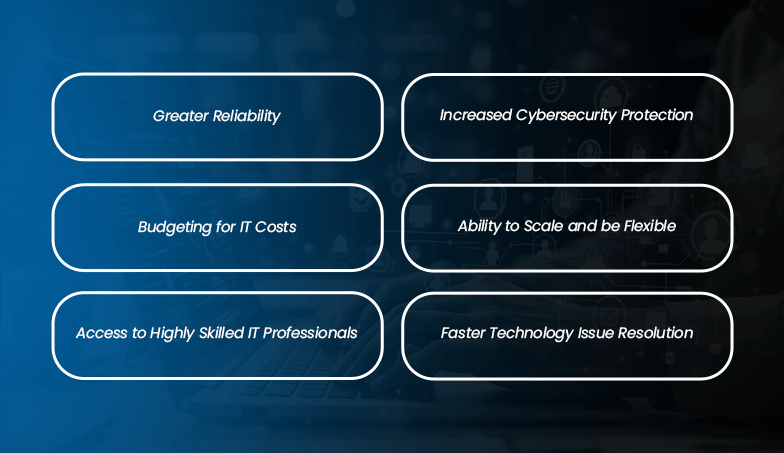
Greater Reliability: The number one advantage is that there will be less downtime due to your systems being monitored continuously, allowing for any potential issues to be fixed before they become a major disruption.
Budgeting for IT Costs: Businesses don’t have unexpected repair or upgrade costs. Instead, they have an agreed-upon monthly fee that makes financial forecasting easier and more consistent.
Access to Highly Skilled IT Professionals: Most companies cannot afford to hire full-time in-house IT professionals with specialized training. Managed service providers provide a solution to this problem by giving businesses access to experienced experts in multiple areas.
Increased Cybersecurity Protection: Cybersecurity is a global issue, as there is an increase in cyber threats today. Managed service providers use the latest technologies and systems to mitigate risks and secure sensitive information.
Ability to Scale and be Flexible: As your business grows, your IT needs will change. Managed services allow you to easily scale your systems without any major physical changes to your infrastructure.
Faster Technology Issue Resolution: Tech teams are dedicated to responding to clients quickly, reducing the time technical issues have an impact on business operations.
How Will You Differentiate Top Managed IT Service Providers?
Not all providers offer the same level of service. The differences become clear when comparing their approach, technology stack, and support models.
Service Depth and Customization: Some providers offer standardized packages, while others focus on tailored solutions based on industry needs.
Response Time and Support Quality: Fast response time is a major differentiator. Businesses often prioritize providers that offer 24/7 support with guaranteed SLAs.
Security Approach: Advanced providers invest heavily in proactive threat detection and compliance management, while basic providers focus mainly on reactive support.
Technology Integration: Modern providers integrate automation, cloud platforms, and monitoring tools to improve efficiency and visibility.
Industry Specialization: Some providers specialize in industries like healthcare or finance, offering more relevant solutions compared to general IT providers.
Market Gap Observation: While these providers offer strong technical capabilities, many businesses still face challenges in terms of flexibility, personalized support, and cost efficiency. This is where newer service-focused IT partners are gaining attention by offering more tailored and business-centric solutions.
Read Also: Benefits and Potential Risks Outsourced IT Services
Managed IT Services Cost Breakdown (USD)
Pricing depends on business size, service scope, and complexity of IT infrastructure. Below is a realistic industry estimate:
| Service Category | Small Business | Mid-Sized Business | Enterprise |
| IT Helpdesk | $500 – $1,500/month | $1,500 – $4,000/month | $5,000+ /month |
| Infrastructure Management | $800 – $2,500/month | $2,500 – $6,500/month | $7,000 – $15,000/month |
| Cybersecurity Services | $1,000 – $3,000/month | $3,000 – $8,000/month | $10,000 – $25,000/month |
| Cloud Management | $1,200 – $3,500/month | $3,500 – $9,000/month | $12,000 – $30,000/month |
| Full Managed IT Services | $2,500 – $6,000/month | $6,000 – $15,000/month | $20,000 – $50,000/month |
These figures vary depending on customization, compliance requirements, and infrastructure complexity.
Reasons that Companies Fail When They Do Not Use Managed IT Services
The majority of businesses continue to depend on in-house IT personnel or support that is not part of a unified approach. Unfortunately, those kinds of processes tend to create:
- Excessive expense from reactive maintenance
- Limited experience with advanced technology.
- More potential for downtime, as well as security breaches
- Difficulty in growing or changing an IT infrastructure quickly
- No guarantee of 24/7 support
All of those items will directly affect both productivity and the long-term success of a business.
Why Partner with Markup Designs?
Choosing the right managed IT service partner is not just about technical support; it is about building a long-term operational advantage.
At Markup Designs, we focus on delivering structured IT support that aligns with business goals. Our approach is built around reliability, scalability, and practical execution rather than complex technical processes.
We work closely with businesses to ensure their IT environment is stable, secure, and ready for growth. Instead of offering one-size-fits-all solutions, we align services based on real operational needs.
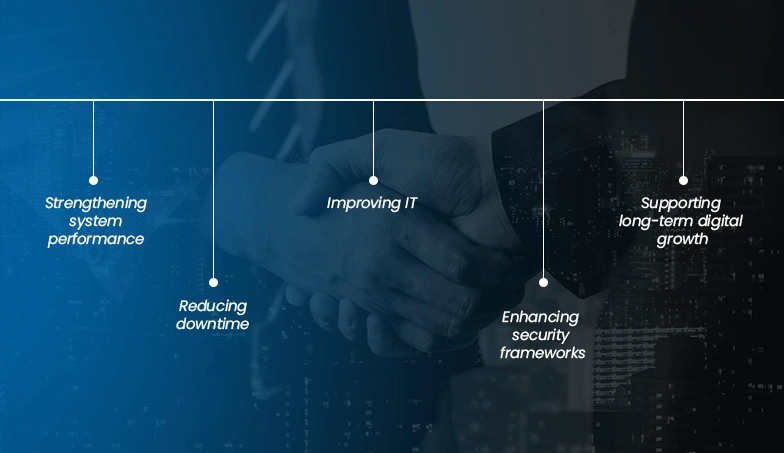
Our focus includes:
- Strengthening system performance
- Reducing downtime and disruptions
- Improving IT cost efficiency
- Enhancing security frameworks
- Supporting long-term digital growth
This approach helps businesses stay competitive in a rapidly evolving digital environment.
FAQ Section
What do managed IT service providers do?
They manage and support a company’s IT systems, including infrastructure, security, and technical support.
Are managed IT services suitable for small businesses?
Yes, they are especially useful for small businesses that cannot maintain full in-house IT teams.
How do managed IT providers charge?
Most providers charge a fixed monthly fee based on services and business size.
What industries use managed IT services the most?
Industries like healthcare, finance, retail, logistics, and education rely heavily on them.
Do managed IT services include cybersecurity?
Yes, most providers include security monitoring and threat protection.
Can managed IT services reduce downtime?
Yes, continuous monitoring helps identify and resolve issues quickly.
What is the difference between IT support and managed IT services?
IT support is usually reactive, while managed IT services are proactive and ongoing.
How do I choose the right provider?
Look for experience, response time, security capabilities, and flexibility in services.
The Conclusion
IT Outsourcing companies are considered an essential part of today’s businesses. They provide not only stability and security but also scalability in an environment that is crucial to the ultimate success of an organization, where technology plays an important role.
Selecting a managed IT service provider will ensure that your organization has a more streamlined IT operation, as well as greater business development opportunities, improved cost management, and enhanced long-term resilience.
In addition to providing daily assistance to businesses, managed IT service providers assist in establishing a more organized and predictable IT environment that is monitored and optimized for maximum performance. This decreases the likelihood of unanticipated breakdowns and enables your staff to have greater confidence in their work efforts.
Furthermore, as businesses continue to grow, managed IT service providers offer businesses strategic value by allowing internal staff to be freed from routine issues with technology and instead devote time to developing new ideas and initiatives, as well as focusing on the primary goals of the organization. This strategic shift can lead to increased productivity over time, as well as better informed decision-making.
Author's Perspective
From practical industry experience, one clear pattern stands out: businesses that invest in structured IT management early tend to scale more efficiently.
Technology is no longer a background function; it directly impacts customer experience, revenue flow, and operational continuity. A reliable managed IT partner reduces uncertainty and allows leadership teams to focus on strategic growth rather than technical firefighting.
The real value is not just in solving IT problems but in preventing them before they impact the business.
Discuss Your Project NowAjit Kumar Jha
VP - Business Operations
Related Posts

Why Businesses in Dubai are Investing in Managed...

Managed IT Services Pricing: What It Really Costs...

How Remote Managed IT Services Help Businesses Scale...
Insights Are Valuable & Execution is Priceless
You’ve read about the digital future. Now, let’s build the infrastructure to take you there. Move your strategy from the page to the product.
Design Your Solution Now
Contact Us
Schedule The Appointment At Your Convenience Date And Time.
30 Min
Web Conference
Time Zone
Indian standard time (08:30pm)

Thanks For Getting In Touch!
You’ve Taken The First Step Toward Transforming Your Digital Presence. Our Experts Will Reach Out Shortly To Take It Forward.
Launch Your Dream Project
Provide a brief overview of your project, and our specialists will evaluate your requirements. We will connect with you to explore how the right digital solutions can help you launch faster.