
Managed IT Services for Small Businesses: How to Scale Faster Without Increasing Costs
Modern small businesses work in a highly competitive, tech-driven environment that runs on complex devices. Their growth is not just about acquiring customers, it depends on the efficiency of operations, systems, and data scale. That is why managed IT services for small businesses have become important as a growth enabler, rather than just being a supportive pillar.
We can say that running a small business is not easy, as it involves multiple tasks to be handled at once. On one side, you are managing the core operations, driving sales, while somehow you will be dealing with the IT issues. So, it seems like one day is a crash for you, while the next day represents a cybersecurity scare. Then your team is stuck waiting hours for a simple fix. What can be the solution? That is why more and more companies are turning to managed IT services for small businesses as a core necessity.
In this blog, we will explore how managed IT services help small businesses scale faster, analyze what top competitors are doing, and outline how the right partner can transform your IT into a growth engine.
Know About Managed IT Services in Detail
Understanding the Core Concept
Managed IT services are a complete approach to IT management in which the IT infrastructure of your company is handled by a professional supplier. This allows you and your team to concentrate on your main company tasks while professionals take care of the complex aspects of IT.
These services are especially helpful for small businesses since they frequently lack the resources and knowledge necessary to properly maintain their IT infrastructure. Small businesses might benefit greatly from outsourcing IT responsibilities to a managed service provider (MSP).
Key Components of Managed IT Services
At their core, managed IT services typically include:
- Infrastructure monitoring and management
- Cloud services and migration
- Cybersecurity and compliance
- Data backup and disaster recovery
- Helpdesk and end-user support
According to industry analysis, MSPs enable small businesses to access enterprise-level IT capabilities without building large in-house teams, significantly reducing operational costs and complexity.
The Reasons Behind Small Businesses’ Use of MSPs
Managed IT services for small businesses are becoming more and more important to small organisations since they
- Minimise risks and downtime
- Establish continuous monthly expenses
- Boost your security posture
- Facilitate the quicker uptake of innovative technology
The demand for efficiency and agility in increasing operations is what is causing this change.
How Do Managed IT Services Help Small Businesses Grow Faster?
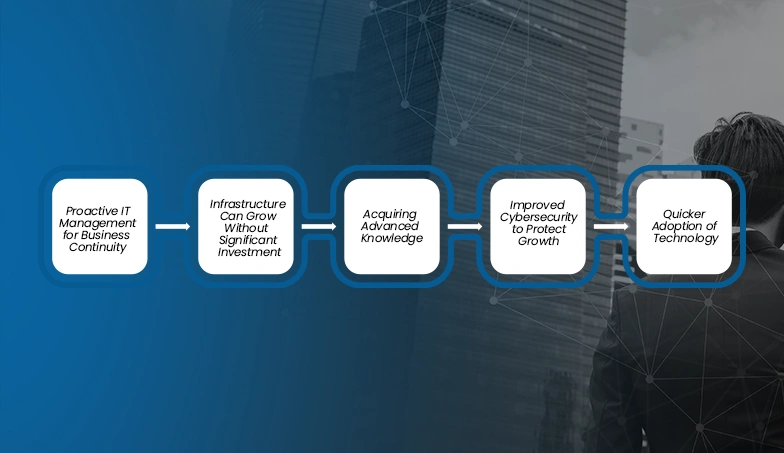
Proactive IT Management for Business Continuity
Growth requires consistency to identify and fix issues before they impact operations. This proactive approach minimizes downtime and guarantees consistent performance. Instead of dealing with IT concerns, businesses can focus on other tasks like sales, marketing, and product development.
Infrastructure Can Grow Without Significant Investment
One of the biggest challenges that small businesses have is scaling infrastructure without going over budget. MSPs provide flexible, scalable solutions that enable businesses to add or remove IT staff by keeping demand in mind. This reduces the need for large initial capital components while guaranteeing that the systems can manage growth.
Acquiring Advanced Knowledge
Finding skilled IT personnel for your company is expensive and difficult due to ongoing competition in the market. MSPs provide access to knowledgeable engineers, cybersecurity experts, and internet specialists at a much reduced cost. Without having to worry about building internal teams, small businesses enjoy a competitive edge.
Improved Cybersecurity to Protect Growth
Businesses become more appealing targets for cyberattacks as they expand. Advanced security frameworks, such as threat detection, endpoint protection, and compliance monitoring, are implemented by managed IT companies. Businesses are prioritising cybersecurity as a fundamental necessity, making it one of the managed services sectors with the greatest rate of growth.
Quicker Adoption of Technology
Cloud platforms, automation tools, and AI-driven analytics are just a few of the new technologies that expanding firms must quickly adopt. MSPs for SMBs speed this process by giving suggestions for appropriate tools, overseeing execution, and making sure the integration is smooth. This increases operational efficiency and speeds up digital transformation.
Important Services That Promote Business Growth
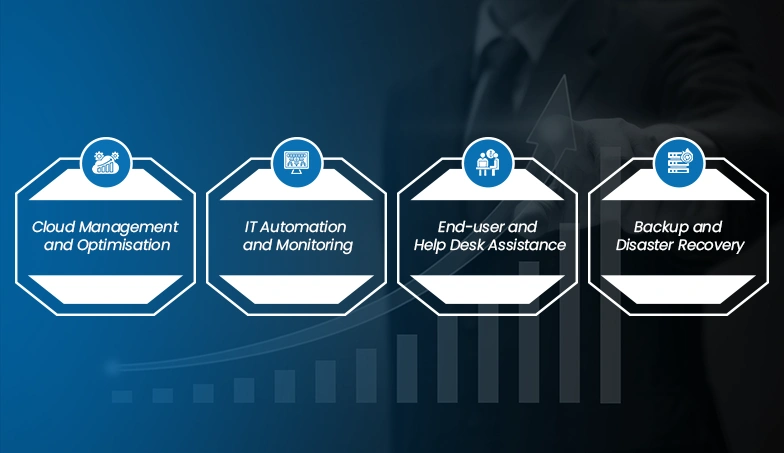
Cloud Management and Optimisation: Cloud services allow businesses to grow without being limited by infrastructure. MSPs manage cloud infrastructures, lower costs, and ensure high availability.
IT Automation and Monitoring: Automation increases productivity and reduces manual labour. Managed IT services utilise advanced technological tools to automate system updates, patching, and monitoring.
End-user and Help Desk Assistance: Employee productivity is ensured by a friendly support desk. Quick issue solutions increase production and reduce downtime.
Backup and Disaster Recovery: Reliable backup solutions ensure business continuity in the case of data loss or system failure. MSPs use robust recovery strategies to minimise downtime.
Key Differentiators Among Competitors
- Proactive Monitoring & Automation: Top providers emphasize real-time monitoring and automation to reduce downtime and improve efficiency.
- Cloud-First Approach: Modern MSPs prioritize cloud infrastructure, enabling businesses to scale quickly and reduce costs.
- Cybersecurity Focus: Security is no longer optional. Leading providers offer multi-layered security solutions as part of their core services.
- Predictable Pricing Models: Most MSPs offer subscription-based pricing, allowing businesses to manage IT costs effectively.
Market Insight
The MSP landscape is evolving, with increasing competition and shrinking deal sizes. Providers are now focusing on specialization, efficiency, and value delivery to stay competitive.
Key Reasons to Partner with Markup Designs
Selecting the appropriate IT partner is essential for expansion. Markup Designs presents itself as a strategic growth partner in addition to a service supplier.
An IT Strategy Focused on Growth: IT strategies are in line with business goals because of markup designs. Rather than providing generic solutions, they create customized IT frameworks that facilitate performance and scalability.
Pay Attention to Business Results: Their methodology extends beyond technical assistance, giving affordable IT services. They concentrate on producing quantifiable results like:
Enhanced Effectiveness Of Operations: Markup Designs enhances the effectiveness of your operations by streamlining IT processes and ensuring all systems work seamlessly together. This enables your business to improve productivity, reduce inefficiencies, and achieve better results with optimized resources.
Flexible and Scalable Solutions: Scalable IT solutions that expand with your company are offered by Markup Designs. Their services adjust to your demands, whether you’re growing your business or breaking into new markets.
Managed IT Services Costing (USD): Below is a general pricing structure for managed IT services based on industry standards:]
| Service Component | Estimated Monthly Cost (USD) |
| Basic IT Support (per user) | $50 – $100 |
| Advanced IT Support (per user) | $100 – $200 |
| Cybersecurity Services | $50 – $150 per user |
| Cloud Management | $100 – $500+ |
| Backup & Disaster Recovery | $50 – $200 |
| Fully Managed IT Services | $150 – $300 per user |
Pricing varies based on complexity, number of users, and service scope. Some providers also offer custom pricing models tailored to business needs.
How to Choose the Right Managed IT Service Provider
Evaluate Their Expertise: Look for providers with experience in your industry and a proven track record.
Assess Their Service Model: Ensure they offer proactive monitoring, automation, and strategic consulting—not just reactive support.
Understand Their Pricing: Transparent and predictable pricing is essential for budgeting and scalability.
Check Their Security Capabilities: Cybersecurity should be a core offering, not an add-on.
Review Client Feedback: Client testimonials and case studies provide insights into service quality and reliability.
FAQ
What is the main benefit of managed IT services for small businesses?
The primary benefit is access to expert IT support and scalable infrastructure without the need for large internal teams.
How do managed IT services reduce costs?
They eliminate the need for hiring full-time IT staff and reduce downtime, leading to better cost efficiency.
Are managed IT services suitable for startups?
Yes, startups benefit from scalable solutions and predictable pricing, allowing them to grow without heavy IT investments.
What industries benefit most from managed IT services?
Industries like healthcare, finance, retail, and SaaS benefit significantly due to their reliance on secure and scalable IT systems.
How secure are managed IT services?
Top providers implement advanced cybersecurity measures, including monitoring, threat detection, and compliance management.
Can managed IT services support remote work?
Yes, they provide cloud solutions, remote monitoring, and secure access systems to support remote and hybrid work environments.
The Final Thought
Managed IT services are essential for the expansion of small businesses. They offer the framework for operational effectiveness, security, and scalability, freeing up resources to concentrate on what really counts: expansion and innovation.
How well your IT infrastructure supports your company’s objectives is the difference between slow expansion and quick scaling in a competitive market. Small businesses may turn IT from a difficulty into a strategic advantage by working with a well-known partner like Markup Designs, allowing quicker, smarter, and more sustainable growth.
Author's Perspective
Managed IT services are now more than simply an operational requirement from a B2B content and strategy perspective; they are a growth booster. Today’s successful small businesses are defined not just by their goods or services but also by how well they use technology to grow. Companies that make proactive IT management investments often outperform those that use reactive support strategies.
The crucial change is that IT is now a strategic growth facilitator rather than a cost center. Working with a well-known managed IT provider may help small businesses that want to grow more quickly gain efficiency, creativity, and a sustained competitive edge.
Discuss Your Project NowAjit Kumar Jha
VP - Business Operations
Related Posts
Why Businesses in Dubai are Investing in Managed...

Managed IT Services Pricing: What It Really Costs...

How Remote Managed IT Services Help Businesses Scale...
Insights Are Valuable & Execution is Priceless
You’ve read about the digital future. Now, let’s build the infrastructure to take you there. Move your strategy from the page to the product.
Design Your Solution Now
Contact Us
Schedule The Appointment At Your Convenience Date And Time.
30 Min
Web Conference
Time Zone
Indian standard time (08:30pm)

Thanks For Getting In Touch!
You’ve Taken The First Step Toward Transforming Your Digital Presence. Our Experts Will Reach Out Shortly To Take It Forward.
Launch Your Dream Project
Provide a brief overview of your project, and our specialists will evaluate your requirements. We will connect with you to explore how the right digital solutions can help you launch faster.