

In Brief
- AI voice agents can assist real estate firms to automate their calls, answer questions regarding the properties, qualify their leads, recommend proper properties, schedule their property visits, and follow up with the buyer/tenants 24*7.
- Main features are natural conversation via voice, lead qualification through AI, property recommendation, automated follow-ups, appointment scheduling, and integration with CRM.
- AI voice agents can help firms to respond to leads quickly, improve the customer experience, reduce repetitive tasks, achieve operational cost savings, and enable the sales team to concentrate on building relationships and closing deals.
- The development cost is usually between $ 10,000 and $ 100,000+ based on features, AI and voice tech, integration with other systems, multi-language support, security, and call volume. The recurring costs may be related to telephony costs, AI costs, hosting, and maintenance.
- For successful implementation, one needs to have correct data about the properties, CRM and calendar integrations, multi-accent and multi-language support, customer data protection, and human intervention in case of complicated queries. It is advisable to start with the most important workflows and scale gradually.
Prompt and efficient communication, timely follow-ups, and a strong network with potential clients are critical components of the real estate business. Yet, handling dozens of calls, answering questions regarding properties, and arranging meetings require much time from real estate specialists. Lack of promptness may result in lost opportunities and missed sales. Here, the role of the AI voice agent for real estate becomes evident.
The AI voice agent uses artificial intelligence and natural language processing to manage phone conversations, answer frequently asked questions, qualify leads, book appointments, and follow up with interested customers. Such an AI voice assistant works continuously and helps real estate companies remain available for their prospects at any time.
In this blog post, we will discuss the essential features of an AI voice agent for real estate, its benefits, and how to develop such an assistant. We will analyze the development cost and return on investment (ROI) and describe the challenges in the process of implementation.
What is an AI Voice Agent for Real Estate?
An AI voice agent in real estate refers to an AI-enabled system that makes and receives calls to facilitate communication with property buyers, sellers, renters, and investors. The system understands the spoken queries posed by customers, provides responses in natural language, and fulfills other functions depending on the requirements of the customer.
Unlike an ordinary automated voice system in real estate, AI voice agents can perform more flexible conversations, which do not necessarily involve menu-based options.
For example, when a person is making an inquiry about a property, the AI voice agent will pose some questions to understand the budget, desired location, property type, and the time frame within which the buyer plans to purchase the asset.
Based on the responses provided, the system will be able to suggest suitable properties, schedule a visit, or transfer the lead to a sales rep. AI voice agents can be used to handle property rental inquiries, send appointment notifications, contact interested buyers, and keep track of customer data within a CRM system.
They are available around the clock, assisting real estate companies to communicate with customers even when their offices are closed.
How AI Voice Agents are Transforming Real Estate
The emergence of AI voice agents is altering the communication strategy that real estate companies use in communicating with prospective customers. As opposed to relying entirely on the sales team for making calls and responding to queries, companies will be able to automate the process of answering routine queries and responding to customers promptly.
Below are some of the ways AI voice agents will change the real estate industry:
- Instant lead response: AI voice agents will respond instantaneously to newly acquired leads immediately after receiving a query from them.
- Lead qualification process: By asking the customer whether he or she has a budget, preferred property type, preferred location, and other questions, the agents will aid the sales team in identifying qualified leads.
- Property discovery: The agents will provide information regarding the properties in relation to customer needs and the property database.
- Scheduling Site Visits: They can schedule site visit times, book site visits, and remind customers about appointments.
- Continuous Follow-Ups: Voice agents can continuously follow up on prospective customers, minimizing the risk of losing leads.
- Communication Around-the-Clock: They can help in addressing customers’ queries outside office hours, helping customers to access the needed information at any convenient time.
This is achieved by automating routine tasks for real estate companies, hence providing efficient handling of inquiries while giving their sales personnel enough time to concentrate on making sales.
Key Features of an AI Voice Agent for Real Estate
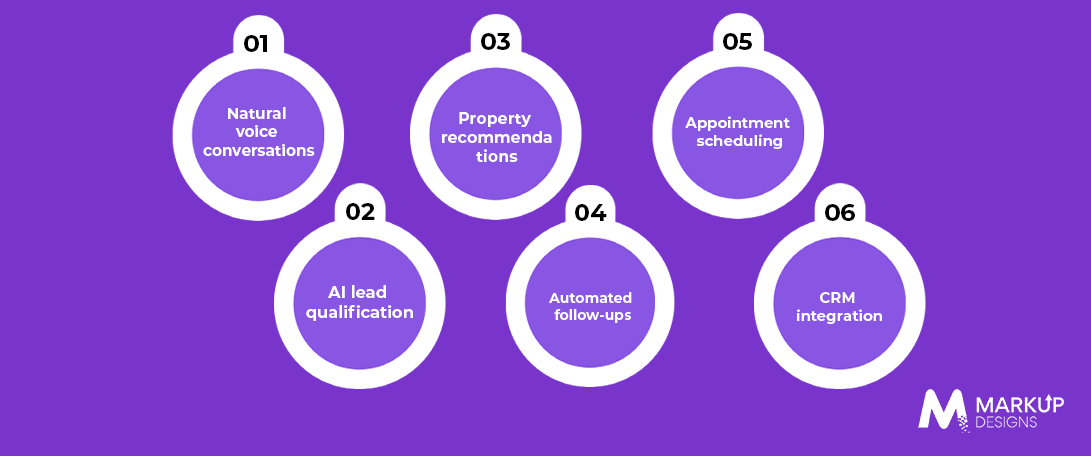
Features are required in an AI voice agent that can assist in dealing with customer queries as well as in managing daily tasks related to real estate business activities.
Natural voice conversations
Helps customers have a natural conversation while receiving the right response without having to go through a pre-recorded telephone menu.
AI lead qualification
Asks questions related to budget, preference of property, location, purchase time frame, etc., to find out the right leads.
Property recommendations
Recommends relevant property according to the needs of the customer, along with the listing details available.
Automated follow-ups
Makes automatic calls to the prospective buyers and tenants to assist in keeping up the communication on a regular basis.
Appointment scheduling
Assists customers in making an appointment to visit the property and confirms it.
CRM integration
Provides information related to leads, summaries of calls, and follow-ups into the CRM database of the organization.
These features assist real estate organizations in dealing with customer queries and avoiding repetitive tasks.
Read Also: AI Voice Agent Challenges: Common Issues and Practical Solutions
Benefits of AI Voice Agents for Real Estate Businesses
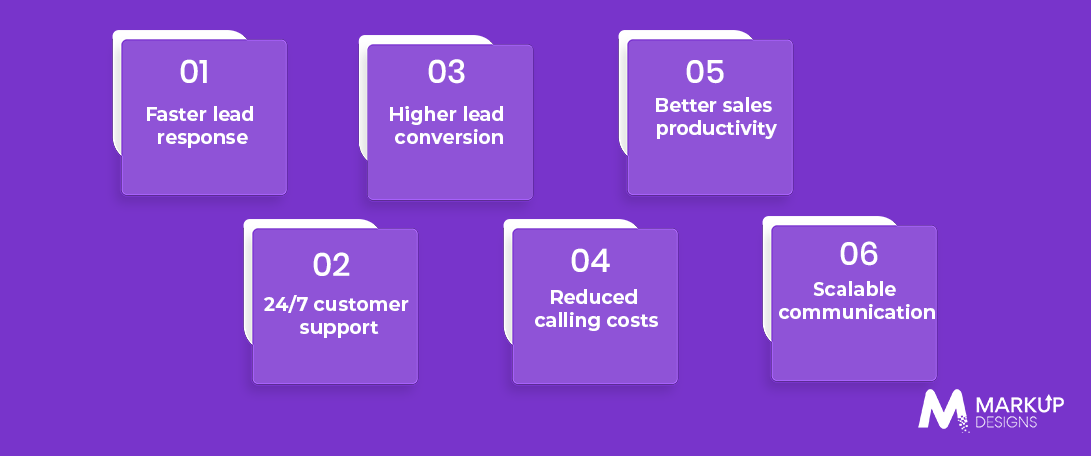
AI voice assistants assist real estate firms in managing customer communications without increasing the burden on their staff. Whether it is responding to queries or initiating follow-ups with possible buyers, AI voice assistants can facilitate the efficiency and organization of daily operations for such firms.
Below are some benefits that real estate firms could enjoy by implementing AI voice assistants in their operations:
Faster lead response
AI voice assistants enable fast responses that can assist companies in making connections with potential buyers when they are still interested.
24/7 customer support
This technology can address common queries and concerns even outside working hours, meaning clients will not be required to wait for an agent.
Higher lead conversion
Consistent follow-ups and prompt communication assist companies in converting possible buyers into buyers visiting the property and buy it.
Reduced calling costs
Repetitive calls can be automated to minimize the amount of time spent by employees on mundane operations.
Better sales productivity
Salesmen would be able to dedicate time to visit clients, arrange property tours, and make negotiations, rather than contacting everyone by phone.
Scalable communication
Fast responses, useful information about the property, and easy appointment setting allow clients to review their options.
Overall, AI voice agents can help real estate companies improve communication and use their team’s time more effectively. The actual results depend on the quality of implementation, property data, and how well the system fits existing workflows.
Want to Automate Your Real Estate Calls With AI?
Give your real estate team more time to focus on clients and close deals. Markup Designs can help you build an AI voice agent that handles inquiries, qualifies leads, and schedules property visits.

How to Build an AI Voice Agent for Real Estate?
The development of an AI voice agent for real estate involves an analysis of your regular interaction needs and the selection of technologies for its successful implementation. This should be done so as to ensure that the solution you build helps you handle customer calls and provides relevant information without turning the conversation into something mechanical.
Below is a description of the major stages of development of an AI voice agent for real estate:
- Specify Your Needs: Determine what tasks need to be automated – lead qualification, property information gathering, follow-ups, or visits to the site.
- Design Interaction Process: Specify how your AI agent will interact with your customers, welcome them, identify their needs, respond to their queries, and route complicated questions to the agents.
- Select Relevant Technologies: Pick the appropriate language model, speech recognition, and text-to-speech technologies for a smooth interaction process.
- Link Property Data to CRM Tools: Integrate property listing information, customer information, calendar, and CRM system for the agent to be able to retrieve information and update lead information.
- Create and Test the Agent: Create a workflow and conduct conversation tests to ensure response correctness, voice quality, scheduling, and lead management.
- Deploy and Optimize Performance: Deploy the solution, analyze call results, customer feedback, and improve responses and workflow over time.
The steps listed above will help you to develop an AI voice agent, which will suit your real estate business needs and will help in improving customer communications.
How Much Does It Cost to Build an AI Voice Agent for Real Estate?
Factors such as complexity, number of integrations, functionality, and the anticipated number of calls will determine the cost of implementing an AI voice assistant in the real estate industry. It should be noted that a simpler solution for answering typical questions is cheaper than a more complex one with additional functions.
Here is an estimated development cost based on the solution’s complexity:
| AI Voice Agent Type | Estimated Development Cost |
| Basic AI voice agent | $10,000–$20,000 |
| Mid-level AI voice agent | $20,000–$50,000 |
| Advanced AI voice agent | $50,000–$100,000+ |
A basic solution may be providing answers to the frequently asked questions and collecting lead information. A mid-level solution would have features such as CRM integration, automatic follow-up, and appointment scheduling. In an advanced solution, one may integrate support for multiple languages, complex workflows, property database integrations, advanced analytics, and enterprise-grade security.
It is also essential to consider the costs associated with ongoing operations. They may consist of the costs of the telephony service, the cost of AI models, cloud hosting services, maintenance, and upgrades of the system.
First of all, it is necessary to identify use cases and the expected number of calls, and then decide on the budget. This way, one may avoid overspending on unneeded features.
Factors Affecting AI Voice Agent Development Cost
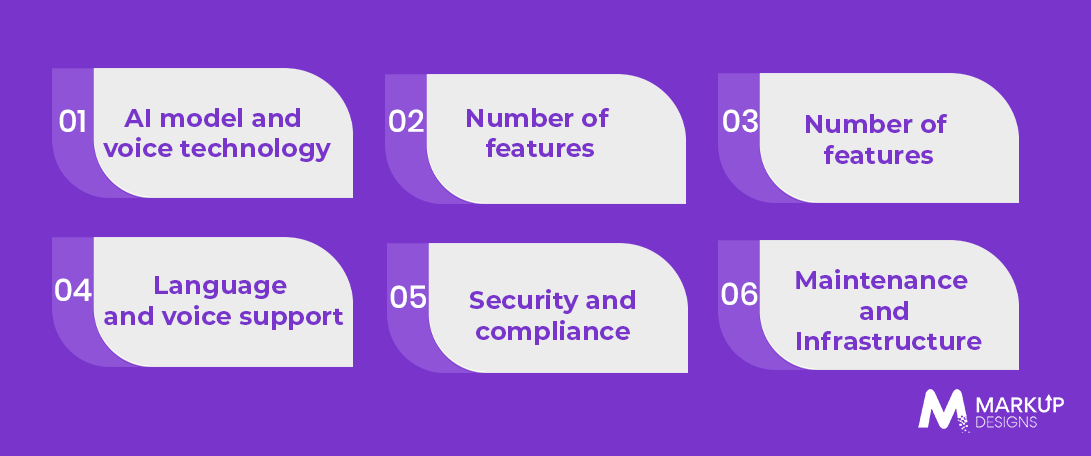
The cost of developing a real estate voice AI agent involves not only the development itself but also some other factors. For instance, specific features, certain technologies chosen, and system integrations can have a great impact on the total development price.
Below are 6 factors that can affect the price of the development:
AI model and voice technology
Advanced language models, natural-sounding voice, and speech recognition can make both development and usage more expensive.
Number of features
An inquiry-handling agent is cheaper to develop than an agent that can qualify leads, provide recommendations about properties, and schedule follow-ups and appointments.
Third-party integrations
Integrations with CRM applications, property databases, calendars, and telephony services involve additional development and testing effort.
Language and voice support
Development of an agent that works in several languages, accents, and regional speech varieties requires extra configuration and testing effort.
Security and compliance
Measures required to protect customer data and control access to it can add to the implementation cost.
Maintenance and Infrastructure
Hosting on the cloud, making phone calls, using AI, testing, updating, and supporting agents add to the monthly cost.
Understanding these factors helps you plan a realistic budget and prioritise the features that offer the most value. Starting with essential workflows and adding advanced capabilities as your needs grow can also help control initial development costs.
Read Also: Cost of Building a Real Estate App Like Property Finder?
Challenges of Implementing AI Voice Agents in Real Estate
Although the use of AI voice agents could make real estate transactions easier, several challenges will need to be sorted out before deploying the system.
- Customer Inquiry Interpretation: Buyers may raise complicated questions regarding the cost, location, payment options, or any other aspect of the property. The AI voice agent should be able to understand and give an appropriate answer.
- Maintaining the Correct Property Details: Incorrect prices, listings, or unavailability of the property can result in bad experiences for the buyers. Up-to-date and reliable integration is important in this regard.
- Handling Different Accents and Languages: Customers seeking real estate may use different dialects or languages. Qa Testing is important to ensure that the voice agent is capable of comprehending the inquiries made.
- Customer Trust: There might be some buyers who would rather talk to a human representative. Having the option of connecting to one can increase trust levels.
- Customer Data Protection: Voice calls will also involve personal information, budgets, and contacts. There is also a need for data protection measures for businesses.
- Integration into Existing Systems: It might be difficult to integrate voice bots with CRM software, property databases, and scheduling tools that use different data formats.
In order to cope with these problems, it is important to have a proper use case, test the voice bot in real-world conversations, and monitor its work after integration. Having a human representative in charge of complicated questions is also helpful.
Why Choose Markup Designs for AI Voice Agent Development?
It is crucial to find a suitable partner to develop an AI voice agent in the real estate industry. Markup Designs will assist the company in developing a custom-made solution for communicating needs, current infrastructure, and future business plans. The AI can be customized for qualification of leads and property inquiries, automatic follow-ups, or any other particular needs. It can also integrate with CRMs, listing portals, and calendars to maintain client data and simplify work processes.
The solution will be based on a scalable architecture that allows dealing with the increasing number of calls and with proper security measures to protect customer data. Further monitoring and enhancements will contribute to achieving better results after the deployment of the voice agent.
With 14+ years of experience, 200+ specialists, and 500+ delivered projects in UAE, Markup Designs has expertise in technology solutions and digital transformation of companies. This technology solution helps real estate firms to communicate better through AI voice automation.
Ready to Build an AI Voice Agent for Your Real Estate Company?
Automate routine calls, respond to property inquiries faster, and manage leads more efficiently with a custom AI voice agent built around your needs.

Conclusion
AI voice assistants enable real estate companies to enhance their communication processes with buyers, renters, and investors. From processing inquiries and lead qualification through appointment setting and follow-up management, the implementation of such solutions could minimize mundane activities and allow sales teams to dedicate themselves to meaningful communication with customers.
However, the successful functioning of an AI voice assistant requires the selection of proper functionality, the integration of reliable property information, and workflow development that aligns with the company’s everyday operations. The cost of development, meanwhile, will depend on complexity, integrations, voice technology, and usage.
Therefore, for those real estate firms that consider implementing AI automation, it would be reasonable to start with a limited number of valuable tasks and gradually integrate more functionality. The appropriate development of an AI voice assistant could be beneficial for both enhancing the customer experience and increasing business efficiency and growth.
FAQs
1. What is an AI voice agent for real estate?
An AI voice agent for real estate is a system that uses artificial intelligence to make or receive calls, answer property-related questions, qualify leads, schedule appointments, and manage follow-ups.
2. How much does it cost to build an AI voice agent for real estate?
Development may cost around $10,000–$20,000 for a basic solution, $20,000–$50,000 for a mid-level system, and $50,000–$100,000 or more for an advanced solution. The actual price depends on features, integrations, and project requirements.
3. How long does it take to develop an AI voice agent?
A basic solution may take several weeks, while a more advanced system with multiple integrations and custom workflows can take several months. The timeline depends on the scope, testing needs, and technology choices.
4. Can an AI voice agent qualify real estate leads?
Yes. It can ask potential buyers about their budget, preferred location, property type, and purchase timeline. It can then record their responses and help sales teams prioritise promising leads.
5. Can an AI voice agent schedule property visits?
Yes. When connected to a calendar or scheduling system, it can check available time slots, arrange site visits, confirm appointments, and send reminders.
Author's Perspective
AI voice agents are becoming a practical option for real estate companies looking to improve customer communication and manage leads more effectively. Their value goes beyond answering calls; they can help teams maintain follow-ups, organise inquiries, and reduce time spent on repetitive tasks. However, successful implementation requires accurate property data, well-planned workflows, and a smooth handoff to human representatives. A clear focus on customer needs and measurable outcomes can help real estate companies adopt AI voice technology with greater confidence.
Discuss Your Project NowGaurav Goyal
Global Sales- VP
Related Posts

30+ Innovative AI Agent Startup Ideas for Entrepreneurs...

How Artificial Intelligence Is Changing Mobile Game Development

How to Build Production-Ready Applications with AI Coding...
Insights Are Valuable & Execution is Priceless
You’ve read about the digital future. Now, let’s build the infrastructure to take you there. Move your strategy from the page to the product.
Design Your Solution Now
Contact Us
Schedule The Appointment At Your Convenience Date And Time.
30 Min
Web Conference
Time Zone
Indian standard time (08:30pm)

Thanks For Getting In Touch!
You’ve Taken The First Step Toward Transforming Your Digital Presence. Our Experts Will Reach Out Shortly To Take It Forward.
Launch Your Dream Project
Provide a brief overview of your project, and our specialists will evaluate your requirements. We will connect with you to explore how the right digital solutions can help you launch faster.