
In Brief
- Outsourcing fintech development allows companies to gain access to needed technical skills without establishing a huge in-house team.
- Also, the outsourced developers who perform the task contribute to faster releases of products and project features, as well as to system renewal and technology improvements.
- Flexible structures of outsourcing enable fintech companies to accommodate changes to development procedures according to the rise in users, financial transactions, or volatility of requirements from the market.
- Outsourced fintech specialists are able to solve complicated problems related to security, compliance, integrations, cloud infrastructure, etc.
- The skilled outsourcing strategy enables a company to overcome difficulties in the development process while concentrating on the key operations of the business.
Fintech companies operate in an environment where speed, expansion, security, and innovation influence the level of their performance. However, the process of enhancing a financial product may be complicated because one should manage different integrations, financial data, and legal aspects. That is why the outsourcing of fintech development is a means to obtain needed skills without increasing the number of internal specialists.
By working with specialised fintech development teams, businesses can accelerate product development, modernise existing systems, add new features, scale infrastructure, and access expertise in areas such as cloud computing, AI, payments, and security. This blog explores how fintech development outsourcing helps businesses scale faster, the areas where outsourced teams can support growth, the benefits and challenges involved, and how businesses can choose an outsourcing partner and strategy that supports long-term scalability.
Why Fintech Businesses Need to Scale Faster
Fintech firms are continuously faced with the challenge of increasing their digital capabilities while complying with security, dependability, and regulations. With the changing nature of customer expectations and the financial technology ecosystem, fintech companies must build up their development skills for continued development of their goods and services and for meeting their growing demands.
Rising Demand for Digital Financial Services
Clients are requiring more and more that financial services are accessible through mobile and web solutions, have quick execution, provide personalized experience, and unlimited access to services. Hence, fintech companies need to enhance their digital services and be ready for the increase in the number of clients.
Increasing Technology and Integration Complexity
Contemporary fintech systems have to operate on the basis of vast ecosystem of technologies, which can consist of APIs, payment services, banking, cloud technologies, AI solutions, and other technologies. To combine them and keep them running, companies often need professional programmers and efficient infrastructure.
Limited Access to Specialised Fintech Talent
Businesses may need professionals experienced in financial applications, payment systems, cybersecurity, cloud infrastructure, data engineering, compliance, and emerging technologies. Hiring and retaining these specialised professionals internally can take considerable time and may create bottlenecks when development requirements increase suddenly.
Pressure to Launch and Adapt Quickly
Fintech markets can change rapidly as customer preferences, technologies, competitors, and regulatory requirements evolve. Long development cycles can delay new product launches and limit a business’s ability to respond to these changes. Increasing development capacity can help fintech businesses test ideas, release improvements, and adapt their products without placing excessive pressure on existing teams.
How Fintech Development Outsourcing Helps Businesses Scale Faster
By outsourcing fintech development, businesses can get access to their desired technology even when they don’t have adequate specialists in-house. With an appropriate outsourcing model, organizations can obtain specific know-how, increase their development capabilities, upgrade their tech stack, and meet more product needs without occupying their core teams with side activities.
Access Specialised Fintech Development Expertise
Outsourcing allows companies to hire people with expertise in fintech software development, fintech architecture, quality assurance, DevOps, cloud technologies, cybersecurity, and fintech integration. Instead of creating all the necessary capabilities internally, businesses can just secure all the needed qualifications for one requisite technology, product, or development phase.
Accelerate Product Development and Launches
Dedicated outstaffing can add engineering capabilities for specific projects. Thanks to this, businesses can get from planning to implementation and testing much faster than with internal teams. This may be especially important when internal teams are overloaded or when companies need to launch their fintech product ASAP.
Scale Development Teams Based on Business Demand
Development requirements differ greatly during product discovery, MVP development, scaling, and maintenance. Outsourcing allows businesses to adjust team size and expertise according to these requirements, providing additional resources during intensive development periods without permanently increasing internal headcount.
Modernise Legacy Financial Systems
Legacy systems can hinder the ability of fintech firms to apply new functionality, introduce modern technologies, or handle a growth in transaction volume. A skilled outsourcing team can help with assessing the current architecture, upgrading applications, carrying out workload migration, creating APIs, and introducing new stacks while planning the changes around the trade-off of business continuity.
Expand Features Without Overloading Internal Teams
Third-party development companies can take the burden of additional product requests from the shoulders of internal staff preserving the possibility to continue their core business and strategic priorities. It can cover such fields as payment capabilities, customer dashboards, financial tools, automation workflows, integration with other parties, mobile functionality, and necessary improvements with the development of the product.
Support Multi-Platform and Multi-Channel Growth
Scaling a fintech enterprise usually requires more than just implementing a single application. Companies have to integrate mobile applications, web applications, APIs, partner portals, payment gateways, administrative applications, and customer services depending on the requirements of the software development. The outsourcing team can implement development through these systems and ensure that they correspond to one another.
Strengthen Security and Regulatory Readiness
Security and compliance need to be considered throughout fintech development rather than added after the product is built. Experienced fintech development teams can incorporate secure architecture, data protection, access controls, encryption, testing, audit requirements, and relevant regulatory considerations into development and deployment processes.
Fintech Areas That Can Scale Faster Through Outsourcing
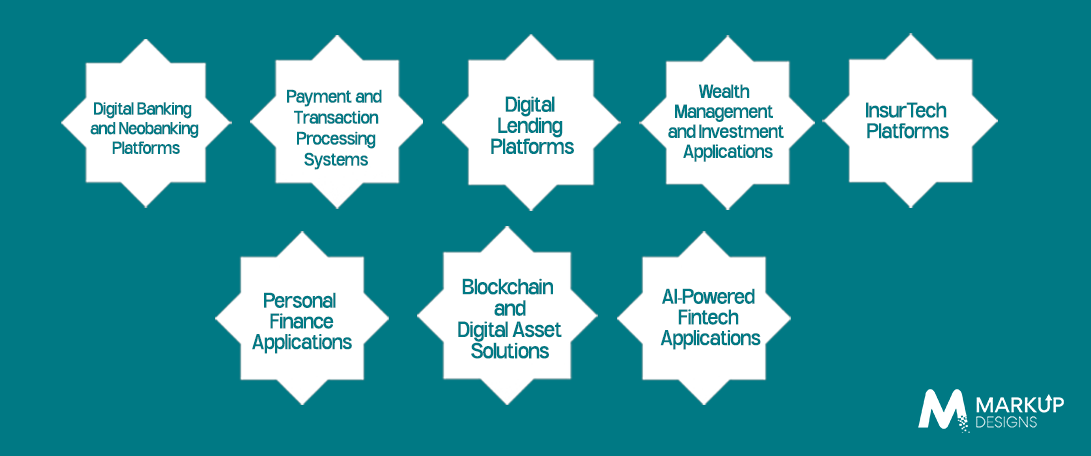
Different fintech products have different technical and operational requirements, but outsourcing can provide additional development capacity across several areas of financial technology.
Digital Banking and Neobanking Platforms
Outsourcing teams can support digital banking applications with account management, payments, transaction processing, customer onboarding, authentication, dashboards, and integrations with banking infrastructure.
Payment and Transaction Processing Systems
Payment platforms require reliable processing, secure integrations, transaction monitoring, and scalable infrastructure. External development teams can support payment gateway integration, payment orchestration, transaction workflows, and related APIs.
Digital Lending Platforms
Fintech businesses can outsource the development of lending workflows covering applications, document processing, eligibility checks, loan management, payment schedules, and integrations with financial data sources.
Wealth Management and Investment Applications
Outsourced teams can help build investment and wealth management platforms with portfolio tracking, financial dashboards, market data integrations, analytics, alerts, and personalised user experiences.
InsurTech Platforms
InsurTech businesses can use outsourced development expertise to build customer portals, policy management systems, claims workflows, automation solutions, data integrations, and AI-enabled insurance applications.
Personal Finance Applications
Personal finance applications can be expanded with budgeting tools, expense tracking, financial dashboards, account aggregation, alerts, analytics, and personalised financial insights.
Blockchain and Digital Asset Solutions
Outsourcing can provide access to specialists for blockchain-based applications, digital asset platforms, smart contracts, wallets, tokenisation solutions, and blockchain integrations where these technologies form part of the business model.
AI-Powered Fintech Applications
AI can support fraud detection, financial forecasting, customer service, risk assessment, document processing, recommendations, and other fintech workflows. Outsourcing gives businesses access to AI and software development expertise needed to integrate these capabilities into scalable financial applications.
How Outsourcing Supports Different Stages of Fintech Business Growth
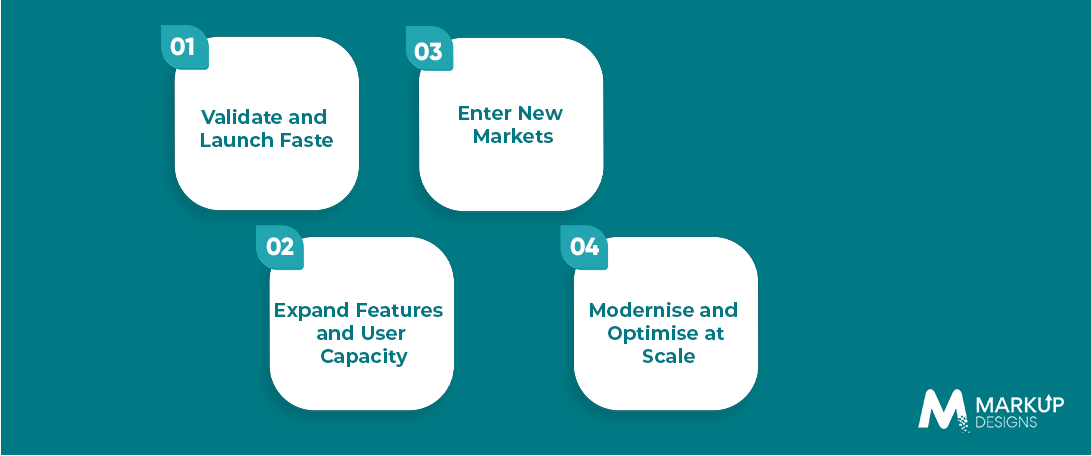
Fintech businesses have different technology requirements at different stages of growth. Outsourcing can provide the development capacity and specialised expertise needed at each stage, from validating an initial product to modernising enterprise systems and supporting expansion into new markets.
Startup Stage: Validate and Launch Faster
At the startup stage, outsourcing can help businesses turn an idea into a functional fintech product without immediately building a large internal technology team. External developers can support MVP development, prototyping, third-party integrations, testing, and early product validation, allowing founders to focus on refining the business model and customer offering.
Growth Stage: Expand Features and User Capacity
As the customer base grows, fintech businesses often need additional features, integrations, performance improvements, and development resources. An outsourced team can augment internal capabilities, optimise application performance, improve infrastructure, and develop new functionality to support increasing users and transaction volumes.
Expansion Stage: Enter New Markets
Entering new markets can require changes to payment infrastructure, currencies, languages, customer workflows, integrations, and regulatory requirements. Outsourcing partners can support localisation, market-specific integrations, infrastructure adjustments, and technology updates needed to extend fintech products into new regions.
Enterprise Stage: Modernise and Optimise at Scale
Established fintech businesses may need to modernise legacy systems while maintaining existing operations. Outsourcing teams can support legacy application modernisation, system integration, automation, security improvements, analytics, cloud migration services, and continuous AI product development across complex enterprise environments.
Key Benefits of Fintech Development Outsourcing for Scaling
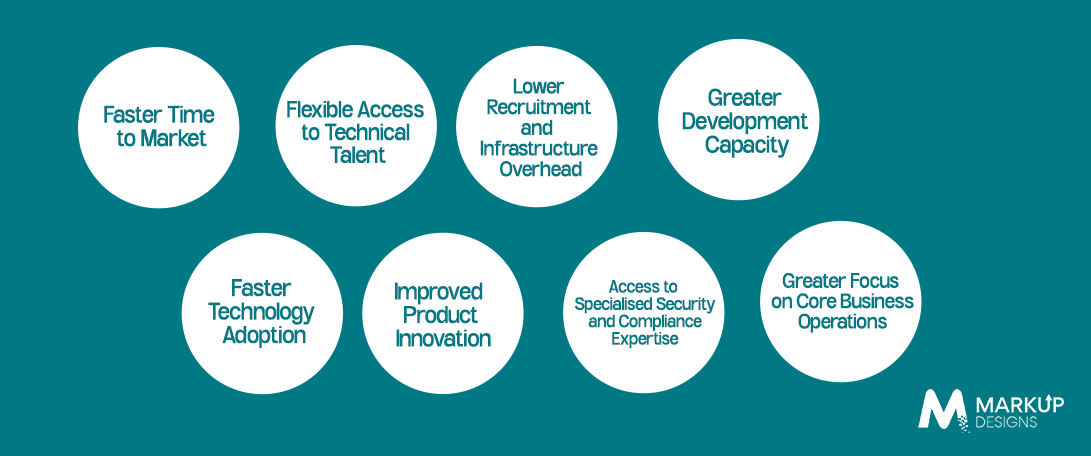
Outsourcing can do more than just provide additional developers. When done properly and accompanied by relevant business and IT goals, it is a powerful tool and a means of increasing the capacity for development and the ability to respond to changing business needs.
Faster Time to Market
Dedicated external teams can work alongside internal stakeholders to increase development capacity and move products and features through development, testing, and deployment more efficiently.
Flexible Access to Technical Talent
Businesses can access developers, architects, QA engineers, DevOps specialists, AI professionals, and other technical roles without permanently hiring every skill required for a particular project.
Reduced Recruitment and Infrastructure Costs
Outsourcing can lower the number of engineers the company has to hire, onboard, and maintain for the in-house development process. It also minimizes the infrastructural costs of setting up the internal development processes.
Increased Development Capacity
With the help of outsourced teams, it is possible to work on more processes simultaneously, thus providing for multiple development processes happening concurrently without overloading internal teams, thus avoiding delays.
Faster Adoption of Advanced Technologies
Fintech outsourcing partner that deals with advanced technologies will help the company adopt cloud solution, AI, APIs, automation, microservices, and other technologies beforehand and thus avoid starting all over again.
Better Product Innovation
More developed technical opportunities will allow the fintech companies to test new features, digital services, automation, and new technologies while still delivering current products to customers.
Access to Experts in Security and Compliance
Fintech products are in need of ensuring the high level of security and compliance with the local regulations and thus outsourcing can provide you with specialists on secure development.
Greater Focus on Core Business Operations
By delegating selected technology responsibilities to an external development team, internal teams can dedicate more time to customers, financial operations, partnerships, business strategy, and market expansion.
Challenges of Using Outsourcing for Fintech Scaling
Various fintech products have their technical requirements and operational specifics, but outsourcing can augment capacities in the development of various financial technologies.
Digital Banking and Neobanking Platforms
Outsourcing teams can assist digital banking platforms in the development of the following areas: account administration, payments, transaction processing, customer account creation, identity verification, and integration with a bank’s infrastructure.
Payment and Transaction Processing Systems
Payment systems provide high processing reliability, safe integrations, transaction monitoring, and scalable infrastructure. External development teams can implement payment gateway deployment, payment orchestrators, transaction flows, etc.
Digital Lending Platforms
Many fintech companies can delegate the development of lending services software, from application development, document processing, determining borrower eligibility, and tracking debts to the integration of financial data sources.
Wealth Management and Investment Applications
Outsourced teams can be tasked with building wealth management software, which includes the development of all of the following components: portfolio management, financial dashboards, financial data integration, analytics, market data, and personalisation features.
InsurTech Platforms
InsurTech companies can engage in outsourcing for building online customer portals, insurance policy management systems, automation solutions etc.
Personal Finance Applications
Personal finance applications now include additional functionalities like budgeting tools, expense monitoring, financial dashboards, and personal finance analytics.
How to Choose a Fintech Development Outsourcing Partner for Scalable Growth
Choosing an outsourcing provider should go beyond comparing development rates. Businesses need to evaluate whether the partner has the technical capabilities, fintech experience, security practices, and delivery model required to support growth over time.
Evaluate Fintech Domain Experience
Review the provider’s experience with financial applications, payment systems, banking platforms, lending solutions, investment products, or other relevant fintech projects.
Review Relevant Development Capabilities
Assess whether the provider has the development, architecture, QA, DevOps, cloud services, AI, integration, and maintenance capabilities required for the project.
Assess Security and Compliance Practices
Review how the provider handles data protection, secure development, access controls, testing, vulnerability management, and compliance requirements relevant to the product.
Check Scalability of Development Resources
Determine whether the provider can expand the team or introduce additional technical specialists when project requirements increase.
Evaluate Technology and Cloud Expertise
Consider experience with cloud platforms, APIs, microservices development, containerisation, databases, DevOps, and other technologies needed to build and operate scalable fintech systems.
Review Communication and Project Management Processes
Understand how requirements, progress, risks, technical decisions, documentation, meetings, and escalation processes will be managed throughout the engagement.
Clarify IP Ownership and Data Protection
Ensure contracts clearly define intellectual property ownership, confidentiality, data access, security responsibilities, and procedures for handling sensitive information.
Compare Engagement and Pricing Models
Compare dedicated teams, staff augmentation, fixed-scope development, and other engagement models based on the project’s scope, flexibility requirements, duration, and expected changes.
How to Build a Scalable Fintech Outsourcing Strategy
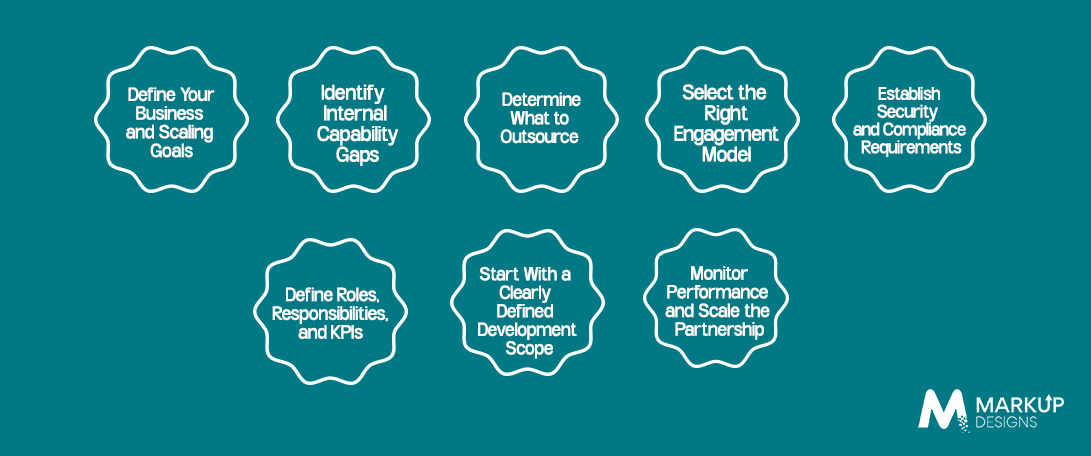
In order to have a competent outsourcing plan, an organization has to do more than just choose a provider. A company must clearly define its goals, acknowledge its shortcomings, and develop a transparent process for organizing its relationship with the outsourcing partner.
Step 1: Define Your Business and Scaling Goals
You should set up clear KPIs, be it launching a new product, improving transactions capacity, entering a new market, updating the infrastructure, or introducing new product features.
Step 2: Identify Internal Capability Gaps
Analyze the current team’s skill set in terms of technology, development capabilities, ability to create infrastructure, and the need for fintech expertise.
Step 3: Determine What to Outsource
Make up your mind about which functions will remain internal and what can be carried out by other companies. An example would be product creation, some modules, integrations, testing, cloud engineering, and maintenance.
Step 4: Select the Right Engagement Model
Decide on the model that suits the scope of the project and possible modifications in the process, whether it will involve hiring dedicated developers, adding to your in-house expertise, or being project-based.
Step 5: Establish Security and Compliance Requirements
Put security controls in place along with rules for data access and compliance obligations or requirements of testing and regulatory mandates before initiating the project.
Step 6: Define Roles, Responsibilities, and KPIs
Assign ownership to the project and specify key performance indicators for development speed, quality, security, and delivery timeframes.
Step 7: Start With a Clearly Defined Development Scope
Have well-defined requirements, technical specifications, milestones, deliverables, and acceptance criteria so everyone can track the process-related progress together.
Step 8: Monitor Performance and Scale the Partnership
Perform common technical and business performance checks on a constant basis. Scale up the partnership as needed depending on other capabilities availability.
How Much Does Fintech Development Outsourcing Cost?
The partnership pricing will considerably vary as the cost of development services can run from cheap MVPs to heavily featured enterprise applications that require complex integrations and security measures. It would be unwise to consider the average price and take that as a benchmark. It’s better to analyze project specifications and technical requirements as it provides sobering numbers.
Factors That Influence Fintech Outsourcing Costs
- Product complexity: The greater the complexity of the operations involved with the financial solution, the more efforts are needed in its development process.
- Development team size: The number of specialists as well as their experience and proficiency level influence costs.
- Technology stack: The usage of modern technologies, cloud computing, AI instruments and special frameworks influences the needed efforts and costs of hiring.
- Features and integrations: The implementation of such components as payment gateways or banking APIs is a significant factor affecting costs.
- Security and compliance requirements: The need to ensure the security of the data and to adhere to the existing regulations has a considerable impact on the budget of the fintech product.
- Development location: The developers’ salaries depend on the markets where they work.
- Engagement model: The mode of cooperation between customer and developers determines the cost of the services.
- Need for maintenance and support: The development of the product is not completed with its launch; monitoring and updates of the development are also needed.
Fintech Outsourcing Cost by Project Type
Costs can also differ according to the type and scale of fintech solution being developed. Businesses may need to estimate development requirements separately for:
- MVP: Core functionality for testing a fintech product concept.
- Mobile fintech application: Customer-facing Android, iOS, or cross-platform financial applications.
- Payment platform: Transaction processing, payment integrations, security, and related infrastructure.
- Digital banking platform: Account management, payments, onboarding, authentication, and banking integrations.
- Enterprise fintech system: Complex systems involving multiple applications, integrations, users, security controls, and enterprise infrastructure.
- AI-powered fintech solution: Financial applications incorporating AI for areas such as fraud detection, risk analysis, automation, recommendations, or document processing.
How Markup Designs Can Help Businesses Scale Fintech Development
Markup Designs provides services to fintech industry players within the context of product development, app modernization, system integration, cloud engineering, implementing artificial intelligence, and cybersecurity services, offering them assistance throughout each stage of implementation of their projects. Clients may closely work with their IT departments or delegate the entire process to us. In such a case, our specialists will complement IT teams of our clients with extra capabilities required for meeting their growing technological needs caused by the expansion of their products and clientele. In case clients need MVP development, implementation of financial APIs, or apps modernization, we are ready to adapt our services to the environment, purposes, and ideas of our clients concerning future development.
Boost Your Fintech Product with Our Development Services
Put your development capacity to work, modernise financial systems, and build scalable fintech solutions with the help of development teams that work according to the company’s business goals.

Conclusion
Fintech companies should be able to develop their technological capabilities in tandem with users, payments, products, and openings on the market. However, to expand the in-house team every time a need arises means increasing the time needed to recruit new employees, time spent on operational processes and the complexity of technology development. Fintech outsourcing offers a solution for the businesses as it makes it possible to get the necessary human resources, flexibility, technological equipment and expertise.
FAQs
1. How does outsourcing benefit the scaling of fintech companies?
Through outsourcing, fintech companies can employ specialized developers, engineers, and designers without having to hire them internally. This allows businesses to scale their operations, shorten time-to-market, carry out system upgrades, and provide adequate technical support in line with their business needs.
2. What services can fintech businesses use outsourcing for?
Some of the services that fintech firms may outsource include fintech application development, online banking development, payment processing system creation, establishment of lending platforms, cloud service development, legacy system upgrades and maintenance, as well as technical support.
3. Is outsourcing beneficial for start-ups in the fintech field?
Yes, outsourcing is valuable for start-ups as they can hire specialized developers without having to create a vast in-house team. This way, start-ups can concentrate on developing their business model while their outsourcing partner takes care of building the prototype, implementing integrations, conducting tests, and improving the product.
4. Can outsourcing streamline the process of product rollout for fintech companies?
Outsourcing can greatly enhance productivity by increasing the workforce dedicated to development while saving time on the recruitment process. As a result, outside developers can finish their work faster.
5. What advantages does outsourcing give in expanding fintech products?
The main benefit of outsourcing is gaining an extra workforce to help in developing new functionalities, integrating banking systems and services, enhancing applications’ performance, expanding to other platforms, modernising infrastructure, and modifying products for new markets. Businesses have the advantage of scaling their external workforce depending on their technical needs.
Author's Perspective
Outsourcing should not be seen as simply delegating software development to a third party. It achieves its effect only when it is used in a well-planned manner. It is about the use of external competence to fill in missing capacities, boost the development potential of a project, and introduce technology skills to processes that cannot be performed by the in-house team. For companies in the fintech sector, this means that the importance of outsourcing as such is as significant as that of the governor of the developers.
Discuss Your Project NowAjit Kumar Jha
VP - Business Operations
Related Posts

Fintech App Development in the Middle East: Trends,...

How Australian Banks Are Modernising Core Banking Systems
Insights Are Valuable & Execution is Priceless
You’ve read about the digital future. Now, let’s build the infrastructure to take you there. Move your strategy from the page to the product.
Design Your Solution Now
Contact Us
Schedule The Appointment At Your Convenience Date And Time.
30 Min
Web Conference
Time Zone
Indian standard time (08:30pm)

Thanks For Getting In Touch!
You’ve Taken The First Step Toward Transforming Your Digital Presence. Our Experts Will Reach Out Shortly To Take It Forward.
Launch Your Dream Project
Provide a brief overview of your project, and our specialists will evaluate your requirements. We will connect with you to explore how the right digital solutions can help you launch faster.