
In Brief
- Understand the key phases involved in planning and implementing an enterprise GRC framework.
- Learn how to assess existing governance, risk, and compliance processes before implementation.
- Explore ways to integrate GRC with enterprise systems, workflows, and data sources.
- Discover how automation and continuous monitoring can improve compliance and risk management.
- Identify practical strategies to overcome common GRC implementation challenges and achieve long-term compliance success.
Enterprise organisations operate across complex processes, multiple departments, third-party relationships, and evolving regulatory requirements. When governance, risk, and compliance activities are managed through disconnected tools and manual processes, organisations can struggle with inconsistent controls, fragmented risk data, delayed reporting, and limited visibility into compliance performance. Enterprise GRC implementation brings these functions into a more structured and connected environment, helping businesses manage risks and compliance requirements alongside their broader operational objectives.
However, implementing GRC successfully is not simply about selecting a platform and configuring a few workflows. It requires a clear understanding of business requirements, existing processes, regulatory obligations, technology infrastructure, and stakeholder responsibilities. A practical roadmap helps enterprises move from assessing their current GRC maturity to designing the right framework, integrating systems, automating controls, and continuously monitoring performance. This guide explores the key stages, challenges, and best practices involved in building an effective enterprise GRC environment.
What Is Enterprise GRC Implementation?
Enterprise GRC implementation is the process of bringing governance, risk management, and compliance activities into a structured and connected framework. It helps organisations standardise controls, improve risk visibility, and manage regulatory obligations more consistently.
A successful implementation goes beyond deploying a GRC platform. It aligns people, processes, policies, data, and technology across departments so that GRC becomes part of everyday business operations rather than a separate compliance function.
Enterprise GRC Implementation Roadmap
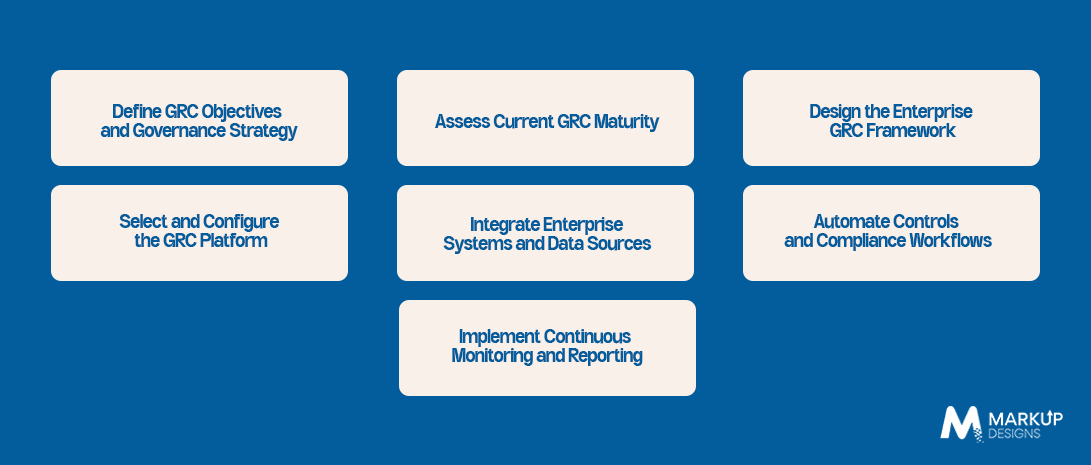
Phase 1: Define GRC Objectives and Governance Strategy
Start by defining what the organisation needs to achieve through GRC. Establish clear ownership, stakeholder responsibilities, and governance priorities that align with business and compliance goals.
Phase 2: Assess Current GRC Maturity
Review existing policies, controls, risk processes, and compliance workflows. Identify gaps, duplicated controls, manual activities, and regulatory requirements that need to be addressed.
Phase 3: Design the Enterprise GRC Framework
Create a structured framework covering risk categories, policies, controls, assessment methods, reporting, and compliance ownership. Standardise these processes across relevant business units.
Phase 4: Select and Configure the GRC Platform
Choose a platform based on the organisation’s requirements rather than available features alone. Configure workflows, dashboards, controls, permissions, and reporting to support the defined GRC framework.
Phase 5: Integrate Enterprise Systems and Data Sources
Connect the GRC environment with relevant systems such as ERP, CRM, HR, ITSM, and security platforms. This creates a more centralised view of risk, compliance, and control data.
Phase 6: Automate Controls and Compliance Workflows
Automate repetitive activities such as risk assessments, evidence collection, control qa testing, approvals, notifications, and escalation. This reduces manual effort while improving process consistency.
Phase 7: Implement Continuous Monitoring and Reporting
Use dashboards, alerts, and performance indicators to continuously track risks and controls. Regular reporting gives executives, compliance teams, and auditors clearer visibility into GRC performance.
Key Components of a Successful Enterprise GRC Implementation
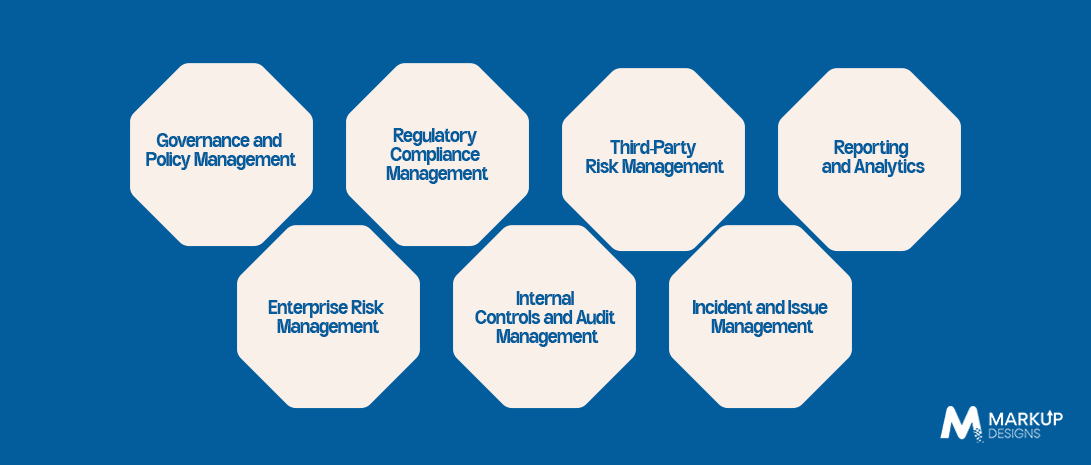
Governance and Policy Management
A strong GRC environment begins with clearly defined policies, governance structures, and ownership. Centralising policies, approval workflows, responsibilities, and documentation helps teams follow consistent governance practices. It also makes policy reviews, updates, and accountability easier to manage across departments.
Enterprise Risk Management
Enterprise risk management helps organisations identify and evaluate risks across business operations, technology, finance, security, and other critical areas. A GRC solution can centralise risk registers, assessments, risk ratings, mitigation plans, and ongoing monitoring. This gives decision-makers better visibility into current and emerging risks.
Regulatory Compliance Management
Enterprises need to continuously track applicable regulations and translate them into practical compliance requirements. GRC systems can map regulatory obligations to policies, controls, owners, and evidence. This creates a clearer connection between regulatory requirements and the actions needed to maintain compliance.
Internal Controls and Audit Management
Internal controls help organisations reduce operational, financial, security, and compliance risks. GRC platforms can support control documentation, testing schedules, audit planning, evidence collection, findings, and remediation. This creates a central record that makes audits easier to manage and track.
Third-Party Risk Management
Vendors, suppliers, contractors, and technology partners can introduce risks that extend beyond an organisation’s internal environment. Third-party risk management helps assess these relationships based on factors such as security, compliance, operational dependency, and performance. Organisations can then monitor vendor risks and address issues throughout the relationship lifecycle.
Incident and Issue Management
GRC implementation should provide a structured way to record, investigate, assign, and resolve incidents and compliance issues. Teams can track corrective actions, assign owners, set deadlines, and monitor remediation progress. This helps prevent recurring issues from being overlooked or left unresolved.
Reporting and Analytics
GRC reporting brings risk, compliance, control, audit, and incident data into a format that decision-makers can use. Dashboards can highlight risk exposure, control performance, overdue actions, compliance gaps, and emerging issues. This gives executives and GRC teams a more consistent view of organisational performance.
Common Enterprise GRC Implementation Challenges
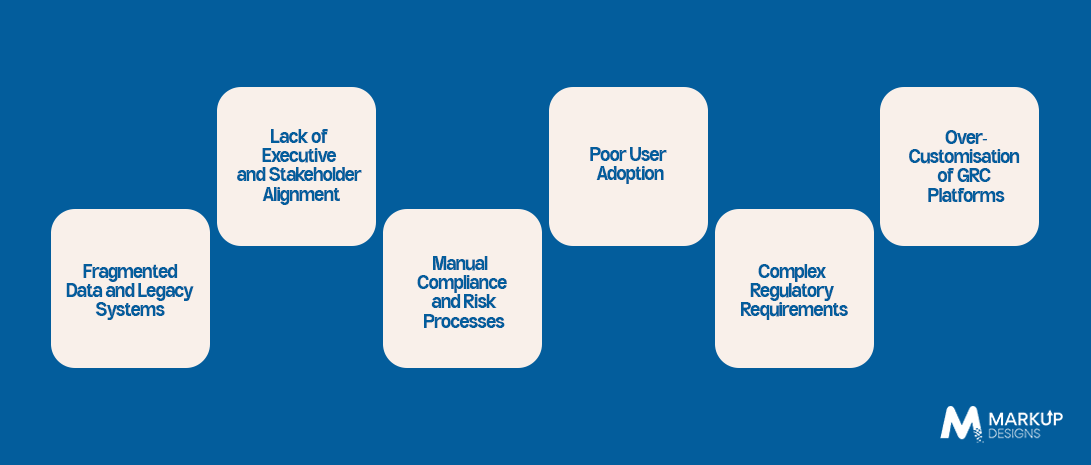
Fragmented Data and Legacy Systems
Many enterprises still rely on spreadsheets, legacy system applications, and disconnected databases to manage GRC activities. This creates duplicate information and makes it difficult to establish a reliable view of risk and compliance. Integrating existing systems and establishing consistent data structures can address these gaps.
Lack of Executive and Stakeholder Alignment
GRC affects multiple functions, so implementation can quickly lose direction when responsibilities and priorities are unclear. Leadership needs to establish clear objectives, while individual teams need defined ownership of risks, controls, policies, and remediation activities. Without this alignment, even a technically strong GRC implementation can struggle to deliver results.
Manual Compliance and Risk Processes
Manual assessments, spreadsheet-based tracking, email approvals, and repetitive evidence collection can consume significant team resources. They can also make it harder to maintain consistent processes and identify overdue activities. Automating high-volume workflows allows teams to spend more time on analysis and risk management.
Poor User Adoption
A GRC platform is only useful when employees actually use it as part of their daily processes. Complicated interfaces, excessive workflows, and unclear responsibilities can create resistance. User-focused design, relevant training, and simple workflows can improve adoption across business functions.
Complex Regulatory Requirements
Enterprises operating across different regions or industries may need to manage multiple regulatory frameworks at the same time. Requirements can overlap, change frequently, and apply differently across business units. A structured GRC environment can help map these requirements to common controls and reduce duplicated compliance efforts.
Over-Customisation of GRC Platforms
Customisation can help align a GRC platform with specific business requirements, but excessive changes can create unnecessary complexity. Highly customised systems may become harder to maintain, upgrade, integrate, and scale. Enterprises should customise where there is genuine business value while keeping core processes as standardised as practical.
Best Practices for Enterprise GRC Implementation
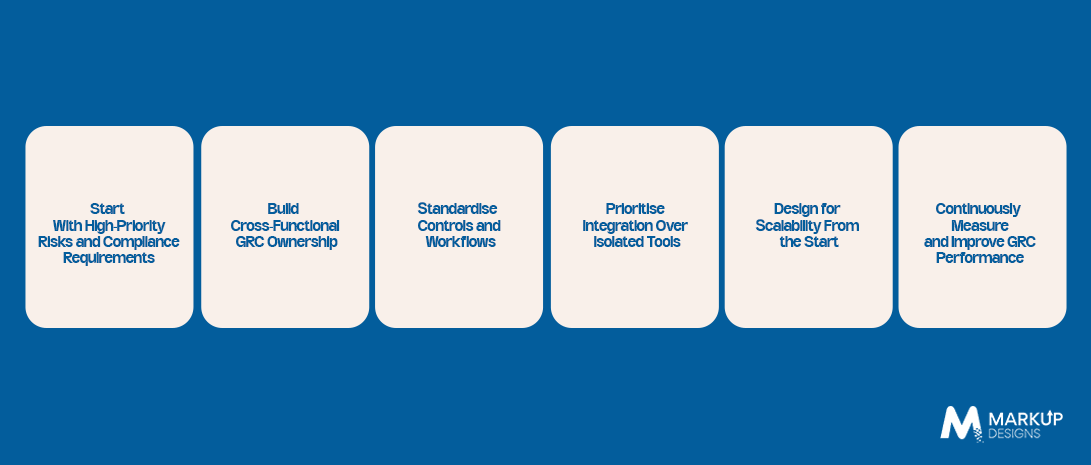
Start With High-Priority Risks and Compliance Requirements
Prioritise the risks, regulations, and business areas that have the greatest operational or compliance impact. This gives the implementation a clear starting point and helps demonstrate value early.
Build Cross-Functional GRC Ownership
GRC should not sit with a single department. Bring together compliance, risk, IT, security, legal, finance, and business teams to establish clear ownership and accountability.
Standardise Controls and Workflows
Create consistent processes for risk assessments, control testing, approvals, evidence collection, and remediation. Standardisation makes GRC easier to manage across different business units.
Prioritise Integration Over Isolated Tools
Connect the GRC environment with existing enterprise systems instead of creating another standalone data source. Integrated systems provide better visibility and reduce duplicate manual work.
Design for Scalability From the Start
Build the GRC framework and technology architecture to support new regulations, business units, users, and risk areas as the organisation grows.
Continuously Measure and Improve GRC Performance
Regularly review risk exposure, control effectiveness, compliance results, and user adoption. Use these insights to identify gaps and improve the GRC programme over time.
How AI and Automation Are Transforming Enterprise GRC
AI and automation can reduce manual GRC workloads while helping teams identify and respond to risks faster.
AI-Powered Risk Identification and Assessment
Analyse large volumes of business data to identify risk patterns and support more informed risk assessments.
Automated Regulatory Monitoring
Track regulatory changes and help compliance teams identify requirements that may affect existing policies and controls.
Intelligent Compliance Evidence Management
Automate evidence collection, classification, and organisation to reduce the effort involved in audits and compliance reviews.
Predictive Risk Analytics
Use historical and operational data to identify emerging risk patterns and support proactive decision-making.
AI-Assisted Reporting and Decision-Making
Generate insights and reports from GRC data, giving stakeholders a clearer view of risks, controls, and compliance performance.
Measuring the Success of an Enterprise GRC Implementation
A successful GRC implementation should be evaluated through measurable improvements in risk management, compliance, operational efficiency, and organisational adoption. Looking beyond platform deployment helps enterprises determine whether the GRC programme is actually delivering business value.
Risk Reduction
Track changes in overall risk exposure, high-priority risks, and unresolved risk areas over time. A mature GRC environment should help teams identify risks earlier, assign appropriate mitigation actions, and monitor whether those actions are reducing exposure.
Control Effectiveness
Measure whether key controls are operating consistently and addressing the risks they were designed to manage. Control testing results, exceptions, overdue actions, and recurring control failures can provide useful indicators of effectiveness.
Compliance Performance
Monitor compliance gaps, outstanding requirements, policy exceptions, and remediation timelines. Improving compliance performance should mean fewer unresolved issues and greater visibility into whether regulatory obligations are being addressed.
Audit Readiness
Evaluate how quickly teams can prepare evidence, respond to audit requests, and resolve findings. A connected GRC environment should reduce the time spent searching across spreadsheets, emails, and disconnected systems for audit information.
Operational Efficiency
Measure reductions in manual assessments, repetitive data entry, evidence collection, approvals, and reporting activities. These improvements show whether automation is actually reducing the operational workload associated with GRC processes.
User Adoption
Track whether relevant teams consistently use GRC workflows, complete assigned activities, and maintain accurate information. Strong adoption indicates that GRC processes have become integrated into day-to-day business operations rather than remaining a separate compliance activity.
Read Also: Developing a Scalable Digital Transformation Roadmap
How Markup Can Help Implement an Enterprise GRC Solution
At Markup, we approach GRC implementation around the organisation’s specific processes, technology environment, and compliance requirements. Our focus is on building connected solutions that can integrate with existing systems while supporting automation, visibility, and long-term scalability.
GRC Strategy and Consulting
We help enterprises define their GRC objectives, assess existing processes, identify gaps, and establish an implementation strategy. This provides a structured foundation before technology decisions are made.
Custom GRC Platform Development
Where standard platforms do not fully address business requirements, we develop customised GRC solutions around specific workflows, controls, reporting needs, and user roles. The approach can be tailored to the organisation’s operating model.
Enterprise System Integration
We connect GRC solutions with relevant enterprise applications and data sources to reduce information silos. Integrations can help bring risk, compliance, security, operational, and business data into a more connected environment.
Workflow and Compliance Automation
We automate repetitive GRC activities such as assessments, approvals, evidence collection, notifications, control testing, and remediation tracking. This helps teams reduce manual effort while maintaining greater process consistency.
AI-Powered Risk and Compliance Capabilities
AI can be incorporated into relevant GRC workflows to support risk analysis, regulatory monitoring, evidence management, reporting, and predictive insights. We focus on practical use cases where AI can improve decision-making rather than adding automation without a clear purpose.
Ongoing Optimisation and Support
GRC requirements evolve as regulations, business operations, and technology environments change. We provide ongoing optimisation and support to help enterprises improve workflows, introduce new capabilities, and keep the GRC environment aligned with changing requirements.
Ready to Build a More Connected GRC Environment?
Bring governance, risk, and compliance into one connected environment designed around your enterprise processes, regulatory requirements, and long-term growth.

Conclusion
Enterprise GRC implementation provides a structured way to bring governance, risk, and compliance processes together across the organisation. From defining objectives and assessing GRC maturity to integrating systems, automating workflows, and continuously monitoring controls, each stage contributes to a stronger and more connected compliance environment.
With the right framework and technology in place, enterprises can improve risk visibility, strengthen controls, reduce manual compliance work, and respond more effectively to changing regulatory requirements.
FAQs
1. How long does enterprise GRC implementation take?
The timeline depends on the organisation’s size, GRC maturity, number of processes, integrations, and level of customisation. A focused implementation can begin with high-priority requirements before expanding across the enterprise.
2. What are the main stages of GRC implementation?
The main stages include defining GRC objectives, assessing current maturity, designing the framework, selecting and configuring the platform, integrating enterprise systems, automating workflows, and establishing continuous monitoring.
3. How much does enterprise GRC implementation cost?
The cost varies based on platform selection, implementation scope, integrations, customisation, number of users, and compliance requirements. A detailed assessment is typically needed to estimate the investment accurately.
4. What systems should a GRC platform integrate with?
Depending on business requirements, a GRC platform may integrate with ERP, CRM, HR, ITSM, cybersecurity, identity management, finance, and other enterprise systems that contain relevant risk or compliance data.
5. How can enterprises measure GRC implementation success?
Enterprises can evaluate risk reduction, control effectiveness, compliance performance, audit readiness, operational efficiency, user adoption, and the reduction of manual GRC activities.
6. Can AI be integrated into an enterprise GRC solution?
Yes. AI can support risk assessment, regulatory monitoring, evidence management, predictive analytics, reporting, and other GRC processes where sufficient quality data and appropriate governance are available.
Author's Perspective
I believe the biggest mistake enterprises make with GRC implementation is treating it as a platform deployment rather than an operational transformation. A GRC solution can centralise data and automate workflows, but it cannot compensate for unclear ownership, poorly defined controls, or disconnected processes.
The better approach is to build the foundation first and then use technology to strengthen it. Prioritising critical risks, involving the right stakeholders, integrating existing systems, and adopting AI selectively can make GRC more practical, scalable, and valuable to the wider business.
Discuss Your Project NowAjit Kumar Jha
VP - Business Operations
Insights Are Valuable & Execution is Priceless
You’ve read about the digital future. Now, let’s build the infrastructure to take you there. Move your strategy from the page to the product.
Design Your Solution Now
Contact Us
Schedule The Appointment At Your Convenience Date And Time.
30 Min
Web Conference
Time Zone
Indian standard time (08:30pm)

Thanks For Getting In Touch!
You’ve Taken The First Step Toward Transforming Your Digital Presence. Our Experts Will Reach Out Shortly To Take It Forward.
Launch Your Dream Project
Provide a brief overview of your project, and our specialists will evaluate your requirements. We will connect with you to explore how the right digital solutions can help you launch faster.