
In Brief
- The Agile method allows businesses to quickly respond to changing business needs.
- Iterative development minimizes the chances of failure and allows value creation to begin much sooner.
- Feedback that occurs throughout the whole development process leads to an improvement in the product and service.
- Developers can act more effectively by involving different experts in their development processes.
- Agile development goes hand-in-hand with such approaches as using cloud solutions and automation.
Development of business-oriented applications is a complex process since all requirements change all the time, the market develops very quickly, customer needs keep changing, and big projects require participation of a great number of teams and specialists. Traditional approaches to developing applications may fail since they do not react fast enough to changes happening in the business environment. By the time a product is ready to be launched, the business requirements may have completely changed.
Agile development solves this problem because it breaks complicated projects into smaller parts that can be developed, launched, and updated one by one. Instead of waiting for a lengthy development cycle to finish, it is possible to start gathering feedback about the product and making changes. As businesses increasingly adopt AI, cloud platforms, and automation, Agile continues to provide the flexibility and collaboration needed to build software that remains relevant in a constantly changing environment.
What Is Agile Development in Enterprise Software?
Agile methodology is an iterative method of building software, supporting companies in managing complex assignments more easily. In Agile, large projects are subdivided into small, manageable deliverables, which means a process moves through small steps instead of going through stages of one huge and lengthy process.
With its support, software development teams, business stakeholders, and other decision-makers work together continuously, which makes it possible to identify bugs very early in the development process, along with other problems, and to take care of them quickly if requirements of the project are changed.
Agile vs Traditional Software Development
The main difference between the two approaches is in the way of dealing with changes. Traditional approaches, including Waterfall, tend to follow a clear process in which specifications are set at the beginning, and one stage ends before another one starts. Testing is usually done later in the process, whereas introduced changes might be too costly.
Agile offers wider flexibility. Specifications can be adjusted based on feedback; the process consists of several pieces of software delivered incrementally and tested simultaneously. Stakeholders remain involved through regular reviews, making it easier to refine priorities and adapt the solution without waiting until the project is complete.
Why Agile Development Continues to Matter for Modern Enterprises
Modern businesses operate in an environment where what is important can change very fast. The state of the marketplace is changing, the expectations of customers are growing, and enterprise systems are becoming more complicated. At the same time, enterprises are required to speed up their process of digital transformation without increasing the risk of failure or creating long delays.
Agile solves the problems mentioned above thanks to the ability to deliver value in phases by constantly reviewing priorities. Enterprises can implement a flexible approach in their development processes instead of sticking to a fixed plan from the start.
Key Benefits of Agile for Enterprise Software Success
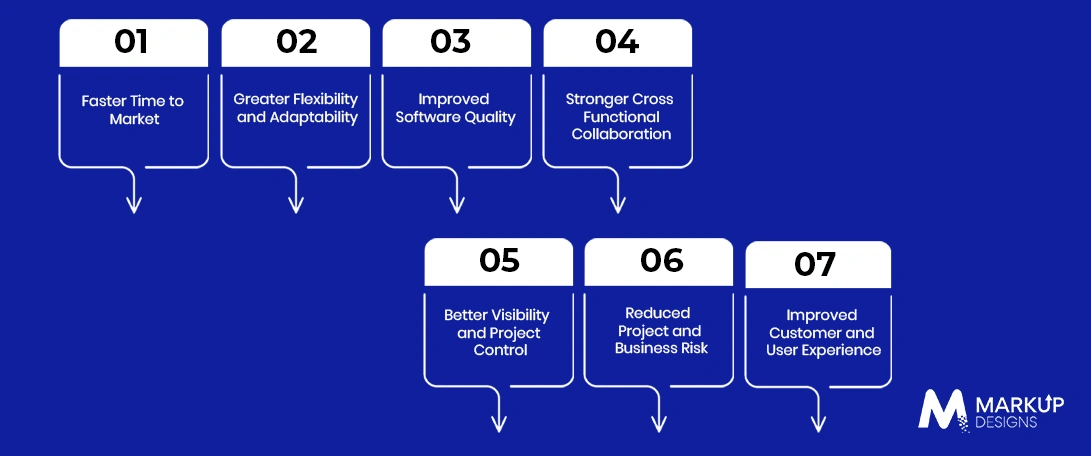
Faster Time to Market
Shorter development cycles and incremental releases allow enterprises to launch valuable features sooner. Teams can gather feedback from early releases and continue improving the software without waiting for the entire product to be completed.
Greater Flexibility and Adaptability
Agile makes it easier to adjust priorities when business goals, customer expectations, regulations or technologies change. This flexibility helps enterprises remain responsive without completely disrupting the development process.
Improved Software Quality
Continuous testing, frequent reviews and ongoing refinement help identify issues earlier in the development cycle. This reduces the likelihood of major defects appearing at launch and supports more reliable software performance.
Stronger Cross Functional Collaboration
Agile brings business stakeholders, product managers, developers, designers, QA teams and operations teams into a shared development process. Regular communication helps reduce silos and keeps technical decisions aligned with business objectives.
Better Visibility and Project Control
Sprint reviews, prioritised backlogs and regular progress tracking give stakeholders greater visibility into development activities. Teams can clearly identify what has been completed, what is in progress and where priorities need to change.
Reduced Project and Business Risk
Incremental delivery allows enterprises to test ideas and validate features before making major investments. Early feedback helps prevent resources from being spent on functionality that does not deliver sufficient business or user value.
Improved Customer and User Experience
Continuous stakeholder and user feedback helps teams refine software based on real needs rather than assumptions. This allows enterprises to improve functionality and user experiences as the product develops.
How Agile Supports Large Scale Enterprise Software Development
Agile methodology is not meant for limited use with only small teams or simple applications. It is used extensively for large enterprise solutions, complex business processes, systems across several departments, and user-facing web products. Agile can also be used with legacy system modernisation and migrating to the cloud, where requirements vary as teams continue discovering dependencies and changes in business priorities.
By breaking down the entire project into smaller stages, companies can make continuous progress while having more control over complexity, risk, and other requirements.
Managing Complex Requirements Through Incremental Delivery
Management of complicated requirements can follow the path of using epics, features, and user stories as initial inputs before structuring them for sprints and releases. This approach allows the teams to focus on producing smaller and manageable deliverables instead of trying to produce an entire system all at once. During the time that one increment is ready for testing and approval, it is possible to detect problems with performance and assess the value of the actual work completed as well.
Supporting Continuous Change Without Disrupting Development
Agile uses prioritised backlogs and sprint planning to manage changing requirements in a structured way. Regular stakeholder feedback helps teams reassess priorities without constantly disrupting ongoing development, ensuring changes are introduced at the right stage.
Read Also: 7 Phases of Software Development Every Enterprise Should Know
Popular Agile Frameworks Used in Enterprise Software Development
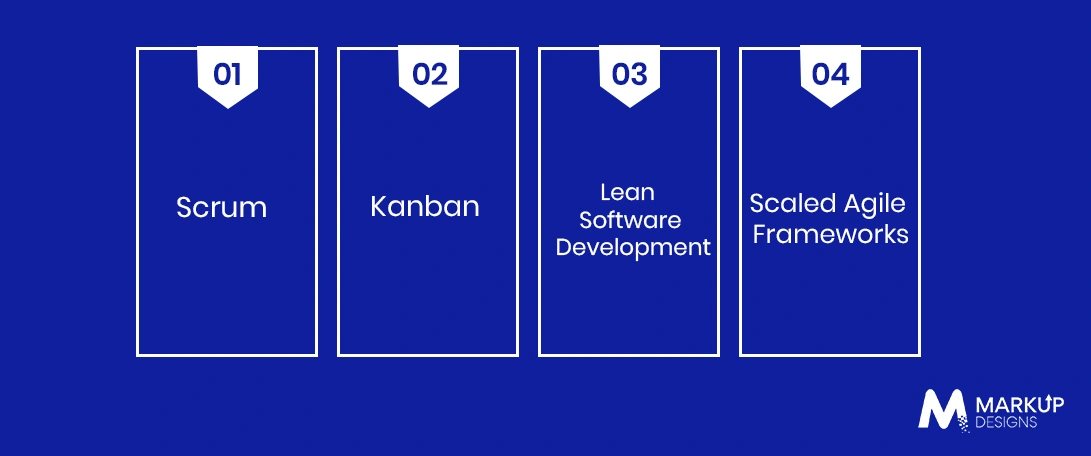
Scrum
Scrum organizes development into small sprints that are intensive and short, lasting around 2-4 weeks. In Scrum, teams work from a prioritized product backlog, collaborate on tasks, and review completed work after each sprint. Retrospective meetings allow teams to look for ways to improve the quality of further sprints.
Kanban
Kanban employs the visual representation of a workflow to ensure tracking and visibility of all tasks. Kanban is especially effective for organizations with great demands concerning flexibility and continuous delivery.
Lean Software Development
Lean looks to eliminate unnecessary activities and utilize resources for real value-adding activities. Moreover, Lean focuses on the enhanсement of work efficiency and proper speed of feedback.
Scaled Agile Frameworks
Large companies can customize Agile practices to support different teams, departments, or projects through implementing the right scaling framework. The selected framework largely depends on the organizational structure of the company and the nature of the project.
Agile and DevOps: A Stronger Model for Enterprise Delivery
Agile and DevOps address different parts of the software delivery process but work effectively together. Agile focuses on iterative development, collaboration, and responding to changing requirements, while DevOps improves integration, deployment, and operational efficiency.
Combined with Continuous Integration and Continuous Delivery practices, this approach helps enterprises release software faster and more reliably. It also strengthens collaboration between development and operations teams, reducing delays between building, testing, and deploying software.
How AI Is Strengthening Agile Software Development
AI is adding new capabilities to Agile development by accelerating repetitive and data-intensive tasks. It can assist with code development, automate testing, identify bugs faster, and support smarter backlog prioritisation based on available data.
AI can also provide predictive project insights and improve documentation and knowledge sharing. These capabilities help teams make faster decisions while reducing the manual effort involved in development and project management.
Why AI Does Not Replace Agile
AI can accelerate individual development activities, but it does not replace the need for collaboration, prioritisation and human decision-making. Agile continues to provide the structure for gathering feedback, managing changing requirements and continuously improving software delivery.
Common Challenges Enterprises Face When Adopting Agile
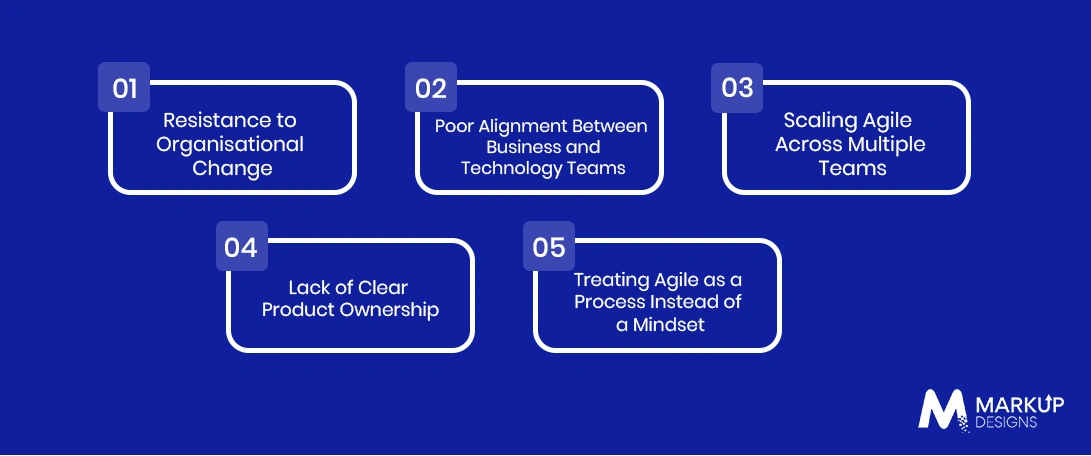
Resistance to Organisational Change
Enterprises moving away from traditional hierarchies and fixed development processes may face resistance from teams accustomed to established ways of working.
Poor Alignment Between Business and Technology Teams
Unclear ownership, communication gaps, and conflicting priorities can prevent Agile teams from making effective decisions and delivering the right outcomes.
Scaling Agile Across Multiple Teams
Coordinating dependencies, timelines, and priorities across numerous teams can become difficult without strong communication and governance.
Lack of Clear Product Ownership
Agile requires clear decision-making and prioritisation. Without effective product ownership, teams may struggle to decide which features deliver the most business value.
Treating Agile as a Process Instead of a Mindset
Daily standups and sprints alone do not make an organisation Agile. The approach requires a genuine commitment to collaboration, adaptability, and continuous improvement.
Best Practices for Successful Enterprise Agile Adoption
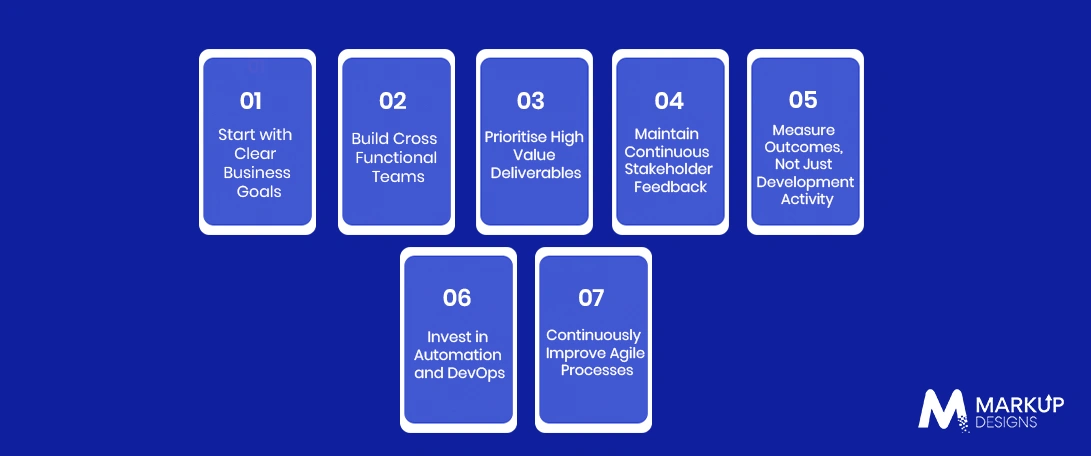
Start with Clear Business Goals
Define the outcomes the software initiative is expected to achieve so development priorities remain connected to business value.
Build Cross-Functional Teams
Bring together the right technical, business, and operational expertise to reduce silos and improve decision-making.
Prioritise High-Value Deliverables
Focus development efforts on features that deliver the greatest value rather than treating every requirement as equally important.
Maintain Continuous Stakeholder Feedback
Regular feedback helps teams validate progress and adjust priorities before issues become more difficult to address.
Measure Outcomes, Not Just Development Activity
Track business impact, software performance, and user outcomes instead of focusing only on completed tasks or development speed.
Invest in Automation and DevOps
Automation can improve testing, integration, and deployment, while DevOps practices help create faster and more reliable delivery pipelines.
Continuously Improve Agile Processes
Teams should regularly review how they work and make practical improvements based on project outcomes and challenges.
How Markup Designs Helps Enterprises Build Agile Software Solutions
Markup Designs helps enterprises build scalable software solutions through Agile development, custom software engineering, and structured product discovery. Our cross-functional teams support requirement prioritisation, continuous testing, quality assurance, and DevOps-enabled delivery while integrating cloud, AI, and automation capabilities where they create measurable value. From complex enterprise platforms to modernisation initiatives, we help businesses maintain flexibility throughout development while building solutions designed for long-term performance and growth.
Develop Enterprise Software that Meets Modern Business Challenges
The rigid development process slows businesses down. Combining Agile practices and sound engineering knowledge, Markup Designs helps companies create scalable software that meets changing business conditions.

Conclusion
Agile continues to drive enterprise software success because it helps organisations deliver value faster while remaining prepared for change. Through iterative development, continuous feedback and regular testing, enterprises can reduce project risk, improve software quality and make better decisions throughout the development lifecycle.
The real advantage, however, does not come from simply adopting Agile practices. Successful enterprise software delivery requires the right engineering expertise, technology strategy, and alignment between business objectives and development priorities. When these elements work together, Agile becomes a practical foundation for building scalable software that can evolve with changing business and customer needs.
FAQs
1. What is the reasoning behind Agile’s significance in enterprise-based software development?
Agile aids enterprises in tackling intricate software development by dividing the process into bite-sized stages. It allows for improved delivery times, constant feedback, better interaction, and higher adaptability in case of any requirements alterations.
2. Can Agile be adopted in case of extensive and advanced enterprise projects?
Indeed. Agile can be useful in the case of extensive enterprise platforms, multi-department systems, and complicated transformation projects. Scaled Agile techniques will allow for coordinating numerous teams and overseeing interdependencies among projects.
3. What distinguishes Agile from DevOps?
Agile is mainly concerned with the process of iteration, close collaboration, and reacting to changing requirements. DevOps, on the other hand, aims to improve the integration, testing, deployment, and operation of the software product. When combined, they provide quicker and more effective delivery of the software solution.
5. Which framework should be used when adopting Agile principles?
There is no sole framework that is suitable for all enterprises. Scrum, Kanban, Lean, scaled Agile frameworks serve different purposes, which means that the selection of the right framework is based on the goals set by the team, the level of the project’s complexity.
6. Is it true that Agile can be integrated with AI and cloud-based technologies?
Indeed, Agile methodology can be used in conjunction with AI and cloud solutions. AI is exceptionally useful in the areas of code construction, software testing, and gaining project insights, while cloud technology brings reliable infrastructure for development and deployment.
7. How can businesses scale Agile across different teams?
There are many ways to scale Agile, including creating strong product ownership and goal alignment, treating dependencies properly, and keeping the lines of communication open. Moreover, feedback loops, governance implementation, and process improvement are vital.
Author's Perspective
Many people believe that Agile is a process of sprints or daily stand-up meetings. In fact, it is a lot more. Agile boasts the ability to help companies make sound decisions before software is run and deployed. Agile provides companies with the capability to adjust priorities in the course of project implementation by gathering feedback at an early stage.
However, Agile alone does not guarantee success. Poor engineering, unclear business goals, and weak ownership can still derail an Agile project. The strongest outcomes come when Agile is supported by capable teams, the right technology strategy, and genuine alignment between business and development objectives.
Discuss Your Project NowJupinder Singh Arora
Founder and CEO
Related Posts

Custom Software Development Cost in Bahrain: Factors, Benefits,...
How Much Does Healthcare Software Development Cost in...
How to Build Compliance Software for Australian Businesses:...
Insights Are Valuable & Execution is Priceless
You’ve read about the digital future. Now, let’s build the infrastructure to take you there. Move your strategy from the page to the product.
Design Your Solution Now
Contact Us
Schedule The Appointment At Your Convenience Date And Time.
30 Min
Web Conference
Time Zone
Indian standard time (08:30pm)

Thanks For Getting In Touch!
You’ve Taken The First Step Toward Transforming Your Digital Presence. Our Experts Will Reach Out Shortly To Take It Forward.
Launch Your Dream Project
Provide a brief overview of your project, and our specialists will evaluate your requirements. We will connect with you to explore how the right digital solutions can help you launch faster.