

In Brief
- Modernizing an outdated mobile application can greatly enhance its efficiency, safety, scalability, and overall usability.
- It can also lead to less spending on maintenance and accumulated technical debts.
- An application outdated due to the usage of an outdated software platform can be identified by such factors as an abundance of crashing cases, bad user reviews, and high support costs.
- The way an app can be modernized will be influenced by your current application infrastructure, your budget, and the specifics of your company.
- At a minimum, an effective modernization approach should consider the implementation of cloud technologies, API integration, UI/UX enhancement, and secure app execution.
- Partnering with a leading mobile app development agency in Australia is a guarantee of effective realization of the mobile app modernization project without obstacles and with maximum profits.
The digitalization push from the Australian companies has contributed to the rise of numerous legacy mobile applications that do not comply with current standards of security, efficiency, and usability. Built on outdated technologies, the applications cause high support costs, limit scalability, and impede the implementation of innovations. Taking into account the massive support of the digital economy for Australia’s future, local companies aspire to implement their mobile modernization plans.
Modernizing a legacy mobile application is not only about programming changes.
It involves improving architecture, cloud readiness, security, APIs, and user experience to support future technologies such as AI and automation.
This blog explores how Australian businesses can successfully modernise legacy mobile applications, the best strategies to adopt, associated costs, key challenges, and how we can help organisations build secure, scalable, and future-ready mobile solutions.
What Qualifies as a Legacy Mobile App Today?
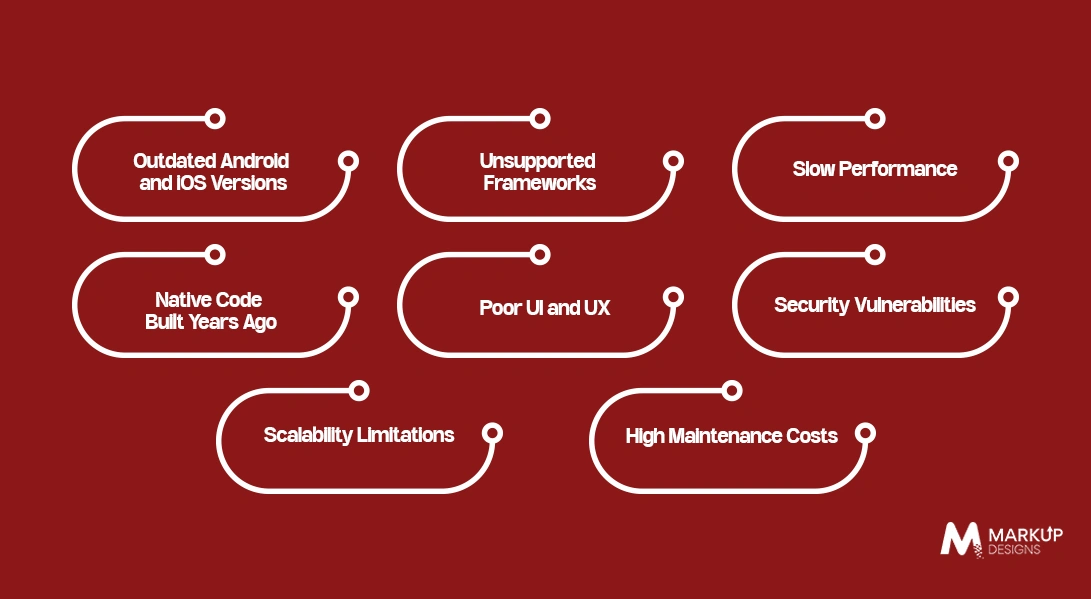
Legacy mobile apps are not merely obsolete ones. These are apps that cannot keep up with the demands of the market, expectations of the users, and technological advances. These applications are typically based on outdated technology stacks, unsupported ones, which complicates their maintenance, security, and scaling. As cloud computing, AI, and automation have come to occupy an increasingly big market share, modernising legacy mobile apps has become critical for successfully enduring in today’s business world.
Common Characteristics of Legacy Mobile Applications
Outdated Android and iOS Versions: Legacy applications are usually developed for old versions of Android or iOS, which makes them obsolete with regard to modern operating systems and possible functions.
Native Code Built Years Ago: A large number of older mobile apps were developed with technologies and programming languages that haven’t been updated for ages, making them hard to fix and develop further. As technology develops, such problems become more complicated and costly.
Unsupported Frameworks: Apps developed using outdated techniques and libraries are not being updated anymore, which contributes to growing tech debt and makes it difficult to implement modern components into the existing app.
Poor UI and UX: Bad design and complicated navigation fail to correspond to modern users’ needs, which leads to lower engagement and brings about negative feedback.
Slow Performance: High latency, crashes, and slow response times are some of the signs of an old mobile app. These issues influence the company’s reputation and user retention.
Scalability Limitations: Older apps usually don’t meet contemporary security criteria, such as high-level encryption, secure user identification, and regular updates.
Scalability Limitations: Older mobile applications are usually unable to grow in the number of users or work in the cloud environment, making it very difficult to develop them in the future.
High Maintenance Costs : As technology ages, maintaining legacy applications requires more developer effort, specialised expertise, and frequent fixes, increasing operational costs while delivering limited business value.
Why Identifying Legacy Risks Matters Before Modernisation
A proper understanding of the risks involved with legacy mobile applications allows companies to adopt the correct modernisation plan and evade expensive missteps.
Business Impact: Legacy mobile applications decrease operational efficiency, prolong the process of innovation, and hinder businesses in reacting in a timely manner to different market changes.
Customer Retention: Users expect mobile experiences that are quick, secure, and easy to follow. The poor performance of mobile applications and obsolete functions may cause them to engage less with the application, thus leading to a lower customer retention rate and negative ratings on the app store.
App Store Compliance: Apple App Store and Google Play Store frequently make changes to their guidelines and technical requirements. Resultantly, legacy applications may fail to conform to these requirements, which may lead to updates not being accepted and less visibility.
Technical Debt: Years of obsolete code, unsanctioned technologies, and temporary fixes result in the rise of technical debt, which makes the development process more difficult with the growth of its cost.
Future AI Integration: New functionalities like AI-powered services, smart chatbots, predictive analysis, and automation require flexible architectures and blow-by-blow infrastructure. Early recognition of limitations posed by legacy technology helps prepare the app for future integration with AI and ongoing innovation.
Common Types of Legacy Mobile Applications Used Across Australian Businesses
As Australian businesses are speeding up their digital transformation, many of them still put much reliance on outdated mobile applications that were designed years ago in line with certain needs of the companies.
| Industry | Legacy Mobile App Examples | Current Challenges | Modernisation Opportunities |
| Banking & Financial Services | Mobile banking, payment, and loan management apps | Legacy infrastructure, security risks, slow feature releases, compliance challenges | Cloud native architecture, biometric authentication, AI-powered fraud detection, and real-time payments |
| Healthcare | Patient portals, appointment booking, telehealth apps | Poor interoperability, outdated UI, data security concerns, and regulatory compliance | Secure cloud platforms, AI assisted diagnostics, wearable integration, enhanced patient experiences |
| Retail & Ecommerce | Shopping, loyalty, and inventory management apps | Slow performance, poor checkout experience, limited personalisation | AI recommendations, omnichannel integration, faster payments, personalised shopping experiences |
| Logistics & Transportation | Fleet tracking, warehouse, and delivery management apps | Limited scalability, inefficient route planning, delayed updates | Real time tracking, IoT integration, predictive analytics, automated workflows |
| Government & Public Services | Citizen service and utility apps | Ageing infrastructure, accessibility issues, security vulnerabilities | Cloud migration, digital identity integration, improved accessibility, secure service delivery |
| Manufacturing | Production monitoring and field service apps | Outdated systems, disconnected data, limited automation | Industrial IoT integration, predictive maintenance, real time analytics, remote monitoring |
| Education | Student learning portals and campus management apps | Poor mobile experience, limited collaboration, and outdated content delivery | AI-powered learning, cloud based LMS, virtual classrooms, personalised education |
| Insurance | Policy management, claims, and customer service apps | Manual processes, slow claims handling, legacy integrations | AI assisted claims processing, self service portals, automated underwriting, intelligent customer support |
The Hidden Cost of Delaying Legacy Mobile App Modernisation
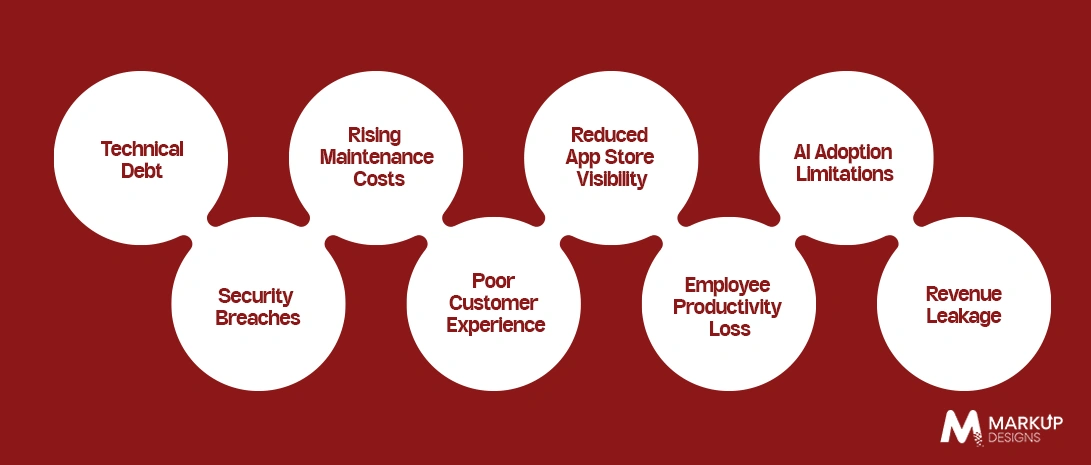
While delaying mobile app modernisation may seem like a way to cut down on costs, it will, in reality, cause an increase in operational, financial, and strategic costs in the future. According to research, anywhere from 60% to 80% of an organisation’s IT budget goes on maintaining existing legacy systems.
Technical Debt
Legacy mobile applications build up technical debt due to incompatibility of code, unsupported libraries, and temporary fixes. According to Gartner, the costs associated with technical debt can represent 20% to 40% of the total value of a business’s technology estate.
Security Breaches
Older mobile applications often lack modern security provisions such as sophisticated encryption tools, safe application programming interfaces (APIs), and multi-factor authentication (MFA) measures. According to the IBM Cost of Data Breach Report 2025, the average global cost of a data breach is approximately USD 4.9 million.
Rising Maintenance Costs
The cost of keeping an old application functioning is steadily rising because it is becoming more difficult to find developers who are familiar with outdated technologies. Many companies now spend more on maintaining legacy apps than building new scalable systems.
Poor Customer Experience
Underperformance due to delays in loading, obsolete layout, and continual breakdowns reduces customer satisfaction. Research suggests that people abandon apps with poor performance, bringing about declines in customer engagement, bad ratings, and a lack of customer loyalty.
Reduced App Store Visibility
Google Play and Apple App Store continuously change their platform requirements. Thus, obsolete apps may suffer from diminished visibility and compatibility issues, delays in approval, or even being removed from the app store.
Employee Productivity Loss
Old internal business apps often need manual workarounds and inefficient processes, and operate poorly. This way, employees spend most of their time dealing with numerous limitations instead of doing more important tasks, which causes losses in efficiency.
Limits of AI Adaptation
At present, AI Technologies-chatbots, predictive analytics, recommendation systems, and automation of workflows- need cloud-based infrastructure and modern API. Old apps often require additional architecture to incorporate the technologies mentioned above.
Revenue Leakage
Underperformance of apps and the abandonment of deals by customers result in a decrease in company profits. Up-to-date legacy apps mean the ability of businesses to enhance customer retention and develop the app faster while generating revenue.
When Should You Modernise Your Legacy Mobile App?
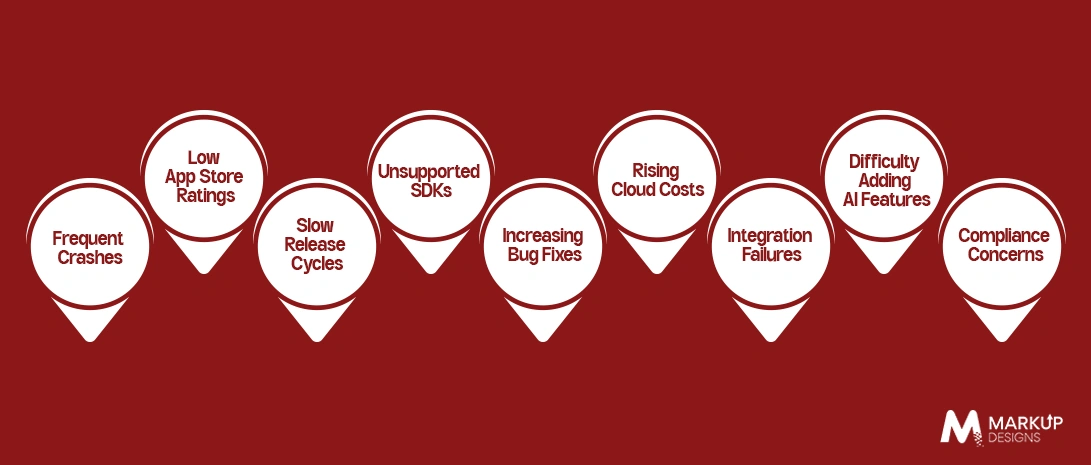
Most companies implement mobile app modernisation only after the mobile application has reached its breaking point. In other words, the best moment to carry out modernisation is before the app turns into a business risk. If your application displays any of the following signs, structured legacy mobile app modernisation should be of great importance to you.
Frequent Crashes
Frequent crashes, freezing, or unexpected shutdowns imply that the app architecture cannot cope with modern devices, systems, and the increasing needs of users.
Low App Store Ratings
Bad reviews and low ratings are often an indicators of such failures as underperformance, an outmoded interface, or a lack of functional capabilities.
Slow Release Cycles
If implementing small changes takes several months instead of weeks, that means that your legacy development methods hinder innovation and competitiveness.
Unsupported SDKs
Applications that require old SDKs, libraries, or frameworks may face difficulties with maintenance and security.
Increasing Bug Fixes
If developers spend more time fixing bugs than creating new capabilities, then maintenance costs rise and business value drops.
Rising Cloud Costs
Inefficient architecture, unnecessary features, and poor resource management lead to inflated infrastructure costs without any measurable business return.
Integration Failures
Not being able to connect the application with new APIs, payment systems, CRM software, analytic tools, and enterprise software is a clear sign that the system architecture needs to be updated.
Difficulty Adding AI Features
New features relying on AI (recommendations, chatbots, predictive analytics, etc.) require up-to-date APIs and scalable data pipelines, something that many outdated mobile applications don’t have.
Compliance Concerns
New rules and regulations related to security, privacy, and accessibility keep appearing in Australia. Legacy applications can face difficulties complying with requirements concerning data protection, the safety of the authentication process, and platform compliance.
Common Legacy Mobile App Modernisation Mistakes Businesses in Australia Make
Some companies realize the necessity of modernizing their mobile applications; however, they still make mistakes as they treat the process as the implementation of new technologies instead of regarding it as the process of transforming the business. Avoiding these mistakes will increase the chances of success a lot.
Rebuilding Without a Business Strategy
Many companies opt for a complete renovation of their applications without providing the necessary details about their business objectives, criteria of success, and the desired results of the project. This results in overpriced projects that generate little commercial revenue.
Ignoring User Behaviour Analytics
Use data from actual use and do not forget about analytics. Ignoring the analytics can lead to changing features that are hardly used by users and not paying attention to the major problems faced by customers.
Skipping UX Redesign
Changing the code while continuing to use the outdated UX is a frequent mistake. Users evaluate the application according to the interface and not according to the technology used for building it.
Choosing the Wrong Technology Stack
Choosing a framework just because it is popular but not considering business needs can lead to issues with performance, scalability, and support in the long run.
Poor API Planning
Weak API architecture does not allow for effective integration with services such as cloud, payment, and AI solutions, and therefore it decreases the prospects of the app in the future.
No Cloud Strategy
New mobile apps rely more on the cloud infrastructure. Without a proper cloud strategy, companies lose the chance to gain scalability and resilience for their business.
Weak Testing Approach
Lack of functional, performance, security, and device testing will create a lot of glitches and weaken the customer’s faith in your app.
Underestimating Data Migration
Moving customer accounts, transaction statistics, preferences, and operational data may appear to be much harder than expected. Poor mobility planning can result in some data loss or service shutdown.
Ignoring App Store Compliance
Apple and Google frequently update submission and security requirements. Failing to account for these standards can delay releases or cause update rejections.
Poor Change Management
Employees, customers, and operational teams must be prepared for the transition. Without clear communication and training, adoption rates can suffer even when the technology succeeds.
Case Example
Australian Retail
A costly rebuild that missed the real problem
An Australian retail firm revamped its mobile application using a different framework while its checkout interface and backend integrations remained the same. The project surpassed its budget while the launch date was delayed, and App Store ratings did not improve significantly.
What was done next?
Once user journey analytics had been applied, checkout user experience redesigned, APIs modernized, and cloud services deployed, the company managed to minimize cart abandonment rate, speed up the feature releases, and boost customer satisfaction.
Takeaway: Successful modernization of legacy mobile apps does not only mean changing the application code. It means having all technology, user experience, data, and business purpose in one strategy.
Legacy Mobile App Modernisation Strategies: Which Approach Works Best?
There’s no universally efficient method of legacy mobile app modernisation. Choice of the right strategy depends on the current state of the app, objectives set, budget, and long-term technological roadmap. Utilization of the suitable approach allows for minimizing risks, regulating costs, and increasing ROI.
| Strategy | Best For | Cost | Complexity | Business Impact | Time Required |
| Rehost | Apps requiring infrastructure upgrades with minimal code changes | Low | Low | Low to Medium | Short |
| Replatform | Applications need better scalability while retaining core functionality | Medium | Medium | Medium | Short to Medium |
| Refactor | Improving code quality and performance without changing the architecture | Medium | Medium | Medium to High | Medium |
| Rearchitect | Enterprise apps requiring cloud native architecture and scalability | High | High | High | Long |
| Rebuild | Outdated apps that no longer meet business or user requirements | High | High | Very High | Long |
| Replace | Applications that can be substituted with modern SaaS solutions | Medium to High | Medium | High | Medium |
| Hybrid Modernisation | Businesses are modernising critical modules in phases | Medium to High | Medium | High | Medium to Long |
How Australian Businesses Choose the Right Modernisation Strategy
Selecting an appropriate modernisation strategy is based on various aspects like the age of the solution, cumulative technical debt, goals of the business venture, its budgetary constraints, limitations relating to scalability, governing rules, and approaches for adopting future AI. Many firms in Australia rely upon a hybrid or staged method, which involves the modernisation of vital functions in the beginning by making certain that operational risks are adequately mitigated and businesses are free from interruptions.
How to Modernise a Legacy Mobile App: Step-by-Step Roadmap
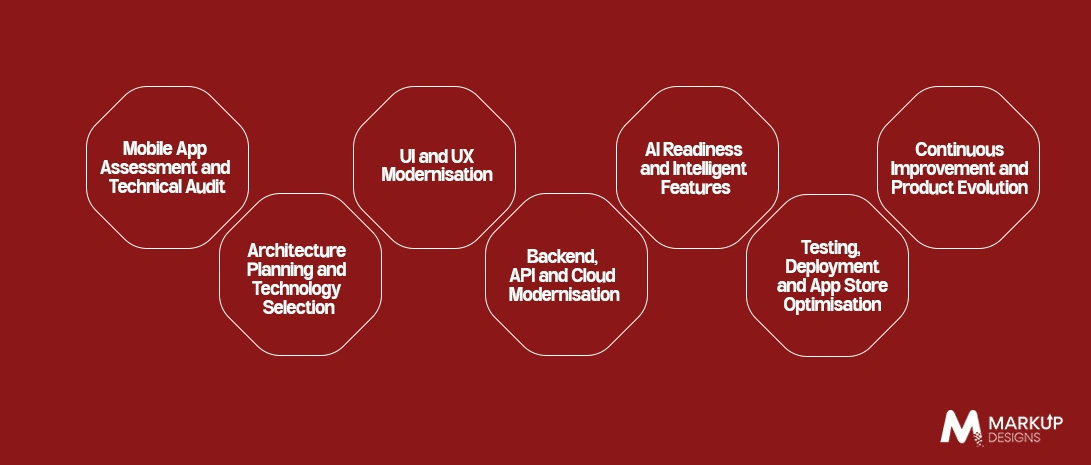
A well-planned guide helps bring about effective modernisation of mobile applications in a way that leaves minimal scope for downtime and uncertainties associated with modernisation.
Phase 1: Mobile App Assessment and Technical Audit
The existing state of the mobile solution should be audited based on a thorough assessment of its code, performance, dependencies, security, user experience, and alignment with business goals. The first step of the process paves the way for accounting for technical debt and estimating the overall volume of required modernisation.
Phase 2: Architecture Planning and Technology Selection
It is vital to select a technology stack that fits perfectly in accordance with the needs of the business. Native, Flutter, or React Native may be selected in addition to planning the backend modernisation, creating API architecture, and choosing the needed cloud and database components.
Phase 3:UI and UX Modernisation
It is essential to enhance the current user experience, which can be conducted via user research, while making the application more accessible and improving the design consistency.
Phase 4: Backend, API and Cloud Modernisation
Upgrade the backend by using microservices, shifting workloads to the cloud, applying secure API gateways, boosting authentication, implementing CI/CD pipelines, applying DevOps principles, and adopting containerisation techniques for higher scalability.
Phase 5: AI Readiness and Intelligent Features
Get the application ready for future innovations with the help of AI-driven chatbots, recommendation engines, predictive analytics, voice assistants, computer vision features, AI-powered search, and personalised user experiences.
Phase 6: Testing, Deployment and App Store Optimization
Guarantee the quality of the application through functional, security, and performance testing before beta releases. Optimize the deployment for Google Play and Apple App Store while evaluating the application performance continuously.
Phase 7: Continuous Improvement and Product Evolution
Keep modernizing after releasing the product. Gather user feedback, provide updates regularly, optimize performance, enhance security, apply artificial intelligence improvement techniques and create a product backlog.
Legacy Mobile App Modernisation Cost in Australia
The costs of modernizing a legacy mobile application depend on its complexity, technology stack, integrations, and other business factors. The costs vary considerably from project to project; however, you could use the following estimates as a guide.
Estimated Cost by Project Size
| Project Size | Estimated Cost (AUD) | Typical Timeline |
| Small Mobile Apps | $20,000 – $50,000 | 2–4 months |
| Medium Business Apps | $50,000 – $150,000 | 4–8 months |
| Enterprise Applications | $150,000+ | 8–12+ months |
Factors That Influence Modernisation Costs
The total amount of funds required for investment depends on many parameters such as the platform used (Android, iOS, or the all-encompassing cross platform), the quality of code, third parties technologies, backend complexity, cloud migration needed, cybersecurity, legal compliance, implementing AI, redesigning UI/UX, finally testing the app, and the size and professionalism of the team of developers.
Compliance, Security and Governance for Mobile Apps in Australia
Security and compliance must be included in every part of the process of modernising an existing mobile application and shouldn’t be seen as a step in the list when everything is finished. Companies in Australia must take care that their apps are secure and protect users’ data, comply with legal requirements, and have proper security practices.
The Privacy Act 1988
The Privacy Act 1988 defines how companies report personal information. The new mobile applications must be created in accordance with the requirements of this law.
The Australian Privacy Principles (APPs)
The APPs are a set of principles regulating personal data usage.
Businesses should implement transparent privacy policies, obtain user consent, and ensure secure data management throughout the application lifecycle.
Essential Eight
Essential Eight is a set of guidelines created by ACSC to assist organizations in mitigating risks from cyber attacks and enhancing application security.
OWASP Mobile Security
Using OWASP Mobile Application Security principles enables developers to tackle vulnerabilities like poor data storage, weak authentication, inadequately secured APIs, and poor session handling.
Data Sovereignty
Companies that work with sensitive customer data must comply with Australian data residency and privacy laws for data handling.
Multi Factor Authentication
Using MFA increases security by verifying a user’s identity in multiple ways.
Encryption
Sensitive information must always be encrypted following modern encryption standards for both data at rest and data in motion.
Identity Management
Proper identity management ensures access to application data is restricted to authorized users only.
Mobile Device Management
Mobile Device Management (MDM) solutions allow companies to maintain control of organizational devices and enforce security regulations in enterprise applications.
Secure APIs
Current API protocols need to use secure authentication, authorization, rate limiting, and monitoring protocols in order to keep mobile applications safe.
How to Modernise Legacy Mobile Apps Without Disrupting Business Operations
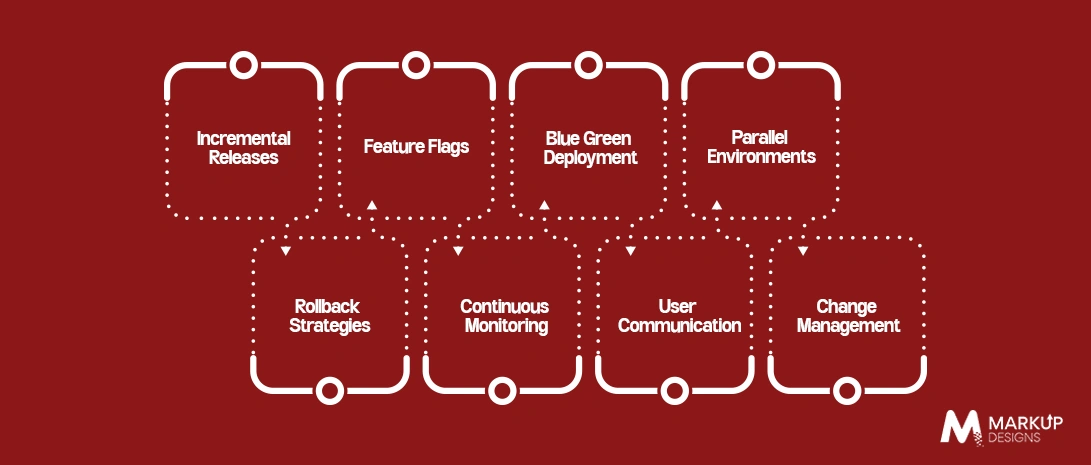
It is possible to modernise a mobile app without bringing daily operations to a standstill. Companies can minimise interruptions, mitigate risk, and keep users engaged throughout the modernisation process by applying a phased approach.
Incremental Releases
Implement new features incrementally in lieu of completely replacing an older app. This helps reduce the risk associated with projects and facilitate continuous improvement.
Feature Flags
Use the feature flag method to selectively switch on/off features for a customer group, thus enabling verification of the upgrade prior to its complete introduction.
Blue Green Deployment
Create two production environments, shifting users to the new version only after testing, so that customer service stays uninterrupted.
Parallel Environment
Early in the migration process, maintain both an old and new version, thus ensuring business continuity.
Rollback Strategies
Implement rollback plans which will allow for a swift revert to the previous version in case problems are encountered.
Continuous Monitoring
Monitor the activity of the app in real time to detect problems before users are affected.
User Communications
Keep users informed about software upgrades and new features to create trust.
Change Management
Implement comprehensive training, documentation, and stakeholder engagement to help employees and users transition smoothly to a modernised application.
Business Benefits of Legacy Mobile App Modernisation
Updating a legacy mobile application offers positive impacts beyond improvement of technology. This allows companies to create innovations faster, enhance customer experience, and lay a solid basis for durable growth in the field of digital technologies.
Better Customer Engagement
Modern UI, quick navigation, and custom experience allow managing users more easily and improving customer satisfaction.
Faster Application Performance
Optimised infrastructure and modern technologies reduce the loading time of applications, improve reaction time, and ensure a better user experience.
Reduced Cost of Maintenance
Switching from outdated technologies to modern frameworks helps reduce the maintenance work required to keep an application operational and the related costs of its operation.
Improved Scalability
Cloud technologies and modern infrastructure allow applications to grow simultaneously with their users, transactions, and business needs.
Better Security
Modern security measures, secure APIs, encryption, and continuous monitoring of the application protect customers and companies.
Preparedness for Artificial Intelligence
Modern applications can implement solutions powered by artificial intelligence, such as chatbots, predictive analytics, recommendation systems, intelligent automation, and more in future development.
Making Updates Quickly
With the help of new DevOps practices and CI/CD pipelines, it is possible to make updates, corrections, and develop new features more often.
Enhanced Ratings on App Stores
Better mobility and usability lead to better rating and improved performance on Google Play and Apple App Store.
Higher Customer Loyalty
Reliable and secure mobile experiences make customers return, stay loyal, and quit using apps less.
Increased Earnings
Better customer experiences, faster innovations, and better operational efficiency lead to more opportunities for new customers, successful conversions, and greater growth.
Future-ready Solutions
Modern application architecture allows us to use new technologies, add new services and adapt to changing business needs without doing a complete redevelopment.
What Makes Markup Designs A Top Choice for Mobile App Modernization in Australia?
Being able to modernize the legacy mobile application requires not only technical skills but also a proactive partner who knows the business requirements, current technologies, and changes in the market. Markup Designs has 12+ years of industry experience, over 300 technology experts, 10,000+ successfully completed projects and 8,000+ international collaborations, which allows it to offer customers from Australia, India, the UK, the USA, the UAE, and Canada safe, stable, and up-to-date digital solutions.
From mobile app consultancy and legacy app evaluations through Android/iOS modernities through Flutter/React Native introduction, cloud transition, API generation, AI embedment, UI/UX enhancement, and DevOps execution, we use our values for providing high-performance applications through 350+ technologies.
Modernize Your Legacy Mobile App with Ease Today
Transform outdated mobile applications into secure, scalable, and AI ready solutions with Markup Designs. Get expert guidance to accelerate innovation and future proof your business.

Conclusion
In light of modern-day transformations, legacy mobile applications are just a hindrance on the way of innovation in terms of operational effectiveness and customer satisfaction. For Australian companies, legacy mobile application modernization is now more of a strategic approach and an investment to increase security levels, improve scalability and decrease maintenance costs. By following a structured modernization process and choosing a reliable technology partner such as Markup Designs, companies are capable of not only minimizing migration risks but also building future-proof technologies.
FAQs
1. What does legacy mobile app modernization mean?
It means upgrading an old mobile application in order to make its performance, safety, scalability, and general experience better.
2. How can I understand if my app needs modernization?
Constant crashes, low speeds, old frameworks, problems with security, and high maintenance costs are signs of the necessity of modernization.
3. How much does it cost to modernize a legacy mobile app in Australia?
The costs would vary from AUD 20,000 for smaller apps to AUD 150,000+ for large-scale applications according to the complexity of the project.
4. Should I rebuild or modernise my existing mobile app?
If your app has a stable foundation, modernisation is usually more cost-effective; otherwise, rebuilding may offer better long-term value.
5. How long does a legacy mobile app modernisation project take?
Most projects take 2 to 12 months, depending on the application’s size, complexity, and modernisation scope.
Author's Perspective
Legacy mobile application modernization does not merely consist of replacing old technology. It involves providing companies with the ability to innovate at greater speed, increase digital security, and provide their clients with flawless digital experience that more and more fulfills new requirements. Companies that carry out modernization in advance manage to adopt artificial intelligence and cloud technologies or other new mobile opportunities without being restricted in their legacy infrastructures. Properly thought-out modernization, therefore, helps to lower long-term costs and build a strong basis for successful business growth and further digital transformation.
Discuss Your Project NowJupinder Singh Arora
Founder and CEO
Related Posts

Cost to Build a Mobile App in Qatar...

How Much Does It Cost to Build an...
How to Build a Car Wash App: Development...
Insights Are Valuable & Execution is Priceless
You’ve read about the digital future. Now, let’s build the infrastructure to take you there. Move your strategy from the page to the product.
Design Your Solution Now
Contact Us
Schedule The Appointment At Your Convenience Date And Time.
30 Min
Web Conference
Time Zone
Indian standard time (08:30pm)

Thanks For Getting In Touch!
You’ve Taken The First Step Toward Transforming Your Digital Presence. Our Experts Will Reach Out Shortly To Take It Forward.
Launch Your Dream Project
Provide a brief overview of your project, and our specialists will evaluate your requirements. We will connect with you to explore how the right digital solutions can help you launch faster.