

In Brief
- Businesses increasingly rely on mobile applications to improve customer engagement, streamline operations, and drive digital growth, but many apps fail due to poor planning and execution.
- Common mobile app development mistakes include unclear business goals, poor UX design, feature overload, weak scalability planning, and choosing the wrong development approach.
- Many organizations also underestimate development and maintenance costs, ignore cybersecurity implementation, and fail to optimize app performance across devices and platforms.
- Lack of testing, weak backend infrastructure, poor analytics integration, and ignoring customer feedback often result in low user retention, security risks, and operational inefficiencies.
- Successful mobile app development requires scalable architecture, cloud-native infrastructure, AI readiness, strong security frameworks, continuous optimization, and user-centric design strategies.
- Businesses that prioritize long-term scalability, performance, analytics, and customer experience are far more likely to build secure, high-performing, and future-ready mobile applications.
Mobile applications have become one of the most powerful digital assets for modern businesses. From startups and eCommerce brands to healthcare providers, fintech companies, logistics firms, and enterprise organizations, mobile apps now drive customer engagement, operational efficiency, and revenue growth.
As smartphone adoption continues growing globally, mobile applications are no longer optional for businesses aiming to remain competitive.
However, while the mobile app market continues expanding rapidly, many business applications fail to achieve long-term success. Some apps struggle with low user retention, while others face security vulnerabilities, performance issues, poor scalability, or complete project failure before launch.
One of the biggest reasons behind these failures is not technology itself. The real issue often lies in poor planning and avoidable strategic mistakes during the app development lifecycle.
Many businesses underestimate the complexity involved in building scalable, high-performing mobile applications. They assume mobile app development is simply about creating attractive screens and launching an app quickly.
Core Challenges While Developing Mobile Applications
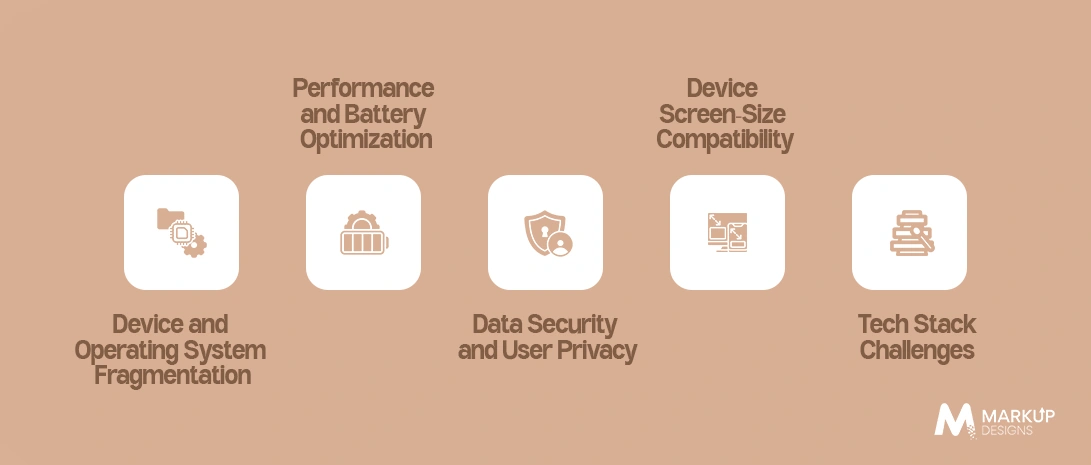
Device and Operating System Fragmentation
There are thousands of smartphones available in the market with different screen sizes, resolutions, hardware capabilities, and operating system versions. Especially in the Android ecosystem, users operate on both older and newer OS versions, making it challenging for developers to create apps that function smoothly and maintain a consistent user experience across all devices. Ensuring compatibility across diverse devices and OS versions also increases cross-platform apps development, testing, and maintenance efforts.
Performance and Battery Optimization
Mobile devices have limited RAM, processing power, and battery life compared to desktops, so apps need to be optimized for smooth performance. While adding advanced features improves user experience, developers must ensure the app does not cause battery drain, overheating, lagging, or crashes, helping users enjoy fast and reliable performance across different devices.
Data Security and User Privacy
Mobile applications often handle sensitive personal and financial data, making them vulnerable to cyberattacks, malware, and data breaches. To protect user information, businesses must implement strong security measures such as secure APIs, data encryption, and safe storage practices while also complying with data protection regulations and industry standards.
Device Screen-Size Compatibility
New smartphones with different screen sizes and aspect ratios are launched regularly. Because of this, developers must ensure that mobile applications work properly and look visually consistent across all devices. Creating a responsive design that adapts smoothly to different screen dimensions is essential for delivering a better user experience.
Tech Stack Challenges
Choosing the right technology stack is one of the most important parts of mobile app development. The technologies used for the front end and back end depend on the app’s features, performance needs, and scalability requirements. For example, developers may use Java or Kotlin for Android app development and Python for backend services.
Common App Development Mistakes That Lead to Project Failure
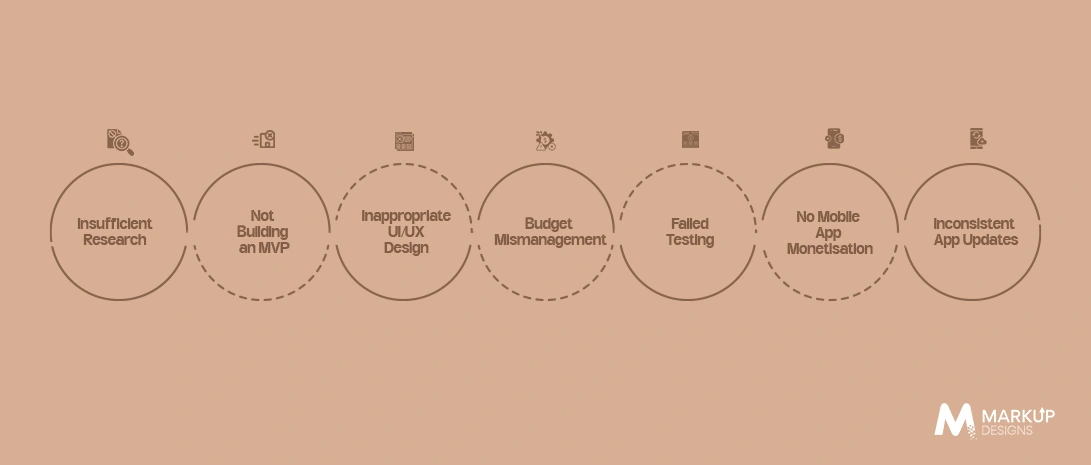
- Insufficient Research
Skipping market and competitor research can lead to poor decision-making. Understanding user needs, industry trends, and competitor strategies is essential for building a successful mobile application. - Not Building an MVP
Launching a full-featured app without first creating a Minimum Viable Product (MVP) can increase costs and risks. An MVP helps businesses test the app idea, gather user feedback, and improve the product before full-scale development. - Inappropriate UI/UX Design
A confusing or unattractive design can negatively impact user experience. Poor navigation, slow interactions, and complicated layouts often lead users to uninstall the app quickly. - Budget Mismanagement
Poor financial planning can delay development or compromise app quality. Businesses must properly allocate budgets for development, testing, maintenance, and future updates. - Failed Testing
Releasing an app without proper testing may result in bugs, crashes, security issues, and poor performance. Thorough testing ensures the app works smoothly across different devices and operating systems. - No Mobile App Monetisation
Many businesses develop apps without a clear monetization strategy. Choosing the right revenue model, such as subscriptions, ads, or in-app purchases, is important for long-term profitability
- Inconsistent App Updates
Ignoring regular updates can make the app outdated and vulnerable to security risks. Frequent updates help improve performance, fix bugs, and introduce new features based on user feedback.
How Can Businesses Avoid Mobile App Development Mistakes?
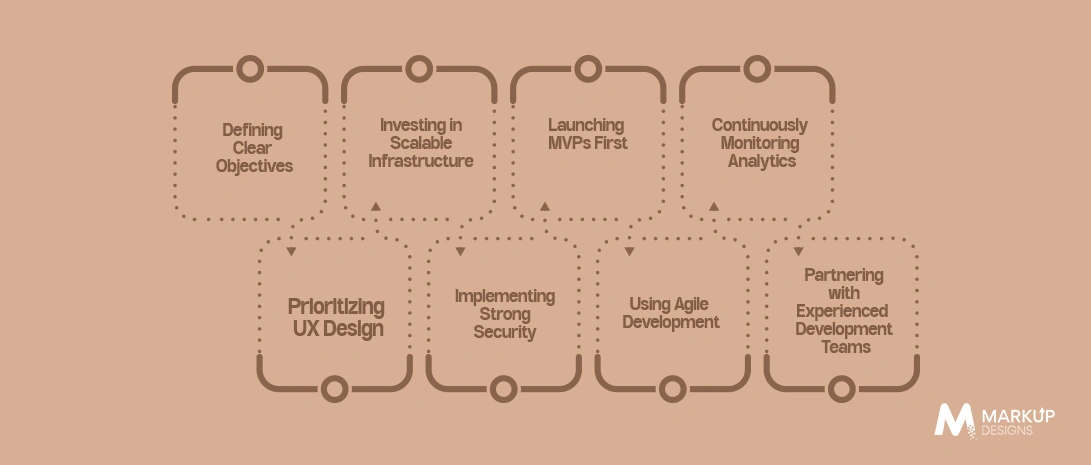
Successful mobile app development requires strategic planning from the beginning. Businesses should focus on:
Defining Clear Objectives
Businesses should establish clear goals before starting mobile app development to ensure the project aligns with their long-term business strategy. Setting measurable KPIs such as user acquisition, customer retention, operational efficiency, and revenue growth helps track performance and evaluate success effectively.
Prioritizing UX Design
A strong user experience is essential for improving engagement and retention. Businesses should focus on building intuitive, user-centric interfaces optimized for mobile behavior, seamless navigation, accessibility, and faster interactions.
Investing in Scalable Infrastructure
Scalable infrastructure ensures the application can handle future business growth without performance issues. Adopting cloud-native architecture allows businesses to support increasing user traffic, third-party integrations, and evolving operational requirements efficiently.
Implementing Strong Security
Cybersecurity should be integrated into every stage of the app development lifecycle rather than treated as an afterthought. Strong security frameworks help protect customer data, financial transactions, and business systems from cyber threats and compliance risks.
Launching MVPs First
Launching a Minimum Viable Product (MVP) helps businesses validate ideas before investing heavily in full-scale development. This approach reduces development risks, gathers real user feedback, and improves feature prioritization.
Using Agile Development
Agile development methodologies improve project flexibility by enabling continuous improvements throughout the development cycle. Businesses can adapt faster to changing market demands, customer feedback, and evolving technology trends.
Continuously Monitoring Analytics
Real-time analytics help businesses understand customer behavior, app performance, and engagement trends. Continuous monitoring enables organizations to optimize user experiences, improve retention rates, and make data-driven business decisions.
Partnering with Experienced Development Teams
Experienced mobile app development partners help businesses avoid common technical and strategic mistakes. Skilled teams ensure scalable architecture, strong security implementation, efficient development processes, and long-term operational success.
Read Also: Practical Guide to Developing Your First Mobile Apps
The Future of Mobile App Development
Mobile applications are evolving far beyond traditional functionality. Future mobile ecosystems will increasingly include:
- AI-powered personalization
- predictive automation
- augmented reality experiences
- voice-enabled interfaces
- hyper-personalized recommendations
- cloud-native app infrastructure
- intelligent analytics
- autonomous AI assistants
Businesses that build scalable and adaptable mobile ecosystems today will be better positioned for long-term success.
Read Also: iOS or Android: Which App Launches First?
Why Choosing the Right Mobile App Development Partner Matters?
Modern mobile app development requires expertise across multiple technical domains. Businesses need partners capable of handling:
- scalable architecture
- AI integration
- cloud infrastructure
- cybersecurity frameworks
- enterprise mobility
- backend engineering
- analytics systems
- UI/UX optimization
An experienced development company helps businesses create scalable, secure, and future-ready mobile ecosystems aligned with long-term growth goals.
Companies like Markup Designs help organizations build intelligent mobile applications through scalable architecture, AI-powered systems, cloud-native development, enterprise mobility solutions, and user-centric digital experiences designed for long-term operational success.
Ready to Build Mobile Apps That Scale and Drive Real Business Growth?
Empower your business with high-performing, user-centric mobile applications designed for scalability, seamless performance, and long-term success. Build secure, feature-rich, and future-ready mobile solutions tailored to your business goals.
Ready to Build Mobile Apps That Scale and Drive Real Business Growth?
Empower your business with high-performing, user-centric mobile applications designed for scalability, seamless performance, and long-term success. Build secure, feature-rich, and future-ready mobile solutions tailored to your business goals.

Conclusion
Mobile applications have become essential business assets in an increasingly digital-first economy. However, successful app development requires far more than launching a visually attractive product.
Businesses that fail to prioritize scalability, cybersecurity, UX design, analytics integration, cloud infrastructure, and long-term maintenance often experience expensive failures, low retention, operational inefficiencies, and poor customer engagement.
The most successful mobile applications are built around:
- clear business objectives
- user-centric experiences
- scalable architecture
- intelligent automation
- strong security frameworks
- continuous optimization
As mobile technology continues evolving, organizations must treat app development as a long-term digital transformation initiative rather than a one-time project.
Businesses that avoid common development mistakes and invest in future-ready mobile ecosystems will be significantly better positioned to compete in rapidly evolving global markets.
FAQs
1. What is the biggest mistake businesses make in mobile app development?
One of the biggest mistakes is starting development without clear business goals, customer research, or scalability planning.
2. Why is UX design important for mobile apps?
Good UX design improves usability, customer satisfaction, retention rates, and overall engagement while reducing user frustration.
3. Why do many mobile apps fail after launch?
Many apps fail because businesses neglect maintenance, analytics monitoring, customer feedback, scalability planning, and ongoing optimization.
4. How important is cybersecurity in mobile app development?
Cybersecurity is critical because mobile apps often handle sensitive customer data, transactions, and operational systems vulnerable to cyber threats.
5. Why is scalability important in app development?
Scalable applications can handle increasing users, data, integrations, and operational complexity without performance issues.
Author's Perspective
One of the most common patterns seen across failed mobile app projects is that businesses often prioritize speed over strategy. They rush toward development without fully understanding customer expectations, operational requirements, long-term scalability, or infrastructure complexity.
Mobile applications today are no longer isolated digital products. They are operational ecosystems connected to cloud infrastructure, analytics engines, AI systems, enterprise workflows, customer engagement channels, payment systems, and cybersecurity frameworks.
The businesses that succeed are usually not the ones building the largest number of features. They are the ones creating focused, scalable, user-centric mobile experiences capable of continuously evolving alongside customer behavior and technological innovation.
In the coming years, mobile app success will increasingly depend on intelligent architecture, AI-driven personalization, enterprise mobility, cloud scalability, cybersecurity maturity, and data-driven optimization.
Organizations that approach mobile app development strategically rather than tactually will ultimately gain the strongest competitive advantage.
Discuss Your Project NowGaurav Goyal
Global Sales- VP
Related Posts

Cost to Build a Mobile App in Qatar...

How Much Does It Cost to Build an...

How to Build a Car Wash App: Development...
Insights Are Valuable & Execution is Priceless
You’ve read about the digital future. Now, let’s build the infrastructure to take you there. Move your strategy from the page to the product.
Design Your Solution Now
Contact Us
Schedule The Appointment At Your Convenience Date And Time.
30 Min
Web Conference
Time Zone
Indian standard time (08:30pm)

Thanks For Getting In Touch!
You’ve Taken The First Step Toward Transforming Your Digital Presence. Our Experts Will Reach Out Shortly To Take It Forward.
Launch Your Dream Project
Provide a brief overview of your project, and our specialists will evaluate your requirements. We will connect with you to explore how the right digital solutions can help you launch faster.