
IT Service Contracts Explained: Costs, Models & What Every Business Should Know?
Running a business in modern competition is no less than finding a needle in a haystack. Modern firms are under constant pressure to stay online, secure, and scalable. Yet, many struggle with recurring IT challenges such as unexpected downtime, rising cybersecurity threats, support costs, and systems that fail to keep up with growth. Along with this, the internal teams find themselves unorganized and uncertain, reacting to issues instead of preventing them.
These pain points are no longer isolated; they directly impact productivity, customer experience, and overall business continuity. As cloud environments expand and 24/7 uptime becomes non-negotiable, relying on fragmented IT is simply not sustainable.
Managed IT Service has become an essential part, as it transforms IT from an operational burden into a structured, strategic function. When you clearly define the service levels, responsibilities, and costs, it brings predictability, accountability, and proactive management into the equation. Managed Service Providers (MSPs) use these contracts to ensure continuous monitoring and stronger security.
About Managed IT Service Contracts
A formal agreement between a company and a managed service provider is called a managed IT service contract. It describes the range of IT services, performance standards, costs, and each party’s obligations.
Managed IT contracts prioritise proactive monitoring, prevention, and optimisation over reactive troubleshooting, in contrast to traditional break-fix IT models.
Important Features of Managed IT Contracts
One of the main objectives of managed IT service contracts is to provide a standardised method for providing and managing IT services. Knowing the key components of these contracts will help an organization assess potential suppliers and contractors more effectively, increasing its ability to develop long-term operational efficiency.
Predictable or Fixed Prices
Monthly or annual service fees, as opposed to erratic maintenance charges, allow businesses to better plan their expenditures.
Specified Service Levels
With quantifiable performance standards, Service Level Agreements (SLAs) guarantee accountability.
Types of Managed IT Service Contracts
Understanding different contract types helps businesses choose the right model based on their operational needs.
Completely Managed IT Services
Through a totally managed IT service model, the managed service provider (MSP) is responsible for all facets of a company’s IT setup and architecture, offering network and infrastructure administration, cyber security, cloud solutions, and full round-the-clock help desk support. This gives a company access to outsourced IT capabilities so it doesn’t have to worry about sustaining day-to-day IT operations.
Co-Managed IT Services
A hybrid IT solution is called a co-managed IT service that enables your company’s own IT division to collaborate with an MSP’s external services. Instead of taking the place of your internal IT department, the external MSP seeks to improve it by filling in knowledge gaps, carrying out your regular tasks, or offering assistance in specialised areas like cyber security, cloud-based services, or regulatory compliance.
Project-Based Services Contract Structure
Project-based IT service contracts are made for certain IT projects over a set period of time. Deliverables with predetermined results, including cloud migration, system upgrades, software implementation, or cybersecurity assessments, are the main emphasis of project-based contracts. Project-based contracts have a set start and finish date as well as a set length.
Key Components of a Managed IT Service Contract
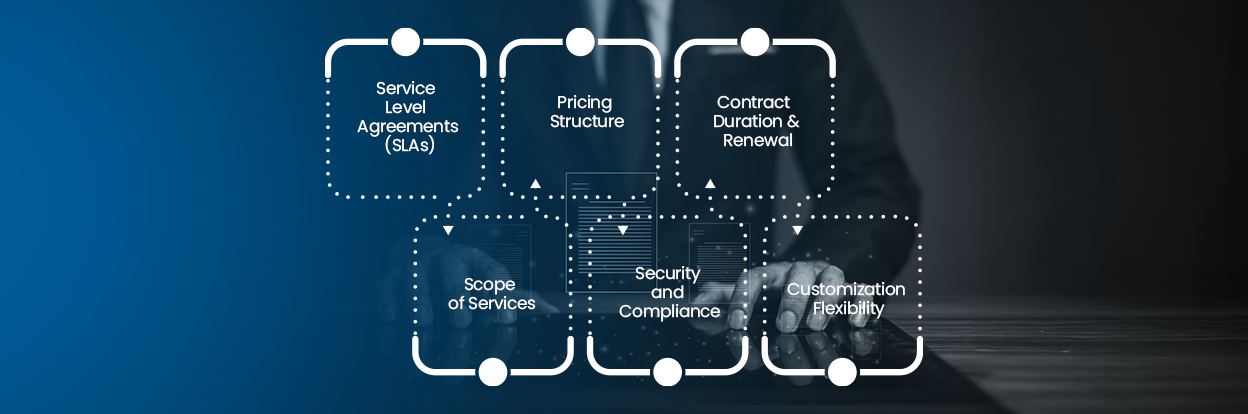
A well-structured contract should be clear, measurable, and aligned with business goals.
Service Level Agreements (SLAs)
SLAs define performance metrics such as response time, resolution time, and uptime guarantees. These are critical for ensuring service reliability.
Scope of Services
Clearly outlines what is included, such as network monitoring, helpdesk support, cybersecurity, cloud services, backup, and disaster recovery.
Pricing Structure
Defines how the services are billed per user, per device, or a flat monthly fee.
Security and Compliance
Specifies how data will be protected and ensures compliance with industry regulations.
Response Time Commitments
Defines how quickly the MSP responds to issues.
Data Protection Policies
Outlines backup strategies and disaster recovery plans.
Escalation Procedures
Explains how complex issues are handled and resolved.
Exit Clauses
Defines how either party can terminate the contract.
Contract Duration and Renewal
Contracts typically range from 1 to 3 years, with renewal clauses that may include automatic extensions.
Customization Flexibility
Modern businesses need flexible contracts that can scale with growth, allowing service adjustments without major disruptions.
Pricing Models Explained
Understanding pricing is essential for making informed decisions. Below is a typical cost breakdown for managed IT services.
Managed IT Services Costing (USD)
| Service Type | Pricing Model | Estimated Cost (USD) |
| Per User | Monthly | $100 – $250/user |
| Per Device | Monthly | $50 – $150/device |
| Flat Rate (SMBs) | Monthly | $2,000 – $10,000 |
| Enterprise Managed Services | Monthly | $10,000 – $50,000+ |
| Cybersecurity Add-ons | Monthly | $500 – $5,000 |
| Cloud Management | Monthly | $1,000 – $8,000 |
| One-Time Setup / Onboarding | One-time | $1,500 – $15,000 |
These costs vary depending on complexity, industry requirements, and geographic region.
Benefits of Managed IT Service Contracts
Budget Control and Predictable Costs
Contracts for managed IT services are advantageous to businesses, since they have set charges that help in budget creation. Instead of budgeting for unforeseen IT system maintenance, companies may set aside a certain monthly or annual sum for the services they will get. For businesses that are expanding and attempting to adhere to a certain budget, this is crucial.
Increased Safety
Today’s business owners are concerned about cybersecurity. In order to help reduce risks before they become significant corporate hazards, managed service providers offer mechanical solutions for cybersecurity, including monitoring for possible attacks, identifying and controlling vulnerabilities, and helping with compliance difficulties.
Enhanced Efficiency
Employee productivity and overall organisational effectiveness are adversely affected by downtime and recurring IT issues. Disruptions are reduced, and operations are regularly monitored and serviced due to managed IT services, which enable issues to be frequently fixed before they interfere with workflow.
Obtaining Professional Expertise
It is costly and challenging to develop and retain a diverse internal IT staff. Access to a multitude of skilled experts with extensive knowledge in a variety of technologies, sectors, and applications is made possible through managed IT service agreements.
Scalability
As businesses grow, their IT needs will get increasingly intricate. You can add or change services as your needs change since managed IT services are made to expand with your business. This includes onboarding new users, growing your IT infrastructure, and implementing new technology. Changes can be accommodated in the service agreement without significantly interfering with business operations.
Common Challenges and How to Avoid Them
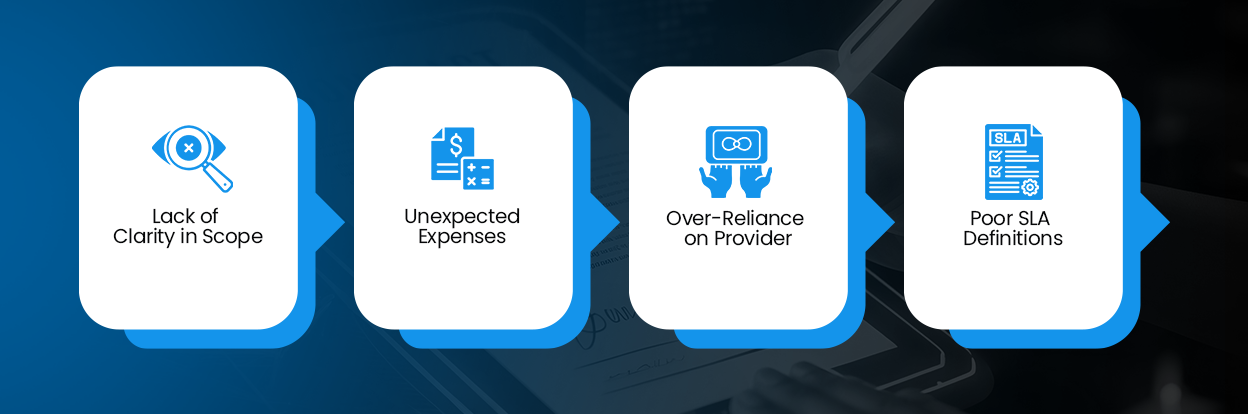
Lack of Clarity in Scope
A poorly specified scope of services is one of the main causes of problems in a managed IT services contract. Both the provider and the customer become confused when specified responsibilities, deliverables, and what is covered in the contract aren’t clearly stated. As a result, each side has conflicting expectations. For instance, a client can think that a certain service is part of the scope of services while, according to the service provider, it is not.
Unexpected Expenses
Managed IT service contracts are frequently commended for their consistent cost. However, if there wasn’t enough transparency at the start of the engagement, there can still be unstated costs connected to those commitments. Examples includes to charging extra for on-site visits, enhanced security measures, after-hours help, or handling unanticipated situations.
Over-Reliance on Provider
Although outsourcing IT operations increases productivity, relying too much on one supplier might be dangerous. Businesses may lose visibility into crucial systems, procedures, and decision-making when they only rely on an MSP without keeping internal monitoring.
Poor SLA Definitions
Poorly stated service level agreements (SLAs) are a common problem, despite being the foundation of any managed IT contract. Measuring service quality becomes challenging if performance criteria like response time, resolution time, uptime guarantees, and escalation procedures are not well defined.
What Top Managed Service Providers (MSPs) Are Doing
Consistent patterns that characterise competitive advantage in this market are found in an analysis of top managed IT providers. Leading companies place a strong emphasis on cybersecurity-first strategies, automation, and AI-driven monitoring. They provide robust SLAs, industry-specific solutions, and flexible pricing. Important observations from leading rivals:
- They prioritise business results over merely technical services.
- Contracts are becoming more adaptable and modular.
- Every service layer incorporates cybersecurity.
- Two key differentiators are customer experience and support response.
The move toward cloud-native managed services, where providers seamlessly handle hybrid and multi-cloud settings, is another significant development. For companies, this entails selecting a partner who supports long-term digital objectives and goes above and beyond basic IT support.
Why Partner with Markup Designs?
Your company’s overall growth might be impacted by the choice of a managed IT partner. For this reason, we refer to the connection between clients and managed services as a partnership rather than just a vendor relationship. The objective is to enhance an organization’s IT environment’s performance so that it supports and aligns with the overarching business objectives.
What sets us apart from our rivals is our capacity to offer businesses scalable solutions and in-depth knowledge of their particular sector. Instead of offering pre-made or standardised solutions, we develop specialised IT strategies that meet the needs of every company.
Our proactive approach to innovation and our ability to collaborate with them to integrate new technology without interfering with their regular business operations also help our clients. Our service model guarantees that we are providing secure solutions, continuous efficiency gains, and steady performance gains over time.
Get in contact with our professionals to find out more about our services in-depth if you’re searching for Managed IT Service Contracts.
Author’s Perspective
These days, IT service agreements should be seen as essential parts of every company rather than as optional. One of the biggest mistakes that many businesses make is thinking that their contractual connection with a provider is merely technical.
More than just outlining the services to be provided, a well-written and implemented contract will provide accountability for both the client and the service provider. Businesses that put in the time and effort to create a suitable application will see increased resilience to interruptions, increased efficiency, and higher returns on investment.
Furthermore, the effective execution of managed IT service agreements is increasingly dependent on cybersecurity integration. Contracts that approach cybersecurity as an auxiliary service in connection to other services provided, as opposed to making it a crucial component throughout the contract, are rapidly becoming out of date. Contracts for managed IT services will eventually become more adaptable, transparent, and strategically coordinated.
FAQ Section
What is included in a managed IT service contract?
A managed IT service contract typically includes network monitoring, helpdesk support, cybersecurity, cloud management, data backup, and disaster recovery.
How long should a managed IT contract be?
Most contracts range from 1 to 3 years, depending on business needs and service complexity.
Can managed IT contracts be customized?
Yes, most providers offer flexible and customizable contracts tailored to business requirements.
What is the difference between MSP and traditional IT support?
MSPs provide proactive, ongoing management, while traditional IT support is reactive and issue-based.
Is managed IT suitable for small businesses?
Absolutely. Managed IT services help small businesses access enterprise-level expertise at predictable costs.
How do I choose the right MSP?
Look for experience, strong SLAs, transparent pricing, scalability, and alignment with your business goals.
The Conclusion
Today’s business strategy for complex environments heavily relies on managed IT service contracts. As technology advances, businesses must start establishing proactive, strategic alliances rather than depending on their reactive IT support. A well-designed managed IT contract will give a business long-term growth and sustainability in addition to operational efficacy.
By comprehending the essential elements, price methods (such as flat-fee/usage-based pricing), and market/economic trends, businesses can efficiently assess and choose companies that bring value to them. In a time when technology is the key to business success, a well-managed IT service contract gives a company a competitive edge and is much more than just a contract.
Author's Perspective
Many businesses look to outsource their IT services as a cost savings opportunity, but the most successful companies use outsourcing as a strategic lever for growth instead. The real difference comes from moving from the question “How can I save money by outsourcing?” to the question “How can I use my outsourced provider to create new capabilities?” It is when you change your focus from cost savings to capability creation that your outsourced IT provider will deliver the value you want to achieve.
In my experience, the biggest difference between successful companies that outsource and those that do not is the degree to which they are clear about the goals they wish to achieve through outsourcing, whether that’s accelerating product development, enhancing their cybersecurity capabilities, or enabling scalable infrastructures. Successful companies tend to create effective outsourcing partnerships, while companies that outsource without a strategic plan are more likely to encounter issues with alignment and a lack of results.
Discuss Your Project NowDeepak Tripathi
Product Manager
Related Posts

Why Businesses in Dubai are Investing in Managed...

Managed IT Services Pricing: What It Really Costs...

How Remote Managed IT Services Help Businesses Scale...
Insights Are Valuable & Execution is Priceless
You’ve read about the digital future. Now, let’s build the infrastructure to take you there. Move your strategy from the page to the product.
Design Your Solution Now
Contact Us
Schedule The Appointment At Your Convenience Date And Time.
30 Min
Web Conference
Time Zone
Indian standard time (08:30pm)

Thanks For Getting In Touch!
You’ve Taken The First Step Toward Transforming Your Digital Presence. Our Experts Will Reach Out Shortly To Take It Forward.
Launch Your Dream Project
Provide a brief overview of your project, and our specialists will evaluate your requirements. We will connect with you to explore how the right digital solutions can help you launch faster.