
Understanding App Development Pricing Based on Features and Complexity
You’ve decided to build an app. Maybe it’s been sitting in your head for months – a real problem, a clear solution, something you genuinely believe people need.
So you do what anyone does. You Google it. You ask around. You get on a few calls with development agencies.
And then the quotes start coming in.
One agency says $8,000. Another says $80,000. A freelancer on Upwork offers to do it for $2,000. Your cousin’s friend who “does tech stuff” says he can build it over a weekend.
You hang up the last call more confused than when you started. Not because the numbers are different – but because nobody explained why.
That’s the real problem with app development pricing. It’s not that it’s expensive. It’s invisible. Nobody shows you what’s inside the number. Nobody explains what makes one app cost $10,000 and another cost $200,000.
This blog does exactly that. By the end of it, you won’t just know what the app development cost is – you’ll understand why the app development cost this much.
Why App Pricing Feels Like a Black Box
The truthful answer is that there is no price list for developing mobile applications like there would be for a plumber or a copywriter. Prices change according to location, experience, methodology used, and, most importantly, according to the application developed.
If you’re looking for a complete breakdown of actual numbers and estimates,
Read Also: How Much Does it Cost to Develop a Mobile App?
Here is the reality behind app development prices:
$50-$150 per hour – North America, Western Europe: Senior developers in the United States or the UK charge their clients in this range. The same project will cost between $50K and $150K if it requires about 1,000 hours (moderately complex).
$25-$60 per hour – Eastern Europe: Technical expertise abounds in countries such as Poland, Ukraine, and Romania. This market contains many mid-market agencies. The same project becomes considerably less expensive without necessarily losing in quality.
$15-$40 per hour – South and Southeast Asia: A large number of developers come from countries such as India, Pakistan, and the Philippines. This market offers the cheapest rates. However, project management and quality control remain a challenge.
About 70% of apps cost more than initially predicted: Don’t be scared by this statistic. This is just one that will help you prepare for the upcoming journey. Many first-time clients do not consider any possible revisions, extra functionality, etc. This doesn’t mean the developer is bad or you ordered wrong. It’s just about being unprepared for the process.
Besides location, it’s essential to keep in mind the kind of team the vendor works with. Freelancers, boutique agencies, and large development companies will give you three drastically different quotes on the same project because of different overhead, experience level, and guarantees.
There is nothing strange about this estimate. It’s just based on components you didn’t see before.
The Real Driver of App Cost – Features, Not Pages
Myth number one: People generally think that having more screens translates into higher prices. We understand why, but that’s definitely not how it works.
What makes an app costly is all about what those screens are capable of doing. A five-page application that has live content, GPS location service and payment systems integrated will cost more than a twenty-page application without any dynamic features.
Let’s understand this easily by taking an example of a house. The costliness of a house does not depend on its square footage. Instead, it depends on its interior and all its technical elements – plumbing, electrical wiring, and construction. You pay for a room only after making sure it is furnished and equipped with everything you might need.
So your app pages would be rooms, while your features – their interiors.
| Basic email login | Social login (Google, Apple) + fingerprint/face ID |
| Static map display | Real-time GPS tracking with route updates |
| One-currency payment | Split payments + multi-currency + refunds |
| Simple push notifications | Smart notifications based on user behaviour |
Not only does each step up from the left side to the right add hours, but it also adds dependencies and additional systems to integrate, which can fail. This is why the cost curve is non-linear and unpredictable when viewed without proper context.
The Four Complexity Tiers
Let us walk you through the simplest way to gauge where your application stands on the pricing ladder. This is the actual range based on the approach adopted by developers around the world to define and price their work.
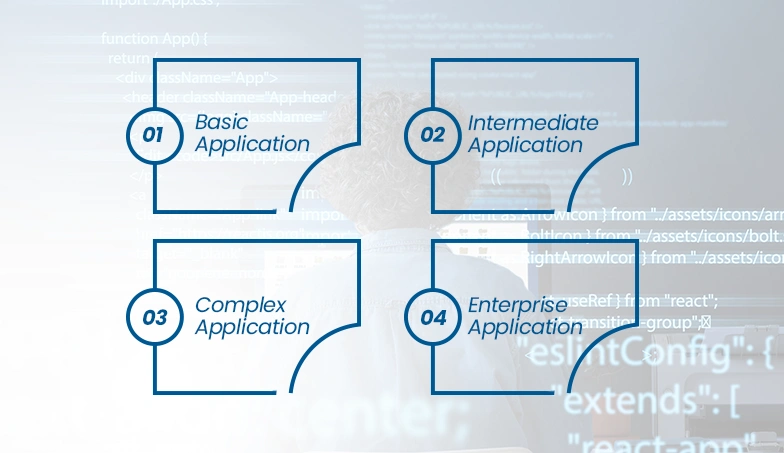
Tier 1
Basic Application – $8,000 to $25,000
Single purpose application with very few user accounts and no complex back-end database system. Examples would be applications like booking platforms for a local business, restaurant digital menus or loyalty cards. Ideal for – Idea validation, internal company applications or small local businesses. MVPs fall into this category.
Tier 2
Intermediate Application – $25,000 to $75,000
The application will feature multiple user types along with a proper back-end database, payment integration and content management via an admin portal. Examples would be an application that connects two different sets of users, a service booking application, etc. Ideal for – businesses with clear models who want their transactional process to begin right away.
Tier 3
Complex Application – $75,000 to $150,000
Features such as real-time capabilities (live chat, real-time location tracking), AI-driven recommendations, deep integration with other services and highly scalable. Examples include logistics software, apps for on-demand services and social platforms where users can create their own content. Best suited for: those who already have validated a product and want to develop it.
Tier 4
Enterprise Application – $150,000 and more
Specific architecture of the application, strict compliance regulations (for example, health care, financial, legal), integration into other enterprise applications and development for large team of users. Think of systems of managing patients in hospitals, fintech applications and custom-made systems for corporations with thousands of employees. Best suited for: companies that operate successfully and want to automate their processes.
As soon as you start estimating mobile app development cost between different tiers, you’ll notice the huge gap in prices. Tier 1 is not only about the difference in price, but also about the type of product.
Most first-time builders assume they need Tier 3. Most first-time products actually need Tier 1 or 2 – and that’s not a compromise, it’s a strategy.
The Hidden Cost Nobody Puts in the Quote
Here’s an important piece of information that developers rarely mention in the first meeting, and you should be aware of it before signing anything. The cost of building an app is one thing, while maintaining an app is another – and it begins from the moment you release it.
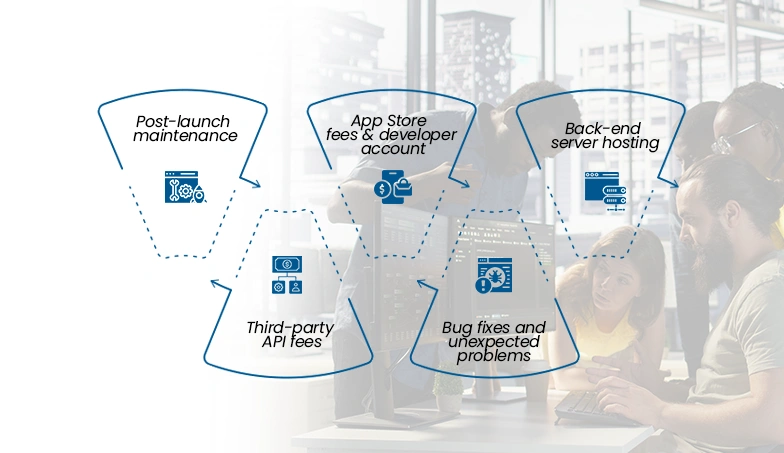
Post-launch maintenance
An app won’t run itself. Apple and Google release new updates constantly, and any one of them may affect the existing functionality of your product. Be ready to allocate 15-20% of the initial development cost annually for maintenance.
App Store fees & developer account
Apple takes $99 annually to list your application. Google asks a flat fee of $25 once you register an app. Not much, but these fees will surprise you on your bill.
Back-end server hosting
The data of your app resides somewhere. Usually, it is stored on a cloud server provided by Amazon, Google, or Microsoft. This means ongoing costs that grow as your user base expands. A small app costs $20-$100 monthly; a rapidly growing application can easily cost thousands.
Third-party API fees
Maps cost money (Google Maps costs per load). SMS notifications cost money. Payment processing takes a cut from every transaction. These are tiny fees that accumulate fast once your app has real users.
Bug fixes and unexpected problems
Real users discover issues your test users never did. Some are insignificant. Some are immediate. Both will require attention, which will take time – and time means money, particularly when charging by the hour.
It’s only when considering what comes after launch that one truly understands the cost of developing an app. Understanding this shifts the question from “How much does it cost to develop?” to “How much does it cost to develop and maintain?”
The quote you’ve been given is just the start of your costs. Understanding this at the outset transforms all future discussions with your developer.
Freelancer vs. Agency vs. In-House – Breaking Down the True Cost Difference
This is definitely one of the most frequent dilemmas for novice app developers, and there is no correct answer here for everyone. Nevertheless, the right option varies depending on your geographical location.
Freelancer: The minimum cost. A good freelance developer can do high-quality work when working with a clearly outlined scope of work and project. Risks associated with the single point of failure are relatively high. Your project may stall in case a freelancer gets ill or overcommits themselves. Suitable solution for MVP projects that have a clear scope and are not very expensive.
Agency: The more costly choice. However, by paying for the app creation services from the agency, you buy an entire team of designers, developers, project managers. Besides, the probability of creating an actual working product is much higher as you get proper documentation and accountability from an agency. This type of service becomes particularly helpful when creating scalable solutions.
In-house: The costliest route in the immediate term – wages, machinery, perks, managerial attention. Feasible only when your product is already live and gaining traction, and there’s a requirement for accelerated development. First-time entrepreneurs won’t be anywhere near this level of maturity, and that’s perfectly okay.
The important point is not whether agencies are superior all the time and why freelancers are bad. The main factor is which option is more suitable for your project considering its magnitude, the processes involved, and what “going wrong” would cost you.
How to Read a Development Quote Without Getting Lost
It doesn’t take much technical know-how to read a quote properly. It all comes down to being able to recognize a good quote and what questions should be asked when something seems fishy.
In addition to the list below, here are some red flags to watch out for when reviewing a quote:
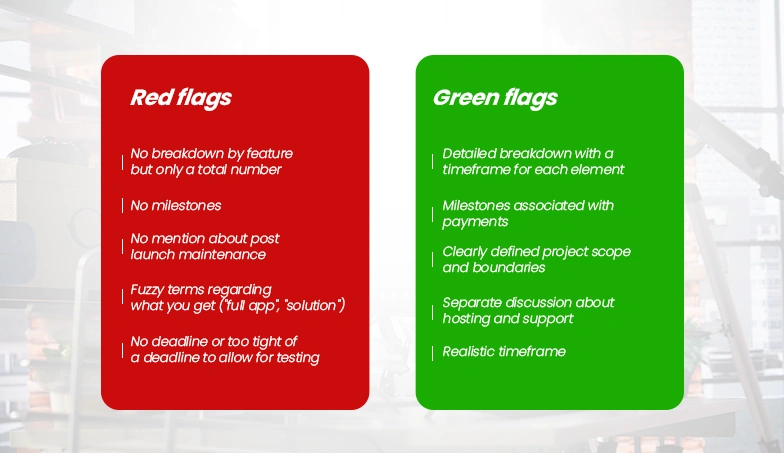
Red flags
- No breakdown by feature but only a total number
- No milestones
- No mention about post-launch maintenance
- Fuzzy terms regarding what you get (“full app”, “solution”)
- No deadline or too tight of a deadline to allow for testing
Green flags
- Detailed breakdown with a timeframe for each element
- Milestones associated with payments
- Clearly defined project scope and boundaries
- Separate discussion about hosting and support
- Realistic timeframe
As you can see, knowing how to estimate mobile application development cost only gets you half the way. Being able to read a quote properly makes up the second part – and a very important one, indeed.
If a developer welcomes these questions, you already have your answer. Even if you do not have any technical skills, you’ll be able to recognise a good quote when you see one.
What a Smart First Budget Actually Looks Like
Do you remember the individual that we started this post with? That person left the phone calls even more confused than when they began them – and not because of the prices. The reason for their confusion lay in the lack of explanation.
So, imagine that person a few weeks later, making those exact same calls, with the same idea, the same budget, the same product – and yet, again, something is different.
Now, the individual knows exactly what their product should fall under – probably Tier 1, while they have a definite plan to add Tier 2 features in their second version after having validated their demand. They know exactly what to ask regarding maintenance costs and how to decipher their quotes. More importantly, they know better than to ask “how much does this cost?” and start considering adding certain features.
That transition from uncertainty to certainty does not need any additional cash at all. It needs understanding how the mobile application development cost model works. And everything gets totally redefined.
An optimal budget for mobile app development is never the largest budget. An optimal budget is a budget when you know exactly what value is delivered by every item, what can be left for version two and what will be your monthly expenses after release.
And here comes another thing – you have to calculate the total app development cost, which includes the build plus the first year of running your product. Hosting, maintenance budget, the App Store fee, third-party services – it all goes into the account. And you got your budget.
Right now, you’re in one of two places.
Place A: You have a clear sense of what tier your app falls into, what features belong in version one, and what questions to ask before you sign anything. You feel like you have a framework, not just a number.
Place B: You have a good idea, a few confusing quotes, and a growing suspicion that you’re about to spend money on something you don’t fully understand yet.
If you’re in Place B – that’s exactly what this was written for. Take what you’ve read here into your next conversation with a developer and ask the questions you now know to ask. The right partner will meet you there with clear, straight answers.
Conclusion
Creating your first app does not mean walking into negotiations blindfolded. You now know that the prices charged are not random; they reflect the work that needs to be done. The more features required, the more complex it will become. Complexity translates to the number of hours put in by the developer, and this dictates how much you pay.
The most successful developers in this business are not always those with the deepest pockets. They are simply those with realistic expectations and knowledge on which package works for them.
You have those questions now.
Return to the quotes with a new perspective. You will interpret them in a different manner. The vague quotes will be easy to identify, while the specific ones will leave you feeling satisfied. Then, when the right partner comes along who communicates effectively and establishes trust first, everything becomes clear.
Author's Perspective
From my perspective, custom blockchain development is not just about adopting a modern technology trend; it’s about making strategic decisions that create real business impact. Many organizations rush into blockchain adoption without clearly defining their objectives, which often leads to underutilized solutions.
The key lies in understanding where blockchain truly adds value. Not every system needs decentralization, but for processes involving multiple stakeholders, trust gaps, or data integrity concerns, blockchain can be transformative.
Ultimately, the success of any blockchain initiative depends on balancing innovation with practicality. With the right strategy, technology, and development partner, businesses can unlock the full potential of blockchain and drive long-term growth.
Discuss Your Project NowJupinder Singh Arora
Founder and CEO
Related Posts

10 Key Factors to Choose the Right Mobile...
Mobile App Development in Kuwait: Cost, Process, Features...

Navigation App Development Guide: Building GPS Apps Like...
Insights Are Valuable & Execution is Priceless
You’ve read about the digital future. Now, let’s build the infrastructure to take you there. Move your strategy from the page to the product.
Design Your Solution Now
Contact Us
Schedule The Appointment At Your Convenience Date And Time.
30 Min
Web Conference
Time Zone
Indian standard time (08:30pm)

Thanks For Getting In Touch!
You’ve Taken The First Step Toward Transforming Your Digital Presence. Our Experts Will Reach Out Shortly To Take It Forward.
Launch Your Dream Project
Provide a brief overview of your project, and our specialists will evaluate your requirements. We will connect with you to explore how the right digital solutions can help you launch faster.