
How to Scale an E-commerce Software for Peak Demand Without Breaking?
Peak demand is no longer an occasional challenge; it has become a defining moment for modern e-commerce businesses. Whether it’s festive seasons, flash sales, influencer-driven spikes, or viral product launches, traffic surges are both an opportunity and a risk. While high traffic signals grow and customer interest, it also tests the limits of your system’s performance.
In today’s competitive landscape, users expect seamless experiences regardless of traffic volume. A delay of even a few seconds can lead to abandoned carts, lost revenue, and long-term damage to brand trust. This is why scalability is no longer just a technical enhancement—it is a foundational business strategy.
In this blog, we will explore how enterprises can design and scale their e-commerce applications effectively to handle peak demand without breaking, ensuring consistent performance, resilience, and long-term growth.
Why Scaling E-commerce Applications Matters?
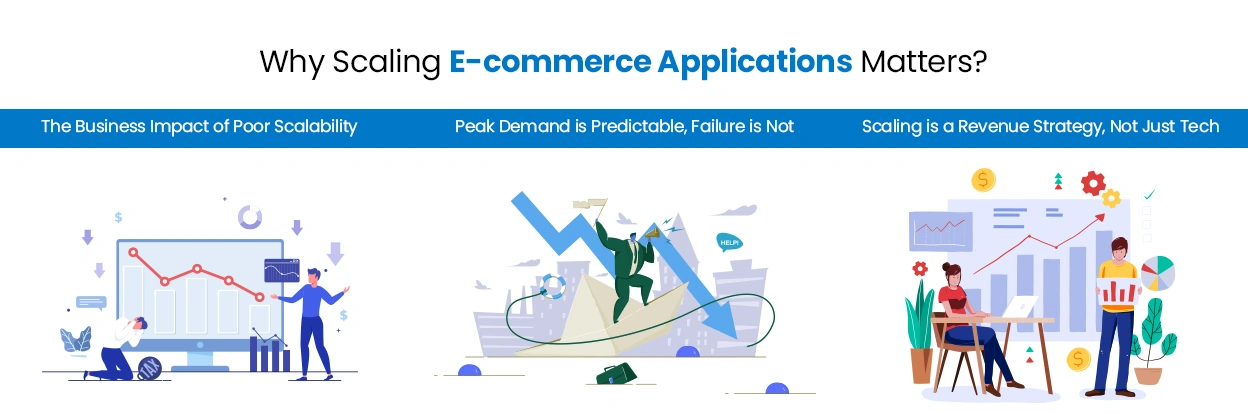
Scaling is not just about preparing for high traffic; it is about delivering consistent performance under unpredictable conditions. Enterprises that fail to scale efficiently often face operational disruptions during their most critical revenue windows.
The Business Impact of Poor Scalability
When an e-commerce platform struggles under load, the consequences are immediate and measurable. Slow page load times frustrate users, leading to higher bounce rates. Failed transactions break trust, especially when users are ready to make a purchase. Cart abandonment increases significantly when checkout flows lag or fail.
Beyond immediate revenue loss, the long-term impact is even more critical. Customers are less likely to return to a platform that failed them during a key moment. Brand reputation takes a hit, and recovery often requires significant investment in marketing and customer retention efforts.
Even a one-second delay in page response can reduce conversion rates, highlighting how closely performance is tied to business outcomes.
Peak Demand is Predictable, Failure is Not
Interestingly, most peak traffic events are predictable. Businesses are aware of upcoming sales, seasonal trends, and marketing campaigns that will drive traffic spikes. Despite this, many systems fail because they are not designed to scale dynamically.
The issue is not a lack of awareness; it is a lack of preparation. Systems built without scalability in mind often rely on static infrastructure, making them vulnerable to sudden spikes. Without dynamic scaling mechanisms, even predictable demand can lead to unexpected failures.
Scaling is a Revenue Strategy, Not Just Tech
Forward-thinking enterprises treat scalability as a revenue enabler rather than a backend concern. A scalable system ensures higher uptime, faster load times, and smoother user journeys—all of which directly contribute to increased conversions.
When your platform performs seamlessly during peak demand, you not only maximize revenue but also create a positive customer experience that drives repeat business. In essence, scalability becomes a competitive advantage.
How to Build a Scalable Architecture Foundation
The foundation of scalability lies in how your system is architected. A poorly designed system cannot be fixed by simply adding more resources. Instead, it requires a shift in how applications are structured and managed.
Move from Monolith to Microservices
Traditional monolithic architectures are tightly coupled, meaning all components are interconnected. While this approach may work in the early stages, it becomes a bottleneck as the application grows.
Microservices architecture addresses this challenge by breaking the application into smaller, independent services. Each service, such as product catalog, checkout, or payment processing, can be developed, deployed, and scaled independently.
This allows businesses to allocate resources more efficiently. For example, during peak demand, the checkout service can be scaled without affecting other parts of the system.
Decouple Services for Flexibility
Decoupling is a critical step toward scalability. By separating services, you ensure that a surge in one area does not impact the entire system.
For instance, a spike in product searches should not slow down payment processing. Decoupled systems isolate failures and prevent cascading issues, improving overall system resilience.
This approach also enables faster innovation, as teams can work on individual components without affecting the entire application.
Enable Horizontal Scaling
Horizontal scaling involves adding more instances of a service rather than increasing the capacity of a single server. This approach is more flexible and cost-effective, especially in cloud environments.
With horizontal scaling, traffic is distributed across multiple instances, reducing the risk of overload. It also allows systems to scale dynamically based on demand, ensuring optimal performance during peak periods.
Leverage Cloud Infrastructure for Better Scaling
Cloud infrastructure plays a crucial role in modern scalability strategies. It provides the flexibility, reliability, and automation needed to handle dynamic workloads.
Use Auto-Scaling to Handle Traffic Spikes
Auto-scaling is one of the most powerful features of cloud platforms. It automatically adjusts resources based on real-time demand, ensuring that your system can handle traffic spikes without manual intervention.
During low traffic periods, resources are scaled down to reduce costs. During peak demand, additional resources are allocated to maintain performance. This balance ensures both efficiency and reliability.
Implement Load Balancing
Load balancers distribute incoming traffic across multiple servers, preventing any single instance from becoming a bottleneck. This ensures consistent performance even under heavy load.
Load balancing also improves fault tolerance. If one server fails, traffic is automatically redirected to other available instances, minimizing downtime.
Multi-Region Deployment
Deploying your application across multiple geographic regions enhances both performance and reliability. Users can access the application from the nearest server, reducing latency and improving response times.
Multi-region deployment also acts as a disaster recovery mechanism. If one region experiences issues, traffic can be redirected to another, ensuring uninterrupted service.
Optimize Performance with Smart Caching
Caching is a critical component of any scalable system. It reduces the load on databases and speeds up data retrieval, significantly improving performance.
Reduce Database Load
Without caching, every user request triggers a database query, which can quickly overwhelm the system during peak demand. Caching stores frequently accessed data temporarily, reducing the need for repeated queries.
This not only improves performance but also enhances system stability.
Types of Caching to Implement
There are multiple levels of caching that enterprises can leverage:
- Application-level caching for frequently accessed data
- Database query caching to reduce repetitive queries
- CDN caching for static assets like images and scripts
Each type plays a unique role in improving performance and scalability.
Improve User Experience
Faster load times directly impact user satisfaction. When pages load instantly, users are more likely to stay engaged and complete their purchases.
Caching ensures that users experience minimal delays, even during high traffic periods.
Use In-Memory Caching
In-memory caching systems store data in RAM, enabling extremely fast data retrieval. This is especially useful for handling high-frequency requests during peak demand.
Cache Critical Data
Focus on caching data that is accessed frequently and does not change often, such as product listings, pricing details, and user sessions. This ensures maximum efficiency with minimal complexity.
Set Cache Expiry Policies
While caching improves performance, it is essential to ensure data accuracy. Proper cache expiration policies ensure that users always see updated information, preventing inconsistencies.
Strengthen Database Scalability
The database is often the backbone of an e-commerce application, and its performance directly impacts the overall system.
Use Read Replicas
Read replicas allow you to distribute read operations across multiple database instances. This reduces the load on the primary database and improves response times.
Implement Database Sharding
Sharding involves splitting large datasets into smaller, manageable pieces. Each shard operates independently, enabling better performance and scalability.
This approach is particularly useful for applications with large volumes of data and high traffic.
Choose the Right Database Type
A hybrid approach often works best for e-commerce platforms. Relational databases are ideal for transactional data, while NoSQL databases provide flexibility and scalability for unstructured data.
Choosing the right combination ensures optimal performance and reliability.
Asynchronous Processing for Heavy Operations
Not all operations need to happen in real-time. Offloading non-critical tasks can significantly improve system performance.
Offload Non-Critical Tasks
Tasks like sending emails, generating invoices, or updating analytics should not block user actions. By handling these tasks asynchronously, you ensure that critical workflows remain smooth.
Use Message Queues
Message queues act as intermediaries that store tasks and process them in the background. This ensures that the system remains responsive even during high traffic.
Improve System Responsiveness
Asynchronous processing allows users to complete actions quickly without waiting for backend processes to finish. This is especially important during checkout, where delays can lead to cart abandonment.
Test, Monitor, and Prepare for Peak Events
Preparation is key to handling peak demand successfully. Continuous testing and monitoring help identify and resolve issues before they impact users.
Conduct Load Testing Regularly
Load testing simulates real-world traffic conditions, helping you identify bottlenecks and performance issues. It provides valuable insights into how your system behaves under stress.
Monitor in Real-Time
Real-time monitoring allows you to track key performance metrics such as response time, error rates, and server utilization. This helps you detect issues early and take corrective action.
Implement Alert Systems
Automated alerts ensure that your team is notified immediately when something goes wrong. This enables quick response times and minimizes downtime.
Why Partner with Markup Designs for Scaling an E-Commerce App?
Scaling an application requires more than just technical expertise—it requires a strategic approach that aligns with business goals.
Strategic Software Scaling Approach
We focus on building scalable systems from the ground up. Our MVP-first approach ensures that your application is designed for growth from day one.
Faster Time-to-Market
Our development process is optimized for speed without compromising quality. This allows you to launch quickly and start capturing market opportunities.
Built for Real-World Demand
We design systems that can handle real-world traffic conditions, ensuring reliability during peak demand.
End-to-End Expertise
From architecture design to deployment and optimization, we provide comprehensive support to ensure seamless scalability.
Business-Centric Execution
Our approach aligns technology decisions with your business objectives, ensuring maximum ROI.
What is the Cost of Scaling an E-commerce Application?
Scaling requires investment, but it is essential for long-term growth. Below is a general cost breakdown:
| Component | Estimated Cost (USD) | Description |
| Cloud Infrastructure Setup | $5,000 – $15,000 | Servers, networking, environments |
| Auto-Scaling Configuration | $2,000 – $6,000 | Dynamic resource scaling |
| Microservices Architecture | $10,000 – $30,000 | System restructuring |
| Caching Implementation | $3,000 – $8,000 | CDN and in-memory caching |
| Database Optimization | $4,000 – $12,000 | Sharding, indexing, replication |
| Load Testing & Performance | $2,000 – $7,000 | Testing tools and execution |
| Monitoring & Observability | $1,500 – $5,000 | Dashboards and alerts |
| Ongoing Maintenance | $2,000 – $10,000/month | Continuous optimization |
Note: Costs vary based on complexity and scale of the project requirements.
FAQs
What is the best architecture for scaling e-commerce applications?
Microservices architecture is widely considered the most effective approach due to its flexibility and scalability.
How do you prepare for flash sales?
By combining load testing, auto-scaling, caching, and queue-based processing.
How important is caching?
Caching is critical as it reduces database load and improves response times.
Can small businesses scale effectively?
Yes, cloud-based solutions make scalability accessible and cost-efficient.
How often should systems be tested?
Ideally, before major campaigns and at least quarterly.
Conclusion
Scaling an e-commerce application is not a one-time effort, it is an ongoing process that requires continuous optimization and strategic planning. Businesses that invest in scalability are better equipped to handle high traffic, deliver exceptional user experiences, and maximize revenue during peak demand. The key lies in building a strong foundation, leveraging modern technologies, and continuously refining the system based on performance insights.
Author’s Perspective
From a practical standpoint, scalability is often misunderstood as simply adding more servers or resources. In reality, it is about designing systems intelligently from the ground up.
Enterprises that succeed in scaling are those that think ahead. They build architectures that are flexible, resilient, and aligned with business goals. Instead of reacting to traffic spikes, they prepare for them.
A well-scaled platform does more than just handle demand, it turns peak moments into growth opportunities. And in the evolving e-commerce landscape, that is what truly sets successful businesses apart.
Related Posts
Case Management Software Development: Enterprise Features & Implementation...

Farm Management Software Development in Australia: Features, AI...
Knowledge Management System Development in Australia: Building AI-Ready...
Insights Are Valuable & Execution is Priceless
You’ve read about the digital future. Now, let’s build the infrastructure to take you there. Move your strategy from the page to the product.
Design Your Solution Now
Contact Us
Schedule The Appointment At Your Convenience Date And Time.
30 Min
Web Conference
Time Zone
Indian standard time (08:30pm)

Thanks For Getting In Touch!
You’ve Taken The First Step Toward Transforming Your Digital Presence. Our Experts Will Reach Out Shortly To Take It Forward.
Launch Your Dream Project
Provide a brief overview of your project, and our specialists will evaluate your requirements. We will connect with you to explore how the right digital solutions can help you launch faster.