
7 Phases of Software Development Every Enterprise Should Know
The success of any enterprise software project goes far beyond writing clean code. It is deeply rooted in how effectively each phase of the software development lifecycle (SDLC) is planned, executed, and continuously optimized. While many organizations invest heavily in development, they often overlook the importance of a structured approach that defines the success or failure of a product.
Speed, scalability, and user experience are critical differentiators in today’s highly competitive digital landscape. It is where understanding the complete software development lifecycle is no longer optional; it is essential. Whether you are building a fintech platform, an enterprise SaaS solution, or a scalable digital product, every phase contributes significantly to minimizing risks, optimizing costs, and maximizing return on investment (ROI).
A well-defined Software Development Life Cycle (SDLC) not only ensures smoother execution but also improves collaboration across teams, better product quality, and accelerates time-to-market. Enterprises that follow a disciplined development approach are better positioned to innovate, adapt, and scale in a rapidly evolving technological environment.
Let us explore the 7 key phases of software development that every enterprise must understand and implement effectively.
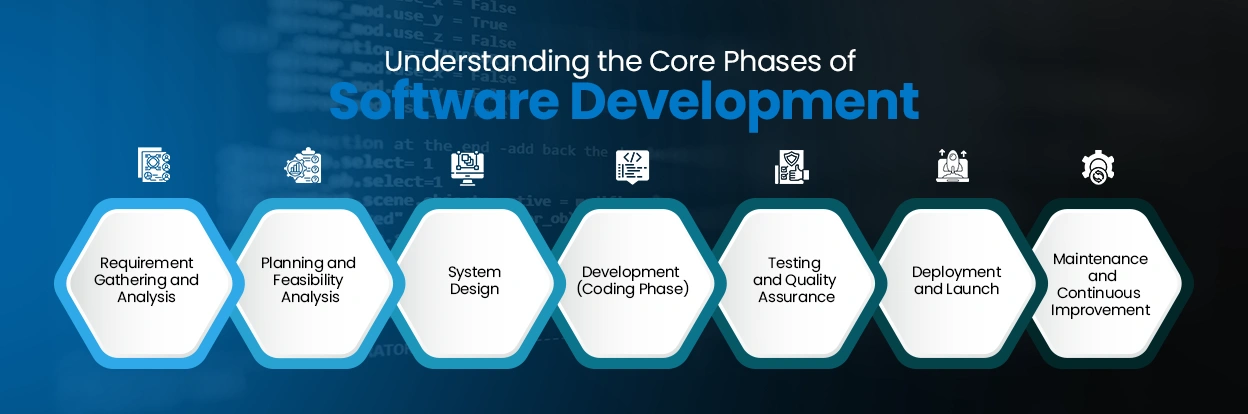
Understanding the Core Phases of Software Development
1. Requirement Gathering and Analysis
This phase is the foundation of any successful software project. It is where ideas are transformed into structured, actionable requirements that guide the entire development lifecycle. Without clearly defined requirements, even highly skilled development teams may deliver solutions that fail to meet business expectations or user needs.
Identifying Business Goals
Enterprises must start by clearly defining what they aim to achieve with the software. This step aligns the project with the overall business strategy and ensures that every feature contributes to measurable outcomes. Whether the goal is increasing revenue, improving operational efficiency, or enhancing customer engagement, clarity at this stage drives better decision-making throughout the project.
Understanding User Needs
A deep understanding of the target audience is critical to building software that truly delivers value. This involves identifying who the users are, what problems they face, and how the software can solve those problems. Enterprises often use techniques such as user personas, journey mapping, and behavioral analysis to gain insights into user expectations.
Defining Functional Requirements
This step involves documenting what the system should do in detail. Functional requirements include features, workflows, system interactions, and expected outputs. Clear and well-structured documentation is just like a blueprint for designers and developers, reducing ambiguity and ensuring consistency across teams. It avoids miscommunication, scope creep, and delays during later stages of development.
2. Planning and Feasibility Analysis
Once requirements are clear, the next step is planning, which means how to execute the project efficiently. It involves the following things as the core planning:
Technical Feasibility
Technical feasibility focuses on evaluating whether the proposed software solution can be built using the available technology, tools, and infrastructure. It helps enterprises determine if their vision is technically achievable within the given constraints. This involves selecting the right technology stack (frontend, backend, databases, frameworks) and ensuring compatibility with existing systems.
Financial Feasibility
Financial feasibility ensures that the project is economically viable and aligned with business goals. It involves estimating the total cost of development, including design, development, testing, deployment, and ongoing maintenance. Enterprises must carefully plan budget allocation, ensuring resources are used efficiently without overspending. At the same time, they should evaluate the expected return on investment (ROI)/
Timeline Planning
Timeline planning defines a realistic roadmap for project execution, ensuring that each phase of development is completed within a structured timeframe. It involves breaking down the project into smaller milestones, sprints, or deliverables for better tracking and management.
A well-planned timeline considers factors such as project complexity, resource availability, dependencies, and potential risks. It also allows teams to set clear expectations and maintain accountability throughout the development process.
Key Considerations:
- Develop a project roadmap
- Identify risks early
- Allocate resources effectively
3. System Design
This phase focuses on creating and designing the software. While understanding the core objectives of businesses, the designer will start working on this phase to meet the exact requirements: This includes the following:
High-Level Design (HLD)
High-Level Design provides a bird’s-eye view of the entire system architecture. It defines how different components of the software will interact with each other and outlines the overall structure of the application. This includes identifying major modules, system layers (frontend, backend, database), third-party integrations, and data flow between components. HLD helps stakeholders and technical teams understand how the system will function at a macro level.
Low-Level Design (LLD)
Low-Level Design focuses on the detailed breakdown of each component defined in the HLD. It provides in-depth technical specifications that developers use during the coding phase. This includes defining database schemas, API endpoints, class diagrams, algorithms, workflows, and logic for individual modules. LLD eliminates ambiguity by clearly specifying how each feature will be implemented.
UI/UX Design
UI/UX design ensures that the software is not only functional but also intuitive, engaging, and easy to use. It focuses on creating seamless user experiences that align with user expectations and business goals. This involves designing user interfaces, navigation flows, wireframes, and interactive prototypes. A good UI/UX design minimizes user friction, improves usability, and enhances customer satisfaction.
Architecture Selection
Choosing the right architecture is a critical decision that impacts the performance, scalability, and flexibility of the software. Enterprises typically choose between monolithic architecture (a single unified system) and microservices architecture (independent, loosely coupled services). While monolithic systems are simpler to develop initially, microservices offer greater scalability, flexibility, and easier maintenance for complex applications.
Scalability Planning
Scalability planning ensures that the system can handle future growth in users, data, and traffic without performance issues. This involves designing systems that can scale horizontally (adding more servers) or vertically (increasing server capacity). It also includes optimizing databases, load balancing, and using cloud infrastructure for dynamic scaling.
Security Design
Security design focuses on integrating robust security measures from the very beginning of the development process. Rather than treating security as an afterthought, it is built into the system architecture. This includes implementing authentication and authorization mechanisms, data encryption, secure APIs, and compliance with industry standards. It also involves protecting against common threats such as data breaches, cyberattacks, and unauthorized access
Key Considerations:
- Focus on scalability and flexibility
- Design for performance optimization
- Ensure security-first architecture
4. Development (Coding Phase)
This is where the actual product is built based on design specifications. Design gives the team an idea of how the development phase will be executed. Core things are considered deeply, which are explained further:
Backend Development
It handles business logic, database interactions, and server-side operations.
Frontend Development
This focuses on user interface and user experience.
API Development
Ensures seamless communication between different system components.
Key Considerations:
- Follow coding standards and best practices
- Use version control systems
- Maintain clean and scalable code
5. Testing and Quality Assurance
Testing ensures that the software is reliable, secure, and performs as expected. This is to know how the designed product looks, giving a final idea of the product. It has the following things:
Functional Testing
Validates that all features work as intended.
Performance Testing
Ensures the system can handle high loads.
Security Testing
Identifies vulnerabilities and ensures data protection.
Key Considerations:
- Automate testing processes
- Conduct regular bug tracking
- Ensure compliance with quality standards
6. Deployment and Launch
After testing is complete, the software is deployed to a live production environment where real users can access it. This phase involves setting up servers, configuring cloud infrastructure, and ensuring smooth data migration.
Deployment Strategy
Choose between phased rollout or full-scale launch.
Environment Setup
Prepare servers, cloud infrastructure, and databases.
Monitoring Post-Launch
Track system performance and user behavior.
Key Considerations:
- Use CI/CD pipelines
- Ensure rollback strategies
- Monitor system health continuously
7. Maintenance and Continuous Improvement
Software development doesn’t end after deployment. Continuous updates are essential for long-term success. That is why the team checks out everything and has a proper maintenance plan that keeps the software running smoothly.
Bug Fixes and Updates
Regularly fix issues and improve performance.
Feature Enhancements
Add new features based on user feedback.
System Optimization
Improve scalability, speed, and security.
Key Considerations:
- Monitor user feedback
- Plan regular updates
- Optimize system performance
Key Reasons to Partner with Markup Designs for Software Development
Building enterprise-grade software can be complex, time-consuming, and resource-intensive. This is where partnering with a strategic development partner like Markup Designs can make a significant difference. Markup Designs specializes in delivering high-performance software that helps enterprises validate ideas quickly while ensuring scalability and long-term success.
What Sets Markup Designs Apart:
Strategic Approach
Focuses on building only the most critical features to validate your software idea faster.
Enterprise-Grade Architecture
Ensures your MVP can scale into a full-fledged enterprise solution.
Faster Time-to-Market
Accelerated development cycles help you stay ahead of competitors.
Cost Optimization
Eliminates unnecessary development costs by prioritizing value-driven features.
Experienced Development Team
Combines technical expertise with industry insights to deliver high-quality solutions.
By partnering with Markup Designs, enterprises can reduce risks, accelerate innovation, and build software that delivers real business impact.
Know the Cost of Software Development (USD)
Below is a general cost breakdown based on project complexity:
Below is a general cost breakdown for fintech software development based on complexity:
| Development Stage | Basic MVP ($) | Mid-Level Solution ($) | Advanced Enterprise ($) |
| Research & Planning | 5,000 – 10,000 | 10,000 – 20,000 | 25,000 – 50,000 |
| UI/UX Design | 5,000 – 15,000 | 15,000 – 30,000 | 30,000 – 60,000 |
| Compliance | 5,000 – 15,000 | 15,000 – 40,000 | 40,000 – 100,000 |
| Testing & QA | 5,000 – 15,000 | 15,000 – 35,000 | 35,000 – 80,000 |
| Maintenance | 5,000 – 10,000 | 10,000 – 25,000 | 25,000 – 70,000 |
| Total Estimation | 25K- 65K | 65K-150k | 155K- 360K |
How Partnering with Markup Designs Maximizes ROI in Software Development?
In today’s competitive business landscape, software development is not just a technical investment; it is a strategic business decision directly tied to ROI. Enterprises are no longer focused only on building products; they are focused on building solutions that deliver measurable returns, long-term value, and sustainable growth. Partnering with Markup Designs ensures that every stage of the software development lifecycle is optimized to maximize return on investment while minimizing risks and unnecessary costs.
FAQs
What is the most important phase in software development?
Requirement gathering is the most critical phase as it defines the foundation of the entire project.
How long does a typical software development lifecycle take?
It can range from 3 months for an MVP to over a year for enterprise-level solutions.
Why is testing important in software development?
Testing ensures reliability, security, and performance before the product reaches users.
What is an MVP in software development?
An MVP (Minimum Viable Product) is a simplified version of the product with core features to validate the idea.
How can enterprises reduce development costs?
By focusing on MVP development, prioritizing features, and partnering with experienced teams.
The Conclusion
Understanding the seven phases of software development is essential for enterprises aiming to build successful digital products. Each phase plays a crucial role in ensuring that the final product is scalable, secure, and aligned with business goals. From requirement analysis to continuous improvement, a structured approach helps minimize risks, optimize costs, and accelerate time-to-market. Enterprises that invest in proper planning and execution are more likely to succeed in today’s competitive environment.
Author’s Perspective
From my perspective, many enterprises underestimate the importance of structured development phases. They often rush into coding without fully understanding requirements or planning architecture, which leads to costly mistakes later. The real value lies not just in building software but in building it the right way. Each phase acts as a checkpoint that ensures the product is aligned with business goals and user expectations.
Speed is important in the modern digital world, but strategy is everything. Enterprises that balance both will always stay ahead of the competition.
Related Posts
Case Management Software Development: Enterprise Features & Implementation...
Farm Management Software Development in Australia: Features, AI...
Knowledge Management System Development in Australia: Building AI-Ready...
Insights Are Valuable & Execution is Priceless
You’ve read about the digital future. Now, let’s build the infrastructure to take you there. Move your strategy from the page to the product.
Design Your Solution Now
Contact Us
Schedule The Appointment At Your Convenience Date And Time.
30 Min
Web Conference
Time Zone
Indian standard time (08:30pm)

Thanks For Getting In Touch!
You’ve Taken The First Step Toward Transforming Your Digital Presence. Our Experts Will Reach Out Shortly To Take It Forward.
Launch Your Dream Project
Provide a brief overview of your project, and our specialists will evaluate your requirements. We will connect with you to explore how the right digital solutions can help you launch faster.