
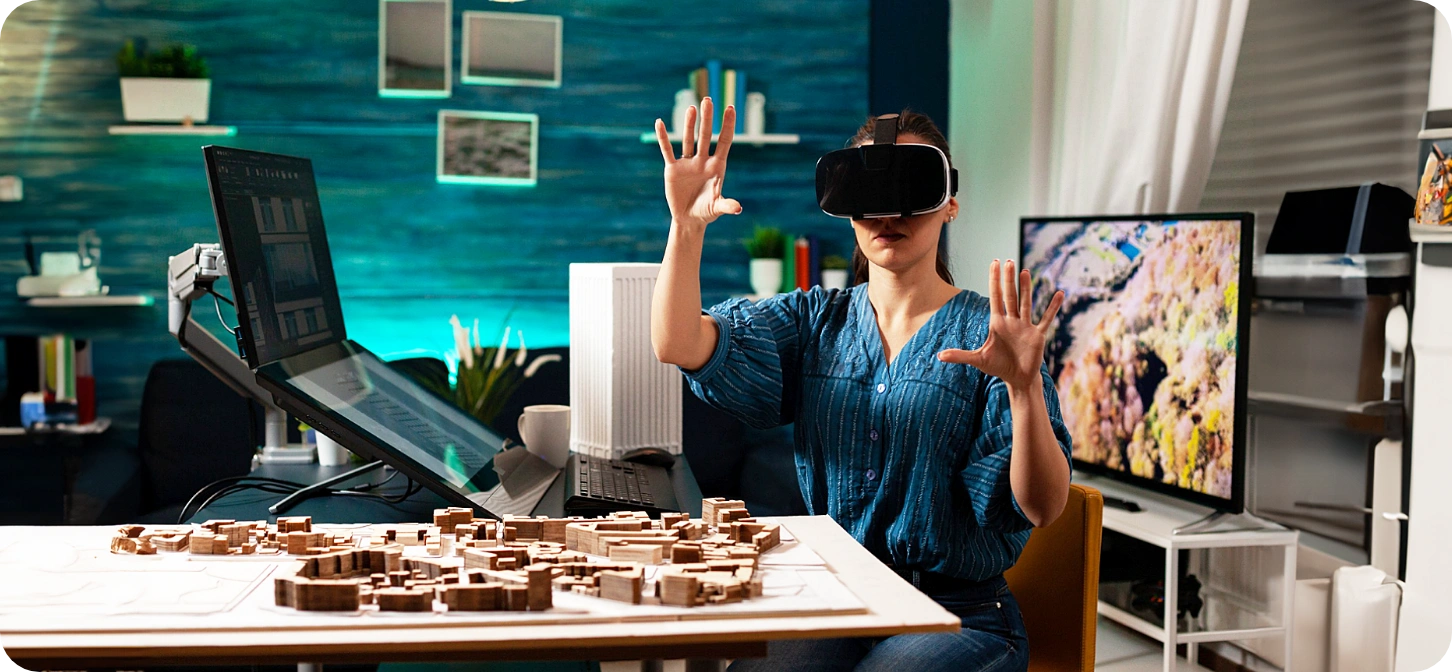
How is 3D Product Modeling in AR/VR Shaping the Real Estate Customer Experience?
The real estate industry has always been about one thing, which is helping people make confident decisions about some of the biggest purchases of their lives. But for a long time, the tools available to do that are pretty limited: flat floor plans, static photos, and in-person site visits. That is why many businesses can not attract maximum investors, representing a significant gap in market potential for many businesses. As the real estate landscape continues to evolve rapidly, marketing strategies must adapt accordingly. 3D product modeling with Augmented Reality (AR) and Virtual Reality (VR) is giving businesses a powerful new way to connect with buyers, speed up decisions, and stand out in a competitive market.
If you are in real estate development, brokerage, or PropTech, this is a shift you cannot afford to ignore. We have broken down what is actually happening, why it matters, and how your business can take advantage of it.
AR/VR & 3D Modeling: Transforming the Real Estate Buying Journey
The Problem With Traditional Property Showcasing
Historically, the property sales process has followed a predictable and largely unchanged pattern. A buyer sees a listing online, schedules a visit, walks through a physical or under-construction space, and tries to imagine what it will look like once finished. This creates mental pressure on the buyer that increases the risk of uncertainty in their decision.
For developers selling off-plan properties, the challenge is even bigger. You areasking buyers to spend millions based on blueprints and render images. The gap between what is shown and what the buyer imagines is where deals fall apart.
That’s where 3D modeling in AR/VR steps in.
What is 3D Product Modeling in Real Estate?
3D product modeling in real estate means creating highly detailed, lifelike digital versions of properties, including interiors, exteriors, furniture, finishes, and layouts, before (or even after) they are built.
When combined with AR/VR technology:
- AR lets buyers overlay digital property views onto real-world environments using their phones or tablets.
- VR lets buyers step into a fully immersive, 360-degree digital version of a property using a headset or browser-based experience.
Together, these tools transform how properties are experienced, evaluated, and sold.
Why Are B2B Real Estate Players Leading the Charge?
For real estate developers, agencies, and PropTech companies, the business case is clear:
- Shorter sales cycles. Buyers who can fully experience a property virtually make decisions faster.
- Lower operational costs. Fewer physical show homes and fewer site visits required.
- Wider reach. International or remote buyers can tour properties without traveling.
- Higher perceived value. Premium visualization signals a premium product.
This extends beyond visual appeal; it directly improves the sales pipeline and enhances operational efficiency.
Key Ways 3D Modeling Is Improving the Real Estate Customer Experience
Virtual Property Tours That Feel Real
One of the most impactful uses of VR in real estate is the virtual property tour. Unlike a video walkthrough, a VR tour is interactive. Buyers can look around freely, move through rooms, open doors, and get a real sense of scale and space.
For developers with off-plan projects, this is a game-changer. Instead of selling from a brochure, you are selling from an experience. Buyers can tour an apartment that would not be ready in two years, and feel confident enough to sign the contract today.
Business Impact: Converting Buyers
Buyers who complete a VR tour are significantly more likely to progress in the purchase process, as the immersive experience effectively eliminates uncertainty. The experience removes doubt. When an investor can “stand” in the living room, see the view from the balcony, and walk through the kitchen, uncertainty drops, and confidence rises; it creates more impact. This has become one of the key reasons to boost sales in the real estate industry.
The Role of High-Quality 3D Models
The quality of the VR experience depends entirely on the quality of the 3D models behind it. Poorly rendered spaces with flat textures and unrealistic lighting break immersion. Photorealistic 3D models with accurate lighting, material finishes, and spatial depth make the difference between a gimmick and a real sales tool.
Customization Options That Drive Engagement
Advanced 3D modeling setups also allow businesses to customize the buyer’s journey of what they see in real time. Buyers can, for instance, switch from oak flooring to marble or adjust kitchen finishes in real time, keeping them engaged and facilitating more meaningful sales conversations. This level of interactivity keeps buyers engaged longer and gives sales teams a powerful conversation tool.
Accessibility for Remote and International Buyers
Remote buyers, whether in another city or another country, represent a huge segment of the real estate market. AR/VR removes the geographic barrier entirely. A developer in Dubai can sell units to buyers in London without those buyers ever visiting the site. That is a significant commercial advantage.
AR-Powered Site and Space Visualization
While VR immerses buyers in a fully digital environment, AR enhances the real world. In real estate, this means buyers can stand on an empty plot of land and see the finished building in front of them, while using nothing but their smartphone.
How Are Developers Using AR on Site?
Innovative developers are using AR during site visits to show what the completed property will look like from specific points. This is particularly effective for large-scale developments like residential towers, commercial complexes, or mixed-use projects where construction is still in early stages.
Staging and Interior Visualization Without the Cost
Traditional property staging, like the practice of furnishing a show apartment to assist buyers in visualizing the space, is both expensive and logistically complex. Digital staging using 3D models delivers the same result at a fraction of the cost.
Real estate agencies can now present multiple furnishing and design options for the same space, helping different buyer segments see the property. A young professional might want a minimalist setup, while a family wants to see a fully-furnished space. In this way, 3D modeling makes both possible, making it a win-win situation for real estate businesses.
Why Partner With Markup Designs for 3D Product Modeling?
When it comes to 3D product modeling for real estate, the quality of your visual output is everything. A poorly rendered model doesn’t just fail to impress; it can actively damage buyer confidence in your project. That’s why partnering with the right 3D modeling team matters. Markup Designs specializes in delivering high-quality, photorealistic 3D product modeling and visualization services built specifically for real estate and PropTech businesses.
Here’s why real estate companies choose to work with us:
- End-to-end Visualization. From architectural exteriors to detailed interior walkthroughs, we handle the entire 3D production pipeline, ensuring consistent, high-quality output across all visual assets.
- AR/VR-Ready Deliverables. Our 3D models are optimized for AR and VR deployment from the start. Whether you’re embedding a tour on your website, building a VR showroom, or integrating AR into a mobile app, our assets are ready to perform.
- Fast Turnaround Without Quality Compromise. Real estate sales cycles move fast. We’re built to deliver detailed, accurate 3D models within timelines to keep your project on track.
- Collaborative Process. We work closely with your development and sales teams to make sure every model accurately reflects your project specifications, finishes, and brand standards.
- Scalable for Large Developments. Whether you are modeling a single apartment or an entire residential township, our team scales to meet your project size without compromising on detail.
If you are looking to give your buyers a better experience, close deals faster, and present your properties with confidence, Markup Designs is the partner you need.
The Future of 3D Modeling and AR/VR in Real Estate
The technology is moving quickly, and the gap between early adopters and those who have not yet invested in 3D visualization is widening. Here is where things are heading:
- AI-Driven Real-Time Rendering. Artificial intelligence is making it possible to generate and modify 3D environments faster than ever before. Soon, your sales teams will be able to make live changes to a 3D model during a buyer meeting.
- Web-Based VR (No Headset Required). Browser-based VR experiences are improving rapidly, meaning buyers will soon be able to take immersive virtual tours directly from a website link, no headset, no app download required.
- Digital Twins for Entire Developments. Beyond individual units, developers are beginning to create digital twins of entire neighborhoods and communities, allowing buyers to explore not just their apartment, but the landscaping, amenities, and surroundings.
Frequently Asked Questions (FAQ)
What is 3D product modeling in real estate?
3D product modeling in real estate refers to the creation of detailed, digital three-dimensional representations of properties, including buildings, interiors, furniture, and finishes. These models are used for virtual tours, AR/VR experiences, digital staging, and marketing materials.
How does AR/VR help in real estate sales?
AR and VR allow buyers to experience a property virtually before it is built or without visiting in person. This improves buyer confidence, reduces sales cycles, and makes it easier to sell off-plan or remote properties to a wider audience.
Is VR-based property touring suitable for off-plan sales?
Yes, in fact, off-plan sales are one of the strongest use cases for VR. Since the physical property doesn’t exist yet, a high-quality VR tour is often the only way to give buyers a genuine sense of what they’re buying.
How much does 3D modeling for real estate cost?
Costs vary based on the scale, detail, and type of deliverable required. A single apartment interior model will cost significantly less than a full development with exteriors, communal areas, and multiple unit types. Partnering with us ensures that you get accurate quotes aligned with the specific project scope.
Can 3D models be updated if the design changes?
Yes, one of the advantages of digital 3D models over physical show homes is that updates can be made relatively quickly. If finishes change, layouts are revised, or new furniture packages are introduced, the model can be updated to reflect those changes.
What’s the difference between AR and VR in real estate?
VR (Virtual Reality) places the buyer in a fully digital, immersive environment, typically viewed through a headset or 360-degree browser experience. AR (Augmented Reality) overlays digital elements onto the real world, typically viewed through a smartphone or tablet.
Wrapping Up
3D product modeling in AR/VR is no longer a futuristic concept; it is a present-day competitive advantage for real estate businesses that want to sell smarter and faster. For developers, agencies, and PropTech companies, the benefits are real and measurable: faster buyer decisions, lower sales costs, broader market reach, and a stronger brand perception. Modern investors expect more from the properties, and the businesses that meet their expectations with immersive, high-quality visual experiences are the ones closing deals strategically.
The question is no longer whether a business should invest in 3D modeling and AR/VR visualization; it is whether it can afford not to. For businesses ready to elevate their real estate sales experience, Markup Designs offers end-to-end support from initial modeling through final deployment.
Author's Perspective
Innovation is no longer optional; it’s the key to staying competitive in a rapidly evolving digital landscape. Businesses that adopt advanced technologies early are the ones that lead, scale faster, and deliver better customer experiences. Markup Designs helps organizations to turn ambitious ideas into powerful digital solutions. This includes intelligent platforms for scalable technology ecosystems. If you’re exploring how technology can support your next stage of growth, let’s start the conversation.
Discuss Your Project NowDeepak Tripathi
Product Manager
Related Posts
How is AR/VR App Development Leading Innovation of...
Insights Are Valuable & Execution is Priceless
You’ve read about the digital future. Now, let’s build the infrastructure to take you there. Move your strategy from the page to the product.
Design Your Solution Now
Contact Us
Schedule The Appointment At Your Convenience Date And Time.
30 Min
Web Conference
Time Zone
Indian standard time (08:30pm)

Thanks For Getting In Touch!
You’ve Taken The First Step Toward Transforming Your Digital Presence. Our Experts Will Reach Out Shortly To Take It Forward.
Launch Your Dream Project
Provide a brief overview of your project, and our specialists will evaluate your requirements. We will connect with you to explore how the right digital solutions can help you launch faster.