

In Brief
- Managed IT services enable companies operating in the UK to cut down on operational expenses due to their proactive approach to technology management and consistent IT investments.
- Constantly monitored infrastructure ensures minimum downtime, optimal system performance, and efficient business operations.
- A managed service provider offers a wide array of specialized cybersecurity services to ensure protection of the business’ network, software, and sensitive data.
- Services of cloud management, data backups, and disaster recovery facilitate operational continuity and scalability of businesses.
- A company that seeks the services of a managed service provider should select one with good security measures, clear SLAs, and an understanding of UK regulations to create a reliable IT environment for itself.
Technology is key to managing the operations of UK businesses, providing services to their customers and maintaining competitiveness in the market. But managing the IT infrastructure can prove to be quite difficult if a company uses cloud platforms and other technologies.
Managed IT services present a logical solution since companies get the opportunity to outsource management of their IT infrastructure, monitoring, and technical support to specialized providers. Whether it is about maintaining your company’s computer systems, cybersecurity, cloud computing, or disaster recovery, all these services will enable you to have a reliable IT environment without handling all IT functions internally. The right managed IT services for your UK business will enhance its efficiency, security, and scalability.
What Are Managed IT Services and How Do They Work for UK Businesses?
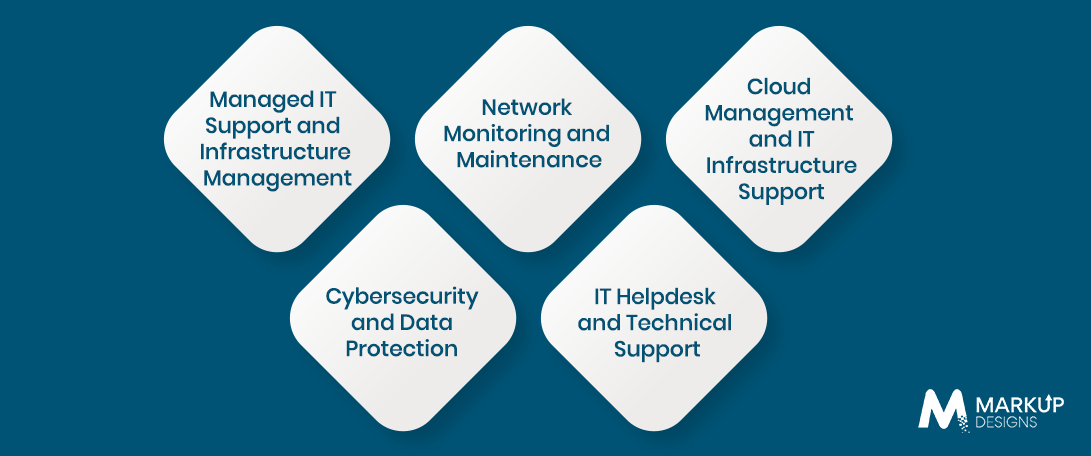
Managed IT services refer to outsourcing the management, maintenance, and monitoring of the company’s IT infrastructure to a third party called a Managed Service Provider (MSP). Managed service providers take care of vital IT activities to help organisations maintain their secure infrastructure, fix technical problems, and manage technology requirements without the necessity to rely entirely on their in-house IT teams. Generally, the services are provided through monthly subscription fees.
Managed IT Support and Infrastructure Management
Managed IT support includes daily management of the company’s computer systems, which include servers, workstations, software, and IT infrastructure.
These service providers offer maintenance services for troubleshooting, configuring, and optimizing systems. This way, organizations will reduce the pressure on their employees and ensure that their IT resources are aligned with their needs.
Network Monitoring and Maintenance
Monitoring networks consists of constantly keeping an eye on the performance and connections of a company’s network to detect any possible problems that could jeopardize its operations. MSPs will help companies monitor routers, switches, firewalls, and network traffic by resolving issues related to the performance and connection of a company’s network.
Cloud Management and IT Infrastructure Support
Cloud management helps businesses manage their cloud environment, whether it is private, public, or hybrid. MSPs will help companies deploy, allocate their resources, control access to cloud resources, as well as monitor the performance of these resources. This allows organisations to access business applications and data more flexibly without managing the entire infrastructure independently.
Cybersecurity and Data Protection
Managed cyber-security services protect a company’s IT systems from malware, ransomware, phishing, and any other unauthorized access. MSPs provide security measures, monitor unusual activity, manage firewall solutions, and help with data protection initiatives. Additionally, MSPs assist businesses in developing proper security policies and protect their important information, including personal data of customers and operational details.
IT Helpdesk and Technical Support
IT helpdesk services provide a centralized point where employees can seek help with hardware issues, software malfunctions, connectivity issues, and access problems. MSPs offer remote and on-site help to clients, troubleshoot technical issues, and manage tickets. This helps employees to solve disruptions and stay productive.
Why Are UK Businesses Investing in Managed IT Services?
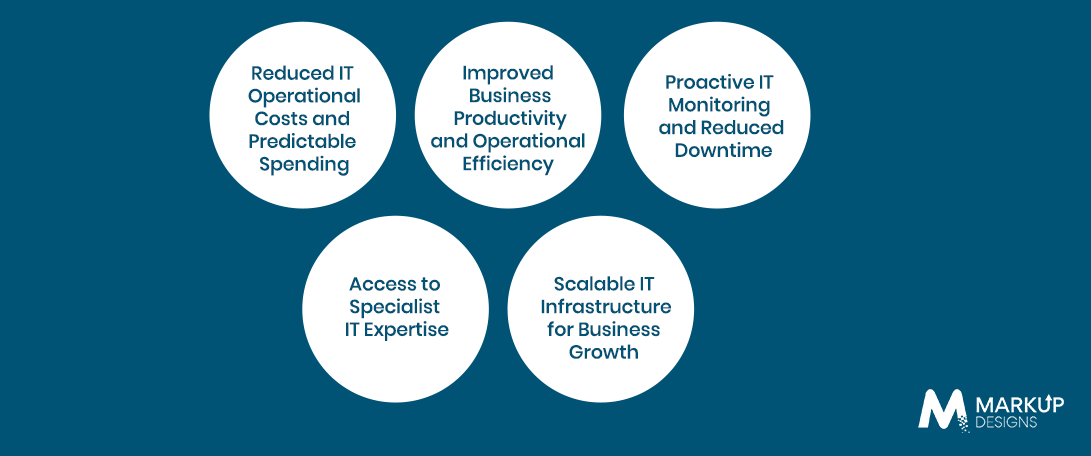
British companies tend to use managed IT services as a solution to meet growing needs in terms of technology, cybersecurity and infrastructure management. Keeping an IT department is quite expensive because of high cost of hiring qualified staff, licensing software, maintaining hardware and managing other aspects of the process.
Reduced IT Operational Costs and Predictable Spending
Running your own IT department requires expenses on hiring, salary payments, training, maintaining infrastructure, and purchasing software licenses. Managed IT services replace many unpredictable expenses with structured monthly service agreements, making IT budgets easier to manage. Businesses can also reduce the costs associated with emergency repairs, system failures, and unplanned infrastructure upgrades.
Improved Business Productivity and Operational Efficiency
Business employees get more time to concentrate on their main job duties when they spend less time on technical issues. Managed service providers help organizations conduct regular maintenance of computer systems, troubleshooting, and IT administration. In that way, companies can make use of available resources more efficiently and effectively.
Proactive IT Monitoring and Reduced Downtime
Typically, traditional IT services respond when a problem affects business operations. Managed IT services are proactive in the sense that they monitor company infrastructure in real time and solve arising problems in a timely manner in order to reduce disruptions.
Access to Specialist IT Expertise
With ever-changing technology needs of the organization, it becomes hard to hire experts in all IT areas. With the help of managed IT services, businesses can have professional specialists working in the following areas such as cloud computing, network management, system administration, and cybersecurity.
Scalable IT Infrastructure for Business Growth
When an organization grows, its technological needs change in terms of increased numbers of users, applications, and data, etc. Thus, businesses can use IT infrastructure scaling services offered by managed IT services.
Managed IT services allow organisations to scale infrastructure, support, and security resources according to their changing needs. This flexibility helps businesses accommodate growth without repeatedly investing in and restructuring their internal IT operations.
Which Managed IT Services Can Improve Business Performance?
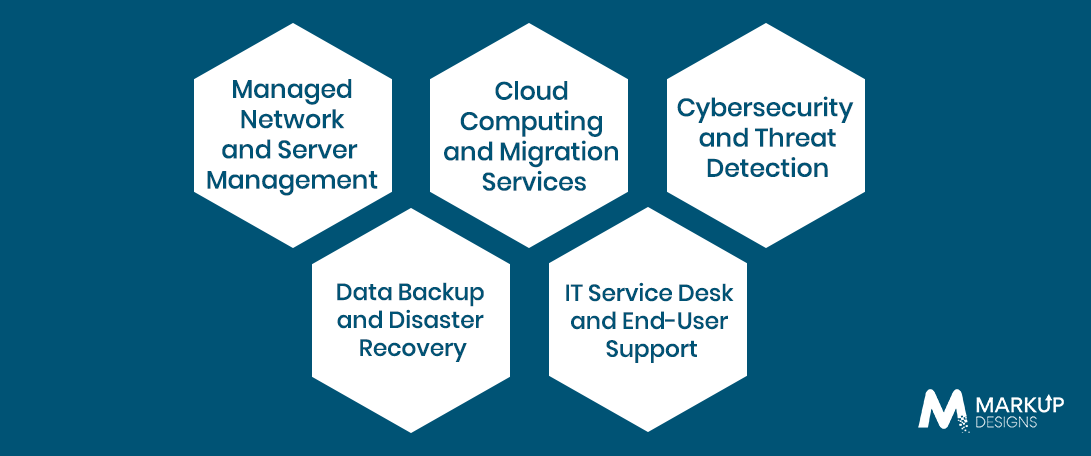
Managed IT services include many technology services that have an impact on business performance and the reliability of system operations. Instead of dealing with IT needs separately, companies can use the capabilities of an MSP to manage their infrastructure, cloud services, cybersecurity, and technical support via one service offering.
Managed Network and Server Management
Managed network and server services guarantee the availability, security and correct configuration of the business infrastructure. The MSPs monitor server performance, network connections, hardware management and system upgrades, and at the same time detect potential problems which may harm the operational performance. Efficient management allows businesses to ensure reliable access to the applications, databases and other business resources.
Cloud Computing and Migration Services
Cloud computing services help companies to migrate the applications, workloads and data to cloud environments from traditional infrastructures. The managed providers manage cloud migration, cloud services configuration, and integration in different cloud platforms, such as Microsoft Azure and Amazon Web Services (AWS), as well as optimize the cloud infrastructure for better accessibility and flexibility.
Cybersecurity and Threat Detection
Cybersecurity services protect business infrastructure from possible external attacks and security risks. Managed providers deploy firewalls, endpoint security, intrusion detection, and threat monitoring solutions to identify and respond to suspicious activities. Regular security assessments and policy updates further strengthen protection across business systems.
Data Backup and Disaster Recovery
Data backup and disaster recovery offer organisations a way to recover important data and get their operations up and running after any form of cyberattack, hardware failure, or other form of disruption. An MSP provides data backup and disaster recovery services which include scheduled backups, storage and recovery processes that will minimise the risk of data loss. An MSP may also set recovery time objective (RTO) and recovery point objective (RPO).
IT Service Desk and End-User Support
IT service desk services entail providing ongoing support to individuals having difficulties with their devices, software, accounts, and business systems. An MSP manages service desks by managing tickets, incidents, requests, and other issues through an established process. It ensures the individual receives the required support while the organisation is aware of any persistent issues in its IT systems.
How Do Managed IT Services Improve Cybersecurity for UK Businesses?
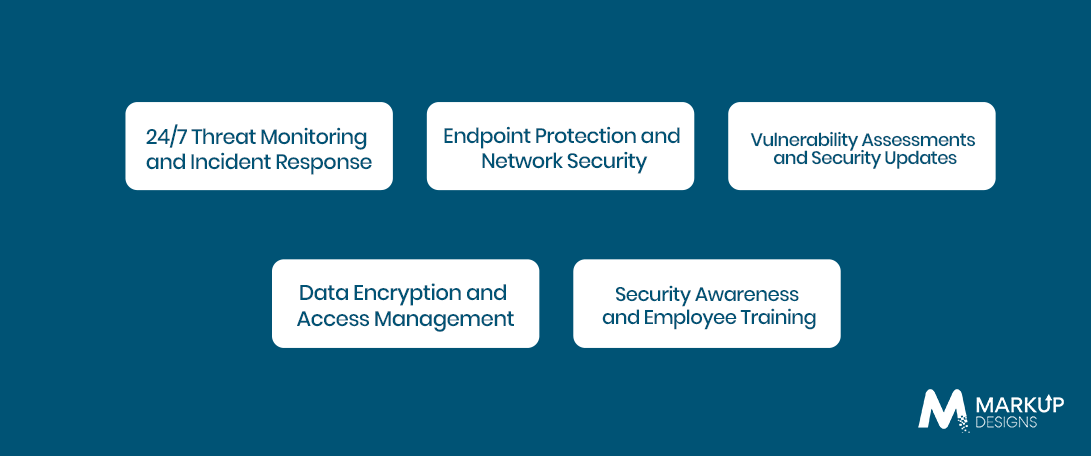
Cybersecurity has become an important factor for UK businesses since many cyberattacks target business networks and information. Managed IT service providers improve cybersecurity through monitoring, prevention and handling incidents.
24/7 Threat Monitoring and Response to Incidents
Continuous security monitoring enables the identification of any suspicious activities within the network, unauthorized access, and any odd behavior in the system. Managed service providers have tools for security monitoring and SIEM to evaluate alerts and detect any potential threat. In case of an incident, there are predefined response procedures to help isolate the threat, analyze the situation, and fix the affected system.
Endpoint Protection and Network Security
Laptops, desktop computers, mobile devices, and servers can be used as an entry point for cyber attacks. The managed security services offer EDR, antivirus software, firewalls, and network access controls for protection of these devices and any other associated systems. Constant monitoring also allows detection of any compromised endpoint before a threat spreads through the whole infrastructure.
Vulnerability Assessments and Security Updates
Software that is outdated, incorrectly configured, and not patched might lead to the exposure of the business infrastructure to security vulnerabilities. Vulnerability assessments are performed in order to detect weaknesses in networks, devices, and applications. MSPs also perform coordinated security patches and software updates in order to avoid any known threats.
Data Encryption and Access Management
Data encryption ensures that confidential business data is in unreadable form for any unauthorised users. Encryption of data at rest and in motion, together with identity and access management services, can be delivered by managed IT providers. MFA and role-based access permissions will further limit access to business resources depending on responsibilities.
Security Awareness and Employee Training
Unaware employees may accidentally put business systems at risk of phishing, malicious links, and social engineering. Managed service providers may assist in organising security awareness campaigns through training, phishing simulations, and teaching secure technology practices. Employee education may assist organisations in reducing security threats caused by humans.
Which UK Compliance Requirements Should Businesses Consider When Choosing Managed IT Services?
There are a number of data protection, cybersecurity and industry-specific regulations that UK businesses which handle client data and use digital infrastructure have to take into account. A managed service provider must be aware of compliance requirements and able to implement appropriate measures. However, outsourcing IT management does not exempt businesses from any liability.
UK GDPR and Data Protection Act 2018
The UK General Data Protection Regulation (UK GDPR) and Data Protection Act 2018 set out rules regarding the collection, processing, storage and protection of personal data. Companies have to implement adequate security measures, manage access to personal data and ensure accountability for their data processing operations. MSPs can assist in the process of implementing encryption, access control, secure backups and data protection policies.
Cyber Essentials and Cyber Essentials Plus
Cyber Essentials is a government-backed cyber security certification scheme aimed at helping businesses to protect themselves from common cyber-attacks. The scheme consists of five technical controls covering such areas as firewalls, secure configuration, security updates management, access controls, and anti-malware tools. Cyber Essentials Plus also involves technical assessment of these controls.
ISO 27001 and Information Security Management
ISO/IEC 27001 is a well-known international standard that describes the way of setting up and managing an Information Security Management System (ISMS). This process implies identification of information security risks, implementation of controls, and continuous improvement of information security practices. Businesses can collaborate with MSPs regarding security documentation, security risk assessment, access control, and monitoring. However, certification is granted to the organisation.
NIS Regulations and Industry-Specific Compliance
The Network and Information Systems (NIS) Regulations 2018 apply to certain operators of essential services and relevant digital service providers in the UK. They establish requirements for managing network and information system security risks and reporting qualifying incidents. Businesses in regulated sectors may also need to consider additional requirements depending on their activities, such as financial services, healthcare and critical infrastructure obligations.
How Can Businesses Choose the Right Managed Service Provider in the UK?
Choosing an appropriate MSP goes beyond service comparison and cost consideration. It is essential for businesses to evaluate technical capabilities, security measures, and service promises of an MSP and its capability to meet future technological needs.
Assess IT Infrastructure and Business Requirements
Begin the evaluation of current IT infrastructure consisting of servers, networks, applications, cloud solutions, and security solutions. Identify problems that you may encounter repeatedly and areas where you lack sufficient internal expertise. These evaluations will enable companies to find out the areas where they need to outsource the services.
Evaluate Technical Expertise and Service Offerings
Evaluate the experience of your MSP in handling the technologies necessary for running your business, including cloud solutions, network solutions, cybersecurity, and data recovery systems. Find out the experience of your MSP, its technical certifications, and capability to handle your current applications. The MSP with comprehensive services will be able to manage different IT needs in a coordinated manner.
Check SLAs, Response Times and Support Availability
The Service Level Agreement (SLA) specifies the commitments of service between a business and an MSP. It includes response time guarantees, target resolutions for problems, system availability, and support hours.
Businesses should ensure that the agreement clearly explains how critical incidents are prioritised and managed.
Review Security Standards and Compliance Practices
Analyze the provider’s approach to cybersecurity standards, incident management, access management and the way the information is handled. Evaluate the provider’s certifications, external security audits, and previous compliance experiences. In addition, businesses need to ask about the location where their information will be kept, access to the information, and the security issues communication policy.
Compare Pricing, Flexibility and Scalability
Compare the pricing models that depend on the number of users, devices, infrastructure needs and services offered within each package. However, don’t pay attention only to the price per month but evaluate additional costs for project work, emergency services, updates, and third-party software.
How Can Markup Designs Assist UK Companies in Building Their Secure and Scalable IT Infrastructures?
Through software development, cloud services and system integration, Markup Designs assists UK companies in building their secure, scalable and efficient IT infrastructure. We concentrate on enhancing performance, securing data, and aligning technological aspects with business needs.
Create a Smarter and More Secure IT Infrastructure for Your Company
Collaborate with Markup Designs to build scalable and efficient technological systems to facilitate your business operations and growth.

Conclusion
The implementation of managed IT services allows UK businesses to save money, increase efficiency, and ensure cybersecurity. With proper selection of the provider and service, companies can minimise downtime, comply with regulations and create scalable IT infrastructure.
FAQ
1. How Much Do Managed IT Services Cost in the UK?
Depending on the scope of service and infrastructure, the cost of managed IT services in the UK ranges from £25 to £150+ per user per month.
2. What do managed IT services include?
Services such as IT support, network monitoring, cloud computing, cybersecurity, software updates, data backup and disaster recovery are common.
3. Can small businesses benefit from managed IT services in the UK?
Yes, since they offer small businesses professional IT skills and security without incurring costs of having their own IT department.
4. What is the difference between managed IT services and traditional IT support?
Traditional IT support is usually reactive in solving problems, while managed IT services concentrate on proactive measures.
5. How can managed IT services decrease business downtime?
The Managed IT services downtime can be decreased through constant monitoring and preventive maintenance.
6. How long does it take to implement managed IT services?
The process may take a couple of days to weeks, depending on the complexity of infrastructure, business size, and security settings.
Author's Perspective
Managed IT services are not only a choice for UK businesses anymore; they are becoming a necessity to keep operations efficient and secure. When choosing an MSP, businesses need to consider more than just costs. The right managed IT strategy can reduce technical disruptions, strengthen business resilience and create a reliable foundation for future growth.
Discuss Your Project NowJupinder Singh Arora
Founder and CEO
Related Posts

Why Businesses in Dubai are Investing in Managed...

Managed IT Services Pricing: What It Really Costs...

How Remote Managed IT Services Help Businesses Scale...
Insights Are Valuable & Execution is Priceless
You’ve read about the digital future. Now, let’s build the infrastructure to take you there. Move your strategy from the page to the product.
Design Your Solution Now
Contact Us
Schedule The Appointment At Your Convenience Date And Time.
30 Min
Web Conference
Time Zone
Indian standard time (08:30pm)

Thanks For Getting In Touch!
You’ve Taken The First Step Toward Transforming Your Digital Presence. Our Experts Will Reach Out Shortly To Take It Forward.
Launch Your Dream Project
Provide a brief overview of your project, and our specialists will evaluate your requirements. We will connect with you to explore how the right digital solutions can help you launch faster.