

In Brief
- ROI (Register of Information) of the DORA is a list that contains a financial organisation’s ICT third-party providers, contractual relations, ICT services, critical functions, and any related subcontractors.
- Development of ROI includes identification of ICT services, mapping of providers, collection and verification of contracts, definition of critical/important functions, mapping of subcontractors, completion of templates provided by DORA, and verification of the data in the register for possible inaccuracies.
- Among the challenges during the development of the register are scattered information, complex relationships with vendors, poor information on subcontractors, incomplete information on contracts, and obsolete information. Well-defined responsibilities and collaboration of the IT department, legal department, procurement, and compliance departments may help to solve such problems.
- Using technologies allows making the process easier due to centralization of information, automation of data collection, mapping of vendors’ relationships, notifications about expiration of contracts, data validation, and updates. Nevertheless, the organization will need accurate source information and manual control for compliance with regulations.
- Regular reviews, clear accountability, and the usage of DORA templates allow for maintaining the accuracy of the register. Markup Designs provides software development services, systems integration, workflow automation, and data management.
Financial firms rely on cloud computing, payment systems, software applications, and other technology services for their day-to-day operations. Although these technologies increase efficiency, managing several technology providers may complicate the process of tracking agreements, service interdependencies, and possible threats. That’s when the DORA Register of Information (ROI) comes into play.
According to the Digital Operational Resilience Act (DORA), all financial organizations that fall under its scope are required to keep track of their agreements with ICT third-party service providers. This helps the organization understand the technologies it uses and the providers behind those technologies.
Building the register is not always an easy task because of the lack of information available in different departments. Following the correct procedure could facilitate the process of building the register.
In this blog post, you will learn about how to build a DORA register of information, what information should be included, pitfalls to avoid, and how technology can help you manage the register.
What is a DORA Register of Information (ROI)?
The DORA ROI is a systematically compiled record containing information about the agreements made by the financial entity with ICT third-party service providers. It comprises the details of the technology services used, the service providers, the contract details and the business function served by these technology services.
To illustrate, financial entities could have contracts for cloud services to host data, payment processing through payment platforms, and third-party software to store customer details. The register enables the financial entity to maintain a systematic record of these agreements.
However, it is not a simple record of vendors. The register follows particular regulatory templates and provides pertinent details regarding the dependencies of the service provided and any subcontracted service provider relationship.
As per DORA, it is the responsibility of the covered financial entities to keep the register and give information to the appropriate bodies based on reporting instructions.
The ROI, as per DORA, helps organisations get a better idea about which ICT services they use and who supplies them to them.
Why is the DORA Register of Information Important?
Financial institutions frequently collaborate with many technology vendors in order to conduct their day-to-day activities. Without appropriate documentation, it can be hard for such an organisation to manage its connections and potential risks associated with them. The DORA Register of Information will assist them in organising the above information and managing third-party technology services more effectively.
The following is the list of reasons behind the importance of the above register.
- Third-party risks visibility: Financial institutions will be able to understand the technology vendors that they rely upon and the risks associated with such connections.
- Supports regulatory reporting: A well-organised register will allow for the preparation of necessary information for the regulator.
- Critical dependency identification: ICT service mapping with organisational business functions allows identifying the services that may lead to disruption in case of failure.
- Strengthens vendor management: The storage of provider and contract information will make it easier to assess service contracts and see where information is missing.
- Supports business continuity: More insights on the dependence on technology will allow organizations to be ready for service disruptions and other issues.
- Improves oversight across the organisation: Financial groups can maintain a clearer view of ICT arrangements across relevant entities and organisational levels.
Overall, a properly maintained DORA Register of Information is a great way for financial organizations to manage technology dependencies better and support their compliance.
What Information Should a DORA Register Include?
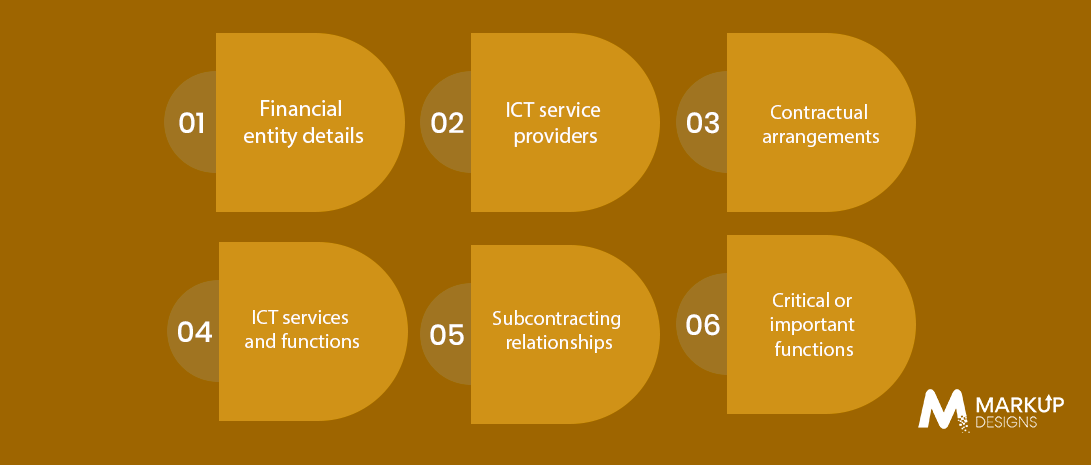
Developing an ICT Service Dependency Register (DORA) is initiated by knowing which information should be captured in the register. The financial institutions have to apply the appropriate regulatory templates and capture the information on their ICT service providers and contracts.
The following are six important information elements to include:
Financial entity details
Information that identifies the institution and the relevant entities captured in the register.
ICT service providers
Information about the ICT providers who provide services to the financial institution.
Contractual arrangements
Information on the agreements with ICT providers and relevant contract information.
ICT services and functions
Information regarding the services and business functions that are supported.
Subcontracting relationships
Information regarding the sub-contractors providing ICT services, especially the ones providing services for critical and important functions.
Critical or important functions
Information regarding the critical or important functions, along with their link to the ICT services and service providers.
The exact information requirements will depend on the appropriate template as well as the contract in place. Organizations need to use the official templates of the DORA Register of Information and not just a simple list of vendors in Excel.
Collecting these details in a consistent format makes it easier to validate records, identify missing information, and prepare the register for regulatory reporting.
How to Create a DORA Register of Information: Step-by-Step Process
Creation of a DORA Register of Information needs the involvement of various departments, such as IT, procurement, legal, and compliance. It is necessary to follow the process to ensure that an organisation obtains the necessary information and creates a DORA Register of Information effectively.
Step 1: Identification of All ICT Services and Dependencies
Begin by compiling the list of technology services used by your organisation. It could be cloud hosting, payment processing, data storage, security applications, and any other business software needed.
Identify the services from IT inventories, procurement documentation, contract information, and internal systems. Information collection from different departments will prevent missing any services.
Step 2: Mapping of ICT Third-Party Service Providers
Having identified the list of services, establish the link between a particular service and its provider.
Collect the necessary provider information and map any relevant relationships between direct providers and suppliers of other services for delivery of a particular service.
Step 3: Acquiring and Validating Contractual Information
Collaborate with the procurement and legal departments to gather all relevant contracts and other related documents.
Compare the information in the contract, service description, and other details against the original document. Ensure that you solve any issues about missing information, old entries, and discrepancies in the provider’s name before inserting the information into the register.
Step 4: Identify Critical or Important Functions
Ascertain which business functions rely on the established ICT services. Consider whether these functions fit the criteria of being critical or important functions in accordance with DORA.
For instance, the payment processing function might be one that relies on the ICT services, where disruption would have a substantial effect on customer services or operations. Consult with the respective business owners and the risk department to make an accurate determination.
Step 5: Map Subcontracting Dependencies
Identify any relevant subcontractors who provide the ICT services that support the critical or important functions.
Examine the disclosures made by the provider, contracts, and other supply-chain information to understand the dependencies. Request updates from the direct providers if necessary, because subcontracting dependencies tend to change over time.
Step 6: Fill In the Official DORA ROI Templates
Arrange the information gathered through the use of the templates designed according to the requirements of the Commission Implementing Regulation (EU) 2024/2956.
Comply with the official guidelines concerning necessary fields, identifiers, and relationships between the records. Do not treat individual templates as separate spreadsheets since some information might be needed to link several related records together.
Step 7: Validation, Reviews, and Maintaining the Register
Conduct preliminary validation and reviews of the register prior to completion to ensure there is no missing information, duplicates, inconsistent identifiers, or incorrect relationships between the provider, service, and function.
Make use of the applicable reporting guidelines and validation tools to detect and fix problems in the data. Provide for regular reviews by assigning appropriate responsibilities for reflecting all changes in the contract, providers, and services in the register.
Common Challenges in Creating a DORA Register of Information
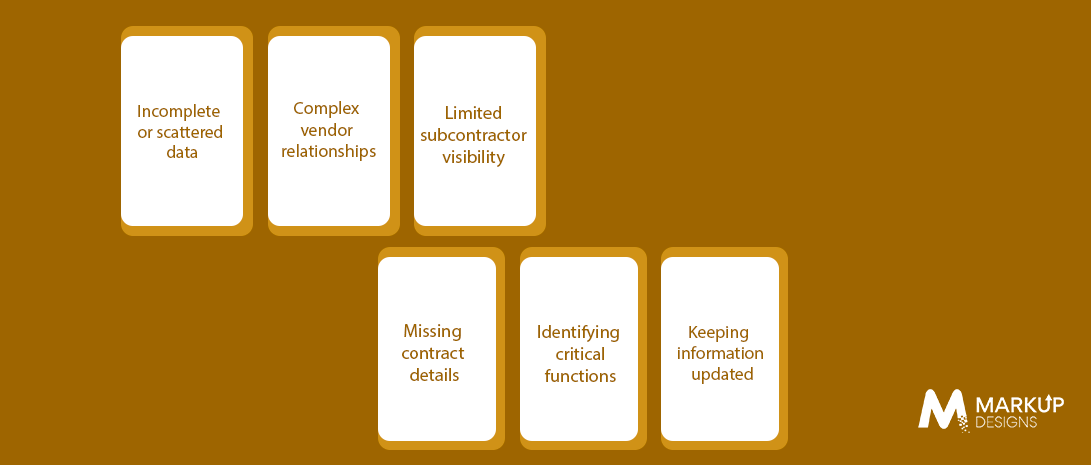
The preparation of a DORA Register of Information becomes difficult when the information is sourced from different departments, systems, and third-party vendors. Identifying these difficulties helps organizations to plan better and avoid unwanted delays.
Incomplete or scattered data
The information related to providers and the associated contract agreements may be dispersed across several systems. Gathering all such information in one place avoids incomplete records.
Complex vendor relationships
One service may have several providers. The mapping of such relations helps organizations identify their technological dependency.
Limited subcontractor visibility
Direct providers do not always provide comprehensive information regarding their subcontractors. Frequent communication and information sharing can help resolve this problem.
Missing contract details
Old contracts or discrepancies in record-keeping can cause data inaccuracies. Reviewing contracts and cross-checking details with legal and procurement departments can help overcome this challenge.
Identifying critical functions
The teams may struggle to identify critical functions or functions that are deemed important. Collaboration with the business owners and risk management team can help address this issue.
Keeping information updated
Changes in service providers, contract renewals, and emerging technology services can cause data to become outdated quickly. Ownership and periodic review of data can help ensure its accuracy.
Overcoming the above challenges will require coordination and reliance on accurate data sources. Organizations can make register management easier and gain insight into ICT third-party risks by addressing these challenges effectively.
Best Practices for Maintaining an Accurate DORA Register of Information
Creation of the register is just a start. The financial organisation will also have to ensure its accuracy with new providers, contracts, and technology services. There are a number of steps that can make it possible.
- Establish Ownership: Make a decision about which department will be in charge of the register and determine the roles of the IT, Procurement, Legal, and Compliance Departments.
- Maintain Centralised Repository: Use a central system for the registration of information about providers, contracts, and ICT services instead of using separate spreadsheets.
- Review Information Regularly: Perform a check of the records against the source documents to find missing and outdated information.
- Track Changes: Create a process for reviewing the register in case of any changes in providers, contracts, and ICT services.
- Improve Team Coordination: Instruct departments to provide timely updates and solve any problems related to the data gaps.
- Comply with Reporting Standards: Use the respective DORA template, completion guidance, and validation requirements.
This enables the organization to keep reliable records without having to treat each reporting period as a fresh project. The standard procedure for review also facilitates easy identification of changes and correction of errors.
How Technology Can Simplify DORA ROI Management
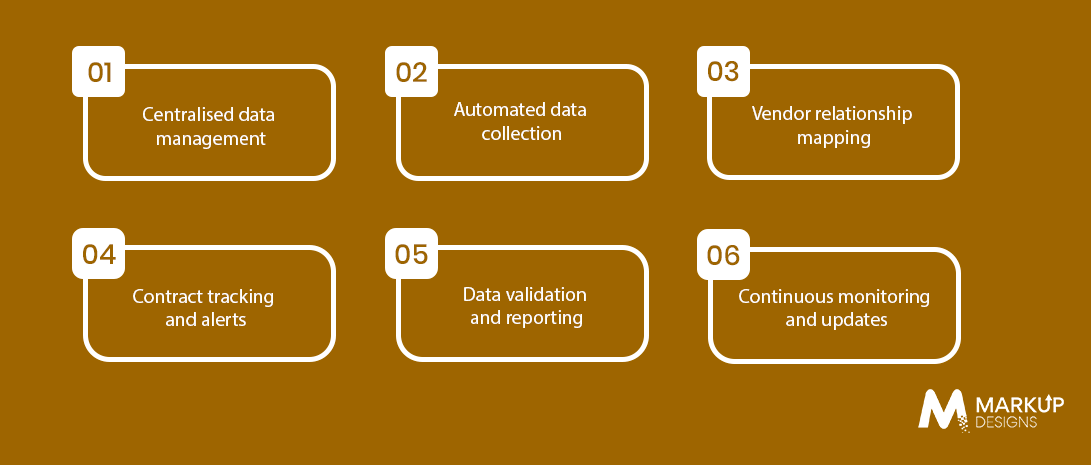
Manual management of a DORA register of information could be cumbersome, especially in cases where the organization deals with several technology providers and thousands of agreements. Proper technology would help you organize your information and cut down on repetitive processes and updates.
The following is how technology can make things easier for you in 6 different ways:
Centralised data management
This involves putting all the details of your providers, contracts, and their services in a centralized location for easy management.
Automated data collection
You can link up with different systems to gather information from different systems like procurement, IT assets, and contract management systems.
Vendor relationship mapping
Mapping ICT providers, subcontractors, and their services in relation to business functions.
Contract tracking and alerts
Create contract renewal and review alerts to enable identification of changes requiring register updates.
Data validation and reporting
Make use of automation for the detection of incomplete records, duplicates, and inconsistencies prior to submission of regulatory reports.
Continuous monitoring and updates
Set up workflows which alert the relevant teams about changes in the information regarding providers/services.
Technology can improve the process of managing the register, but it cannot guarantee compliance alone. Financial organizations need to have source data, data owners, reviews, and processes that satisfy the requirements set out by the DORA regulation.
Combining technology solutions with proper internal processes will help financial organizations keep their records in order.
Why Choose Markup Designs for DORA-Ready Technology Solutions?
DORA compliance requires proper technology, proper handling of data, and coordination between various teams. Markup Designs enables organizations to look into technology solutions that can meet these needs and make things easier. With 14+ years of experience, 200+ experts, and services provided to 500+ companies in UAE, we have experience in software development and digital transformation.
The services we offer include the development of bespoke software, application integration systems, workflow automation, and data management. The above services can assist organizations in linking their systems, minimizing manual entry of data, arranging provider details, and improving access to critical documents. Reporting dashboards and workflows can also be developed in line with the specified needs.
With the help of these technologies, we can help in connecting existing systems, removing manual processes of entering data, organizing the information of providers, etc. We can also help in developing dashboards and workflows on the basis of operational needs.
Each organization has its own systems and needs for compliance. The first step towards finding the best solution is analyzing the existing processes and finding the improvements. Markup Designs can help you find practical technology solutions to manage your data more efficiently and increase digital resilience.
Ready to Simplify Your DORA ROI Management?
Managing ICT records and provider information doesn’t have to be complicated. Markup Designs can help you explore custom technology solutions to organise data, connect systems, and streamline everyday workflows.

Conclusion
The creation of the DORA Register of Information needs a thorough understanding of your ICT services, third-party providers, their contracts, and dependencies. The step-by-step approach will help financial institutions gather the necessary data, identify any gaps, map the relevant subcontractors, and compile the register based on the respective templates of regulators.
At the same time, the creation of the register alone is not enough. Companies need to ensure their accuracy as providers, contracts, and ICT services evolve. It can be achieved by having clearly defined ownership, conducting regular reviews, and collaborating across departments.
It is also possible to leverage technology in order to support the process through centralized data management, integration of systems, automation of workflows, and validation of data.
Ultimately, a properly maintained DORA Register of Information can become a part of the organization’s operational resilience framework.
FAQs
1. Who needs to maintain a DORA Register of Information?
Financial entities within DORA’s scope must maintain a register of their contractual arrangements with ICT third-party service providers. The specific requirements depend on the entity’s regulatory status and organisational structure.
2. What information should a DORA Register of Information include?
The register includes details about financial entities, ICT providers, contractual arrangements, services, supported functions, and relevant subcontracting relationships. Organisations must follow the applicable official templates and completion instructions.
3. How often should a DORA Register of Information be updated?
Organisations should review the register regularly and promptly correct identified errors or inconsistencies. Relevant records should also be updated when contracts, providers, services, or subcontracting arrangements change.
4. Does the DORA Register of Information need to be submitted to a regulator?
Yes. In-scope financial entities must provide the required register information to their competent authorities according to the applicable reporting requirements and instructions.
5. What is the difference between a DORA Register of Information and a vendor register?
A vendor register generally contains basic supplier details and commercial information. A DORA Register of Information follows specific regulatory templates and records contractual arrangements, ICT services, supported functions, and relevant subcontracting relationships.
Author's Perspective
A DORA Register of Information is more than a regulatory record; it helps financial organisations understand their dependence on external technology providers. Maintaining accurate information requires clear ownership, regular reviews, and coordination across departments. Technology can make this work easier by connecting systems, reducing manual tasks, and improving data visibility. Organisations should focus on building a consistent process that keeps the register updated as their technology environment changes. This approach can support better third-party risk management, more efficient reporting, and stronger digital operational resilience.
Discuss Your Project NowAjit Kumar Jha
VP - Business Operations
Insights Are Valuable & Execution is Priceless
You’ve read about the digital future. Now, let’s build the infrastructure to take you there. Move your strategy from the page to the product.
Design Your Solution Now
Contact Us
Schedule The Appointment At Your Convenience Date And Time.
30 Min
Web Conference
Time Zone
Indian standard time (08:30pm)

Thanks For Getting In Touch!
You’ve Taken The First Step Toward Transforming Your Digital Presence. Our Experts Will Reach Out Shortly To Take It Forward.
Launch Your Dream Project
Provide a brief overview of your project, and our specialists will evaluate your requirements. We will connect with you to explore how the right digital solutions can help you launch faster.