
In Brief
- Logistics software allows courier and transportation firms to book shipments, arrange pickups, track in real time, optimize routes, make payments, handle driver activities, and communicate with customers using one integrated system.
- There are several components that a typical courier service such as Aramex comprises, including the customer app, driver app, admin dashboards, and business portal, which are built on the backend infrastructure and integrate with maps, payment gateway, ecommerce platform, ERP systems, and notification services.
- Creating logistics software includes establishing a business model, conducting market research, designing the architecture and user interface, developing key features, integrating third-party software, testing the app, and finally releasing and scaling.
- The development process may cost somewhere between $25,000 (for a simple courier app MVP) to over $250,000 (for a complex platform similar to Aramex), based on the features, platforms, integrations, AI, security, and scalability requirements.
- In the case of firms located in UAE and Saudi Arabia, there are certain factors to consider when creating their logistics app, such as Arabic language support, integration with ecommerce platforms, GPS tracking, secure data storage, and scalable cloud infrastructure.
The process of sending, receiving, and tracking shipments has greatly changed. Shippers now require quick shipping, shipment status updates, easy delivery pickup, and quick customer service. Increased demands have made logistics applications an essential component of modern courier and transport services. The platform, such as Aramex, serves as an example of how a technological solution can link clients, delivery service providers, businesses, and logistics staff within one ecosystem.
A well-designed logistics application can offer more than just tracking of the shipment. It can help with booking shipments, delivery management, optimization of shipping routes, payment management, and even increased operational insight for businesses.
In this blog, we are going to cover the important characteristics of the logistics and courier app, the process of creating a platform similar to Aramex, the cost of development, possible difficulties, and the necessary aspects for companies operating in the UAE and Saudi Arabia.
Why Invest in Logistics App Development?
There is an increased use of technology in logistics as clients and firms demand more convenience and easy tracking of deliveries. Using a logistics application is a perfect solution for delivery firms to achieve this and improve their performance.
Here are some key reasons businesses invest in logistics app development:
- Increased shipment visibility: Customers and businesses can track shipments in real-time and get updates at each significant stage.
- Faster speed of delivery: Automated dispatch and optimization of delivery routes will allow drivers to deliver orders faster.
- Decreased workload: Order booking, delivery assignments, order status tracking, and invoice generation become fully digitized.
- Customer satisfaction: Options such as scheduling pickups, various payment methods, notifications, and support contribute to a better customer experience.
- Fleet management: It becomes easier to manage drivers, delivery trucks, deliveries, and activities.
- Growth of the business: A scalable delivery application can accommodate the increase in customers, delivery partners, number of locations, and deliveries.
For courier businesses, a logistics app is therefore not just a customer-facing tool. It can become the digital backbone of the entire delivery operation.
How Does a Courier Platform Like Aramex Work?
A courier platform such as Aramex involves the integration of clients, couriers, organizations, and administration through an interconnected platform where all parties have what they require for their specific function in the delivery process.
- Customer app: Users can book shipments, set pickup times, calculate shipping costs, select payment options, and track shipments.
- Driver app: Couriers can get shipments assigned, use navigation, manage shipment status, and generate electronic proof of delivery.
- Admin dashboard: Operations managers can manage shipments, couriers, pricing, customer accounts, warehouses, and deliveries.
- Business portal: Businesses can manage bulk shipments, track orders, manage invoicing, and integrate systems using API calls.
Behind these interfaces is a backend that takes care of shipment data, locations, payments, notifications, and integrations. Upon booking a shipment from the customer interface, the system can assign an appropriate driver, direct him in the right way, track shipment information, and notify the customer regarding his package at each stage.
This interconnected solution enables courier companies to deliver packages and give more transparency to their customers.
Essential Features of a Logistics and Courier App
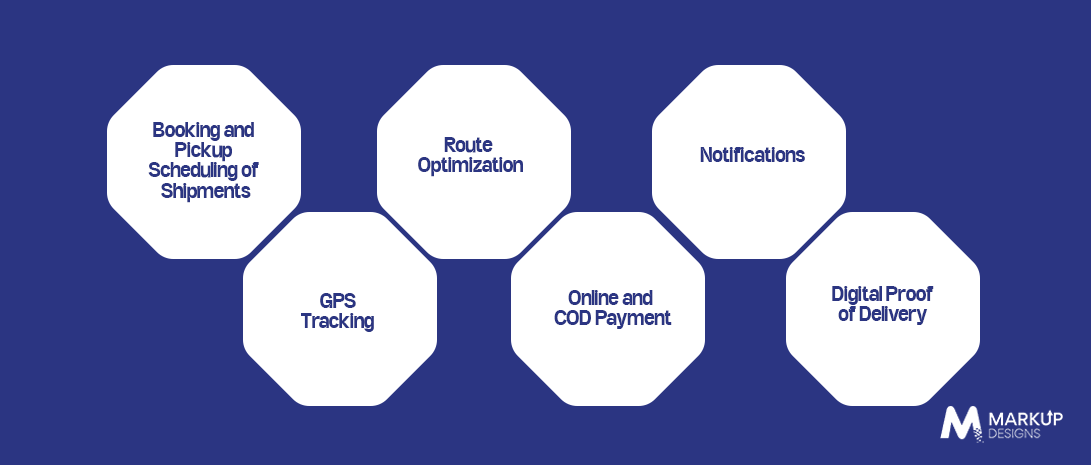
A successful logistics app needs features that make shipping simple for customers while helping courier teams manage deliveries efficiently. The exact feature set can vary based on the business model, but several capabilities are essential.
- Booking and Pickup Scheduling of Shipments: Customers will have the option to book their shipments and set preferred pickup times.
- GPS Tracking: Users can check the progress of their shipments as well as get updated information about the delivery.
- Route Optimization: The route optimization feature will help in making smart decisions by drivers regarding the route they should take.
- Online and COD Payment: The application will provide the option of COD payment to users as well as facilitate online payments.
- Notifications: Automated notifications about shipment pickup, tracking, delays, and delivery completion will be sent automatically to the users.
- Digital Proof of Delivery: Drivers can digitally collect signatures of delivery from their customers through the mobile app.
Other useful capabilities can include a rate calculator, address management, customer support, ratings, multilingual support, and shipment history. Together, these features create a smoother experience for both customers and logistics teams.
How to Build a Logistics App Like Aramex?
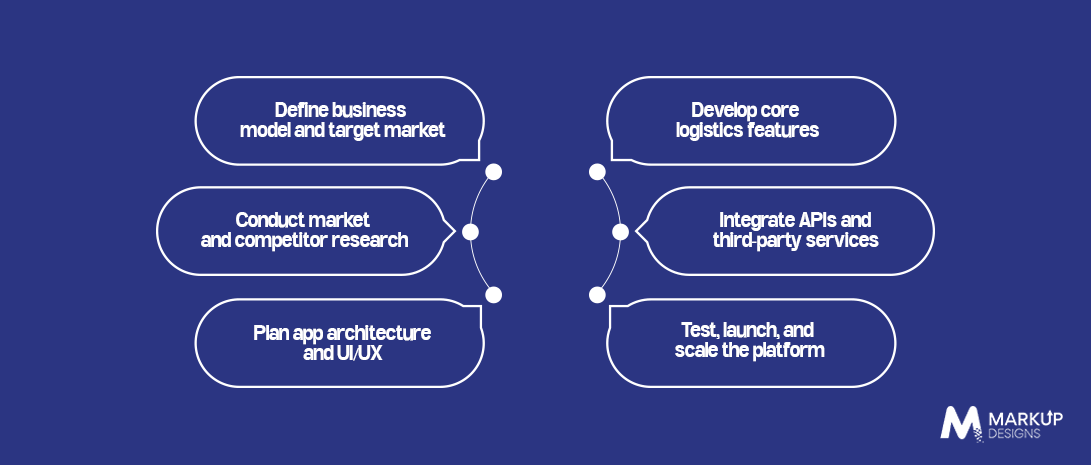
Designing a logistics app such as Aramex is not just about building a mobile app but also designing the whole system, which comprises customer and driver apps, an administration panel, a backend, as well as integrating third-party applications.
Define business model and target market
To begin with, you should be clear if the platform will provide shipping for B2B, courier service for B2C, last-mile delivery, e-commerce fulfillment, express deliveries or a mix of everything.
Conduct market and competitor research
This step will involve studying the customer, competition, delivery expectations, price models, and region-specific requirements.
Plan app architecture and UI/UX
Create simple flows for customers, drivers, and administrators. With that, build a scalable backend that is capable of handling growing numbers of shipments.
Develop core logistics features
Develop core features like booking, tracking, driver management, route planning, notifications, payments, and shipment management.
Integrate APIs and third-party services
Implement integrations for maps, payment gateways, SMS and OTP, e-commerce platforms, ERP, and other logistics apps, if needed.
Test, launch, and scale the platform
Conduct testing of your platform for performance, security, GPS, payments, and multiple devices. Then launch an MVP or choose to go with a specific market and scale further.
Build a Smarter Logistics Platform
Ready to turn your courier or delivery idea into a scalable digital platform? Markup Designs can help you build a logistics app with shipment tracking, fleet management, route optimization, payment integration, and other essential capabilities.

How Much Does It Cost to Develop a Logistics App Like Aramex?
The cost of developing a logistics application like Aramex is dependent on several factors, including the functionality of the platform to be created, level of integration, complexity, design, and the developer team. An MVP for courier services will be cheaper than a full-fledged ecosystem with apps for customers and drivers, among other features.
| App Type | Estimated Cost |
| The number | |
| Mid-Level Logistics Platform | $50,000–$100,000 |
| Advanced Aramex-Like Platform | $100,000–$250,000+ |
Several factors can influence the final development cost:
- Number of platforms: Customer app, driver app, admin panel, and business portal will increase the development cost.
- Complexity of features: AI-based route planning, prediction algorithms, fleet management, and automation involve extra development.
- Third-party integrations: Integration with maps, payment gateways, SMS services, e-commerce platforms, ERP systems, and warehousing solutions can increase integration costs.
- Security and scalability: A platform processing high amounts of shipments should be secure and scalable, requiring a robust backend, security measures, and cloud infrastructure.
Starting with an MVP can help businesses validate the concept before investing in advanced features and larger-scale expansion.
Key Challenges in Building a Logistics App
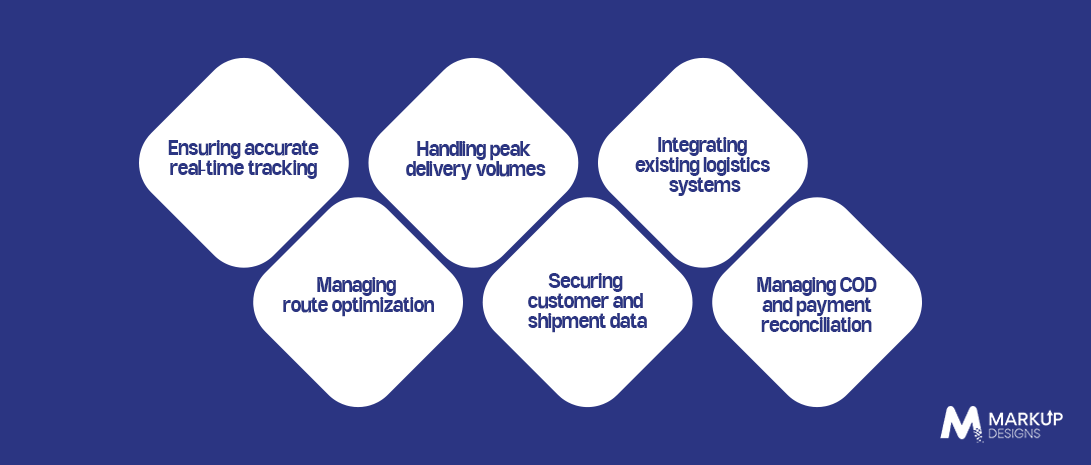
Developing a logistics platform involves various operational and technical hurdles. Resolving these issues earlier can result in a reliable and scalable logistics delivery system.
Ensuring accurate real-time tracking
Keeping up-to-date about the location and progress of shipments can be difficult if there are connectivity issues.
Managing route optimization
Traffic, road conditions, priority of deliveries, and other variables have to be taken into account for efficient routing.
Handling peak delivery volumes
High loads during peak seasons can stress out the drivers, servers, warehouses, and customer service teams.
Securing customer and shipment data
The security of customer details, their addresses, payment details, and shipment data must be ensured.
Integrating existing logistics systems
Integration with payment services, map service providers, e-commerce platforms, ERP systems, and logistics applications should be carefully managed.
Managing COD and payment reconciliation
Management of cash on delivery and payments needs to be accurate and effective.
A scalable architecture, testing, integrations, and monitoring can assist organizations in dealing with these challenges as the platform scales.
Logistics App Development for UAE and Saudi Arabia
UAE and Saudi Arabia have been making huge investments in digitization, e-commerce, and logistics, which offer excellent prospects for courier service platforms. Nevertheless, an app meant to serve these regions should consider certain aspects like customer expectations, methods of payment, languages, and business needs.
UAE Logistics App Development
A logistics application for UAE must include capabilities such as speed, digital payments, GPS, ecommerce and multilingual support. The business might also consider additional capabilities such as VAT invoice processing, express delivery and smart city logistics capabilities.
Saudi Arabia Logistics App Development
For the market of Saudi Arabia, Arabic and RTL capabilities can be very important for developing a comfortable user experience. Payment methods, last-mile delivery capabilities, e-commerce capabilities, and fleet management can also be crucial.
For both markets, the business must consider additional aspects such as privacy laws, payment laws, and other regulations that apply to the business. A flexible and scalable design can make future expansion into other cities and even other GCC countries easier.
Why Choose Markup Designs for Logistics App Development?
The choice of the right development partner may significantly affect the creation of a logistics platform. Markup Designs is a company specializing in development of digital products for user experience and business processes.
When developing logistics apps, our specialists will be able to help your company create:
- Applications for customers and drivers allowing to manage deliveries efficiently.
- Administration and business dashboards for tracking operations, deliveries, drivers and their performance.
- Real-time tracking and route management for increasing efficiency of deliveries.
- Integration with third-party services such as maps, payment gateways, e-commerce, ERP and other business applications.
- Artificial intelligence and automation technologies for routing, forecasting, customer service and making decisions.
- Cloud-based infrastructure which would allow your company to manage growing number of deliveries and expand its presence in other markets.
Markup Designs is ready to offer you professional assistance in all stages of logistics app development – from planning and designing user interface through development, testing, launch and improvements.
Take Your Logistics Business Digital
Whether you are building a courier startup or modernizing an existing logistics operation, the right technology can help you manage deliveries more efficiently and provide customers with greater visibility.

Conclusion
The emergence of logistics app development is aiding courier and transportation companies to shift from traditional to faster and more integrated workflows. An app inspired by Aramex will allow you to manage booking services, delivery tracking, routes, payments, operations of drivers and communications with customers all in one digital environment.
However, creating an efficient logistics platform means more than just developing numerous additional features. The logistics app should be easy to use, have reliable tracking, data security, integration and scalable architecture capable of supporting rising delivery volumes.
It’s important to pay attention to the localization of the application in case you develop the platform for business in UAE, Saudi Arabia and other GCC countries. The support of Arabic language, right-to-left interface, regional payment systems and delivery requirements will make the application more relevant to its target audience.
With a proper development approach and technology company, businesses can create an efficient logistics platform that will optimize their operational performance and provide better delivery experience to customers.
FAQs
1. How much does it cost to develop a logistics app like Aramex?
The cost can range from around $25,000 for a basic courier MVP to $250,000 or more for an advanced platform with multiple apps, dashboards, integrations, automation, and AI features.
2. How long does it take to build a logistics app?
Development time depends on the platform’s complexity. A basic MVP may take a few months, while a large-scale logistics ecosystem can require significantly more time.
3. What features should a logistics app have?
Important features include shipment booking, pickup scheduling, GPS tracking, route optimization, payments, notifications, driver management, and digital proof of delivery.
4. Can a logistics app support both B2B and B2C deliveries?
Yes. A well-planned logistics platform can support individual customers, ecommerce businesses, corporate clients, and other shipping partners through different workflows and dashboards.
5. Can I build a logistics app for UAE and Saudi Arabia?
Yes. The platform can be designed for regional requirements, including Arabic and RTL support, local payment options, GPS tracking, e-commerce integration, and applicable security and privacy requirements.
Author's Perspective
The future of logistics is increasingly connected, automated, and customer-focused. From real-time tracking to AI-powered route planning, digital platforms are changing how courier businesses manage deliveries and serve customers.
For businesses planning to build a logistics app like Aramex, the focus should not be on copying an existing platform feature by feature. Instead, the goal should be to understand the target market, identify operational gaps, and build a platform that solves real customer and business problems.
A strong logistics app should be easy to use, reliable during everyday operations, secure enough to handle sensitive information, and flexible enough to grow with the business. With the right technology strategy, businesses can turn logistics apps into a long-term digital asset rather than simply another delivery tool.
Discuss Your Project NowJupinder Singh Arora
Founder and CEO
Insights Are Valuable & Execution is Priceless
You’ve read about the digital future. Now, let’s build the infrastructure to take you there. Move your strategy from the page to the product.
Design Your Solution Now
Contact Us
Schedule The Appointment At Your Convenience Date And Time.
30 Min
Web Conference
Time Zone
Indian standard time (08:30pm)

Thanks For Getting In Touch!
You’ve Taken The First Step Toward Transforming Your Digital Presence. Our Experts Will Reach Out Shortly To Take It Forward.
Launch Your Dream Project
Provide a brief overview of your project, and our specialists will evaluate your requirements. We will connect with you to explore how the right digital solutions can help you launch faster.