
In Brief
- Understand the essential cybersecurity controls required to protect modern FinTech applications.
- Explore how identity, data, API, payment, and application security controls work together.
- Learn how to embed security across the FinTech application development lifecycle.
- Examine key compliance requirements and common cybersecurity challenges in financial applications.
- Discover practical ways to implement, monitor, and continuously strengthen FinTech security.
Financial applications handle highly sensitive information, real-time transactions, digital identities, and payment data, making them attractive targets for cyberattacks. A vulnerability in an API, authentication mechanism, application layer, or third-party integration can expose customer data or disrupt critical financial operations. For FinTech businesses, cybersecurity therefore needs to be built into the application’s architecture rather than added after development.
A secure FinTech application requires multiple controls working together across identity management, data protection, APIs, transactions, infrastructure, and continuous monitoring. Security also needs to remain part of the development lifecycle as applications evolve and new threats emerge. This guide explores the essential cybersecurity controls for FinTech applications, along with implementation practices that can help businesses protect financial data, reduce attack exposure, and maintain regulatory compliance.
Why FinTech Applications Need Strong Cybersecurity Controls
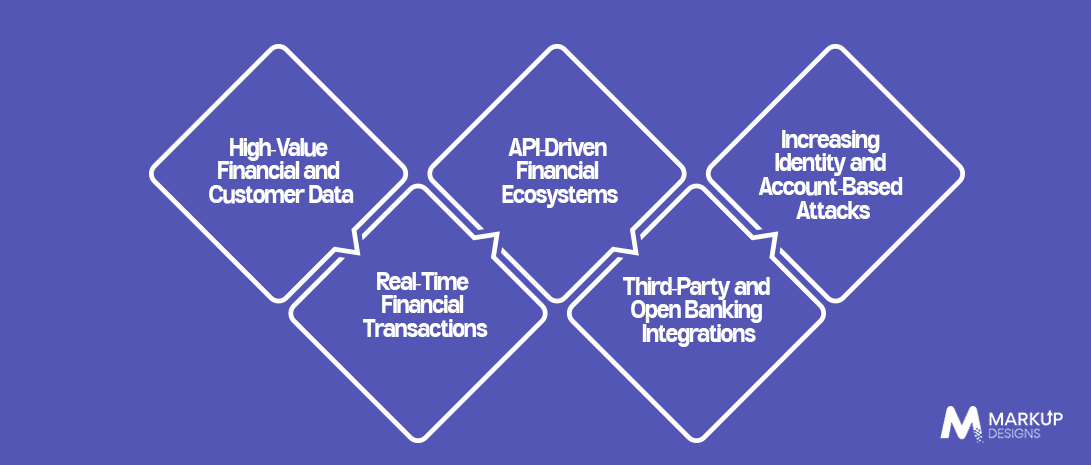
High-Value Financial and Customer Data
FinTech applications process sensitive information such as account details, payment data, personal information, and financial records. A security breach can expose this data to fraud, identity theft, and financial loss. Strong access controls, encryption, and data protection measures are therefore essential from the application’s earliest design stages.
Real-Time Financial Transactions
Financial applications often process transactions within seconds, leaving little room for security checks that delay legitimate activity. Security controls need to identify suspicious transactions without creating unnecessary friction for genuine users. Transaction monitoring, authentication, limits, and fraud detection can help protect financial operations in real time.
API-Driven Financial Ecosystems
APIs connect FinTech applications with banks, payment providers, financial platforms, and internal services. Poorly secured APIs can expose sensitive data or provide attackers with an entry point into connected systems. Strong authentication, authorisation, validation, rate limiting, and continuous monitoring are critical for reducing API-related risks.
Third-Party and Open Banking Integrations
FinTech platforms increasingly depend on external providers for payments, identity verification, banking connectivity, analytics, and other services. Each integration introduces additional security considerations. Businesses need to assess third-party risks, control data access, and continuously monitor connected services rather than assuming external providers are secure by default.
Increasing Identity and Account-Based Attacks
Attackers increasingly target user credentials and accounts through phishing, credential stuffing, social engineering, and other techniques. Strong authentication, multi-factor authentication, behavioural monitoring, and risk-based access controls can help prevent unauthorised account access and reduce identity-related fraud.
Essential Cybersecurity Controls for FinTech Applications
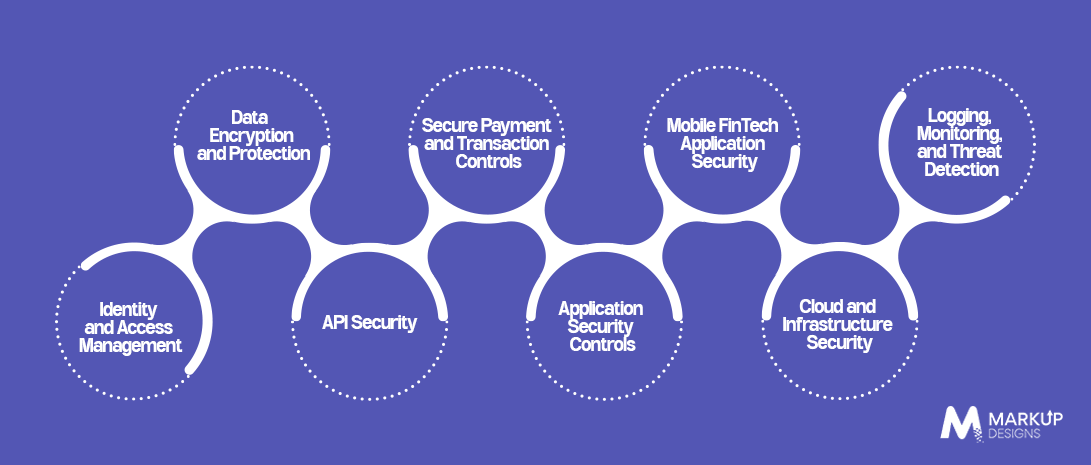
Identity and Access Management
FinTech applications should ensure that users and employees can access only the resources they are authorised to use. Multi-factor authentication, role-based access control, privileged access management, and secure session management help strengthen identity security while limiting the impact of compromised accounts.
Data Encryption and Protection
Sensitive financial and customer information should be protected throughout its lifecycle. Encryption should be applied to data both in transit and at rest, supported by secure key management practices. Tokenisation, data masking, and tightly controlled access can provide additional protection for highly sensitive information.
API Security
APIs need security controls that protect both the data they expose and the systems they connect. Strong authentication and authorisation should be combined with input validation, rate limiting, throttling, and protection against common API vulnerabilities. Continuous API logging and monitoring can also help identify unusual activity.
Secure Payment and Transaction Controls
Payment workflows require controls that verify transactions before they are processed. Transaction authentication, configurable limits, velocity checks, risk-based monitoring, and real-time fraud detection can help identify suspicious activity. Integrity checks can further ensure that transaction information has not been altered during processing.
Application Security Controls
Security should be incorporated into application development rather than addressed only before deployment. Secure coding practices, input validation, output encoding, secure session handling, and protection against common application vulnerabilities can reduce the attack surface. Regular security testing helps identify weaknesses before they reach production.
Mobile FinTech Application Security
Mobile financial applications require protection at both the application and device levels. Secure local storage, biometric authentication, application integrity checks, and protected network communication can reduce exposure to common mobile threats. Measures against reverse engineering and tampering can provide an additional layer of application protection.
Cloud and Infrastructure Security
Cloud-based FinTech applications require secure configurations, controlled infrastructure access, network segmentation, and continuous vulnerability management. Security controls should extend across computing resources, databases, storage, and connected services. Reliable backups and disaster recovery measures also help maintain financial services during security incidents or infrastructure failures.
Logging, Monitoring, and Threat Detection
Continuous visibility is essential for detecting suspicious activity and investigating security incidents. Centralised logging can bring authentication events, transactions, API activity, and system events into a common monitoring environment. Real-time alerts, escalation workflows, and detailed audit trails help security teams respond more quickly to potential threats.
Read Also: Cybersecurity Risk Management: Strategies, Frameworks, and Best Practices
FinTech Cybersecurity Controls Across the Application Lifecycle
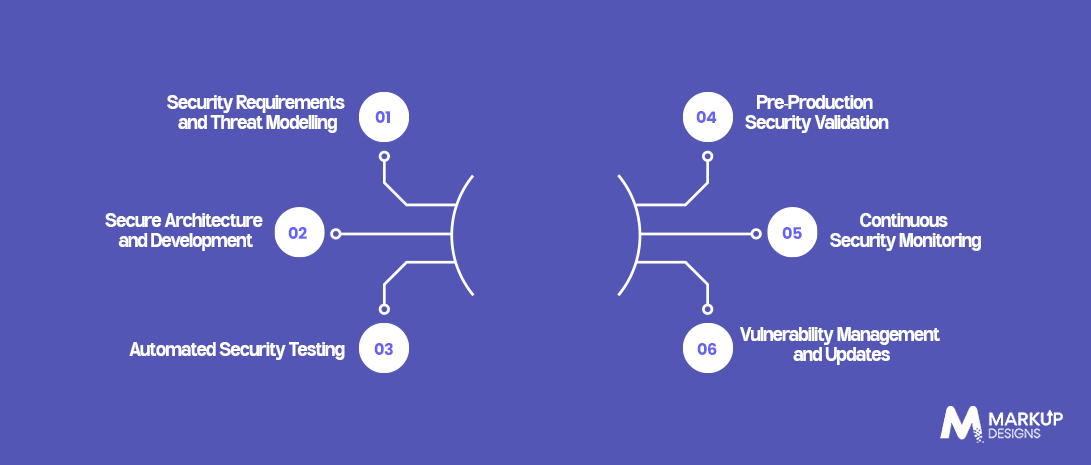
Security Requirements and Threat Modelling
Identify sensitive assets, potential attack paths, regulatory requirements, and security objectives before development begins. Threat modelling helps teams understand where an application could be attacked and determine which controls should be built into its architecture.
Secure Architecture and Development
Design the application around principles such as least privilege, secure authentication, data protection, and defence in depth. Development teams should follow secure coding practices and incorporate security requirements into the design and development process.
Automated Security Testing
Automated testing can identify vulnerabilities throughout development without relying entirely on manual security reviews. SAST, DAST, dependency scanning, API testing, and other automated checks can help detect issues earlier in the development lifecycle.
Pre-Production Security Validation
Before release, applications should undergo deeper security validation to identify vulnerabilities that automated development checks may miss. Penetration testing, configuration reviews, access-control testing, and compliance validation can help establish production readiness.
Continuous Security Monitoring
Security does not end when an application goes live. Continuous monitoring helps detect suspicious behaviour, unusual access patterns, emerging vulnerabilities, and potential attacks as they occur.
Vulnerability Management and Updates
FinTech applications need a defined process for identifying, prioritising, and remediating vulnerabilities. Regular patching, dependency updates, security assessments, and remediation tracking help prevent known weaknesses from becoming exploitable entry points.
Regulatory and Compliance Considerations for FinTech Security
PCI DSS
For applications that store, process, or transmit payment card data, PCI DSS provides security requirements for protecting cardholder information. Controls around access, encryption, monitoring, testing, and vulnerability management should be incorporated according to the organisation’s applicable PCI DSS scope.
SOC 2
SOC 2 evaluates controls related to areas such as security, availability, processing integrity, confidentiality, and privacy. FinTech businesses can use SOC 2-aligned controls to demonstrate that appropriate safeguards are in place for managing customer and operational data.
ISO 27001
ISO 27001 provides a framework for establishing and continually improving an information security management system. Its risk-based approach can help FinTech organisations formalise security policies, controls, responsibilities, and continuous improvement processes.
GDPR and Data Privacy Requirements
FinTech applications handling personal data may need to comply with GDPR or other applicable privacy regulations. Data minimisation, access controls, encryption, retention policies, and appropriate privacy processes should be considered throughout the application lifecycle.
Regional Financial Regulations
FinTech businesses may also be subject to financial and cybersecurity regulations specific to the countries and markets in which they operate. Requirements can vary based on the type of financial service, customer data processed, payment activities, and regulatory jurisdiction. Security architecture and compliance controls should therefore be mapped to the applicable regional requirements.
Common FinTech Cybersecurity Challenges
Balancing Security With User Experience
Financial applications need strong security without making routine transactions unnecessarily difficult. Excessive authentication steps can frustrate users, while weak controls can increase security exposure. Risk-based authentication and adaptive security measures can help maintain this balance.
Securing Legacy Systems and Modern APIs
Many FinTech businesses operate with legacy financial systems alongside newer applications and APIs. Connecting these environments can introduce security gaps if older systems lack modern security capabilities. Secure integration, access controls, and continuous monitoring are important for reducing this risk.
Managing Third-Party Security Risks
External payment providers, banking services, cloud platforms, and technology vendors expand the FinTech ecosystem but also increase its attack surface. Organisations need to assess third-party security practices, control data access, and monitor integrations throughout their lifecycle.
Preventing Account Takeover and Identity Fraud
Compromised credentials can give attackers direct access to financial accounts and sensitive information. Multi-factor authentication, behavioural analysis, device intelligence, and transaction monitoring can help identify suspicious access and reduce account takeover risks.
Protecting Against Insider Threats
Employees and privileged users may unintentionally or deliberately expose sensitive financial information. Role-based access, least-privilege permissions, activity monitoring, and segregation of duties can limit unnecessary access and make unusual activity easier to detect.
Maintaining Security Across Rapid Release Cycles
FinTech applications often evolve quickly to introduce new features and respond to market requirements. Frequent releases can create vulnerabilities when security testing is treated as a final-stage activity. Integrating security checks into development and deployment processes helps maintain protection without slowing delivery unnecessarily.
Best Practices for Strengthening FinTech Cybersecurity
Adopt a Layered Security Architecture
No single security control can protect a financial application from every threat. Combining identity security, encryption, API protection, application security, infrastructure controls, monitoring, and incident response creates multiple defensive layers.
Implement Zero Trust Access Controls
Zero Trust assumes that access should not be automatically trusted based on a user’s location or network. Verify users, devices, and access requests continuously, while limiting permissions according to business requirements and risk.
Secure APIs From Design to Deployment
API security should be considered from architecture through production monitoring. Use strong authentication, authorisation, input validation, rate limiting, secure configurations, and continuous testing to protect APIs and the financial data they expose.
Automate Security Testing and Monitoring
Automation can bring security checks into development pipelines and continuously monitor production environments. Vulnerability scanning, dependency checks, API testing, threat detection, and automated alerts can help security teams identify issues earlier.
Apply Least-Privilege Access
Users, applications, and services should receive only the permissions required to perform their intended functions. Regularly reviewing and removing unnecessary privileges reduces the potential impact of compromised accounts or credentials.
Conduct Regular Security Assessments
Security assessments should cover applications, APIs, infrastructure, third-party integrations, and access controls. Regular penetration testing, vulnerability assessments, and configuration reviews can uncover weaknesses that need remediation.
Maintain an Incident Response and Recovery Plan
Even strong security controls cannot eliminate every cyber risk. A defined incident response plan helps teams detect, contain, investigate, and recover from security events while reducing disruption to financial services.
How AI Is Transforming FinTech Cybersecurity
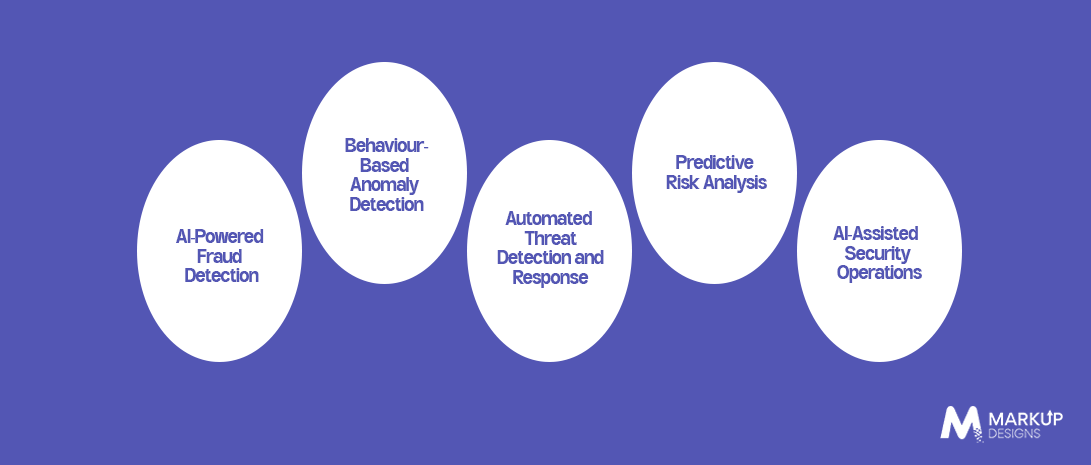
AI-Powered Fraud Detection
AI can analyse transaction patterns, customer behaviour, and historical data to identify potentially fraudulent activity. This can help security teams detect suspicious transactions more quickly and distinguish unusual behaviour from legitimate activity.
Behaviour-Based Anomaly Detection
AI models can establish behavioural patterns for users, devices, and transactions and flag activity that deviates significantly from those patterns. This provides an additional layer of detection for account compromise and suspicious access.
Automated Threat Detection and Response
AI-powered security systems can analyse large volumes of security events and identify potential threats without relying entirely on manual investigation. When combined with appropriate safeguards, automated responses can help contain certain threats more quickly.
Predictive Risk Analysis
Historical security and transaction data can be analysed to identify patterns associated with future risks. Predictive insights can help FinTech teams prioritise vulnerabilities, monitor high-risk activities, and allocate security resources more effectively.
AI-Assisted Security Operations
AI can support security teams by summarising alerts, correlating events, identifying patterns, and assisting with investigations. Human oversight remains important, particularly when AI-driven decisions could affect financial transactions or customer access.
FinTech Cybersecurity Implementation Roadmap
Step 1: Assess the Existing Security Environment
Begin by reviewing the current application architecture, infrastructure, APIs, access controls, data flows, and security processes. Identify existing vulnerabilities, compliance gaps, and areas that require immediate attention.
Step 2: Identify Critical Assets and Attack Surfaces
Map sensitive financial data, customer information, payment workflows, APIs, third-party connections, and critical infrastructure. Understanding where valuable assets exist helps teams prioritise the most important security controls.
Step 3: Define Security Controls and Compliance Requirements
Establish security requirements based on business risks, application functionality, regulatory obligations, and industry standards. Map these requirements to specific controls, responsibilities, and testing processes.
Step 4: Implement Security Across Application and Infrastructure Layers
Deploy appropriate controls across identity, data, APIs, applications, cloud infrastructure, networks, and payment workflows. Security should be implemented as a connected architecture rather than as isolated tools.
Step 5: Integrate Monitoring and Threat Detection
Centralise relevant security logs and establish monitoring for authentication events, transactions, APIs, infrastructure, and application activity. Configure alerts and response workflows for suspicious behaviour and security incidents.
Step 6: Test, Audit, and Continuously Improve
Validate security controls through vulnerability assessments, penetration testing, audits, and ongoing monitoring. Use the findings to address weaknesses and continuously improve the security environment as applications and threats evolve.
Measuring the Effectiveness of FinTech Cybersecurity Controls
Security performance should be measured through both technical and business outcomes. Key indicators can include:
- Security incidents: Number, severity, and impact of successful security incidents.
- Vulnerability remediation time: How quickly identified vulnerabilities are addressed.
- Authentication violations: Frequency of suspicious or unauthorised access attempts.
- Fraud detection rates: Effectiveness of systems in identifying and preventing fraudulent activity.
- Compliance performance: Security audit results and unresolved compliance gaps.
- Security testing coverage: Percentage of applications, APIs, and infrastructure regularly assessed.
- Mean time to detect and respond: How quickly teams identify and contain security incidents.
How Markup Helps Build Secure FinTech Applications
Markup helps businesses build FinTech applications with security considered across architecture, development, integration, and ongoing operations. Our approach combines application engineering with security controls designed around the specific requirements of financial platforms.
FinTech Application Security Consulting
We help businesses assess application risks, define security requirements, and establish an architecture that supports secure financial operations.
Secure Application Architecture
Our teams design security into application architecture, including identity management, data protection, access controls, APIs, and infrastructure.
API and Payment Security
We implement controls for securing APIs and payment workflows, helping protect transaction data and reduce exposure to unauthorised access and fraud.
Identity and Access Management
We can integrate authentication, multi-factor authentication, role-based access, and other access controls to protect users, employees, and privileged systems.
Data Protection and Encryption
Sensitive financial and customer data can be protected through encryption, secure storage, tokenisation, controlled access, and appropriate data management practices.
Security Testing and Compliance Support
Security testing can be incorporated throughout the development lifecycle to identify vulnerabilities and support relevant regulatory and compliance requirements.
AI-Powered Fraud and Threat Detection
AI capabilities can be integrated into suitable use cases such as fraud detection, anomaly identification, risk analysis, and security monitoring.
Ongoing Security Monitoring and Optimisation
Security requires continuous attention after deployment. We help businesses monitor their applications, address vulnerabilities, and improve security controls as their technology environment evolves.
FAQs
What are the essential cybersecurity controls for FinTech applications?
Key controls include identity and access management, encryption, API security, transaction protection, application security, cloud security, monitoring, threat detection, and incident response. The specific controls required depend on the application’s architecture, data, financial services, and regulatory environment.
How can FinTech applications protect sensitive financial data?
FinTech applications can use encryption in transit and at rest, secure key management, tokenisation, access controls, data masking, and appropriate data retention practices. Security controls should protect data throughout its lifecycle rather than only at the storage layer.
How can APIs be secured in FinTech applications?
APIs should use strong authentication and authorisation alongside input validation, rate limiting, secure configurations, monitoring, and regular security testing. Access should also be restricted according to the specific data and functionality each API needs to expose.
What security standards should FinTech applications follow?
The applicable standards depend on the application and market. Common considerations include PCI DSS, SOC 2, ISO 27001, GDPR, and regional financial regulations. Businesses should determine requirements based on the financial services they provide and the jurisdictions in which they operate.
How can AI improve FinTech cybersecurity?
AI can support fraud detection, behavioural anomaly detection, threat analysis, predictive risk assessment, and security operations. However, AI should complement established security controls rather than replace them, with appropriate human oversight for high-impact decisions.
Build a More Secure FinTech Application
Protect financial data, digital identities, and transactions with security controls built into your FinTech application from the start.

Conclusion
FinTech cybersecurity requires more than protecting a single application layer. Financial platforms need coordinated controls across identity, data, APIs, transactions, infrastructure, third-party integrations, and continuous monitoring. Building these controls into the development lifecycle can help organisations reduce vulnerabilities while maintaining the performance and user experience expected from modern financial applications.
As FinTech ecosystems become increasingly connected, security also needs to evolve continuously. Regular testing, risk assessment, monitoring, and targeted use of automation and AI can help businesses respond to emerging threats while maintaining stronger control over sensitive financial operations.
Author's Perspective
In my view, the biggest cybersecurity mistake in FinTech is treating security as a final checkpoint before launch. Financial applications change too quickly and handle too much sensitive information for that approach to work. Security needs to influence architecture, development, integrations, transactions, and user access from the beginning.
I also believe AI should be adopted selectively rather than treated as a replacement for fundamental security controls. Strong authentication, least-privilege access, secure APIs, encryption, monitoring, and regular testing remain the foundation. AI becomes genuinely valuable when it strengthens these controls and helps security teams detect and respond to risks faster.
Discuss Your Project NowJupinder Singh Arora
Founder and CEO
Related Posts

Neobank App Development Cost: Enterprise Banking Guide for...
Cybersecurity Risk Management: Strategies, Frameworks, and Best Practices
Cybersecurity in Banking: Challenges, Best Practices, and Future...
Insights Are Valuable & Execution is Priceless
You’ve read about the digital future. Now, let’s build the infrastructure to take you there. Move your strategy from the page to the product.
Design Your Solution Now
Contact Us
Schedule The Appointment At Your Convenience Date And Time.
30 Min
Web Conference
Time Zone
Indian standard time (08:30pm)

Thanks For Getting In Touch!
You’ve Taken The First Step Toward Transforming Your Digital Presence. Our Experts Will Reach Out Shortly To Take It Forward.
Launch Your Dream Project
Provide a brief overview of your project, and our specialists will evaluate your requirements. We will connect with you to explore how the right digital solutions can help you launch faster.