

In Brief
- The EdTech industry in Australia is growing rapidly due to the introduction of digital methods of learning, the use of AI, and the increasing demand for more flexible education.
- The successful development of an EdTech application requires an understanding of the needs of learners, good UX design, a scalable technical architecture, and compliance with the law in terms of education and privacy in Australia.
- The use of AI-based features creates new opportunities for learning platforms, including personalisation, intelligent tutoring, automated assessment, and learning analytics.
- The costs and timeframes for development depend on factors such as complexity of the platform, technological advancements, integration, and security needs.
- Choosing the right EdTech app development team helps to achieve faster results, meet the requirements of laws, save budget, and get a product that is ready for future usage.
The education industry in Australia is transforming digitally. Schools, universities, Registered Training Organisations, and enterprises are increasingly utilising technology-based education solutions to make the learning process engaging and easy.
The challenges posed by new technologies and innovations in artificial intelligence, cloud computing, adaptive learning, and data analytics make it possible to rush technological advancements in the industry.
From AI-powered tutors and automated assessments to personalised learning pathways and real-time performance tracking, modern educational applications are reshaping how people learn and teach. In this blog, we’ll walk you through everything you need to know about building an EdTech app in Australia for 2026, including essential features, development steps, technology stack, compliance requirements, costs, timelines, and the latest industry trends to help you launch a scalable and future-ready solution.
Australia’s EdTech Landscape in 2026
Australia’s education sector is responding to the need for digital transformation, as demands for flexible and customized learning continue to rise. Investments in education technology are increasing, and new technology, such as AI, is being integrated into the educational framework, which is leading the EdTech market in Australia.
Growth of the Australian EdTech Market
The Australian EdTech market is growing rapidly as educational institutions and corporate organizations are utilizing technology in their teaching and operations. The growing demand for the use of e-learning systems has led to growth in the sector.
Government Initiatives Propelling Towards Digital Education
The role of the government in promoting digital education cannot be ignored, as various initiatives are taken to endorse the use of technology in teaching. Moreover, the need for responsible use of AI and privacy of data is also promoted.
AI and Personalized Learning Taking Education by Storm
AI is helping in making the educational systems more interactive and personalized, as it helps in administering students with their pace of learning and enables them to assess themselves.
Why Australia Is an Ideal Market for EdTech Innovation
A strong digital infrastructure, widespread internet access, growing investment in educational technology, and increasing demand for lifelong learning make Australia an attractive market for developing and scaling innovative EdTech solutions.
What Is an EdTech App?
EdTech applications act as digital platforms aimed at improving the teaching, learning, and skill development process. The efficacy of these apps lies in their embracing of cutting-edge technologies, such as cloud services, AI, analytics, and video conferencing to make learning engaging and personalized and also available to a diverse audience, including school or university students, or corporate training applicants.
Understanding Current EdTech Software
Modern-day EdTech software goes beyond simply enrolling people into online courses. These applications offer numerous advantages, such as virtual classrooms, interactive learning, progress tracking, assessments, collaboration, and AI-assisted programs that allow for constant improvement of learning conditions.
Benefits of EdTech Apps Compared to Conventional Educational Software
Unlike traditional educational software whose main function lies in delivering static material to users, modern EdTech applications offer learners personalized learning journeys as well as adaptive tests, collaborative learning experiences, and AI-enabled learning.
Types of EdTech Apps
EdTech tools have various functions and are applied in different fields of education and professional development.
- K-12 Learning Apps: Provide school students with quizzes or tasks, organize virtual classrooms, and other interactive means of learning.
- Higher Education Platforms: Help universities with organizing their courses.
- Corporate Learning Apps: Enable employee training, compliance programmes, and professional development.
- Language Learning Apps: Help users develop language skills through interactive lessons and AI-driven practice.
- Skill Development Platforms: Provide industry-relevant programs for the improvement of technical and vocational skills.
- Test Preparation Apps: Help the learners prepare for competitive tests through practice exams, questions, and tracking the performance of the learners.
- Tutor Marketplace Apps: Provide the students with qualified tutors for individual and group learning, both online and in-person.
- Learning Management Systems (LMS): Centralize course management, student tracking, assessments, and certification.
Key Users Groups for EdTech Apps in Australia
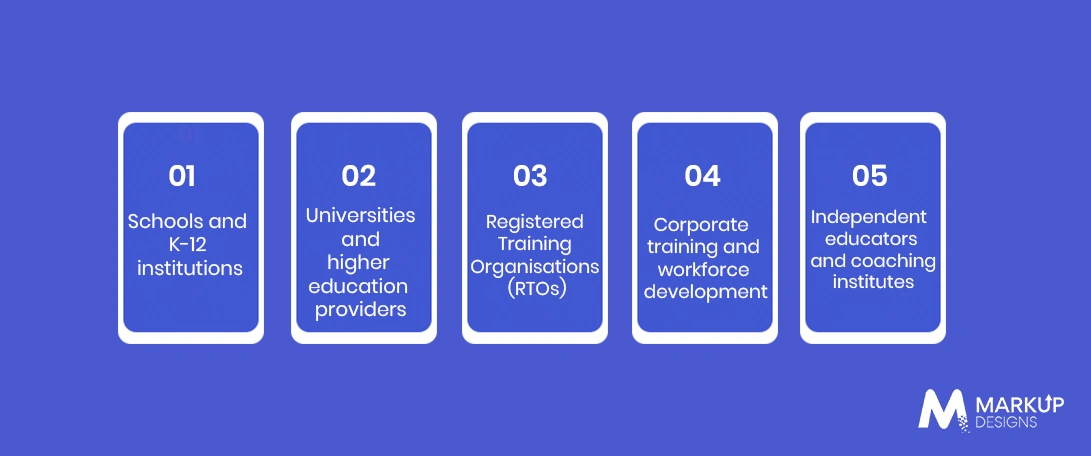
EdTech apps have different users depending on their needs. When it comes to understanding your target audience, you can learn about different types of learners and institutions.
Schools and K-12 institutions
Schools are capable of using different EdTech applications that support classroom learning by providing digital instructions, assignments, and virtual classes.
Universities and higher education providers
Higher education institutions use EdTech applications to enable online learning.
Registered Training Organisations (RTOs)
RTOs utilize EdTech apps to provide vocational courses, manage certifications, and monitor students’ progress.
Corporate Training and Workforce Development
Businesses invest in EdTech platforms to deliver employee onboarding, compliance training, leadership development, and continuous skill enhancement.
Independent Educators and Coaching Institutes
Tutors and coaching centres use EdTech apps to conduct live classes, share study materials, manage students, and deliver personalised learning experiences.
Read Also: How to Develop an MVP App in Australia: Cost and Process
Essential Features Every EdTech App Should Have
The right features play a vital role in delivering an engaging, interactive, and effective learning experience. A modern EdTech platform should address the needs of learners, educators, administrators, and institutions alike.
Student Features
Students expect a seamless and personalised learning journey. Essential features include:
- User registration and profiles
- Personalised learning dashboard
- Interactive courses
- Video based learning
- AI powered tutor
- Progress tracking
- Quizzes and assessments
- Digital certificates
- Gamification
- Offline learning
Educator Features
Educators need tools to create, manage, and monitor learning efficiently.
- Course management
- Assignment management
- Student performance analytics
- Live virtual classes
- Content management
- AI assisted content creation
Admin Features
Administrators require complete control over platform operations and user management.
- User management
- Course management
- Reports and analytics
- Subscription management
- Notifications
- Role based access control
AI Powered Features
Artificial Intelligence enhances learning through automation and personalisation.
- AI chatbot
- Adaptive learning
- AI based recommendations
- Automated grading
- Predictive analytics
- AI content generation
- Speech recognition
- Language translation
Read Also: How to Build an AI Chatbot in Australia: Features, Process, and Cost
Step-by-Step EdTech App Development Process
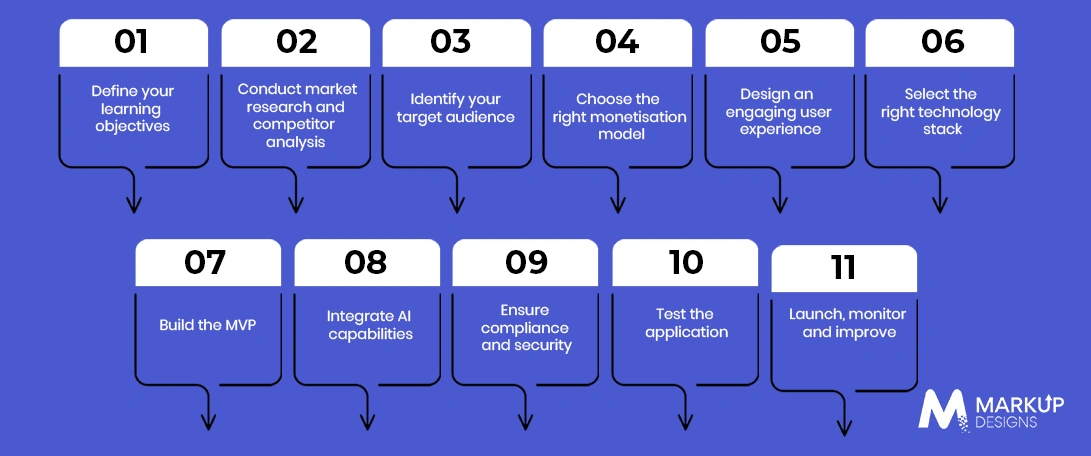
When a good EdTech app is developed, it has to be developed with caution and with the right technologies so that it is based on the learning-first approach. With the usage of a step by step approach in the development process of the app, one will be able to make sure that the app is engaging, scalable and complies with educational objectives.
Step 1: Define the learning objectives
Establish the goal of the app, outcome of the process of learning and the problems which need to be solved by the app.
Step 2:Conduct market research and competitor analysis
Be aware of the competition, market tendencies, user requests and find the opportunity to create a unique app.
Step 3: Identify your target audience
Understand the usage of the app. Is it for companies, for high schools, universities or for individual users?
Step 4: Choose the right monetisation model
Think of the model of revenue which corresponds to the objectives of your business: it can be in form of subscriptions, one-time purchase, freemium model or enterprise license.
Step 5: Design an user-friendly interface
Design the interface where navigation will be intuitive for the target audience.
Step 6: Select the right technology stack
Choosing the right technologies ensures your EdTech platform remains secure, scalable, and future ready.
| Layer | Technologies |
| Frontend | React, Angular, Vue.js |
| Backend | Node.js, Django, Laravel, .NET |
| Mobile | Flutter, React Native, Swift, Kotlin |
| Database | PostgreSQL, MySQL, MongoDB, Firebase |
| Cloud | AWS, Microsoft Azure, Google Cloud |
| AI Frameworks | TensorFlow, PyTorch, Scikit learn |
| LMS APIs | Moodle API, Canvas API, Blackboard API |
| Analytics | Google Analytics, Firebase Analytics, Mixpanel |
| DevOps | Docker, Kubernetes, GitHub Actions |
| Security | OAuth 2.0, JWT, SSL/TLS, AES Encryption |
Step 7: Create Robot
Create fundamental prototype with key functions enabling testing of the concept and receiving feedback.
Step 8: Add AI Functionality
Improve the solution with AI features such as machine learning and automated assessments.
Step 9: Guarantee Compliance and Security
Provide for security and adherence to Australian privacy and education regulations.
Step 10: Validate the Solution
Carry out tests to verify the solution’s performance.
Step 11: Release, Supervise and Develop
After the launch of the product take steps to monitor performance and gather feedback.
AI Technologies Supporting Modern Ed-Tech Apps.
AI is revolutionizing digital educational projects by personalizing the learning process and making it more effective. The following technologies give a boost to modern EdTech solutions.
Machine Learning
Analyses user behavior in order to provide personalized recommendations or adaptive assessment methods.
Large Language Models
Enables using AI tutors, conversational learning, and intelligent answering systems.
Natural Language Processing
Facilitates chatbot use, language translation, sentiment evaluation, and automation of feedback processes for education.
Computer Vision
Enables image identification, document examination, overseeing online testing, and providing the users with engaging visual education.
Voice Recognition
Helps convert conversations into written form and thus enables voice-based education, creation of access features, and speech evaluation.
Generative AI
Assists teachers in coming up with lesson plans, tests, and study assistance materials in a more effective way.
Predictive Statistics
Utilises students data in order to discover regularities in their academic performance as well as forecast their future academic achievements and suggest remedies in case of failure.
EdTech Requirements and Security Measures in Australia
Creating an EdTech app in Australia requires abiding by the principle of privacy, accessibility and educational requirements in order to ensure safety and reliability in education.
Australian Privacy Act
The Act regulates the way users data is collected and kept by educational institutions in order to protect users’ personal information and keep it safe.
Australian Privacy Principles (APPs)
The Principles state how to collect users’ data in a right way and to keep it private.
ST4S (Safer Technologies 4 Schools)
ST4S (Safer Technologies 4 Schools) provides a framework used nationally to measure the privacy as well as security status of digital products used in Australian schools.
Australian Framework for Generative AI in Schools
The framework emphasises the safe, ethical and responsible use of Generative AI in schools.
AI Safety Guidelines
AI Safety Guidelines Application of AI safety guidelines helps to reduce bias, enhance transparency and promote the responsible use of AI technology.
WCAG 2.1 Accessibility Guidelines
Compliance with WCAG 2.1 guarantees inclusion of all users having different abilities through making services accessible.
ASQA Compliance Requirements for RTOs
EdTech services offered to Registered Training Organisations (RTOs) should meet ASQA requirements concerning learner management, assessment and compliance reporting.
Cybersecurity Requirements
Data encryption and cybersecurity lens compliance entails usage of encryption as well as secure authentication, frequent audits, and access control for educational and personal information.
Technology Stack for EdTech App Development
Selecting the right technology stack ensures your EdTech application delivers a seamless learning experience while remaining scalable and secure.
Frontend
Technologies such as React, Angular, and Vue.js create responsive and interactive web interfaces.
Backend
Frameworks like Node.js, Django, Laravel, and .NET manage application logic, APIs, and data processing.
Mobile Frameworks
Flutter, React Native, Swift, and Kotlin enable high-performance Android and iOS applications.
AI Frameworks
Popular AI frameworks include TensorFlow, PyTorch, and Scikit-learn for developing intelligent learning features.
Cloud Infrastructure
Cloud platforms such as AWS, Microsoft Azure, and Google Cloud provide scalable infrastructure and storage.
Database
PostgreSQL, MongoDB, MySQL, and Firebase are commonly used for secure and efficient data management.
Video Streaming
Services like Agora, Twilio, and Zoom SDK enable live classes and interactive virtual learning.
Analytics
Google Analytics, Firebase Analytics, and Mixpanel help monitor learner engagement and platform performance.
Security
Security measures such as OAuth 2.0, JWT, SSL/TLS, and AES Encryption protect user data and platform access.
| Technology Layer | Popular Technologies |
| Frontend | React, Angular, Vue.js |
| Backend | Node.js, Django, Laravel, .NET |
| Mobile | Flutter, React Native, Swift, Kotlin |
| AI Frameworks | TensorFlow, PyTorch, Scikit-learn |
| Cloud | AWS, Microsoft Azure, Google Cloud |
| Database | PostgreSQL, MongoDB, Firebase |
| Video Streaming | Agora, Twilio, Zoom SDK |
| Analytics | Google Analytics, Firebase Analytics, Mixpanel |
| Security | OAuth 2.0, JWT, SSL/TLS, AES Encryption |
Cost to Build an EdTech App in Australia
The cost of developing an EdTech app depends on factors such as platform complexity, AI capabilities, integrations, infrastructure, and ongoing maintenance.
Development Cost by Application Complexity
The overall budget varies based on the scope and functionality of the platform.
| Platform Type | Estimated Cost (AUD) |
| Basic Platform | $70,000 – $150,000 |
| Mid-Level Platform | $150,000 – $300,000 |
| Enterprise Learning Platform | $300,000 – $700,000+ |
Cost Based on AI Features
Features like AI tutors, adaptive learning, automated grading, personalised recommendations, and Generative AI increase development costs based on their complexity.
Infrastructure Costs
Cloud hosting, databases, storage, video streaming, and AI computing resources contribute to recurring operational expenses.
Third Party Integrations
Integrations with payment gateways, LMS platforms, video conferencing tools, CRM systems, and authentication services add to the project budget.
Maintenance and Support Costs
Regular updates, bug fixes, security patches, feature enhancements, and AI model optimisation are essential to keep the platform secure and high performing.
| Cost Component | Estimated Cost Impact |
| Platform Development | High |
| AI Features | Medium to High |
| Cloud Infrastructure | Medium |
| Video Streaming Services | Medium |
| Third Party Integrations | Medium |
| Maintenance & Support | 15–20% of annual development cost |
Timeline for EdTech App Development
The development timeline depends on the platform’s complexity, AI features, and integration requirements. On average, an EdTech app takes 4 to 9 months to develop.
Discovery
Define project goals, target users, and feature requirements.
UI/UX Design
Create wireframes, prototypes, and intuitive user interfaces.
Development
Build the frontend, backend, APIs, and core platform features.
AI Integration
Implement AI-powered features such as adaptive learning and intelligent recommendations.
Testing
Conduct functional, security, performance, and usability testing.
Deployment
Launch the application, monitor performance, and release ongoing improvements.
| Phase | Estimated Timeline |
| Discovery | 2–3 Weeks |
| UI/UX Design | 3–4 Weeks |
| Development | 8–14 Weeks |
| AI Integration | 3–6 Weeks |
| Testing | 2–4 Weeks |
| Deployment | 1 Week |
Challenges in EdTech App Development and How to Overcome Them
Building a successful EdTech platform comes with technical and operational challenges. Addressing them early ensures a secure, scalable, and engaging learning experience.
Student Data Privacy
Protect sensitive learner information through secure data handling and privacy compliance.
Platform Scalability
Use cloud-based infrastructure to support growing users and learning content.
User Engagement
Incorporate interactive content, gamification, and personalised learning to improve retention.
Legacy LMS Integration
Use APIs and modern architecture to integrate with existing learning systems.
Accessibility Compliance
Design platforms that comply with WCAG standards to support learners of all abilities.
Content Quality Management
Maintain accurate, engaging, and regularly updated educational content.
AI Accuracy and Bias
Train and monitor AI models continuously to improve accuracy and reduce bias.
Continuous Platform Updates
Regularly release updates, security patches, and new features to keep the platform relevant.
Benefits of Building an EdTech App
EdTech applications help educational institutions and businesses deliver engaging, scalable, and data-driven learning experiences.
Personalised Learning Experiences
Deliver customised learning paths based on individual learner needs.
Increased Learner Engagement
Interactive lessons, quizzes, and AI powered recommendations improve participation.
Better Learning Outcomes
Real time feedback and progress tracking help learners achieve better results.
Scalable Education Delivery
Reach learners anywhere through online and mobile learning platforms.
Data Driven Decision Making
Learning analytics provide valuable insights into learner performance and engagement.
New Revenue Opportunities
Generate revenue through subscriptions, certifications, enterprise licensing, and premium courses.
Future Trends in Australian EdTech
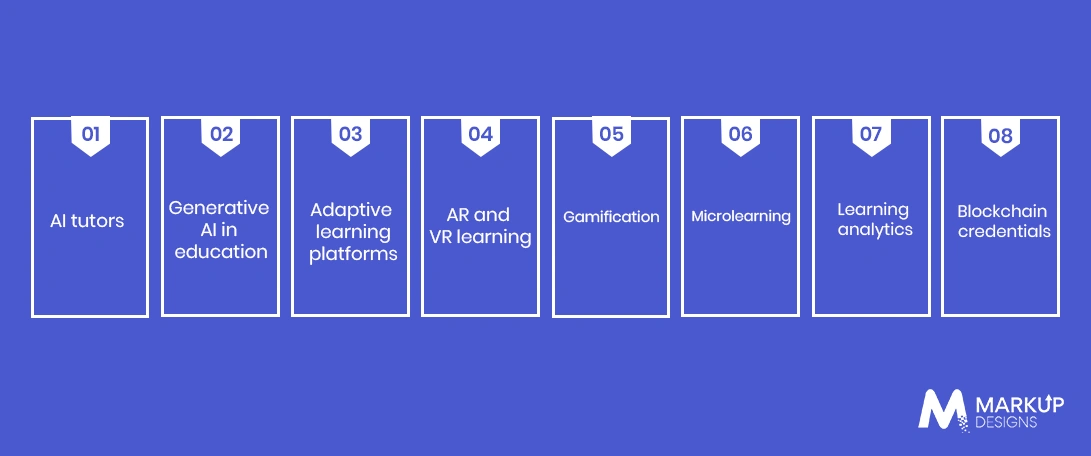
Emerging technologies continue to shape the future of digital learning across Australia.
AI Tutors
Provide personalised guidance and instant learner support.
Generative AI in Education
Create lesson plans, quizzes, and learning materials more efficiently.
Adaptive Learning Platforms
Adjust content automatically based on learner performance.
AR and VR Learning
Deliver immersive and interactive educational experiences.
Gamification
Increase learner motivation through rewards, badges, and challenges.
Microlearning
Offer short, focused lessons for better knowledge retention.
Learning Analytics
Use data insights to improve teaching strategies and learner outcomes.
Blockchain Credentials
Enable secure, verifiable digital certificates and academic records.
Why Choose Markup Designs for EdTech App Development in Australia?
Building a successful EdTech platform requires expertise in education, technology, AI, and security. With 12+ years of experience, 300+ technology experts, 10,000+ successful projects, and 8,000+ global collaborations, Markup Designs delivers scalable, secure, and AI enabled learning solutions tailored to the Australian education sector. Our expertise spans 350+ technologies, enabling us to build everything from LMS platforms and virtual classrooms to AI powered learning applications. With an agile development approach, enterprise grade security, end to end product development, and dedicated post launch support, we help educational institutions, startups, and businesses create future ready EdTech solutions that drive meaningful learning outcomes.
Build the Future of Digital Learning with Markup Designs
Whether you’re creating an AI-powered learning platform, a corporate training solution, or a next-generation LMS, our experts help transform your vision into a secure, scalable, and engaging EdTech application built for the Australian market.

Conclusion
Australia’s EdTech sector is experiencing rapid growth as educational institutions, businesses, and training providers embrace digital learning to meet evolving learner expectations. However, building a successful EdTech application goes beyond developing engaging features. It requires a strong technology foundation, AI-driven innovation, scalable architecture, and compliance with Australia’s privacy, accessibility, and education standards. By partnering with Markup Designs, businesses can transform their ideas into secure, intelligent, and future-ready EdTech solutions that deliver exceptional learning experiences while supporting long-term growth.
FAQs
1. How much does it cost to build an EdTech app in Australia?
The development cost typically ranges from AUD 70,000 to AUD 700,000+, depending on the platform’s complexity, AI capabilities, integrations, and infrastructure requirements.
2. How long does EdTech app development take?
Most EdTech applications take between 4 and 9 months to develop, although larger enterprise platforms with advanced AI features may require additional time.
3. Which features are essential in an EdTech application?
A modern EdTech app should include user management, interactive courses, video learning, assessments, progress tracking, AI-powered recommendations, analytics, notifications, and secure payment or subscription management.
4. How can AI improve an EdTech platform?
AI enhances learning through personalised recommendations, intelligent tutoring, automated grading, adaptive learning paths, predictive analytics, content generation, and real-time learner insights.
5. What regulations should Australian EdTech apps comply with?
EdTech applications should comply with the Privacy Act, Australian Privacy Principles (APPs), ST4S, WCAG 2.1 Accessibility Standards, and other relevant education and AI governance frameworks, depending on their target users.
6. Can an existing LMS be modernised with AI capabilities?
Yes. Existing Learning Management Systems can be enhanced with AI-powered features such as virtual tutors, personalised learning, automated assessments, intelligent search, and predictive analytics without replacing the entire platform.
Author's Perspective
The future of education in Australia will be shaped by intelligent, accessible, and learner centric digital experiences. As Artificial Intelligence, adaptive learning, and data driven insights become integral to modern education, organisations must focus on building platforms that are not only innovative but also secure, scalable, and compliant with evolving regulations. Businesses that invest in future ready EdTech solutions today will be better equipped to improve learning outcomes, adapt to changing educational needs, and remain competitive in Australia’s rapidly evolving digital education landscape.
Discuss Your Project NowJupinder Singh Arora
Founder and CEO
Related Posts

How Much Does It Cost to Build a...

How to Build a Secure Payment Gateway Integration...

Cost to Build a Mobile App in Qatar...
Insights Are Valuable & Execution is Priceless
You’ve read about the digital future. Now, let’s build the infrastructure to take you there. Move your strategy from the page to the product.
Design Your Solution Now
Contact Us
Schedule The Appointment At Your Convenience Date And Time.
30 Min
Web Conference
Time Zone
Indian standard time (08:30pm)

Thanks For Getting In Touch!
You’ve Taken The First Step Toward Transforming Your Digital Presence. Our Experts Will Reach Out Shortly To Take It Forward.
Launch Your Dream Project
Provide a brief overview of your project, and our specialists will evaluate your requirements. We will connect with you to explore how the right digital solutions can help you launch faster.