
The Investor-Approved Approach to MVPs in 2026
In Brief
- An MVP is not about perfection; it is about testing your core idea with real users as quickly as possible before burning time and money on a full build.
- Investors in 2026 care about evidence over ideas. Real user data, retention rates, and engagement metrics are far more convincing than projections on a slide deck.
- Startups with a validated MVP are 3x more likely to close seed funding and tend to command 20–35% higher early valuations simply because the risk feels lower to investors.
- The process follows a clear sequence, such as sharp problem definition, a narrow target audience, only essential features, agile build, controlled launch, and then iterate based on what real users actually do.
- The most common mistake is overbuilding. Adding features that feel important but are not essential delays validation and defeats the whole purpose.
- Targeting too broad an audience early on gives you weak, unclear signals. A narrow user group with a sharp problem gives you much more actionable feedback.
- Waiting for the product to be “ready” before launching is a trap. Missed timing in early markets is very hard to recover from.
Introduction
Thousands of founders worldwide are caught in the same paradox: you need funding to build, but investors need proof before they fund. The gap between a great idea and a signed term sheet has never felt wider.
But something has shifted. The founders closing pre-seed rounds today aren’t waiting for a finished product. They’re stripping everything down to the single most essential function, shipping it, and letting real-world validation do the talking.
What’s changing the game isn’t the idea. It’s the Minimum Viable Product (MVP).
An MVP isn’t a shortcut; it’s a strategy. It’s the earliest version of a product that delivers enough value to attract real users, generate real feedback, and prove real demand. In a funding climate where conviction alone no longer opens checkbooks, the MVP has become the founder’s most powerful proof of concept.
But as powerful as the concept is, building one in today’s landscape comes with its own set of brutal challenges.
Know About Minimum Viable Product (MVP) in the 2026 Environment
A Minimum Viable Product represents a focused, functional version of a product, designed to solve a core user problem while enabling rapid learning. Unlike traditional development models that aim for feature completeness before launch, MVP development focuses on validation and iteration.
The objective is not to build a perfect product but to build one that answers critical questions about user demand, engagement, and product-market fit. Successful companies such as Airbnb, Uber, and Dropbox all started with stripped-back versions of their products, focused on validating one core hypothesis at a time.
Modern MVP development aligns closely with agile engineering and lean startup principles – enabling faster iteration and better decision-making throughout the product lifecycle.
How is MVP Directly Linked to a Startup’s Success?
Investors in 2026 are more selective and data-driven than ever. They prioritize startups that demonstrate real-world validation over those that rely solely on projections. This has made MVPs a key factor in funding decisions.
According to recent research, startups with validated MVPs are approximately 3x more likely to secure seed funding, as compared to idea-stage startups. They also tend to close funding rounds significantly faster, because investors can assess actual user engagement rather than hypothetical projections.
MVP-driven startups also tend to achieve 20–35% higher valuations in early funding rounds due to reduced investment risk and stronger evidence of market demand.
Key Benefits of Building an MVP
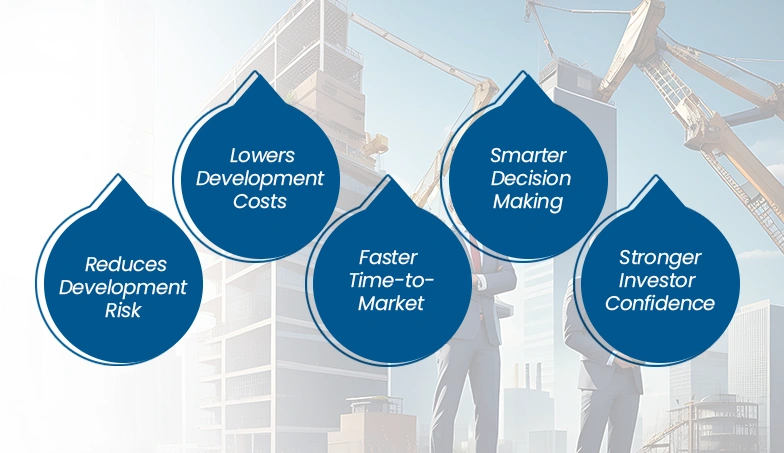
Building an MVP is one of the most strategically sound decisions a startup can make in their early stages. Rather than investing months of time and capital into a fully built product that may or may not resonate with the market, an MVP allows founders to move fast, learn faster, and course-correct before the stakes get too high. Here is a closer look at the core benefits:
MVPs also improve decision-making by replacing assumptions with real user data. This leads to more accurate feature prioritization, better user experience design, and stronger long-term scalability.
- Reduces Development Risk
- Ensures only essential features are built first, eliminating over-engineering
- Identifies fundamental flaws in the product concept before they become costly
- Creates a continuous feedback loop that de-risks future development decisions
- Lowers Development Costs
- Reduces unnecessary development costs, as compared to full-scale launches
- Smaller scope means leaner team requirements and reduced spend
- Capital saved can be redirected toward growth and user acquisition
- Faster Time-to-Market
- Enables launches in weeks rather than months, creating a head start over competitors
- Earlier access to real user behavior beats any internal assumption or market report
- Signals a strong execution capability to investors
- Smarter Decision Making
- Replaces internal assumptions with real-world user data
- Behavioral insights drive better feature prioritization and UX design
- Actual performance metrics strengthen investor pitches far more than projections
- Stronger Investor Confidence
- Traction metrics such as active users, retention, and engagement are far more persuasive than concepts alone
- A functioning MVP proves the team can ship, iterate, and respond to feedback
- Startups with validated MVPs consistently close funding rounds faster and on better terms
Step-by-Step Process to Build an MVP in 2026
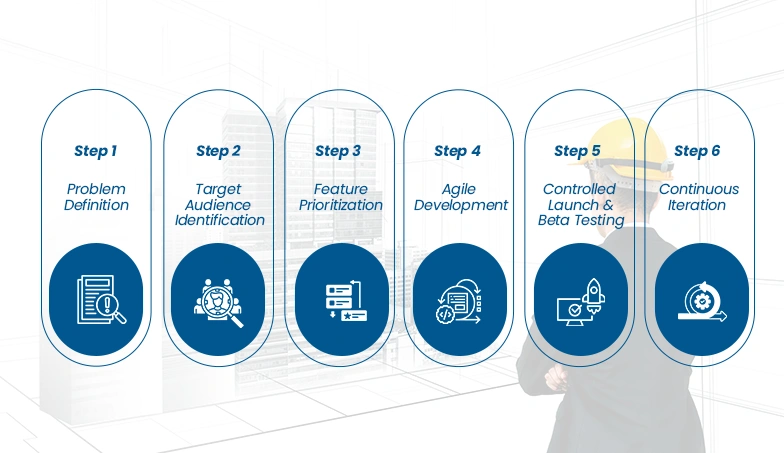
The MVP development process begins with identifying a focused problem statement. The clarity of the problem directly impacts the success of validation.
- Step 1: Problem Definition: The MVP development process begins with identifying a focused problem statement. The clarity of the problem directly impacts the success of validation.
- Step 2: Target Audience Identification: Once the problem is defined, the next step is identifying a narrow target audience. Instead of targeting a broad market, MVPs focus on user segments where the problem is more acute and frequent.
- Step 3: Feature Prioritization. Only core functionalities that directly solve the primary problem are included, while all secondary features are intentionally excluded to maintain speed and focus.
- Step 4: Agile Development The development phase follows an agile methodology, allowing rapid iterations and continuous improvements. Modern startups increasingly use cloud infrastructure and scalable architectures to maintain flexibility from the earliest version.
- Step 5: Controlled Launch and Beta Testing Once developed, the MVP is launched to a controlled group of users through beta testing or limited release. This ensures structured feedback collection and early behavioral insights.
- Step 6: Continuous Iteration Finally, the product undergoes continuous iteration based on real-world usage data, ensuring constant improvement and alignment with user needs.
How Does an MVP Help Startups Raise Funding?
MVPs play a critical role in transforming ideas into investable opportunities. They provide tangible proof of concept by demonstrating that real users are engaging with the product in meaningful and measurable ways.
When startups present MVP traction to investors, the conversation shifts from speculation to evidence. This significantly improves investor confidence and reduces perceived risk.
MVPs also enable founders to present real performance data such as retention rates, activation metrics, and engagement patterns, making pitch presentations significantly more compelling.
Once MVP validation is achieved, startups are far better positioned to approach venture capital firms, angel investors, and accelerator programs with stronger credibility that comes from real evidence.
Cost Considerations for MVP Development
The cost of building a Minimum Viable Product in 2026 is not fixed; it varies significantly based on the product complexity, the number of core features included, the technology stack used, and the level of scalability required in the initial phase.
On average, MVP development costs typically range between $10,000 and $150,000, depending on whether the product is a simple validation prototype, a mid-level functional application, or a more advanced MVP with scalable architecture.
However, focusing only on cost provides an incomplete picture. The real value of MVP development lies in risk reduction and intelligent investment allocation. Instead of building a full-scale product upfront, startups invest in a focused version that validates assumptions, tests user demand, and identifies market fit before scaling further.
For businesses looking to better understand structured product planning before investment, exploring product discovery and validation frameworks can provide deeper clarity on how MVP decisions impact long-term cost efficiency and scalability.
Common Mistakes in MVP Development
One of the most common mistakes that businesses make is overbuilding their MVP by adding unnecessary features that delay validation. Another major issue is ignoring early user feedback, which undermines the entire purpose of MVP development.
Many startups or established businesses also fail by targeting overly broad audiences, which results in weak positioning and unclear validation signals. Additionally, delaying MVP launch in pursuit of perfection often leads to missed market opportunities.
You may also like to read: MVP Development: Checklist To Know Before Writing Code for Startups
Build Your MVP Successfully with Markup Designs
Every successful product starts with an idea, but only a few evolve into scalable businesses because they are built with clarity, speed, and validation. At Markup Designs, we believe an MVP is not just a development milestone; it is the foundation of your product journey and the first real step toward market success and investor confidence.
- When we work with startups and enterprises, we begin by helping you identify the core problem your product is meant to solve. We do not jump into features or assumptions. Instead, we focus on understanding your users, their pain points, and the real gap your product is trying to address.
- Once the problem is clearly defined, we work with you to shape a focused product vision. At this stage, our goal is to simplify complexity. We ensure your MVP is not overloaded with unnecessary features but is instead designed around the most critical user journey that validates demand in the shortest possible time.
- Our development approach is intentionally lean and strategic. We prioritize only those features that directly contribute to validation and user learning. At Markup Designs, we ensure that every line of development effort is tied to a measurable outcome, whether it is user engagement, retention, or early adoption signals.
- After building your MVP, we do not consider the job done. We help you launch it to real users in a structured environment so that we can observe real behavior. This stage is crucial because it allows us to understand how users interact with your product, what they value, and where improvements are needed.
At Markup Designs, we do not just build MVPs; we partner with you to shape your product journey from idea to impact. Our approach is focused on reducing risk, increasing speed, and maximizing your chances of success in a competitive market.
Conclusion
The Minimum Variable Product (MVP) is no longer just a development milestone; it is a strategic foundation for startup success and funding readiness. It enables startups to validate ideas faster, reduce risk, and build investor confidence through real-world evidence.
Startups that adopt an MVP-first mindset are significantly more likely to achieve product-market fit, secure funding, and scale successfully in competitive markets. In today’s ecosystem, execution backed by validation matters far more than ideas alone.
A well-built MVP is not just the first version of a product; it is the first proof of a scalable business.
FAQs
1.What is a Minimum Viable Product (MVP)?
A Minimum Viable Product is a simplified version of a product that includes only core features required to solve a primary user problem and validate market demand.
2.Why is MVP important for startups in 2026?
MVPs help startups validate ideas quickly, reduce development risk, and attract investors by demonstrating real user traction instead of assumptions.
3.How does an MVP help in raising funding?
An MVP provides real-world usage data such as user engagement, retention, and activation metrics, which significantly increases investor confidence and improves funding chances.
4.How long does it take to build an MVP?
On average, an MVP can be built in 4 to 12 weeks, depending on complexity, features, and technology stack.
5.What is the cost of building an MVP?
MVP development costs typically range from $10,000 to $150,000, depending on scope, features, and scalability requirements.
6.What are the key features of a successful MVP?
A successful MVP focuses only on core functionality, solves a specific user problem, and enables fast feedback collection and iteration.
7.What are common mistakes in MVP development?
Common mistakes include overbuilding features, ignoring user feedback, targeting too broad an audience, and delaying product launch.
8.What happens after launching an MVP?
After launch, startups collect user feedback, analyze behavior metrics, and iterate continuously to improve product-market fit before scaling.
Author's Perspective
From my perspective, custom blockchain development is not just about adopting a modern technology trend; it’s about making strategic decisions that create real business impact. Many organizations rush into blockchain adoption without clearly defining their objectives, which often leads to underutilized solutions.
The key lies in understanding where blockchain truly adds value. Not every system needs decentralization, but for processes involving multiple stakeholders, trust gaps, or data integrity concerns, blockchain can be transformative.
Discuss Your Project NowDeepak Tripathi
Product Manager
Insights Are Valuable & Execution is Priceless
You’ve read about the digital future. Now, let’s build the infrastructure to take you there. Move your strategy from the page to the product.
Design Your Solution Now
Contact Us
Schedule The Appointment At Your Convenience Date And Time.
30 Min
Web Conference
Time Zone
Indian standard time (08:30pm)

Thanks For Getting In Touch!
You’ve Taken The First Step Toward Transforming Your Digital Presence. Our Experts Will Reach Out Shortly To Take It Forward.
Launch Your Dream Project
Provide a brief overview of your project, and our specialists will evaluate your requirements. We will connect with you to explore how the right digital solutions can help you launch faster.